personality-tests
Big Five Personality Traits and Career Fit in Logistics, Supply Chain, and Operations Management
Discover how your Big Five personality traits (OCEAN) align with successful careers in logistics, supply chain, and operations management. Learn which traits predict success and how to assess your fit.
Quick answer
What Big Five personality traits are most important for logistics, supply chain, and operations management roles?
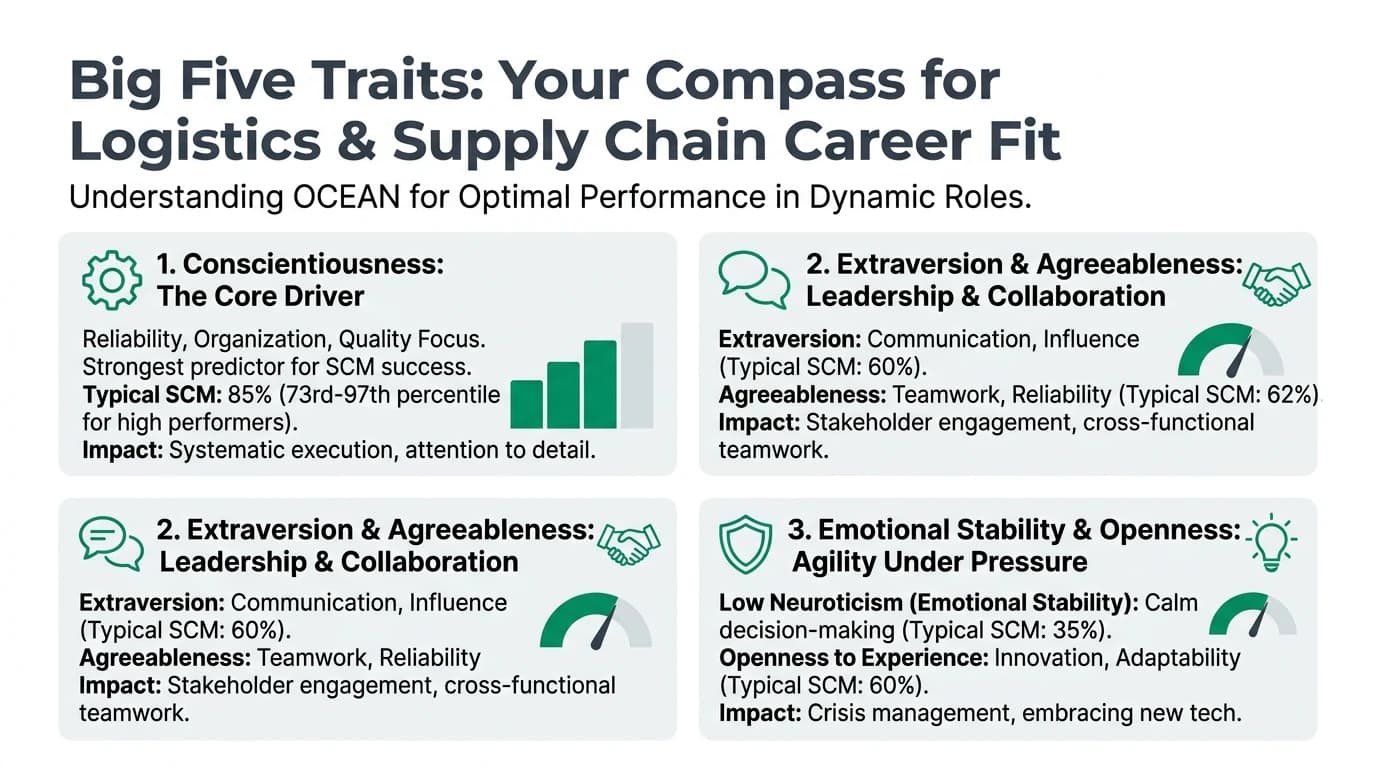
For logistics, supply chain, and operations management roles, **Conscientiousness** is the most critical Big Five trait, driving reliability, organization, and attention to detail. **Extraversion** supports leadership and communication, while **Agreeableness** fosters collaboration. **Emotional Stability (low Neuroticism)** helps manage stress, and moderate **Openness to Experience** balances innovation with operational consistency.
Source: PersonalityHQ, CareerExplorer, Academy of Management research
Executive Summary
Ever wondered if your natural personality is a good fit for the fast-paced world of logistics, supply chain, or operations management? You're not alone! Understanding your Big Five personality traits (Openness, Conscientiousness, Extraversion, Agreeableness, and Neuroticism – or OCEAN for short) can offer valuable insights into how well you might thrive in these dynamic careers. This guide explores how each trait plays a role, helping you identify your strengths and areas for growth.
Research consistently shows that certain personality profiles are more common and often more successful in these fields. While skills and experience are vital, your underlying personality traits significantly influence how you approach challenges, interact with teams, and adapt to change. This article will break down each Big Five trait, provide benchmarks for logistics professionals, and offer practical advice for career development and hiring.
The bottom line: Conscientiousness is the strongest predictor of success in logistics and supply chain roles, but a balanced profile of traits, including moderate Extraversion, Agreeableness, and high Emotional Stability, creates a well-rounded and high-performing professional.
Critical Warning: While personality traits offer powerful insights, they are not the sole determinant of success. Skills, experience, education, and organizational culture also play crucial roles. Use personality assessments as a guide, not a definitive judgment.
What are the Big Five Personality Traits?
The Big Five personality traits, often remembered by the acronym OCEAN, are a widely accepted and scientifically validated model for describing human personality. Think of them as five broad dimensions that capture the essence of how people typically think, feel, and behave. Unlike some other personality frameworks, the Big Five are backed by extensive research across cultures and are considered stable over time 1.
These traits don't put you into a "type" but rather describe where you fall on a spectrum for each dimension. Understanding them can help you gain self-awareness and better predict how you might perform in different work environments.
The OCEAN Model at a Glance
| Trait | What It Means | Key Characteristics | Impact on Work |
|---|---|---|---|
| Openness to Experience | How open you are to new ideas and experiences. | Curious, imaginative, creative, unconventional. | Innovation, adaptability, learning new skills. |
| Conscientiousness | How organized, responsible, and disciplined you are. | Organized, reliable, self-disciplined, goal-oriented. | Productivity, attention to detail, follow-through. |
| Extraversion | How outgoing and energetic you are. | Sociable, assertive, energetic, talkative. | Leadership, communication, networking. |
| Agreeableness | How cooperative and compassionate you are. | Cooperative, empathetic, trusting, kind. | Teamwork, conflict resolution, customer service. |
| Neuroticism | How emotionally stable and calm you are. | Anxious, moody, easily stressed, emotionally reactive. | Stress management, resilience, decision-making. |
Conscientiousness: The Cornerstone of Supply Chain Success
When it comes to logistics, supply chain, and operations management, Conscientiousness stands out as the most critical Big Five trait. This isn't just an opinion; it's consistently supported by academic research and industry benchmarks 2. Conscientious individuals are reliable, organized, detail-oriented, and driven to achieve their goals.
In a field where precision, timely delivery, and efficient processes are paramount, these qualities are indispensable. From managing inventory levels to ensuring compliance with regulations, a high degree of conscientiousness directly translates into better performance and fewer errors.
Why Conscientiousness Drives Performance
- Systematic Approach: Conscientious individuals naturally create and follow structured processes, which is vital for complex supply chains.
- Quality Focus: They pay close attention to detail, reducing defects and ensuring high standards in operations.
- Reliability: They are dependable, meet deadlines, and follow through on commitments, building trust with colleagues and stakeholders.
- Goal-Oriented: They set clear objectives and work diligently to achieve them, pushing projects forward efficiently.
For high-performing supply chain managers, conscientiousness typically falls in the 73rd to 97th percentile 3. This means that the most successful professionals in this field are almost always highly conscientious.
Conscientiousness Levels and Career Outcomes in Supply Chain
| Conscientiousness Level | Typical Behaviors in Logistics | Career Trajectory | Development Needs |
|---|---|---|---|
| Very High (90th+ percentile) | Meticulous planning, strict adherence to protocols, exceptional reliability. | Often excels in process optimization, quality control, strategic planning. | May struggle with flexibility or delegating control. |
| High (70th–89th percentile) | Organized, dependable, strong work ethic, attention to detail. | Strong performer in most supply chain roles, good for project management. | Can become overly focused on details, missing the bigger picture. |
| Moderate (40th–69th percentile) | Generally organized, can be reliable but may need reminders. | Capable, but might benefit from structured systems and mentorship. | Improve time management, attention to detail, follow-through. |
| Low (Below 40th percentile) | Disorganized, prone to missed deadlines, less attention to detail. | Likely to struggle with core demands of logistics and operations. | Develop strong organizational habits, accountability, self-discipline. |
Extraversion: Leading and Connecting in Logistics
While conscientiousness provides the backbone, Extraversion adds the vital element of human connection and leadership in supply chain roles. Logistics and operations are not just about processes; they're also about people. Supply chain managers frequently interact with diverse stakeholders, including vendors, customers, internal teams, and senior leadership.
Extraverted individuals tend to be more outgoing, assertive, and energetic. These qualities enable them to build rapport, negotiate effectively, and motivate teams. A typical supply chain manager scores around 60% on Extraversion, indicating a moderate-to-high level 4.
Impact of Extraversion in Supply Chain
- Stakeholder Communication: Easily builds relationships with suppliers, customers, and internal departments, ensuring smooth information flow.
- Leadership & Influence: Naturally takes charge, articulates vision, and persuades others, crucial for driving change and managing teams.
- Networking: Expands professional contacts, which can be invaluable for problem-solving and identifying new opportunities.
- Team Motivation: Brings energy and enthusiasm, fostering a positive and productive work environment.
Important: While extraversion is beneficial, it's not a strict requirement for success. Introverted individuals can also excel by developing strong communication skills and leveraging their thoughtful, analytical strengths. The key is effective communication, regardless of your natural energy source.
Extraversion in Logistics Roles
| Extraversion Level | Strengths in Logistics | Potential Challenges | Best Fit Scenarios |
|---|---|---|---|
| High | Dynamic leader, excellent negotiator, strong networker, team motivator. | May dominate conversations, overlook quiet team members, need constant stimulation. | Client-facing roles, team leadership, strategic partnerships. |
| Moderate | Balanced communicator, comfortable in social settings, good team player. | Might need to push themselves to speak up in large groups. | Project management, cross-functional team roles, internal coordination. |
| Low | Thoughtful, good listener, excels in focused, independent work. | May be perceived as reserved, less proactive in group settings. | Data analysis, process design, technical specialist roles. |
Agreeableness: Fostering Collaboration and Relationships
In the complex web of global supply chains, Agreeableness plays a crucial role in fostering collaboration, building trust, and resolving conflicts. Agreeable individuals are typically cooperative, empathetic, and considerate of others. These traits are essential for navigating relationships with diverse vendors, internal departments, and international partners.
Successful supply chain professionals often fall within the 50th to 74th percentile for Agreeableness 3. This moderate-to-high range suggests a balance: they are cooperative and team-oriented but can also make tough decisions when necessary.
Why Agreeableness Matters for Collaboration
- Teamwork: Facilitates smooth collaboration within teams and across departments, ensuring everyone works towards common goals.
- Vendor Relationships: Builds strong, trusting relationships with suppliers, leading to better terms, reliability, and problem resolution.
- Conflict Resolution: Approaches disagreements with empathy and a desire for mutual understanding, helping to de-escalate tensions.
- Customer Service: Understands and responds to customer needs, enhancing satisfaction and loyalty.
Agreeableness and Supply Chain Competencies
| Big Five Trait | Supply Chain Competency | Example Behavior | Performance Impact |
|---|---|---|---|
| Agreeableness | Cross-functional Collaboration | Actively seeks input from other departments; mediates disputes. | Smoother project execution; reduced inter-departmental friction. |
| Agreeableness | Vendor Relationship Management | Builds long-term trust with suppliers; fair negotiation. | Improved supplier reliability; better pricing and terms. |
| Agreeableness | Team Cohesion | Supports colleagues; fosters a positive and inclusive work environment. | Higher team morale; better knowledge sharing. |
| Agreeableness | Ethical Conduct | Adheres to fair practices; prioritizes integrity in dealings. | Stronger reputation; reduced risk of compliance issues. |
Emotional Stability (Low Neuroticism): Calm Under Pressure
The world of logistics and supply chain management is inherently unpredictable. Disruptions, delays, and unexpected challenges are daily occurrences. This is where Emotional Stability, or low Neuroticism, becomes incredibly valuable. Individuals with low Neuroticism are calm, resilient, and less prone to stress, anxiety, or mood swings.
A typical supply chain manager scores around 35% on Neuroticism 3, indicating a relatively low level. This means they tend to remain composed and rational, even when facing high-pressure situations like port closures, material shortages, or sudden demand spikes.
The Value of Emotional Stability in Crisis
- Crisis Management: Maintains a clear head during disruptions, allowing for logical problem-solving and effective decision-making.
- Stress Resilience: Handles the inherent pressures of tight deadlines and complex operations without becoming overwhelmed.
- Consistent Performance: Delivers reliable results even under adverse conditions, providing stability to the team.
- Rational Decision-Making: Avoids impulsive reactions driven by stress, ensuring well-thought-out solutions.
Big Five Traits and Supply Chain Crisis Response
| Crisis Type | Required Traits | Why It Matters | Example Response |
|---|---|---|---|
| Port Disruption | Low Neuroticism, High Conscientiousness, Moderate Openness | Calmly assesses impact, systematically reroutes, considers new shipping methods. | Quickly identifies alternative ports and transport modes, communicates changes clearly. |
| Material Shortage | Low Neuroticism, High Agreeableness, High Conscientiousness | Maintains composure, collaborates with suppliers, meticulously tracks inventory. | Negotiates with alternative suppliers, prioritizes critical orders, updates production schedule. |
| Shipping Delay | Low Neuroticism, Moderate Extraversion, High Conscientiousness | Manages stress, communicates proactively, systematically updates stakeholders. | Informs affected parties, explores expedited options, adjusts delivery expectations. |
| Technology Failure | Low Neuroticism, High Openness, High Conscientiousness | Stays calm, adapts to new systems, systematically troubleshoots. | Implements manual workarounds, coordinates with IT, plans for system recovery. |
| Vendor Bankruptcy | Low Neuroticism, High Conscientiousness, Moderate Extraversion | Remains steady, systematically finds new vendors, communicates with legal. | Secures alternative suppliers, manages contract transitions, minimizes supply disruption. |
Openness to Experience: Adapting to a Changing Landscape
The logistics and supply chain industry is constantly evolving, driven by technological advancements like AI, automation, and big data. This makes Openness to Experience an increasingly important trait. Open individuals are curious, imaginative, and willing to embrace new ideas and approaches.
A typical supply chain manager scores around 60% on Openness 3. This moderate level suggests a healthy balance: they are receptive to innovation and new technologies but also value stability and proven processes. Too much openness might lead to constant change without consolidation, while too little could result in resistance to beneficial advancements.
Openness and Industry Adaptability
- Innovation Adoption: Embraces new technologies (AI, blockchain, IoT) to improve efficiency and visibility.
- Problem-Solving: Approaches challenges with creativity, seeking novel solutions rather than sticking to old methods.
- Continuous Learning: Stays updated with industry trends, regulations, and best practices.
- Adaptability: Adjusts strategies and operations in response to market shifts, geopolitical events, or unforeseen disruptions.
Openness to Experience in Logistics
| Openness Level | Strengths in Logistics | Potential Challenges | Best Fit Scenarios |
|---|---|---|---|
| High | Visionary, early adopter of technology, drives innovation, thrives on change. | May overlook practical constraints, struggle with routine tasks, initiate too many changes. | R&D, strategic planning, digital transformation leadership. |
| Moderate | Balances innovation with practicality, open to new ideas but values stability. | Might need encouragement to step outside comfort zone for truly disruptive ideas. | Process improvement, system implementation, operational strategy. |
| Low | Prefers established methods, values tradition and consistency, resistant to change. | May hinder adoption of essential new technologies, struggle in rapidly evolving environments. | Highly standardized operations, compliance-focused roles. |
Finding Your Fit: Big Five Assessment for Logistics Careers
Understanding your Big Five profile is a powerful step in career planning, whether you're just starting out or considering a career change. While self-reflection is a good start, validated personality assessments provide a more objective and accurate picture. These tools can help you compare your natural tendencies against the benchmarks for successful professionals in logistics and supply chain management.
Interpreting your results involves looking at your scores for each trait and considering how they align with the demands of the roles you're interested in. It's not about being "perfect" but about understanding your strengths and identifying areas where you might need to develop complementary skills.
Personality Fit Assessment – Self-Evaluation Checklist
Use this table to reflect on your own traits and compare them to typical benchmarks for supply chain managers. Remember, this is a self-assessment and not a substitute for a professional, validated test.
| Big Five Trait | Supply Chain Benchmark (Typical Score/Range) 34 | Your Score (High, Moderate, Low) | Gap Analysis (Aligns, Minor Gap, Major Gap) | Development Action (if needed) |
|---|---|---|---|---|
| Conscientiousness | 85% (73rd–97th percentile) | |||
| Extraversion | 60% (Moderate-High) | |||
| Agreeableness | 62% (50th–74th percentile) | |||
| Openness to Experience | 60% (Moderate) | |||
| Neuroticism (Emotional Stability) | 35% (Low) |
Building High-Performing Supply Chain Teams with Big Five Insights
For HR professionals and hiring managers, incorporating Big Five insights into recruitment and team building can significantly improve outcomes. By understanding the personality profiles of candidates, organizations can make more informed hiring decisions, reduce turnover, and create more balanced and effective teams. It's about finding individuals who not only have the right skills but also the right behavioral tendencies to thrive in specific roles and within a particular team culture.
Using validated assessments as part of the hiring process can provide objective data that complements interviews and experience checks. This holistic approach helps identify candidates who are more likely to be engaged, productive, and satisfied in their roles, ultimately leading to better organizational performance.
Hiring Rubric – Big Five Traits in Supply Chain Recruitment
| Trait | Ideal Range for Role | Interview Questions (Examples) | Red Flags (Low Scores) | Compensatory Strengths |
|---|---|---|---|---|
| Conscientiousness | High (70th+ percentile) | "Tell me about a time you managed a complex project with tight deadlines." | Missed deadlines, disorganized responses, lack of follow-through. | Strong analytical skills, high adaptability (if balanced). |
| Extraversion | Moderate-High (40th–70th percentile) | "Describe how you build relationships with new suppliers or clients." | Reluctance to engage, poor eye contact, difficulty articulating ideas. | Deep expertise, strong written communication, independent work. |
| Agreeableness | Moderate-High (50th–75th percentile) | "How do you handle conflict with a team member or vendor?" | Overly critical, dismissive of others' ideas, difficulty compromising. | Strong decision-making, ability to challenge status quo (if balanced). |
| Openness to Experience | Moderate (40th–70th percentile) | "What new technologies or trends in supply chain excite you?" | Resistance to new ideas, preference for rigid routines, lack of curiosity. | Strong focus on established processes, consistency, attention to detail. |
| Emotional Stability | Low Neuroticism (Below 40th percentile) | "Describe a high-pressure situation and how you managed it." | Overly anxious responses, blaming others, emotional outbursts. | High energy, passion (if managed), drive for perfection. |
The "Enterprising + Conventional" Archetype in Supply Chain
Many successful supply chain and operations managers embody a unique blend of two personality archetypes: Enterprising and Conventional. This concept, often explored in career interest inventories, helps explain the dual nature of these roles.
- Enterprising individuals are leaders, persuaders, and initiators. They enjoy influencing others, taking charge, and achieving ambitious goals. This aligns with the leadership, negotiation, and strategic aspects of supply chain management.
- Conventional individuals are organized, detail-oriented, and systematic. They thrive on structure, data, and precision. This perfectly matches the need for meticulous planning, process adherence, and analytical rigor in logistics.
This dual archetype means that a truly effective supply chain manager can both lead a team through a crisis and meticulously audit inventory records. They can negotiate a complex contract and then ensure every clause is systematically implemented.
Personality Archetypes in Supply Chain Management
| Archetype | Big Five Profile | Strengths in Logistics | Potential Challenges | Best Fit Roles |
|---|---|---|---|---|
| The Systematic Leader | High Conscientiousness, Moderate Extraversion, Low Neuroticism | Drives efficient processes, leads teams effectively, calm under pressure. | May be seen as overly rigid or less innovative. | Operations Director, Supply Chain Manager, Logistics Head. |
| The Collaborative Problem-Solver | High Conscientiousness, High Agreeableness, Moderate Openness | Excellent team player, builds strong vendor relations, open to new solutions. | Might avoid necessary conflicts, take longer to make tough decisions. | Procurement Manager, Inventory Planner, Supply Chain Analyst. |
| The Adaptive Innovator | High Conscientiousness, High Openness, Moderate Extraversion | Embraces new tech, drives change, communicates vision for improvement. | Can push for too much change, potentially disrupting stable operations. | Supply Chain Strategist, Digital Transformation Lead, Innovation Manager. |
| The Steady Executor | High Conscientiousness, Low Neuroticism, Moderate Agreeableness | Highly reliable, emotionally stable, ensures consistent operations. | Less likely to challenge status quo, may lack assertive leadership. | Warehouse Manager, Logistics Coordinator, Compliance Officer. |
Adapting Leadership and Communication Styles
Understanding the Big Five traits of your team members can be a game-changer for leaders in logistics and supply chain. By tailoring your communication, feedback, and motivation strategies to individual personalities, you can foster a more engaged, productive, and psychologically safe work environment. This personalized approach helps maximize each team member's potential and strengthens overall team cohesion.
For example, a highly conscientious team member will appreciate clear, detailed instructions and regular updates on progress, while a highly agreeable person might respond better to collaborative problem-solving and positive reinforcement.
Personality-Based Communication Strategies for Supply Chain Leaders
| Team Member Trait Profile | Communication Style | Feedback Approach | Motivation Strategy |
|---|---|---|---|
| High Conscientiousness | Direct, detailed, structured, focus on facts and processes. | Specific, actionable, data-driven, emphasize impact on goals. | Give clear objectives, autonomy in execution, recognize precision. |
| High Extraversion | Engaging, energetic, allow for discussion, focus on big picture. | Public recognition, focus on impact on team/stakeholders. | Provide opportunities for leadership, networking, social interaction. |
| High Agreeableness | Collaborative, empathetic, focus on team harmony and mutual goals. | Gentle, constructive, emphasize team benefit, offer support. | Foster teamwork, create positive environment, acknowledge contributions to group. |
| High Openness | Conceptual, open to new ideas, encourage brainstorming. | Focus on innovation, potential for growth, new learning. | Offer challenging projects, opportunities for creativity, exposure to new tech. |
| Low Neuroticism | Calm, rational, focus on solutions, avoid emotional language. | Objective, factual, focus on problem-solving, avoid blame. | Provide stability, clear expectations, trust in their ability to handle pressure. |
Action checklist
Action Checklist for Your Logistics Career
- Assess Your Big Five Profile: Take a validated Big Five personality test to understand your strengths and areas for development.
- Compare to Benchmarks: Use the provided data to see how your traits align with successful logistics and supply chain professionals.
- Identify Development Areas: Pinpoint traits where you might want to develop complementary skills or adjust your approach.
- Tailor Your Job Search: Look for roles and company cultures that align well with your natural personality strengths.
- Enhance Communication: If you're a leader, practice adapting your communication style to better engage diverse personalities on your team.
- Seek Feedback: Ask trusted colleagues or mentors for feedback on how your personality traits manifest in your work.
FAQ
What personality traits do successful supply chain managers have?
Successful supply chain managers typically exhibit high Conscientiousness (73rd–97th percentile), moderate-to-high Extraversion (around 60%), moderate-to-high Agreeableness (50th–74th percentile), moderate Openness to Experience (around 60%), and low Neuroticism (around 35%) 34. Conscientiousness is the strongest predictor of performance due to its link with organization and reliability.
How does the Big Five model predict job performance in logistics?
The Big Five model predicts job performance by identifying stable behavioral patterns that align with job requirements. For instance, high Conscientiousness predicts systematic execution and attention to detail, crucial for logistics. Research from the Academy of Management indicates a strong correlation between Big Five traits and various job performance outcomes 5.
Is extraversion necessary for a supply chain management career?
While moderate-to-high Extraversion is common among supply chain managers (around 60%), it's not strictly necessary. Extraversion helps with leadership, communication, and networking, but introverted individuals can also succeed by developing strong communication skills, leveraging their analytical strengths, and focusing on building deep, meaningful relationships rather than broad ones 4.
What does low neuroticism mean for supply chain roles?
Low Neuroticism, also known as high Emotional Stability, means an individual is calm, resilient, and less prone to stress or anxiety. In supply chain roles, this is crucial for managing disruptions, making rational decisions under pressure, and maintaining composure during crises like shipping delays or material shortages 3.
Can someone with low conscientiousness succeed in supply chain management?
Succeeding in supply chain management with low Conscientiousness would be significantly challenging, as it's the strongest predictor of performance in these roles. Individuals with lower scores would need to develop strong compensatory skills in organization, time management, and attention to detail, or seek roles that are less process-driven and require less meticulous planning 2.
How does openness to experience affect supply chain careers?
Moderate Openness to Experience (around 60%) is beneficial in supply chain careers. It allows professionals to embrace new technologies like AI and automation, adapt to industry changes, and approach problems with creativity, while still valuing operational stability. Too much openness might lead to constant change, while too little could result in resistance to innovation 3.
Does personality fit matter more than skills and experience in supply chain hiring?
Personality fit is a strong predictor of job performance and satisfaction, but it does not matter more than skills and experience. All three are crucial. Personality traits indicate how someone will approach their work, while skills and experience indicate what they can do. The ideal scenario involves a candidate with both the necessary technical competencies and a personality profile that aligns well with the role and organizational culture.
How can I assess my Big Five personality for career fit?
You can assess your Big Five personality using validated online assessments, many of which are available through career counseling services or reputable psychology websites. While self-assessment can provide initial insights, formal instruments offer more reliable and objective results. Always choose assessments backed by scientific research 6.
Notes
Primary Sources
| Source | Type | URL |
|---|---|---|
| PersonalityHQ | Industry Benchmark | https://personalityhq.com/careers/supply-chain-manager |
| CareerExplorer | Industry Profile | https://www.careerexplorer.com/careers/supply-chain-manager/personality/ |
| TRIOS | Industry Blog | https://www.trios.com/blog/9-traits-to-take-your-supply-chain-logistics-career-to-the-next-level/ |
| Michigan State University Online | Educational Resource | https://michiganstateuniversityonline.com/resources/leadership/lead-your-team-with-big-five-model/ |
| Simply Psychology | Educational Resource | https://www.simplypsychology.org/big-five-personality.html |
| Indeed Career Advice | Career Guidance | https://www.indeed.com/career-advice/finding-a-job/big-five-personality-traits |
| Pre-Employment Assessments | Industry Resource | https://preemploymentassessments.com/blog/big-5-personality-traits-explained/ |
Conclusion
Understanding the Big Five personality traits offers a powerful lens through which to view career fit in logistics, supply chain, and operations management. While Conscientiousness emerges as the most critical trait for its link to reliability and organization, a balanced profile including moderate Extraversion, Agreeableness, and high Emotional Stability (low Neuroticism) creates a well-rounded and effective professional. Openness to Experience, at a moderate level, ensures adaptability in an ever-changing industry.
By assessing your own Big Five profile and comparing it to industry benchmarks, you can gain valuable self-awareness, identify areas for development, and make more informed career decisions. For organizations, leveraging these insights in hiring and team building can lead to more engaged employees, reduced turnover, and ultimately, higher-performing teams that are better equipped to navigate the complexities of global supply chains.
Footnotes
-
Simine Vazire, UC Davis Psychology. Research indicates the Big Five model produces "largely consistent results" for predicting achievement and behavior. ↩
-
Essentials of Organizational Behavior (14th Edition). Academic research consistently shows conscientiousness has the largest influence on job performance across most roles. ↩ ↩2
-
PersonalityHQ. Role Benchmark v1 for Supply Chain Manager. Provides percentile data for high-performing supply chain managers. ↩ ↩2 ↩3 ↩4 ↩5 ↩6 ↩7 ↩8
-
CareerExplorer. Personality profile for Supply Chain Manager. Offers typical Big Five scores for the role. ↩ ↩2 ↩3 ↩4
-
Academy of Management research. Peer-reviewed studies consistently show that Big Five traits correlate to job performance outcomes. ↩
-
Simply Psychology. Educational resource on the Big Five model and its scientific validation. ↩