personality-tests
Big Five Personality Traits and Work Meaningfulness: Finding Purpose and Crafting Your Job
Discover how your Big Five personality traits influence your sense of purpose at work, how to 'job craft' for more meaning, and strategies for a fulfilling career.
Quick answer
How do the Big Five personality traits relate to work meaningfulness?
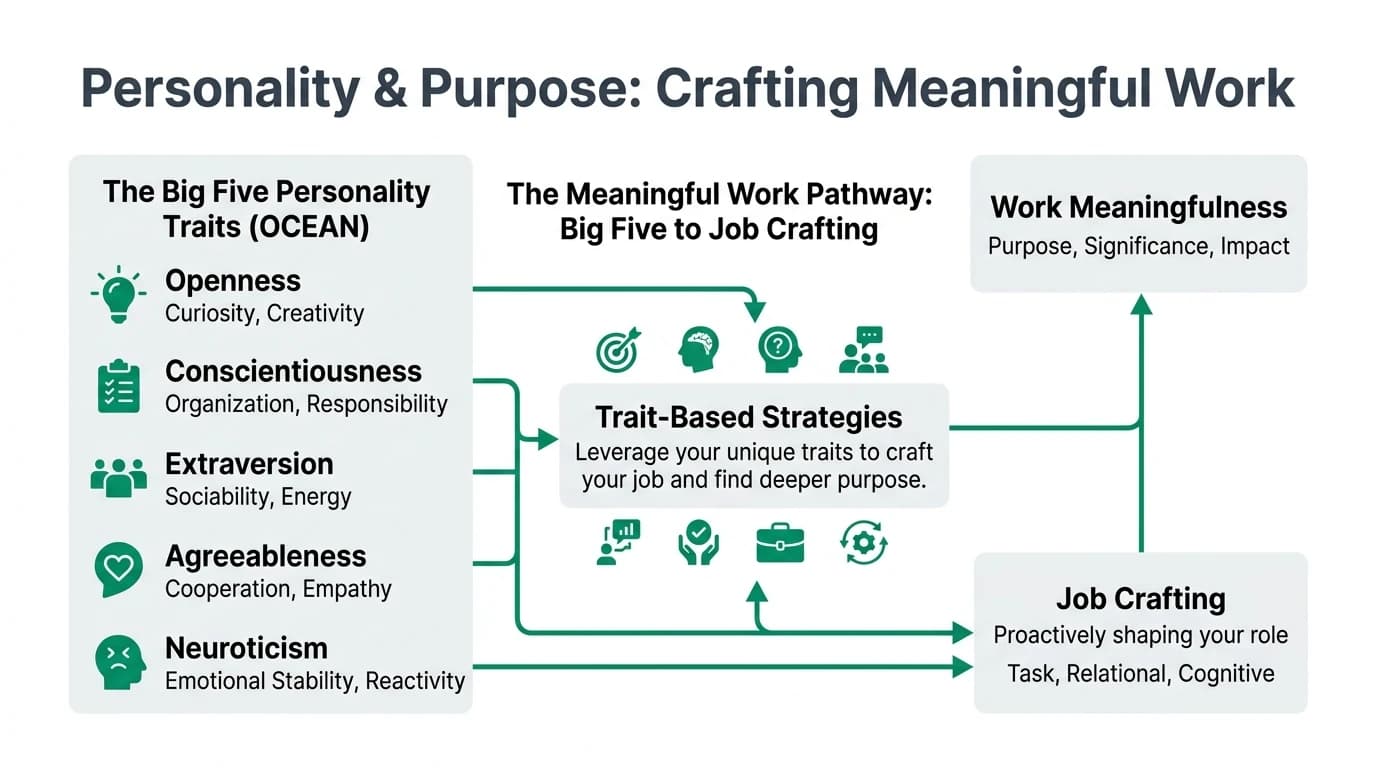
The Big Five traits influence how individuals seek and experience purpose at work. For example, Conscientiousness often links to meaning through achievement, while Openness to Experience finds it in creativity and learning. Extraversion can derive meaning from social impact, Agreeableness from helping others, and Neuroticism may struggle with meaning due to higher stress, but can find it in stability. These traits shape an individual's approach to 'job crafting'—proactively redesigning their role to align with personal values and strengths.
Source: Judge, Heller, & Mount (2002); Steger, Dik, & Duffy (2012)
Executive Summary
Ever wondered why some people seem to thrive on challenges while others prefer stability? Or why certain tasks feel incredibly fulfilling to you, but tedious to a colleague? It often comes down to personality. This guide explores the fascinating connection between your Big Five personality traits and how much meaning and purpose you find in your work.
We'll dive into how traits like Openness or Conscientiousness shape your desire for purpose and your approach to 'job crafting'—the art of redesigning your role to better fit who you are. You'll discover practical, trait-based strategies to boost your own work meaningfulness and learn how organizations can create environments where everyone can find their purpose.
The bottom line: Understanding your personality isn't just for self-discovery; it's a powerful tool for building a more fulfilling and purposeful career.
What is Work Meaningfulness, Anyway?
Work meaningfulness is more than just liking your job or being engaged; it's about feeling that your work truly matters and contributes to something significant. It's the sense that your efforts have purpose and value beyond just a paycheck.
Think of it as a deep, personal connection to what you do. When your work feels meaningful, it aligns with your core values and helps you feel like you're making a positive difference, whether big or small.
Meaningfulness vs. Satisfaction vs. Engagement
It's easy to mix up these terms, but they describe different aspects of your work experience.
| Concept | Definition | Key Focus | Primary Outcome |
|---|---|---|---|
| Work Meaningfulness | Feeling your work has purpose, significance, and value. | Personal values, impact, transcendence. | Deep fulfillment, sense of purpose. |
| Job Satisfaction | Liking your job and its conditions (pay, colleagues, tasks). | Contentment, positive feelings about the job. | Happiness, comfort, liking the job. |
| Work Engagement | Being fully absorbed, enthusiastic, and committed to your work. | Energy, dedication, absorption. | High performance, motivation, focus. |
Meaningfulness often underpins both satisfaction and engagement. When your work feels purposeful, you're more likely to be satisfied and engaged.
The Big Five Personality Traits: A Quick Refresher
The Big Five model is a widely accepted framework in psychology for understanding personality. It describes five broad dimensions that capture most of the differences in human personality. Think of them as fundamental building blocks of who you are.
These traits are often remembered with the acronym OCEAN.
The OCEAN of Personality
| Trait | Core Characteristics | High Score | Low Score |
|---|---|---|---|
| Openness to Experience | Inventive, curious, artistic, imaginative. | Enjoys novelty, learning, creativity. | Prefers routine, practical, conventional. |
| Conscientiousness | Efficient, organized, dependable, disciplined. | Goal-oriented, responsible, thorough. | Spontaneous, disorganized, less careful. |
| Extraversion | Outgoing, energetic, assertive, sociable. | Seeks social interaction, stimulation. | Reserved, solitary, reflective, quiet. |
| Agreeableness | Friendly, compassionate, cooperative, trusting. | Empathetic, helpful, avoids conflict. | Challenging, competitive, detached. |
| Neuroticism | Sensitive, nervous, prone to worry, easily stressed. | Experiences negative emotions more. | Calm, secure, resilient, emotionally stable. |
Understanding your own Big Five profile can offer powerful insights into what truly drives you at work and what kind of environment you'll thrive in.
How Big Five Traits Shape Your Search for Purpose at Work
Your personality traits don't just describe you; they influence what you look for in a job and how you find meaning in it. Each trait can guide you towards different sources of purpose.
For instance, someone high in Openness might seek meaning through creative projects, while a highly Conscientious individual might find it in achieving challenging goals.
Traits and Their Link to Work Meaningfulness
| Trait | Core Characteristics | Potential Link to Meaningfulness | Example Work Behaviors |
|---|---|---|---|
| Openness to Experience | Curious, imaginative, intellectual. | Meaning through creativity, learning, innovation, exploring new ideas. | Seeks new projects, learns new skills, challenges status quo. |
| Conscientiousness | Organized, efficient, responsible, goal-oriented. | Meaning through achievement, competence, making a tangible impact, fulfilling duties. | Meticulous planning, meeting deadlines, striving for excellence. |
| Extraversion | Outgoing, energetic, sociable, assertive. | Meaning through social impact, collaboration, leadership, connecting with others. | Enjoys teamwork, networking, public speaking, mentoring. |
| Agreeableness | Compassionate, cooperative, trusting, helpful. | Meaning through helping others, fostering positive relationships, contributing to a harmonious team. | Supports colleagues, resolves conflicts, volunteers for community work. |
| Neuroticism | Anxious, sensitive, prone to worry, easily stressed. | Can struggle with meaning due to stress; may find it in stability, security, or preventing harm. | Focuses on risk mitigation, seeks clear procedures, values job security. |
Job Crafting: Your Blueprint for Purpose
Job crafting is like being an architect for your own role. Instead of passively accepting your job description, you actively redesign aspects of your work to make it more engaging, meaningful, and aligned with your strengths and passions. It's a proactive, bottom-up approach to job design.
This isn't about changing your entire career overnight. It's about making small, intentional adjustments to your existing role. These changes can lead to a greater sense of ownership, personal fit, and, ultimately, more purpose.
The Three Types of Job Crafting
Job crafting typically involves three main strategies1:
- Task Crafting: Changing the tasks you do, how you do them, or the number of tasks you take on.
- Relational Crafting: Altering your interactions with others at work, such as who you interact with, how often, and the nature of those interactions.
- Cognitive Crafting: Changing how you perceive your job, its purpose, or its impact. This is about reframing your mindset.
| Crafting Type | Description | How it Enhances Meaning | Example |
|---|---|---|---|
| Task Crafting | Modifying job duties, scope, or methods. | Aligns work with skills, interests, and values; increases challenge or autonomy. | Taking on a new project, delegating a disliked task, automating a repetitive process. |
| Relational Crafting | Changing interactions with colleagues, clients, or managers. | Builds stronger connections, fosters support, increases social impact. | Mentoring a junior colleague, seeking feedback, collaborating more frequently. |
| Cognitive Crafting | Reframing how you view your job and its purpose. | Connects daily tasks to a larger mission, highlights impact, shifts perspective. | A cleaner seeing their role as contributing to public health, not just tidiness. |
Personality Traits as Drivers of Job Crafting
Not everyone job crafts in the same way, or even at all. Your Big Five traits play a significant role in how likely you are to engage in job crafting and what kind of crafting you'll naturally lean towards.
Certain traits, like high Conscientiousness and Openness, are often linked to a more proactive personality, making individuals more inclined to shape their work environment.
Big Five Traits and Job Crafting Propensities
| Trait | Likely Job Crafting Focus | Example Crafting Behavior |
|---|---|---|
| Openness to Experience | Task & Cognitive Crafting | Seeks out new learning opportunities, proposes innovative solutions, redefines job as creative. |
| Conscientiousness | Task Crafting | Optimizes workflows, takes on challenging projects, refines processes for efficiency. |
| Extraversion | Relational Crafting | Initiates collaborations, builds networks, seeks leadership roles, mentors others. |
| Agreeableness | Relational Crafting | Offers help to colleagues, mediates conflicts, builds supportive team dynamics. |
| Neuroticism | Task & Cognitive Crafting (Stress Reduction) | Streamlines tasks to reduce pressure, reframes difficult situations to manage stress. |
Individual Strategies for Enhancing Meaning Based on Your Big Five
Understanding your Big Five profile isn't just academic; it's a roadmap for personal growth and career fulfillment. You can use these insights to tailor your career path and job crafting efforts.
The key is to leverage your strengths and proactively address areas where your traits might lead to challenges in finding meaning.
Personalized Strategies for Meaningful Work
| Trait | Recommended Individual Strategy | Focus Area |
|---|---|---|
| Openness to Experience | Seek novelty, learning, and creative outlets. | Innovation, skill development, diverse projects. |
| Conscientiousness | Set clear goals, pursue mastery, take ownership. | Achievement, quality, reliability, impact. |
| Extraversion | Engage in social roles, lead, build connections. | Collaboration, networking, team leadership, mentorship. |
| Agreeableness | Focus on helping others, teamwork, positive culture. | Service, empathy, conflict resolution, supportive relationships. |
| Neuroticism | Develop coping mechanisms, seek stability, reframe challenges. | Stress management, emotional regulation, security, positive outlook. |
Practical Steps for Self-Assessment:
- Reflect: Think about past jobs or projects. When did you feel most energized and purposeful? What tasks were involved?
- Observe: Pay attention to what drains your energy and what excites you in your current role.
- Use Tools: Consider taking a reputable Big Five personality assessment to get a clearer picture of your profile. These are for self-understanding, not labels.
Organizational Strategies to Foster Meaningful Work
It's not just up to individuals to find meaning; organizations play a crucial role. Leaders and HR professionals can create environments that naturally support purpose and allow employees to thrive.
By understanding how different personalities seek meaning, organizations can design more inclusive and fulfilling workplaces.
How Organizations Can Foster Meaning
| Strategy Area | Description | How it Supports Meaning | Example Initiative |
|---|---|---|---|
| Leadership | Leaders model purpose, provide autonomy, and offer feedback. | Connects individual work to bigger picture, empowers ownership. | Regular 1-on-1s discussing purpose, transparent goal setting. |
| Culture | Foster a culture of psychological safety, values, and recognition. | Encourages authenticity, collaboration, and shared purpose. | Values-driven mission statements, peer recognition programs. |
| Job Design | Design roles with variety, autonomy, and clear impact. | Provides opportunities for skill use, challenge, and visible contribution. | Cross-functional projects, flexible work arrangements, clear KPIs. |
| Development & Growth | Offer learning opportunities, career paths, and skill-building. | Supports personal growth, mastery, and future-oriented purpose. | Mentorship programs, tuition reimbursement, internal mobility. |
The Role of Organizational Culture and Leadership
A supportive organizational culture and effective leadership are like fertile ground for work meaningfulness. They can amplify the positive effects of individual personality traits and job crafting efforts. Without this foundation, even the most proactive employee might struggle to find purpose.
Leaders, in particular, are key architects of this environment. They can inspire, empower, and connect daily tasks to a larger vision.
Leadership and Culture: Pillars of Purpose
- Visionary Leadership: Leaders who clearly articulate the organization's mission and values help employees connect their work to a larger purpose.
- Empowerment & Autonomy: Giving employees control over how they do their work fosters a sense of ownership and allows for job crafting.
- Psychological Safety: A culture where employees feel safe to experiment, voice ideas, and even fail without fear of retribution encourages proactive behaviors like job crafting.
- Feedback & Recognition: Regular, constructive feedback helps employees understand their impact, while recognition validates their contributions and reinforces their sense of value.
- Values Alignment: When organizational values genuinely align with individual values, the work naturally feels more meaningful.
Potential Pitfalls and Ethical Considerations
While leveraging personality insights for work meaningfulness is powerful, it's essential to navigate this space thoughtfully and ethically. Misuse can lead to negative consequences.
Navigating the Nuances
| Pitfall / Consideration | Reality / Why it Matters | Recommendation |
|---|---|---|
| Personality Stereotyping | Reducing individuals to labels; ignores complexity & growth. | Use traits for self-understanding & development, not rigid categorization. |
| "One Best Personality" Myth | No single trait profile guarantees success or meaning. | Value diversity; different traits bring different strengths to teams. |
| Ignoring Context | Personality interacts with job design, culture, leadership. | Consider the whole ecosystem; don't blame lack of meaning solely on personality. |
| "Purpose-Washing" | Organizations claiming purpose without genuine action. | Authenticity is key; purpose must be embedded in practices, not just words. |
| Privacy & Data Use | Misusing personality assessment data. | Ensure transparency, consent, and focus on development, not selection. |
Personality is dynamic and can evolve, especially in response to new experiences and roles. It's a guide, not a fixed destiny.
Measuring Work Meaningfulness and Personality
To truly understand the connection between personality and work meaningfulness, both individuals and organizations can benefit from reliable measurement tools. These tools provide objective data to inform strategies.
Tools for Insight
- For Personality (Big Five):
- NEO-PI-R (Neuroticism-Extraversion-Openness Personality Inventory-Revised): A comprehensive, scientifically validated assessment widely used in research and professional settings.
- IPIP-NEO (International Personality Item Pool): A public domain alternative that offers various versions of Big Five assessments.
- For Work Meaningfulness:
- Work and Meaning Inventory (WAMI): A well-regarded scale developed by Steger, Dik, and Duffy (2012) to assess perceived meaningfulness at work.
- Meaningful Work Scale: Other scales exist that measure different facets of meaning, such as significance, purpose, and contribution.
These tools should always be used by trained professionals for accurate interpretation and ethical application.
Action Checklist for More Meaningful Work
- Reflect on your Big Five traits and how they align with your current role.
- Identify 1-2 small aspects of your job you can 'craft' (task, relational, or cognitive).
- Proactively seek out projects or interactions that leverage your personality strengths.
- Discuss your career aspirations and what brings you purpose with your manager.
- For leaders: Evaluate your team's roles for opportunities to increase autonomy and impact.
- For organizations: Review your culture and leadership practices to ensure they support individual purpose.
FAQ
Can personality predict job satisfaction?
Yes, research consistently shows that certain Big Five traits are correlated with job satisfaction. For instance, high Conscientiousness and Extraversion tend to be positively linked, while high Neuroticism is generally negatively associated with job satisfaction. However, personality is just one factor among many, including job design and organizational culture3.
Which Big Five trait is most important for career success?
While "success" can be defined in many ways, Conscientiousness is often cited as the strongest predictor of overall job performance and career success across a wide range of occupations. This is due to its association with diligence, organization, and goal-orientation. However, other traits are crucial for specific roles and industries4.
How does job crafting increase work meaningfulness?
Job crafting increases work meaningfulness by allowing employees to proactively shape their jobs to better align with their personal values, strengths, and passions. By altering tasks, relationships, or perceptions of their work, individuals can create a role that feels more authentic and purposeful, leading to a deeper sense of meaning and engagement5.
What is the difference between job satisfaction and work meaningfulness?
Job satisfaction refers to how much you like your job and its conditions (e.g., pay, colleagues). Work meaningfulness, on the other hand, is the deeper sense that your work has purpose and significance, contributing to something valuable. You can be satisfied with a job without finding it deeply meaningful, but meaningful work often leads to higher satisfaction6.
How can managers foster purpose at work?
Managers can foster purpose by clearly communicating the organization's mission, connecting individual tasks to the bigger picture, providing autonomy and opportunities for skill development, offering regular feedback, and recognizing contributions. Creating a psychologically safe environment where employees feel empowered to "job craft" also helps7.
Are some personality types more prone to burnout?
Yes, individuals high in Neuroticism tend to be more prone to burnout due to their predisposition to experience negative emotions, stress, and worry. Conversely, traits like high Conscientiousness (when combined with perfectionism) can also contribute to burnout if not managed well, as individuals may overwork themselves in pursuit of high standards.
How can I find more meaning in my current job?
Start by reflecting on your Big Five traits and what truly energizes you. Then, explore job crafting strategies: can you adjust your tasks, improve relationships, or reframe how you view your contributions? Seek out opportunities to learn new skills or take on projects that align with your values. Even small changes can make a big difference.
Notes
Primary Sources
| Source | Type | URL |
|---|---|---|
| Judge, T. A., Heller, D., & Mount, M. K. (2002). Five-Factor Model of Personality and Job Satisfaction: A Meta-Analysis. Journal of Applied Psychology, 87(3), 530–541. | Peer-Reviewed Journal Article | https://psycnet.apa.org/record/2002-01968-006 |
| Steger, M. F., Dik, B. J., & Duffy, R. D. (2012). Measuring meaningful work: The Work and Meaning Inventory (WAMI). Journal of Career Assessment, 20(3), 322-337. | Peer-Reviewed Journal Article | https://journals.sagepub.com/doi/abs/10.1177/1069072711420740 |
| Wrzesniewski, A., & Dutton, J. E. (2001). Crafting a job: Revisioning employees as active crafters of their work. Academy of Management Review, 26(2), 179-201. | Peer-Reviewed Journal Article | https://journals.aom.org/doi/abs/10.5465/amr.2001.4378011 |
| Bakker, A. B., Tims, M., & Derks, D. (2012). Proactive personality and job performance: The role of job crafting and work engagement. Human Relations, 65(10), 1359-1378. | Peer-Reviewed Journal Article | https://journals.sagepub.com/doi/10.1177/0018726712453506 |
| Barrick, M. R., & Mount, M. K. (1991). The Big Five personality dimensions and job performance: A meta-analysis. Personnel Psychology, 44(1), 1-26. | Peer-Reviewed Journal Article | https://onlinelibrary.wiley.com/doi/abs/10.1111/j.1744-6570.1991.tb00688.x |
| McCrae, R. R., & Costa, P. T., Jr. (1997). Personality trait structure as a human universal. American Psychologist, 52(5), 509–516. | Peer-Reviewed Journal Article | https://psycnet.apa.org/record/1997-06385-001 |
Conclusion
Finding purpose and meaning in your work is a deeply personal journey, yet it's profoundly influenced by your inherent personality traits. By understanding your Big Five profile, you gain a powerful lens through which to view your career, identify what truly fulfills you, and proactively shape your role. Job crafting, whether through adjusting tasks, relationships, or your perspective, emerges as a key strategy for aligning your work with your authentic self.
Organizations also bear a significant responsibility in fostering meaningful work. Through supportive leadership, a values-driven culture, and thoughtful job design, they can create environments where diverse personalities can thrive and contribute their unique strengths. Ultimately, recognizing the interplay between personality, purpose, and proactive work behaviors empowers both individuals and workplaces to build more fulfilling and impactful careers.
Footnotes
-
Wrzesniewski, A., & Dutton, J. E. (2001). Crafting a job: Revisioning employees as active crafters of their work. Academy of Management Review, 26(2), 179-201. This foundational paper introduced the concept of job crafting and its three forms. ↩
-
Bakker, A. B., Tims, M., & Derks, D. (2012). Proactive personality and job performance: The role of job crafting and work engagement. Human Relations, 65(10), 1359-1378. This research highlights the link between proactive personality and engagement in job crafting behaviors. ↩
-
Judge, T. A., Heller, D., & Mount, M. K. (2002). Five-Factor Model of Personality and Job Satisfaction: A Meta-Analysis. Journal of Applied Psychology, 87(3), 530–541. This meta-analysis provides comprehensive data on the correlations between Big Five traits and job satisfaction. ↩
-
Barrick, M. R., & Mount, M. K. (1991). The Big Five personality dimensions and job performance: A meta-analysis. Personnel Psychology, 44(1), 1-26. This seminal meta-analysis established the robust link between Conscientiousness and job performance. ↩
-
Berg, J. M., Dutton, J. E., & Wrzesniewski, A. (2013). Job crafting and meaningful work. In B. J. Dik, Z. S. Byrne, & M. F. Steger (Eds.), Purpose and meaning in the workplace (pp. 81-104). American Psychological Association. This chapter details how job crafting contributes to perceived meaningfulness. ↩
-
Steger, M. F., Dik, B. J., & Duffy, R. D. (2012). Measuring meaningful work: The Work and Meaning Inventory (WAMI). Journal of Career Assessment, 20(3), 322-337. This paper defines meaningful work and distinguishes it from related constructs like job satisfaction. ↩
-
Grant, A. M. (2007). Relational job design and the motivation to make a prosocial difference. Academy of Management Review, 32(2), 393-417. While not directly about personality, Grant's work emphasizes how managers can design jobs and foster relationships to enhance meaning and impact. ↩