personality-tests
Ethics of AI Personality Screening in Hiring
Explore the ethical implications of using AI for personality screening in hiring, focusing on bias, privacy, and human rights.
Quick answer
What are the ethical concerns of AI personality screening in hiring?
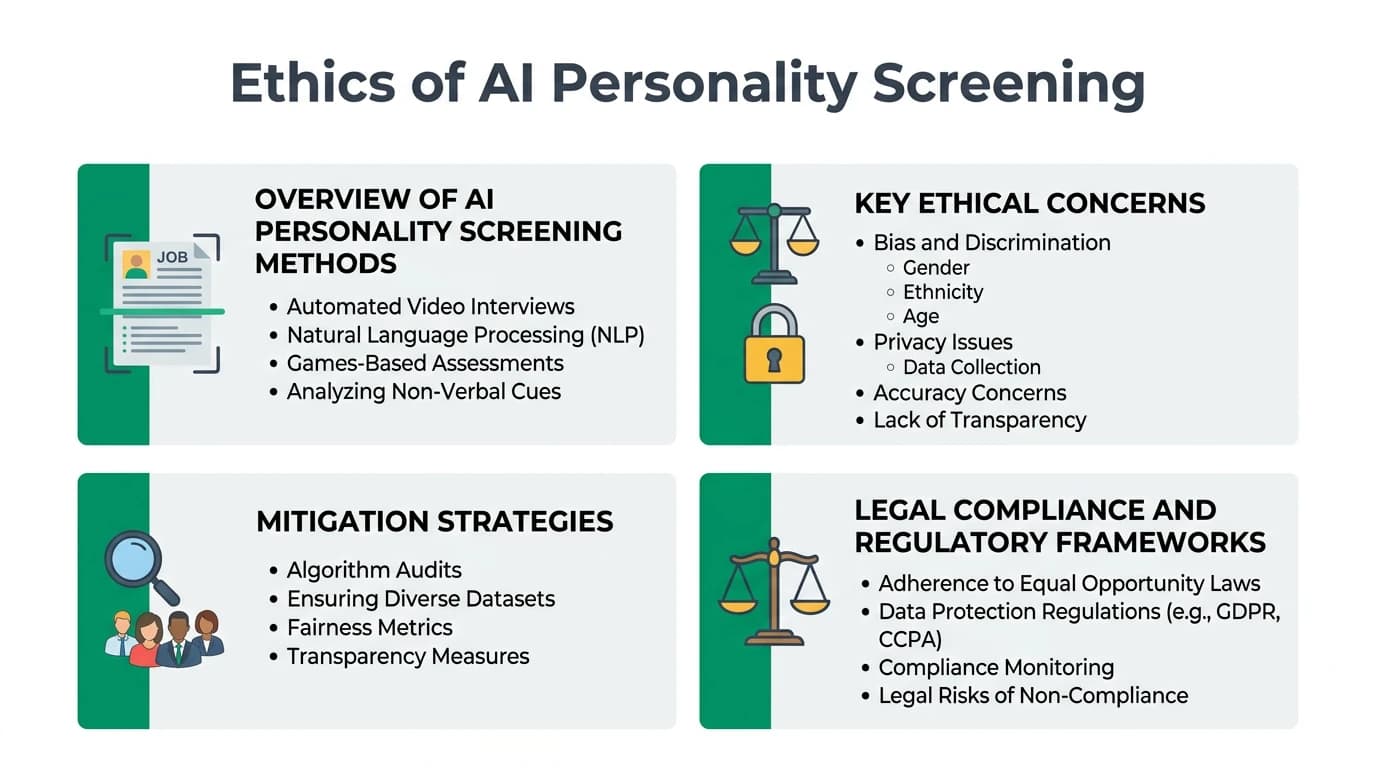
AI personality screening in hiring raises ethical concerns about bias, privacy, and human rights, requiring careful regulation and oversight.
Source: Harvard Business Review
Executive Summary
AI personality screening in hiring uses algorithms to assess candidates' traits, aiming for efficient selection. However, it raises ethical concerns about bias, privacy, and human rights. Companies must navigate these challenges to ensure fair and legal hiring practices.
The bottom line: Companies using AI in hiring must balance efficiency with ethical responsibility, ensuring compliance with regulations and human rights standards.
Critical Warning: Ignoring ethical guidelines can lead to legal repercussions and damage to company reputation.
What is AI Personality Screening?
AI personality screening involves using machine learning and psychometric tools to evaluate candidates' traits and cultural fit.
- Tools Used: Big Five tests, situational judgment tests.
- Purpose: Predict traits like emotional stability and leadership.
- Process: Analyzes behavioral patterns through gameplay or responses.
| Method | Tools Used | Bias Risk | Scalability | Legal Cases |
|---|---|---|---|---|
| AI Screening | Big Five, Situational Judgment | High | High | Target, Best Buy |
| Traditional | Myers-Briggs, Interviews | Medium | Low | Few |
Bias Risks and Mitigation Strategies
AI can inadvertently amplify biases present in data or algorithms.
- Historical Cases: EEOC fines against Target for race and gender bias.
- Mitigation: Algorithm audits, diverse datasets, blind résumé screening.
| Strategy | Description | Source/Example |
|---|---|---|
| Algorithm Audits | Regular checks for bias | HBR Research |
| Diverse Datasets | Inclusive data collection | Mitratech |
| Blind Screening | Removing identifiers | Best Practices |
Human Rights Implications
AI in hiring can conflict with human rights principles like autonomy and nondiscrimination.
- Autonomy: Reduced candidate control over outcomes.
- Nondiscrimination: Risk of biased outcomes.
- Privacy: Concerns over data use and transparency.
| Right | Reproaches | Counterarguments | Mitigation |
|---|---|---|---|
| Autonomy | Loss of control | Efficiency gains | Human oversight |
| Nondiscrimination | Bias risk | Improved fairness | Diverse datasets |
| Privacy | Data misuse | Enhanced security | Transparency mandates |
Privacy and Transparency Requirements
Regulations demand transparency and privacy in AI hiring systems.
- EU Mandates: Explainability audits for high-risk AI.
- Candidate Disclosures: Informing candidates about AI use.
- Oversight Reports: Regular human oversight.
Legal Compliance and Regulatory Frameworks
AI hiring tools must comply with legal standards to avoid discrimination.
- EEOC Enforcement: Against tests violating Civil Rights Act and ADA.
- Emerging Rules: U.S. and EU regulations on bias testing.
- Corporate Responsibilities: Upholding human rights standards.
| Company | Violation Type | Fine/Outcome | Year/Period |
|---|---|---|---|
| Target | Race/Gender Bias | 2.8M USD Fine | Recent |
| Best Buy | Civil Rights Breach | Investigation | 2003-2010 |
Effectiveness and Predictive Validity
AI can link psychological traits to job performance, but limitations exist.
- Benefits: Scalability in assessments.
- Limitations: Difficulty in quantifying dynamic traits like motivation.
Ethical Governance Models
Establishing ethical frameworks ensures responsible AI use in hiring.
- AI Review Boards: Include HR, Legal, DEI, Compliance.
- AI Bills of Rights: Disclosure and appeal processes.
- Third-Party Audits: Regular reviews akin to financial audits.
| Practice | Implementation Steps | Benefits |
|---|---|---|
| AI Review Board | Cross-departmental collaboration | Balanced oversight |
| Recurring Audits | Scheduled evaluations | Bias reduction |
| Candidate Disclosure | Transparent communication | Trust building |
Personality Test Prevalence and Evolution
The use of personality tests in hiring is widespread and evolving.
- Adoption Rates: 88% of Fortune 500 use personality tests.
- AI Enhancements: Shortening tests and ranking traits.
| Metric | Percentage | Source | Date |
|---|---|---|---|
| Fortune 500 Use | 88% | Cowen Partners | 2025 |
| Overall AI in Hiring | 90% | HBR | 2025 |
Human Oversight and Hybrid Approaches
Human involvement is crucial to counter AI limitations.
- Human-in-the-Loop: Final decision-making by humans.
- Diverse Panels: Ensuring varied perspectives in hiring.
Impact on Candidate Experience
AI can change how candidates approach interviews.
- Behavioral Changes: Use of buzzwords in AI interviews.
- Transparency: Clear messaging builds trust.
Future Trends from Recent Research
AI adoption in hiring is reshaping views on bias and fairness.
- Adoption Rates: 90% of companies use AI in hiring.
- Research Reviews: Over 120 studies on ethics in recruitment AI.
Action checklist
- Conduct regular algorithm audits.
- Ensure diverse datasets in AI models.
- Implement human oversight in decision-making.
FAQ
What are the main ethical concerns with AI in hiring?
How can bias be mitigated in AI hiring tools?
What legal frameworks govern AI hiring practices?
How prevalent are personality tests in hiring?
What role does transparency play in AI hiring?
What are the benefits of AI in hiring?
How can companies ensure ethical AI use in hiring?
Notes
Primary Sources
| Source | Type | URL |
|---|---|---|
| Assess Candidates | Article | https://www.assesscandidates.com/ethical-ai-automation-in-recruitment/ |
| PMC/NCBI | Research | https://pmc.ncbi.nlm.nih.gov/articles/PMC9309597/ |
| Mitratech | Blog | https://mitratech.com/resource-hub/blog/the-ethics-of-ai-in-recruiting-bias-privacy-and-the-future-of-hiring/ |
| Cowen Partners | Article | https://cowenpartners.com/the-ethics-of-personality-tests-in-the-hiring-process/ |
| Harvard Business Review | Research | https://hbr.org/2025/12/new-research-on-ai-and-fairness-in-hiring |
Conclusion
AI personality screening in hiring offers efficiency but poses ethical challenges. Companies must balance innovation with responsibility, ensuring compliance with legal and ethical standards.