personality-tests
How to Use Big Five in Hiring: A Bias-Resistant Process and Scorecard
Explore how the Big Five personality model can create a bias-resistant hiring process and develop an effective scorecard for candidate evaluation.
Quick answer
What is the Big Five model?
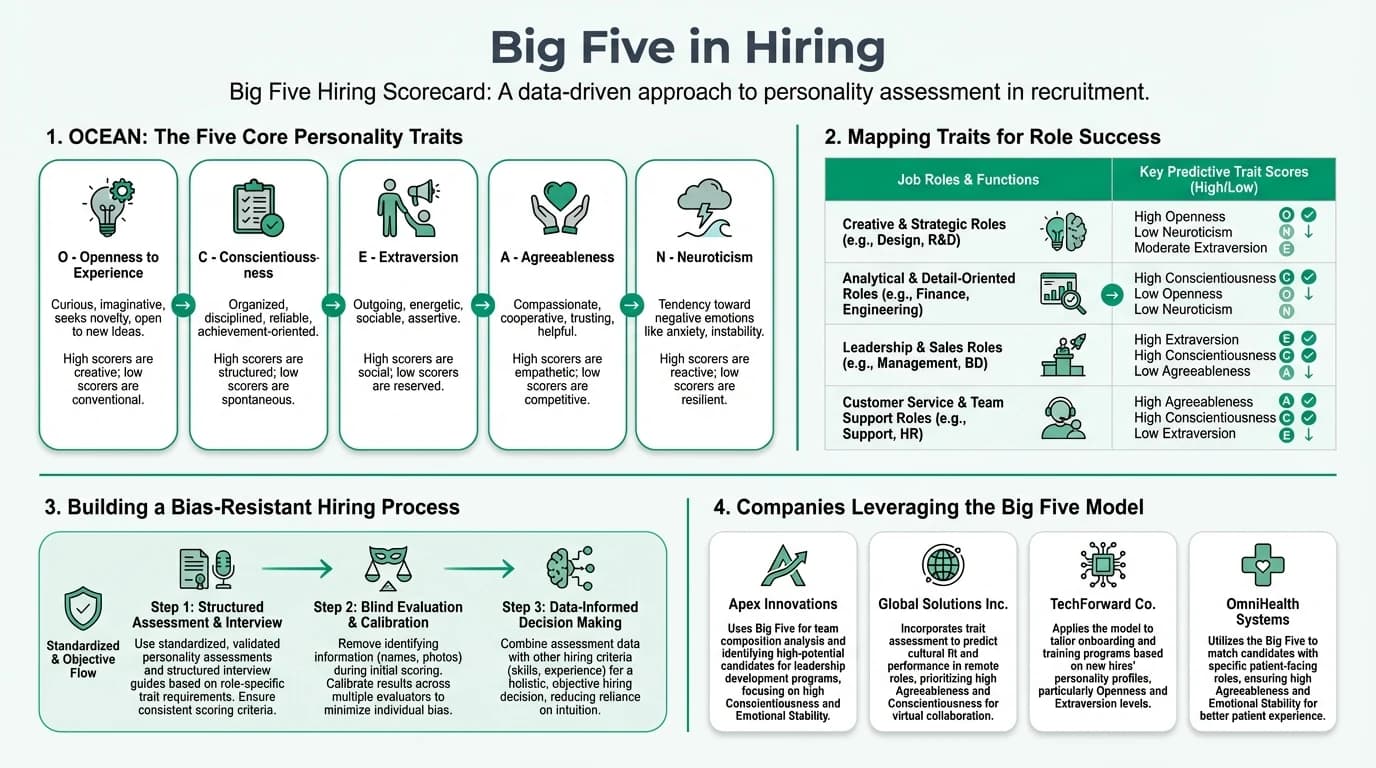
The Big Five model is a personality assessment framework that evaluates individuals based on five key traits: Openness, Conscientiousness, Extraversion, Agreeableness, and Neuroticism.
Source: University of Minnesota
Executive Summary
The Big Five personality model, encompassing Openness, Conscientiousness, Extraversion, Agreeableness, and Neuroticism, is a robust tool for hiring. It provides an objective framework to assess candidates, reducing subjective bias and enhancing the prediction of job performance. This model is validated across various roles, with conscientiousness being the strongest predictor of success.
Implementing the Big Five in hiring involves mapping traits to job roles, creating bias-resistant processes, and developing a scorecard that weights traits based on job-specific requirements. Companies like IBM and P&G have successfully integrated these practices, emphasizing traits like conscientiousness and extraversion for leadership positions.
Key takeaway: The Big Five model offers a scientifically-backed approach to improve hiring accuracy and reduce bias by aligning personality traits with job requirements.
Before implementation, align your team on interpretation standards using Big Five Personality Test: Complete Interpretation Guide, then add guardrails from Personality Test Reliability and operationalize shortlisting with the Big Five Role-Fit Calculator.
Understanding the Big Five Traits
The Big Five model evaluates individuals based on five dimensions:
- Openness: Creativity and openness to new experiences.
- Conscientiousness: Organization and dependability.
- Extraversion: Sociability and assertiveness.
- Agreeableness: Cooperation and empathy.
- Neuroticism: Emotional stability and resilience.
Practical Application
For example, a high level of conscientiousness is crucial for roles requiring meticulous attention to detail, such as project management. Conversely, extraversion is beneficial in sales and leadership roles where interaction and persuasion are key.
| Trait | Ideal Role Example |
|---|---|
| Openness | Creative positions |
| Conscientiousness | Project management |
| Extraversion | Sales, leadership |
| Agreeableness | Customer service |
| Neuroticism | High-stress environments |
Mapping Traits to Job Roles
Mapping the Big Five traits to specific job roles ensures candidates are evaluated on relevant criteria. This alignment helps in identifying the best fit for both the position and the company culture.
Example: Sales Roles
Sales roles benefit from high extraversion and agreeableness. Candidates with these traits are likely to excel in building relationships and closing deals.
| Trait | Importance in Sales Roles |
|---|---|
| Extraversion | High |
| Agreeableness | Moderate |
| Conscientiousness | Moderate |
Implementing Big Five Assessments in Recruitment
Incorporating Big Five assessments at different recruitment stages—initial screening, interviews, and culture fit analysis—ensures a comprehensive evaluation process. This method helps in filtering candidates early and focusing on those who align with the role's requirements.
Example: Initial Screening
Using a Big Five assessment during initial screening can quickly identify candidates with the desired traits, saving time and resources.
| Recruitment Stage | Assessment Focus |
|---|---|
| Initial Screening | Conscientiousness, Extraversion |
| Interviews | Agreeableness, Openness |
| Culture Fit | Overall trait alignment |
Creating a Bias-Resistant Process
To develop a bias-resistant hiring process, it's essential to conduct a thorough job analysis and create a role-specific scoring system. This approach minimizes subjective judgments and focuses on objective criteria.
Example: Role-Specific Scoring
A Match Criteria Survey can be used to weight traits based on job analysis, ensuring that each candidate is evaluated fairly.
| Job Role | Key Traits |
|---|---|
| Manager | Conscientiousness, Extraversion |
| Creative Designer | Openness, Agreeableness |
Developing a Hiring Scorecard
A hiring scorecard quantifies the importance of each trait for a specific role, allowing for a structured evaluation process. This tool helps in comparing candidates objectively and selecting the best fit.
Example: Scorecard for Project Manager
| Trait | Weight (%) |
|---|---|
| Conscientiousness | 40 |
| Agreeableness | 20 |
| Neuroticism | 10 |
| Extraversion | 15 |
| Openness | 15 |
Real-World Examples
Companies like IBM and P&G have successfully integrated the Big Five model into their hiring processes. IBM emphasizes conscientiousness and extraversion for management roles, while P&G focuses on these traits for sales positions.
Example: IBM
IBM's hiring process includes a structured interview format that prioritizes conscientiousness and extraversion, aligning candidates with leadership potential.
Ethical Considerations and Validation
Ethical hiring practices require validation of assessments through incumbent performance data and expert reviews. This ensures that the Big Five assessments are fair and reliable.
Example: Validation Process
Incorporating feedback from current employees and industry experts helps in refining the assessment process and ensuring its effectiveness.
| Validation Method | Description |
|---|---|
| Incumbent Data | Performance comparison |
| Expert Reviews | Assessment accuracy |
For teams that also rely on typology language, review MBTI vs Big Five before choosing final score weights for hiring panels.
Action checklist
- Conduct a job analysis to determine key traits.
- Develop a role-specific scorecard for candidate evaluation.
- Validate assessments with incumbent data and expert input.
FAQ
What are the Big Five personality traits?
How does conscientiousness predict job performance?
Can the Big Five model reduce hiring bias?
How are Big Five assessments implemented in recruitment?
What is a hiring scorecard?
Primary Sources
| Source | Type | URL |
|---|---|---|
| APA Dictionary of Psychology | Institutional definition | dictionary.apa.org/five-factor-model |
| McCrae & John (1992) | Foundational Big Five paper | doi.org/10.1111/j.1467-6494.1992.tb00970.x |
| Soto & John (2017) | Modern BFI-2 validation study | doi.org/10.1037/pspp0000092 |
| NCBI (PMC) | Hiring and personality research overview | pmc.ncbi.nlm.nih.gov/articles/PMC10089283 |