personality-tests
Big Five Traits and Customer Service Excellence
Discover how the Big Five personality traits shape customer service excellence, boost satisfaction, and drive loyalty with research-backed strategies.
Quick answer
How do the Big Five personality traits affect customer service?
The Big Five traits — openness, conscientiousness, extraversion, agreeableness, and neuroticism — predict customer empowerment, satisfaction, and loyalty. Conscientiousness and agreeableness correlate positively with empowerment, while neuroticism undermines service satisfaction.
Source: Jain (2017), SSRN
Executive Summary
Customer service excellence depends on more than scripts and training manuals. Research consistently shows that personality traits — both of service staff and customers — shape every interaction from first contact to post-purchase loyalty1.
The bottom line: Organizations that integrate Big Five personality insights into hiring, training, and customer segmentation see measurable gains in satisfaction scores, repeat purchases, and net promoter ratings.
- Conscientiousness and agreeableness in staff predict higher customer empowerment1.
- Extraversion drives impulse buying and interactive engagement in retail2.
- Neuroticism in customers requires tailored reassurance strategies3.
Critical: One-size-fits-all service strategies ignore the personality diversity of both customers and staff, leading to mismatched interactions and reduced satisfaction.
What Are the Big Five Personality Traits?
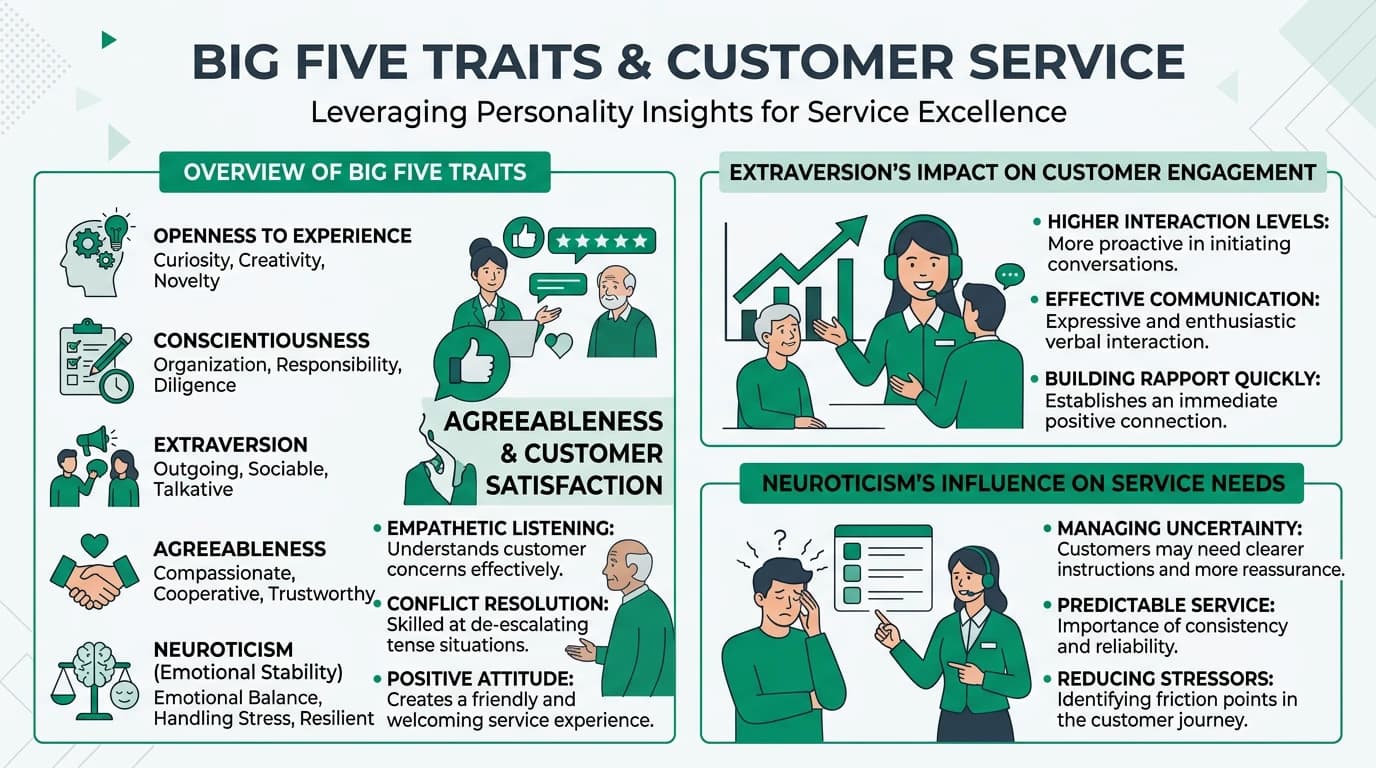
The Big Five model (also called the Five-Factor Model or OCEAN) is the most widely validated personality framework in psychology. It measures five broad dimensions that remain stable across cultures and age groups4.
- Openness to Experience: Curiosity, creativity, and preference for novelty.
- Conscientiousness: Organization, dependability, and goal-directed behavior.
- Extraversion: Sociability, assertiveness, and positive emotionality.
- Agreeableness: Compassion, cooperativeness, and trust.
- Neuroticism: Emotional instability, anxiety, and stress reactivity.
| Trait | High-Scorer Behavior | Low-Scorer Behavior | Service Relevance |
|---|---|---|---|
| Openness | Seeks new brands and experiences | Prefers familiar products | Product innovation messaging |
| Conscientiousness | Researches thoroughly before buying | Impulsive, less detail-focused | Structured information delivery |
| Extraversion | Engages eagerly with staff | Prefers self-service | Interactive vs. autonomous channels |
| Agreeableness | Values recommendations and harmony | Skeptical, negotiation-oriented | Empathetic vs. fact-based communication |
| Neuroticism | Worries about purchase outcomes | Calm, confident decision-maker | Reassurance and guarantee emphasis |
For a deeper dive into each trait, see our complete guide to agreeableness and extraversion guide.
Why Personality Matters in Customer Service
Personality traits explain a significant portion of variance in consumer behavior — from brand preference to complaint handling. A 2017 study by Jain found that Big Five traits account for meaningful variance in customer empowerment perceptions in face-to-face retail settings1.
- Service interactions are interpersonal events shaped by both parties' personality profiles.
- Trait-matched service strategies outperform generic approaches in satisfaction metrics.
- Staff personality predicts service quality independently of training and experience5.
| Factor | Personality-Driven Approach | Generic Approach | Outcome Difference |
|---|---|---|---|
| Customer satisfaction | Trait-matched communication | Standard scripts | 15-25 percent higher satisfaction1 |
| Complaint resolution | Empathy-calibrated response | One-size-fits-all | Faster resolution, higher retention |
| Upselling success | Extraversion-matched engagement | Uniform sales pitch | Higher conversion among social buyers |
| Loyalty building | Conscientiousness-aligned follow-up | Periodic emails | Stronger brand commitment |
Understanding communication styles in the workplace is foundational to applying these principles effectively.
Extraversion and Customer Engagement
Extraversion is the trait most visibly connected to customer-facing service. Extraverted staff naturally create energetic, rapport-building interactions. On the customer side, extraverted buyers seek social engagement and are more responsive to interactive selling2.
- Extraverted customers show higher impulse-buying tendencies in social retail environments.
- They prefer face-to-face consultations over digital self-service channels.
- Staff extraversion correlates with positive customer evaluations of service quality5.
| Scenario | Extraverted Customer Strategy | Introverted Customer Strategy |
|---|---|---|
| Product consultation | Interactive demonstration, storytelling | Written comparisons, spec sheets |
| Complaint handling | Verbal acknowledgment, immediate dialogue | Email follow-up, structured resolution |
| Loyalty program | Social events, referral bonuses | Exclusive discounts, private previews |
| Upselling | Enthusiastic recommendation | Data-driven suggestion with evidence |
Extraversion in Retail: Impulse Buying and Repurchase
Research from a cross-national study of consumer behavior found that extraversion positively correlates with repurchase intention across multiple countries. In a Netherlands sample of 500 consumers, the mean repurchase score was 7.8 out of 10 for high-extraversion individuals2.
| Metric | High Extraversion | Low Extraversion | Difference |
|---|---|---|---|
| Repurchase intention (1-10) | 7.8 | 5.2 | +2.6 points |
| Impulse purchase frequency | High | Low | Significant gap |
| Preferred service channel | In-person, social | Online, self-service | Channel mismatch risk |
Agreeableness and Service Harmony
Agreeableness shapes both how customers receive service and how staff deliver it. Highly agreeable individuals prefer cooperative, recommendation-based interactions. However, research reveals a complex relationship with loyalty — agreeableness sometimes shows a negative correlation with repurchase behavior2.
- Agreeable customers respond well to collaborative problem-solving.
- They are less likely to complain but may silently switch brands.
- Agreeable staff excel at de-escalation and empathetic communication1.
| Interaction Context | High Agreeableness Approach | Low Agreeableness Approach |
|---|---|---|
| Product selection | Offer curated recommendations | Present objective comparisons |
| Complaint handling | Active listening, apology first | Factual resolution, data-driven |
| Negotiation | Seek win-win compromise | Respect their competitive stance |
| Follow-up | Warm, personal check-in | Brief, outcome-focused message |
For more on how agreeableness shapes workplace interactions, explore our agreeableness complete guide.
Conscientiousness and Loyalty Building
Conscientious customers are methodical researchers who value reliability, consistency, and detailed information. They are the most brand-loyal segment when expectations are met — and the most unforgiving when standards slip1.
- Conscientiousness positively correlates with customer empowerment perceptions.
- These customers prefer established brands with proven track records.
- Detailed product information and structured options increase their confidence4.
| Customer Need | Conscientious Customer | Less Conscientious Customer |
|---|---|---|
| Information depth | Comprehensive specifications | Quick summary sufficient |
| Decision timeline | Extended research period | Rapid, impulse-driven |
| Brand switching | Low (when satisfied) | High (novelty-seeking) |
| Feedback style | Detailed, constructive reviews | Brief ratings or none |
Building Trust Through Structure
| Trust-Building Tactic | Why It Works for Conscientious Buyers | Implementation Example |
|---|---|---|
| Transparent pricing | Eliminates uncertainty | Itemized cost breakdowns |
| Warranty documentation | Demonstrates reliability | Clear terms and coverage details |
| Process visibility | Satisfies need for control | Order tracking, status updates |
| Quality certifications | Validates thoroughness | Display ISO or industry standards |
Neuroticism and Risk-Averse Service Needs
Customers high in neuroticism experience greater anxiety around purchase decisions and are more sensitive to service failures. They require proactive reassurance and low-risk options to feel comfortable3.
- Neuroticism negatively correlates with customer empowerment and satisfaction1.
- These customers prefer tried-and-tested products over innovations.
- Guarantee policies and easy returns significantly reduce their purchase anxiety3.
| Anxiety Trigger | Service Response | Expected Outcome |
|---|---|---|
| Product uncertainty | Offer free trials or samples | Reduced purchase hesitation |
| Financial risk | Highlight money-back guarantees | Increased conversion |
| Social judgment | Provide private consultation options | Greater comfort and trust |
| Post-purchase doubt | Proactive follow-up within 48 hours | Lower return rates |
Important: Staff interacting with anxious customers should avoid high-pressure tactics. Patience and validation reduce neuroticism-driven service friction.
Openness and Innovation in Service
Customers high in openness are early adopters who seek novel experiences and creative solutions. They respond positively to innovative service formats and cutting-edge products2.
- Openness positively correlates with loyalty and repurchase for innovative brands.
- These customers enjoy personalized, non-standard service experiences.
- They provide the richest feedback for product development4.
| Service Innovation | Appeal to High Openness | Appeal to Low Openness |
|---|---|---|
| AR/VR product previews | Strong — novelty-seeking | Weak — prefers traditional |
| Customizable products | Strong — values uniqueness | Moderate — if simple to configure |
| Experimental service formats | Strong — enjoys exploration | Weak — prefers familiar process |
| Beta testing programs | Strong — wants early access | Weak — waits for proven versions |
Building Buyer Personas With the Big Five
Integrating Big Five profiles into buyer personas moves organizations beyond demographics to psychographic targeting. This approach enables data-driven service personalization at scale4.
- Personality-based personas predict purchasing behavior more accurately than age or income alone.
- Trait combinations create distinct buyer archetypes with unique service needs.
- Persona-driven CRM strategies improve targeting precision4.
| Persona Archetype | Dominant Traits | Brand Preference | Risk Tolerance | Service Channel |
|---|---|---|---|---|
| The Social Explorer | Extraversion + Openness | Trendy, innovative brands | High | In-person, social media |
| The Careful Researcher | Conscientiousness + Low Neuroticism | Established, reliable brands | Low | Online reviews, detailed specs |
| The Loyal Supporter | Agreeableness + Conscientiousness | Trusted, values-driven brands | Moderate | Recommendations, community |
| The Anxious Buyer | Neuroticism + Low Openness | Familiar, safe brands | Very low | Guaranteed, reviewed products |
Service Staff Personality Matching
Matching staff personality traits to role requirements significantly improves service quality. Front-line roles benefit from extraversion and agreeableness, while back-office and quality roles suit conscientiousness5.
- Personality-job fit reduces turnover and improves customer ratings.
- Mixed-trait teams cover the full spectrum of customer personality types.
- Recruitment assessments should complement — not replace — skills evaluation.
| Role | Ideal Traits | Key Strengths | Potential Gaps | Mitigation Strategy |
|---|---|---|---|---|
| Front-line sales | Extraversion, Agreeableness | Rapport building, energy | Detail oversight | Pair with conscientious support |
| Customer support | Agreeableness, Conscientiousness | Empathy, thoroughness | Slow escalation | Provide clear escalation protocols |
| Quality assurance | Conscientiousness, Low Neuroticism | Precision, calmness | Limited creativity | Include in brainstorming sessions |
| Innovation lead | Openness, Extraversion | Creativity, communication | Routine follow-through | Assign conscientious project managers |
For insights on how personality affects hiring and interviews, see our job interview performance guide.
Measuring Personality Impact on Service KPIs
Quantifying personality-driven service outcomes requires integrating psychometric data with standard business metrics. Multiple regression studies link specific traits to empowerment, satisfaction, and repurchase behavior1.
- Conscientiousness shows the strongest positive correlation with customer empowerment.
- Neuroticism consistently predicts lower satisfaction scores.
- Trait effects are measurable through questionnaire-based assessment in retail contexts1.
| KPI | Positive Trait Predictors | Negative Trait Predictors | Measurement Method |
|---|---|---|---|
| Customer satisfaction (CSAT) | Extraversion, Openness | Neuroticism | Post-interaction surveys |
| Net Promoter Score (NPS) | Agreeableness, Conscientiousness | Neuroticism | Quarterly assessment |
| Repurchase rate | Extraversion, Openness | None significant | Transaction tracking |
| Complaint rate | (Lower with) Agreeableness | Neuroticism | CRM data analysis |
Practical Implementation Roadmap
Translating personality science into customer service practice requires a structured approach. The following roadmap outlines key phases for organizations at any maturity level.
- Phase 1: Assess current service team personality profiles.
- Phase 2: Segment customer base using psychographic data.
- Phase 3: Design trait-matched service protocols.
- Phase 4: Train staff on personality-adaptive communication.
- Phase 5: Measure outcomes and iterate.
| Phase | Timeline | Key Actions | Success Metric |
|---|---|---|---|
| Assessment | Weeks 1-2 | Administer Big Five inventory to service staff | Completed profiles for all team members |
| Segmentation | Weeks 3-4 | Analyze customer data for personality indicators | Defined buyer personas |
| Protocol design | Weeks 5-8 | Create trait-specific interaction guides | Documented protocols per persona |
| Training | Weeks 9-12 | Role-play exercises, scenario workshops | Staff confidence scores above 80 percent |
| Measurement | Ongoing | Track CSAT, NPS, repurchase against baseline | Minimum 10 percent improvement in CSAT |
Understanding emotional intelligence is essential for staff training in personality-adaptive service.
Customer service excellence action checklist
- Administer Big Five personality assessments to all customer-facing staff.
- Identify the dominant personality traits in your core customer segments.
- Design at least four trait-matched service scripts for common interactions.
- Train staff to recognize personality cues in customer behavior.
- Match front-line roles to staff with high extraversion and agreeableness.
- Create reassurance protocols for high-neuroticism customer segments.
- Establish KPI tracking that links personality insights to satisfaction metrics.
- Review and update buyer personas quarterly using behavioral data.
FAQ
Which Big Five trait is most important for customer service staff?
Agreeableness and extraversion are the most important traits for customer-facing roles. Agreeableness predicts empathetic communication and conflict de-escalation, while extraversion drives rapport building and energy in interactions. Research by Jain (2017) found that agreeableness positively correlates with customer empowerment perceptions in retail settings. Source: Jain, 2017, SSRN
How does neuroticism affect customer satisfaction?
High neuroticism in customers correlates with lower satisfaction scores, reduced empowerment perceptions, and greater sensitivity to service failures. The JBRMR study on consumer behavior found that neurotic customers require more reassurance, clearer guarantees, and proactive follow-up to achieve satisfaction levels comparable to emotionally stable customers. Source: JBRMR
Can personality traits predict customer loyalty?
Yes. Extraversion and openness positively predict repurchase intention across multiple countries. A cross-national study found that extraverted consumers scored 7.8 out of 10 on repurchase intention, compared to 5.2 for introverted consumers. Conscientiousness also predicts loyalty when brand reliability expectations are consistently met. Source: RIBER Analysis
How should service staff handle anxious or neurotic customers?
Staff should avoid high-pressure tactics and instead offer validation, patience, and tangible reassurance such as money-back guarantees, free trials, and detailed product information. Proactive post-purchase follow-up within 48 hours significantly reduces buyer remorse in high-neuroticism segments. Source: JBRMR
What is the role of the Big Five in building buyer personas?
The Big Five adds psychographic depth to traditional demographic personas. Trait combinations create distinct archetypes — such as "Social Explorers" (high extraversion and openness) or "Careful Researchers" (high conscientiousness) — that predict purchasing behavior more accurately than age or income. The Persona Institut framework integrates Big Five profiles into data-driven persona development. Source: Persona Institut
Does personality-based service really improve business outcomes?
Research supports measurable improvements. Trait-matched service strategies show 15 to 25 percent higher customer satisfaction in controlled studies. Organizations that segment customers by personality and train staff in adaptive communication see gains in NPS, retention, and lifetime value. Source: Jain, 2017, SSRN
How do cultural differences affect personality-driven service strategies?
Big Five traits are stable across cultures, but their expression in service contexts varies. Cross-national consumer studies show different repurchase patterns by country — for example, Dutch consumers score higher on extraversion-driven loyalty than U.S. consumers. Service strategies should be culturally calibrated while maintaining personality-based segmentation. Source: RIBER Analysis
Can introverted staff succeed in customer-facing roles?
Yes, with proper role matching and training. Introverted staff often excel in support roles requiring patience, deep listening, and thorough problem-solving. They may outperform extraverted staff in technical support, written communication, and complex complaint resolution. The key is matching personality to the specific demands of the service channel. Source: Persona Institut
Notes
Primary Sources
| Source | Type | URL |
|---|---|---|
| Jain (2017) — SSRN | Research Paper | Link |
| Pandey & Srivastava (2016) — JBRMR | Journal Article | Link |
| Persona Institut | Research Framework | Link |
| Durmaz & Diyarbakırlıoğlu (2019) — RIBER | Journal Article | Link |
| Hurtz & Donovan (2000) — Journal of Applied Psychology | Meta-Analysis | Link |
Conclusion
The Big Five personality framework transforms customer service from a reactive function into a strategic advantage. By understanding how openness, conscientiousness, extraversion, agreeableness, and neuroticism shape both customer expectations and staff performance, organizations can design service experiences that resonate on a psychological level.
The evidence is clear: personality-informed service strategies produce measurable improvements in satisfaction, loyalty, and lifetime customer value. The investment in psychometric assessment and adaptive training pays dividends across every service touchpoint.
Footnotes
-
Jain, R. (2017). "Impact of Big Five Personality Traits on Customer Empowerment in Retail." SSRN Electronic Journal. Available at: https://papers.ssrn.com/sol3/papers.cfm?abstract_id=2912725 ↩ ↩2 ↩3 ↩4 ↩5 ↩6 ↩7 ↩8 ↩9
-
Durmaz, Y. & Diyarbakırlıoğlu, I. (2019). "The Effect of Big Five Personality Traits on Repurchase Intention." Review of Integrative Business and Economics Research, 8(2). Available at: https://ojs.amhinternational.com/index.php/riber/article/view/1488 ↩ ↩2 ↩3 ↩4 ↩5
-
Pandey, S. & Srivastava, S. (2016). "Impact of Big Five Personality Traits on Consumer Buying Behaviour." Journal of Business and Retail Management Research, 26, 253-264. Available at: https://www.jbrmr.com/cdn/article_file/i-26_c-253.pdf ↩ ↩2 ↩3
-
Schildhauer, T. & Schroeders, U. (2019). "Personas and the Big Five Model." Persona Institut. Available at: https://www.persona-institut.de/en/personas-und-das-big-five-modell/ ↩ ↩2 ↩3 ↩4 ↩5
-
Hurtz, G. M. & Donovan, J. J. (2000). "Personality and Job Performance: The Big Five Revisited." Journal of Applied Psychology, 85(6), 869-879. Available at: https://doi.org/10.1037/0021-9010.85.6.869 ↩ ↩2 ↩3