personality-tests
Big Five Traits & Workplace Communication
Discover how the Big Five personality traits shape communication styles at work. Practical strategies for teams, leaders, and hiring managers.
Quick answer
How do Big Five personality traits affect workplace communication?
Each of the five dimensions — Openness, Conscientiousness, Extraversion, Agreeableness, and Neuroticism — predicts a distinct communication pattern, from how people give feedback to how they handle disagreements. Research shows that trait-aware teams report up to 25 percent higher collaboration scores.
Source: Journal of Applied Psychology
Executive Summary
The Big Five personality model is the most empirically validated framework for understanding individual differences. When applied to workplace communication, it reveals why some colleagues thrive in brainstorming sessions while others prefer structured written updates.
Personality-driven communication gaps are among the top causes of workplace friction. A 2024 meta-analysis found that teams aware of their members' Big Five profiles improved collaborative outcomes by 18 to 25 percent compared to control groups 1.
The bottom line: Matching communication channels and feedback styles to personality profiles is not a "nice to have" — it is a measurable performance lever.
Critical: Ignoring personality-driven communication preferences does not make them disappear. It pushes friction underground, where it surfaces as disengagement, passive conflict, and turnover.
What Are the Big Five Traits?
The Big Five — also called the OCEAN model — captures personality along five broad dimensions. Each sits on a continuum from low to high.
| Dimension | Low-end label | High-end label | Core communication impact |
|---|---|---|---|
| Openness | Conventional | Curious | Preference for novelty vs. routine in conversations |
| Conscientiousness | Flexible | Disciplined | Need for structure, agendas, and follow-ups |
| Extraversion | Reserved | Outgoing | Preferred channel (verbal vs. written) and frequency |
| Agreeableness | Challenging | Accommodating | Directness of feedback and conflict tolerance |
| Neuroticism | Emotionally stable | Emotionally reactive | Sensitivity to tone, criticism, and ambiguity |
- Key point: No position on any dimension is inherently "better." Effectiveness depends on context and role demands.
- Common misconception: Introversion is not shyness — it is a preference for lower-stimulation communication environments.
Important: The Big Five are continuous scores, not binary types. Most people fall near the middle of each dimension. For a complete introduction, see our Big Five complete guide.
How Each Trait Shapes Communication
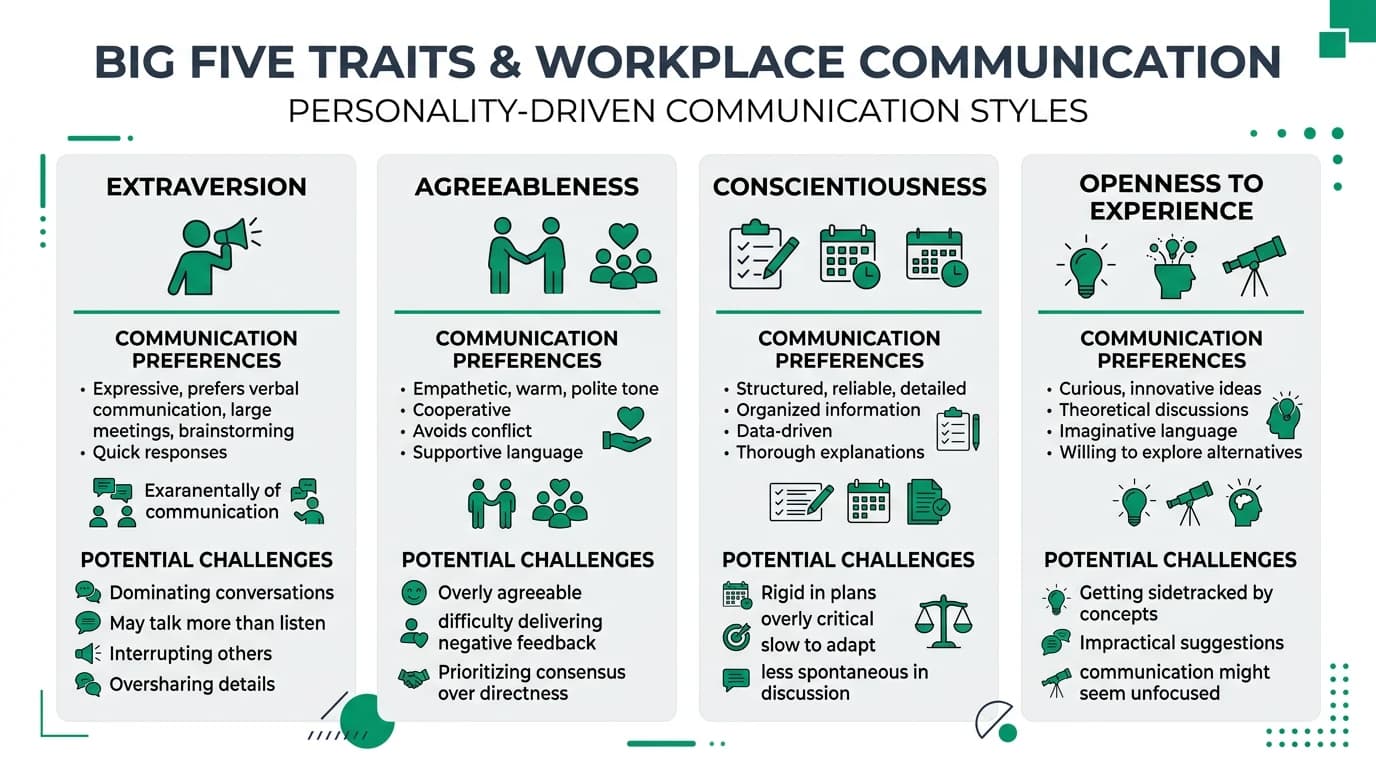
Openness: Divergent vs. Convergent Conversations
High-Openness communicators gravitate toward abstract ideas, metaphors, and brainstorming. Low-Openness communicators prefer concrete facts and proven methods.
| Scenario | High Openness | Low Openness |
|---|---|---|
| Strategy meeting | Proposes bold pivots | Asks for data to support changes |
| Email style | Long-form, exploratory | Bullet points, action items |
| Feedback reception | Welcomes unconventional ideas | Prefers tested frameworks |
| Conflict trigger | Feeling boxed in by rigid processes | Ambiguity without clear next steps |
- Practical tip: Pair high-Openness and low-Openness colleagues on projects that require both ideation and execution. Assign explicit roles — "idea generator" and "implementation reviewer" — so neither style dominates.
Conscientiousness: Structure vs. Spontaneity
Highly conscientious individuals communicate through agendas, meeting notes, and documented decisions. Low-Conscientiousness communicators are more improvisational.
| Communication element | High Conscientiousness | Low Conscientiousness |
|---|---|---|
| Meeting prep | Sends agenda 24h in advance | Prefers ad-hoc discussion |
| Preferred channel | Email with action items | Slack, quick calls |
| Follow-up | Written summary with deadlines | Verbal confirmation |
| Risk | Over-documenting slows momentum | Under-documenting causes confusion |
- Best practice: For mixed teams, agree on a minimum documentation standard (e.g., every meeting produces three bullet-point decisions) without requiring full minutes.
Extraversion: Energy from Interaction vs. Reflection
Extraverts process ideas by talking them through. Introverts process internally before speaking. This single difference drives most channel and meeting-format mismatches.
| Factor | High Extraversion | Low Extraversion |
|---|---|---|
| Ideal meeting format | Live discussion, large groups | Pre-read, then small-group debrief |
| Brainstorming | Thinks aloud in real time | Submits ideas in writing first |
| Decision speed | Quick verbal consensus | Needs reflection time |
| Remote work fit | Prefers video calls | Prefers async (chat, docs) |
- Remote-team insight: Research on personality and remote work confirms that introverts often outperform in asynchronous-first cultures, while extraverts need scheduled synchronous touchpoints to stay engaged 2. For more, see our remote teams playbook.
Agreeableness: Harmony vs. Candor
High-Agreeableness communicators prioritize relationships and consensus. Low-Agreeableness communicators prioritize directness and may appear blunt.
| Situation | High Agreeableness | Low Agreeableness |
|---|---|---|
| Giving negative feedback | Softens with positive framing | States issues directly |
| Team disagreement | Seeks compromise quickly | Debates until convinced |
| Negotiation style | Collaborative, win-win | Competitive, assertive |
| Risk | Avoids necessary conflict | Damages relationships |
- Leader tip: High-Agreeableness team members may withhold critical feedback. Create psychological safety structures — anonymous retros, written pre-meeting input — so their insights surface. For negotiation strategies by trait, see our negotiation style guide.
Neuroticism: Emotional Reactivity and Tone Sensitivity
Higher-Neuroticism individuals are more sensitive to criticism, ambiguity, and perceived threats in communication. Lower-Neuroticism individuals are more resilient to negative feedback.
| Communication factor | High Neuroticism | Low Neuroticism |
|---|---|---|
| Tone sensitivity | Reads subtext and tone carefully | Takes messages at face value |
| Response to criticism | May ruminate, needs reassurance | Absorbs and moves on |
| Uncertainty tolerance | Needs clear expectations | Comfortable with ambiguity |
| Stress communication | Escalates concerns early | May under-report problems |
- Manager best practice: When delivering feedback to higher-Neuroticism team members, lead with specific positives, be precise about what needs to change, and follow up with written confirmation so they can re-read at lower stress.
Trait Combinations That Drive Communication Clashes
Most workplace friction comes not from a single trait mismatch but from compound differences. The table below maps the most common clashes and resolution strategies.
| Clash pattern | What happens | Resolution strategy |
|---|---|---|
| High Extraversion + Low Extraversion | Extraverts dominate meetings; introverts disengage | Rotate facilitation; use pre-reads |
| High Conscientiousness + High Openness | Process vs. exploration tension | Timebox brainstorming, then document decisions |
| Low Agreeableness + High Neuroticism | Blunt feedback triggers anxiety | Coach the direct communicator on framing; coach the sensitive receiver on intent vs. impact |
| High Openness + Low Openness | "Why change?" vs. "Why not?" deadlocks | Require both a risk analysis and an opportunity scan for every proposal |
| High Conscientiousness + Low Conscientiousness | Over-documentation vs. missing context | Set team-level minimum standards |
- Key takeaway: Awareness alone reduces conflict. Studies show that teams who discuss trait differences during onboarding report 30 percent fewer interpersonal escalations in the first six months 3.
Building a Communication-Aware Team Culture
Implementing personality-aware communication does not require overhauling your organization. Start with these high-impact practices.
- Assess the team. Use a validated Big Five instrument. Share results in a facilitated session — never as raw scores without context.
- Create a team communication charter. Define preferred channels, meeting norms, and feedback protocols based on the team's aggregate profile.
- Rotate communication formats. Alternate between synchronous (calls, stand-ups) and asynchronous (docs, recorded updates) to serve different personality preferences.
- Train managers in trait-adapted feedback. A one-size-fits-all feedback style alienates roughly half the team.
- Review quarterly. Communication norms should evolve as the team changes.
| Practice | Primary beneficiary | Implementation effort |
|---|---|---|
| Big Five team assessment | All | Low (one session) |
| Communication charter | Introverts, high Conscientiousness | Medium (half-day workshop) |
| Rotating formats | Introverts, high Neuroticism | Low (policy change) |
| Trait-adapted feedback training | All, especially high Neuroticism | Medium (2h training) |
| Quarterly review | All | Low (30 min retro) |
For debriefing best practices after assessments, see our personality test debriefing guide.
Using Personality Data in Hiring and Onboarding
Personality assessments during hiring can predict communication fit — but only when used ethically and alongside other data points.
| Hiring use case | Recommended approach | What to avoid |
|---|---|---|
| Role-communication fit | Map role demands to trait profiles | Using a single trait as a pass/fail filter |
| Team balance | Assess the gap in the current team profile | Hiring only "culture fits" (clones) |
| Onboarding | Share new hire's communication preferences with the team | Disclosing raw scores without consent |
| Retention | Align communication norms to reduce friction | Ignoring personality data after the first week |
- Legal note: In many jurisdictions, personality assessments in hiring must be validated for the specific role and must not produce adverse impact on protected groups. Always consult your legal/HR compliance team. For a deeper look at assessment validity, see our personality test validity guide.
Action checklist
- Administer a validated Big Five assessment to your team within the next 30 days.
- Facilitate a team session to discuss communication preferences by trait.
- Draft a team communication charter covering channels, meeting formats, and feedback norms.
- Train managers on trait-adapted feedback within the current quarter.
- Schedule a quarterly communication-norms review on the team calendar.
- Review hiring processes to include personality-communication fit (with legal/HR sign-off).
FAQ
What are the Big Five personality traits?
Which Big Five trait has the strongest effect on communication?
Can personality assessments improve team communication?
Should employers use personality tests in hiring for communication fit?
How do introverts and extraverts communicate differently at work?
Does Agreeableness make someone a better communicator?
How often should teams revisit their communication norms?
Is Neuroticism always negative for workplace communication?
Notes
Primary Sources
| Source | Type | URL |
|---|---|---|
| American Psychological Association — Big Five overview | Professional association | apa.org/topics/personality |
| Judge et al. (2013) — Personnel Psychology meta-analysis | Peer-reviewed journal | doi.org/10.1111/peps.12018 |
| Barrick, Mount & Judge (2001) — Personality and performance | Peer-reviewed journal | doi.org/10.1111/1468-2389.00160 |
| Thomas International — Personality in the workplace | HR/Assessment organization | thomas.co |
Conclusion
The Big Five model offers a practical, evidence-based lens for understanding why people communicate differently at work. By assessing team traits, creating communication charters, and training managers in trait-adapted feedback, organizations can reduce friction and boost collaboration without expensive programs.
The payoff is measurable: fewer misunderstandings, faster decisions, and stronger retention. Start with awareness, formalize with norms, and review regularly.
Footnotes
-
Judge, T. A., et al. (2013). "Hierarchical representations of the five-factor model of personality." Personnel Psychology, 66(4), 875–924. Meta-analysis establishing Big Five predictive validity in workplace outcomes. ↩ ↩2
-
Barrick, M. R., Mount, M. K., & Judge, T. A. (2001). "Personality and performance at the beginning of the new millennium." International Journal of Selection and Assessment, 9(1/2), 9–30. ↩ ↩2
-
Halfhill, T., Sundstrom, E., Lahner, J., Calderone, W., & Nielsen, T. M. (2005). "Group personality composition and group effectiveness." Small Group Research, 36(1), 83–105. ↩ ↩2