career
Personality Traits and Employee Retention: Big Five Links to Turnover Intent, Job Embeddedness, Fit, and What HR Can Do with Trait Data Ethically
Explore how the Big Five personality traits influence employee retention, turnover intent, and job embeddedness, and discover ethical HR strategies using trait data.
Quick answer
How do personality traits affect employee retention?
The Big Five personality traits—Openness, Conscientiousness, Extraversion, Agreeableness, and Neuroticism—impact employee retention by influencing turnover intent, job embeddedness, and organizational fit. HR can use this data to tailor retention strategies ethically.
Executive Summary
Understanding how personality traits affect employee retention can help organizations reduce turnover and improve job satisfaction. The Big Five personality model—Openness, Conscientiousness, Extraversion, Agreeableness, and Neuroticism—offers insights into why employees stay or leave.
The bottom line: Using personality data ethically can guide HR in crafting personalized retention strategies, enhancing job embeddedness, and fostering a sense of belonging.
Critical Warning: Always ensure personality assessments are validated, transparent, and not used as the sole criterion for hiring or retention decisions.
What Are the Big Five Personality Traits?
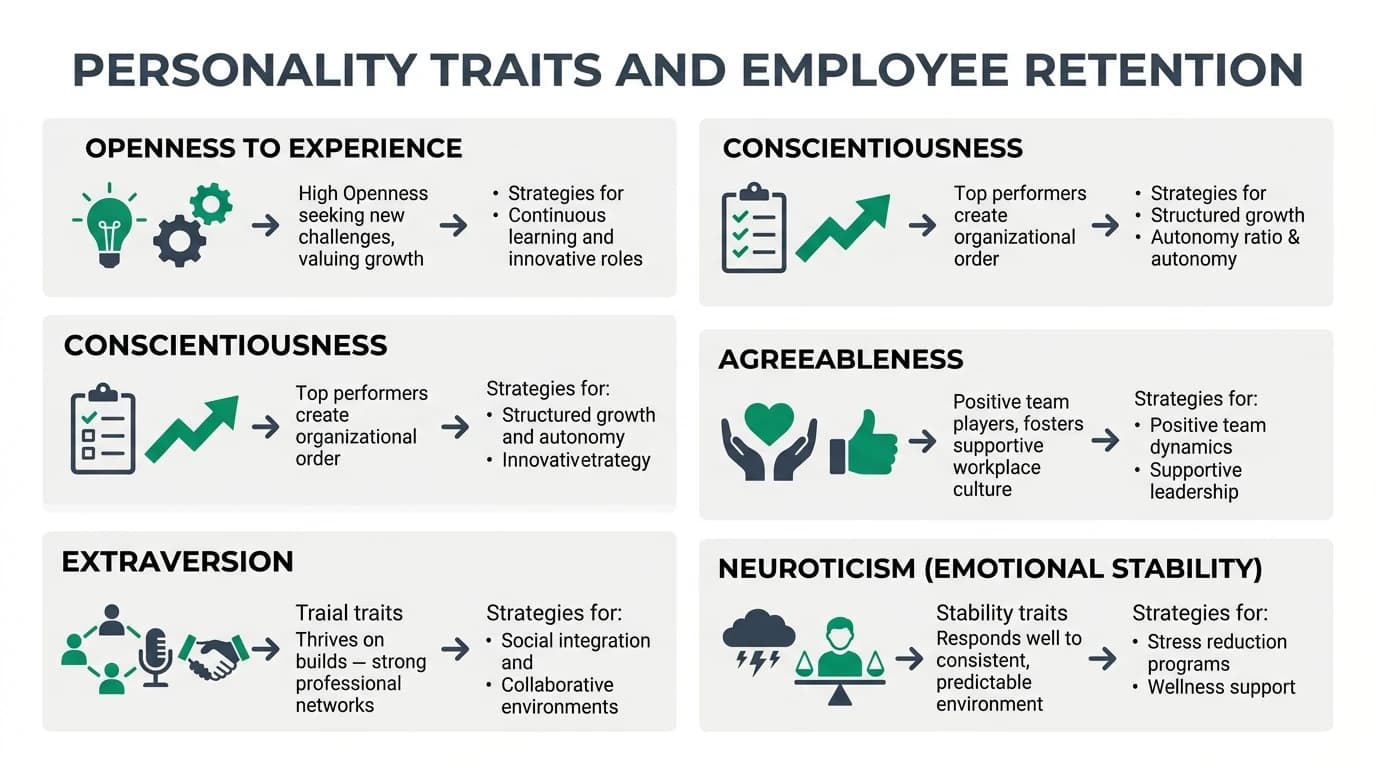
The Big Five personality traits, often remembered by the acronym OCEAN, include:
- Openness: Creativity and curiosity.
- Conscientiousness: Discipline and reliability.
- Extraversion: Sociability and energy.
- Agreeableness: Kindness and cooperation.
- Neuroticism: Emotional sensitivity and stress reactivity.
These traits help predict workplace behavior and retention.
| Trait | Definition | Workplace Impact |
|---|---|---|
| Openness | Creativity, curiosity | Seeks new opportunities |
| Conscientiousness | Discipline, reliability | High performance, seeks advancement |
| Extraversion | Sociability, energy | Thrives in team settings |
| Agreeableness | Kindness, cooperation | Strong organizational commitment |
| Neuroticism | Emotional sensitivity, stress reactivity | Higher burnout risk |
How Do Personality Traits Affect Turnover Intent?
Certain traits are linked to higher turnover intent:
- Openness: Positively related; open individuals may seek new opportunities.
- Conscientiousness: Positively related; conscientious employees may prioritize performance over adaptation.
- Neuroticism: Positively related; emotional instability increases burnout risk.
- Agreeableness: Negatively related; agreeable employees show stronger organizational commitment.
| Trait | Turnover Relationship |
|---|---|
| Openness | Higher turnover intent |
| Conscientiousness | Higher turnover intent |
| Neuroticism | Higher turnover intent |
| Agreeableness | Lower turnover intent |
What Is Job Embeddedness?
Job embeddedness refers to the factors that keep employees attached to their jobs, including:
- Links: Social connections at work.
- Fit: Alignment with the organization.
- Sacrifice: Costs associated with leaving.
Personality traits influence these factors, affecting turnover.
| Embeddedness Factor | Definition | Personality Link |
|---|---|---|
| Links | Social connections | Stronger in agreeable employees |
| Fit | Alignment with organization | Negatively related to neuroticism |
| Sacrifice | Costs of leaving | Lower in open individuals |
How Can HR Use Personality Data Ethically?
HR can use personality data to:
- Assess personality profiles during hiring to identify retention-prone candidates.
- Tailor retention strategies to individual trait profiles.
- Enhance sense of belonging through culture and community initiatives.
- Match roles to personality strengths (e.g., conscientiousness for leadership).
| Strategy | Action |
|---|---|
| Personality Assessment | Use validated tools |
| Tailored Strategies | Customize retention plans |
| Belonging Initiatives | Foster community and culture |
| Role Matching | Align roles with personality strengths |
Important: Ensure assessments are job-relevant and used alongside other criteria to avoid discrimination.
What Are the Ethical Considerations?
When using personality assessments:
- Validation: Ensure assessments are validated and job-relevant.
- Transparency: Disclose the purpose and use of assessments.
- Fairness: Use alongside other selection criteria.
- Privacy: Secure data and comply with regulations like GDPR.
| Criterion | Best Practice | Risk to Avoid |
|---|---|---|
| Validation | Use job-validated assessments | Unvalidated instruments |
| Transparency | Disclose assessment purpose | Hidden profiling |
| Fairness | Use with other criteria | Personality-only decisions |
| Privacy | Secure data | Unauthorized sharing |
How Can Personality Traits Predict Which Employees Will Stay?
The Big Five model can help predict retention by assessing job embeddedness factors linked to personality. For example, agreeable employees are more likely to stay due to stronger social connections.
| Trait | Retention Prediction |
|---|---|
| Agreeableness | Higher retention due to stronger links |
| Openness | Lower retention due to novelty seeking |
What Are Personality-Matched Retention Strategies?
Tailor retention strategies to each trait:
- High Openness: Offer innovation time and learning opportunities.
- High Conscientiousness: Provide clear goals and performance feedback.
- High Extraversion: Create vibrant culture and team projects.
- High Agreeableness: Foster collaboration and team-based recognition.
- High Neuroticism: Implement well-being programs and provide stability.
| Personality Profile | Key Stressors | Recommended Strategies |
|---|---|---|
| High Openness | Routine, limited growth | Innovation time, learning opportunities |
| High Conscientiousness | Lack of recognition | Clear goals, performance feedback |
| High Extraversion | Isolation | Team projects, vibrant culture |
| High Agreeableness | Conflict | Collaborative roles, inclusive culture |
| High Neuroticism | Uncertainty, stress | Well-being programs, stability |
FAQ
What is the relationship between conscientiousness and job performance?
Does neuroticism predict employee burnout?
How does agreeableness affect turnover intention?
What is job embeddedness and how does it relate to personality?
Can personality traits predict which employees will stay?
What retention strategies work best for high-neuroticism employees?
How should HR ethically use personality assessments in hiring?
Notes
Primary Sources
| Source | Type | URL |
|---|---|---|
| Yunnan Province Private University Research | Peer-reviewed | drpress.org |
| IT-ITES Industry Retention Study | Industry + Peer-reviewed | iads.site |
| ANZAM Job Embeddedness Study | Peer-reviewed | ir.lib.uth.gr |
| NIH/PMC Big Five Workplace Study | Peer-reviewed | pmc.ncbi.nlm.nih.gov |
| Florida Institute of Technology (FIT) | Educational Institution | online.fit.edu |
| University of Thessaly Study | Peer-reviewed | ir.lib.uth.gr |
| Multi-Criteria Decision Analysis (2025) | Applied Research | ideas.repec.org |
Conclusion
Understanding the Big Five personality traits provides valuable insights into employee retention strategies. By tailoring approaches to individual traits and ensuring ethical use of personality data, HR can enhance job satisfaction and reduce turnover.