personality-tests
Personality and Organizational Culture Fit: How Big Five Predicts Workplace Alignment
Explore how the Big Five personality traits influence organizational culture fit and predict workplace alignment.
Quick answer
How do the Big Five personality traits predict workplace alignment?
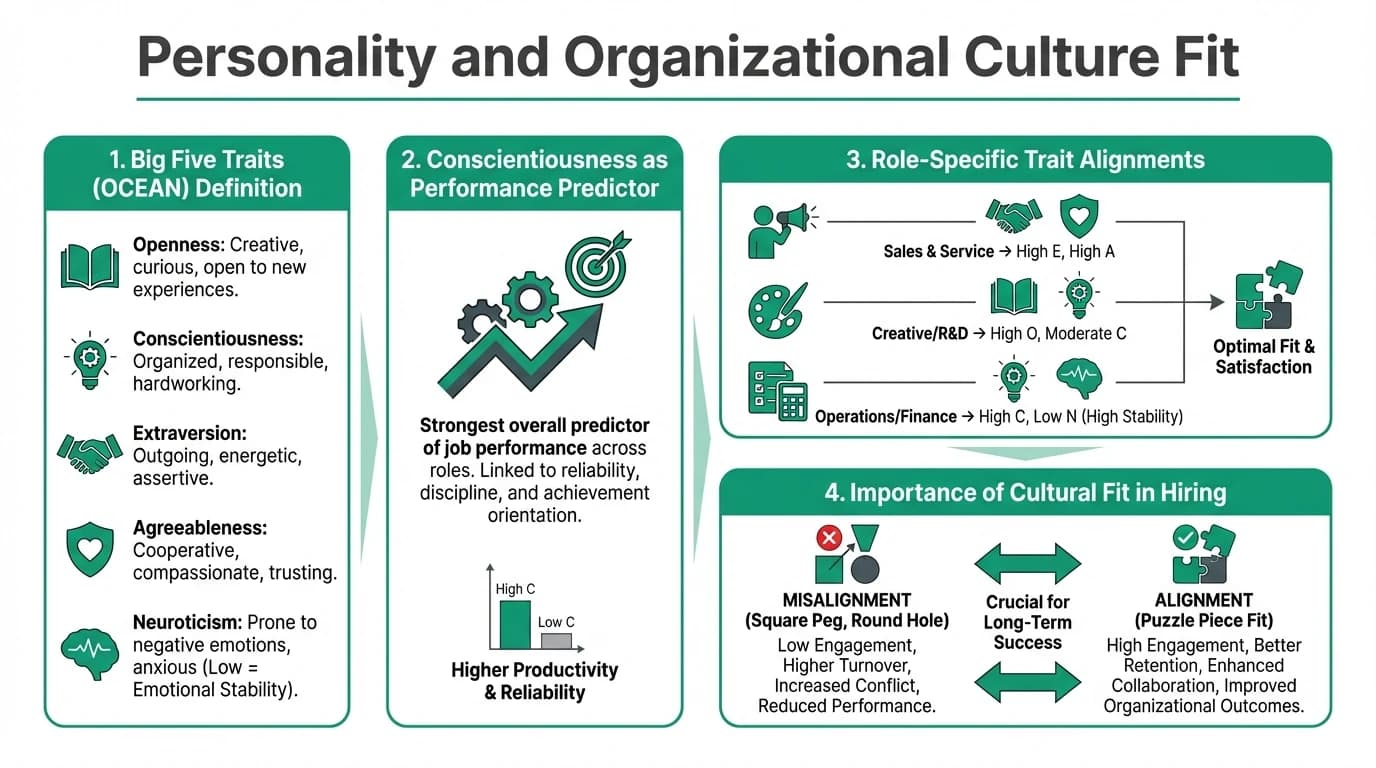
The Big Five traits—Openness, Conscientiousness, Extraversion, Agreeableness, and Neuroticism—predict workplace alignment by matching individual traits to organizational culture, job demands, and team dynamics. Conscientiousness is the strongest predictor of job performance, while traits like Extraversion and Openness align with specific role cultures.
Source: Florida Tech Online
Executive Summary
The Big Five personality traits—Openness, Conscientiousness, Extraversion, Agreeableness, and Neuroticism—play a crucial role in predicting how well individuals align with organizational culture. This alignment can significantly impact job performance, satisfaction, and retention.
The bottom line: Understanding the Big Five traits helps organizations enhance cultural fit and optimize team dynamics.
Critical Warning: Ignoring cultural fit can lead to decreased job satisfaction and increased turnover.
What are the Big Five Personality Traits?
The Big Five personality traits, often referred to as OCEAN, provide a comprehensive framework for understanding individual differences in personality.
- Openness: Creativity and openness to new experiences. Ideal for roles requiring innovation.
- Conscientiousness: Reliability and organization. Strong predictor of job performance.
- Extraversion: Sociability and assertiveness. Suits roles in sales and leadership.
- Agreeableness: Compassion and cooperation. Beneficial in team-based environments.
- Neuroticism: Emotional stability. Low levels preferred for stress management.
| Trait | High-Score Strength | Ideal Roles | Evidence Source |
|---|---|---|---|
| Openness | Creativity | Graphic Designer | [Florida Tech Online]1 |
| Conscientiousness | Reliability | Project Manager | [Barrick and Mount]2 |
| Extraversion | Sociability | Sales Representative | [Academy of Management]1 |
| Agreeableness | Cooperation | Team Leader | [University of Iowa]2 |
| Neuroticism | Emotional Stability (Low) | Crisis Manager | [PMC/NIH]3 |
Conscientiousness: The Top Performance Predictor
Conscientiousness stands out as the strongest predictor of job performance across various occupations.
- Effect: High reliability and organization.
- Process: Enhances job knowledge and leadership skills.
- Caveat: May limit adaptability in dynamic environments.
| Trait | Pros | Cons |
|---|---|---|
| Conscientiousness | Performance predictor | Less adaptive in creative roles |
Role-Specific Trait Alignments
Different roles require different personality traits for optimal performance.
- Extraversion: Ideal for social roles like sales.
- Openness: Suits innovative and creative environments.
- Neuroticism: Low levels beneficial for high-stress positions.
| Scenario | Mismatched Trait | Aligned Trait | Outcome Improvement |
|---|---|---|---|
| Sales Role | Introversion | Extraversion | Increased client engagement |
| Creative Team | Low Openness | High Openness | Enhanced innovation |
| Crisis Management | High Neuroticism | Low Neuroticism | Better stress handling |
Personality Differences by Employment Status
Entrepreneurs and managers often exhibit distinct personality profiles.
- Entrepreneurs: Low Neuroticism, high Openness, Conscientiousness, and Extraversion.
- Managers: Similar traits but generally lower in Agreeableness.
| Trait | Entrepreneurs | Managers | Key Difference |
|---|---|---|---|
| Agreeableness | Lower | Moderate | Entrepreneurs less agreeable |
| Conscientiousness | High | High | Both value reliability |
Big Five's Influence on Organizational Culture
The Big Five traits significantly impact organizational culture by shaping employee behavior and performance.
- Positive Effect: Enhances culture through improved behavior.
- Mediation: Culture mediates the effect on performance.
| Study | Big Five Effect on Culture | Effect on Performance | Quantitative Result |
|---|---|---|---|
| Pangastuti 2018 | Positive | Improved | SEM-PLS analysis |
| Yusuf 2021 | Positive | Enhanced | SEM-PLS analysis |
Cultural Fit Beyond Personality: Values and Behaviors
Cultural fit extends beyond personality traits to include values and behaviors.
- Integration: Combining Big Five with cultural assessments improves hiring.
- Benefits: Boosts satisfaction, performance, and retention.
Important: Relying solely on personality assessments without considering cultural fit can lead to poor hiring decisions.
Hiring and Assessment Tools
Combining Big Five tests with culture assessments enhances hiring processes.
- Benefits: Increases retention and performance.
- Tools: Platforms like MyCulture.ai offer real-world solutions.
Action checklist
- Incorporate Big Five assessments in hiring processes.
- Evaluate cultural fit alongside personality traits.
- Use tools like MyCulture.ai for comprehensive assessments.
FAQ
How does Conscientiousness predict job performance?
What roles are best suited for high Openness?
Can personality traits change over time?
How does Extraversion impact sales roles?
Why is cultural fit important in hiring?
Are there limitations to using the Big Five in workplaces?
What tools can help assess personality and culture fit?
Notes
Primary Sources
| Source | Type | URL |
|---|---|---|
| NIH/PMC | Article | PMC |
| Stanford GSB | Insights | Stanford GSB |
| Academy of Management Journal | Study | N/A |
| British Psychological Society | Research | Wiley |
| Florida Tech Online | Article | Florida Tech |
Conclusion
Understanding the Big Five personality traits and their alignment with organizational culture is key to optimizing workplace performance and satisfaction. By integrating personality assessments with cultural evaluations, organizations can enhance hiring processes and team dynamics.
Footnotes
-
Florida Tech Online provides insights into how the Big Five traits influence work behavior. ↩ ↩2 ↩3 ↩4 ↩5
-
Barrick and Mount's meta-analysis highlights Conscientiousness as a strong predictor of job performance. ↩ ↩2 ↩3 ↩4 ↩5
-
PMC/NIH studies compare personality profiles of entrepreneurs and managers. ↩
-
British Psychological Society's research on dynamic interactions between traits and job characteristics. ↩