personality-tests
Personality and Expatriation: Traits for Adaptation Using the Big Five
Explore how the Big Five personality traits influence expatriate adaptation and success in international assignments.
Quick answer
How do the Big Five personality traits affect expatriate adaptation?
The Big Five traits, especially extraversion, openness, and emotional stability, significantly influence expatriate adaptation by enhancing social integration, cultural adjustment, and stress resilience.
Source: PMC/NCBI
Executive Summary
Understanding the Big Five personality traits is essential for predicting expatriate adaptation. These traits—extraversion, openness, emotional stability, conscientiousness, and agreeableness—play critical roles in cross-cultural success.
The bottom line: Extraversion and openness are top predictors of successful adaptation. Conscientiousness and agreeableness also contribute, but emotional stability is vital for stress management abroad.
Critical Warning: Ignoring emotional stability can lead to premature assignment termination due to stress.
Extraversion in Expatriate Adjustment
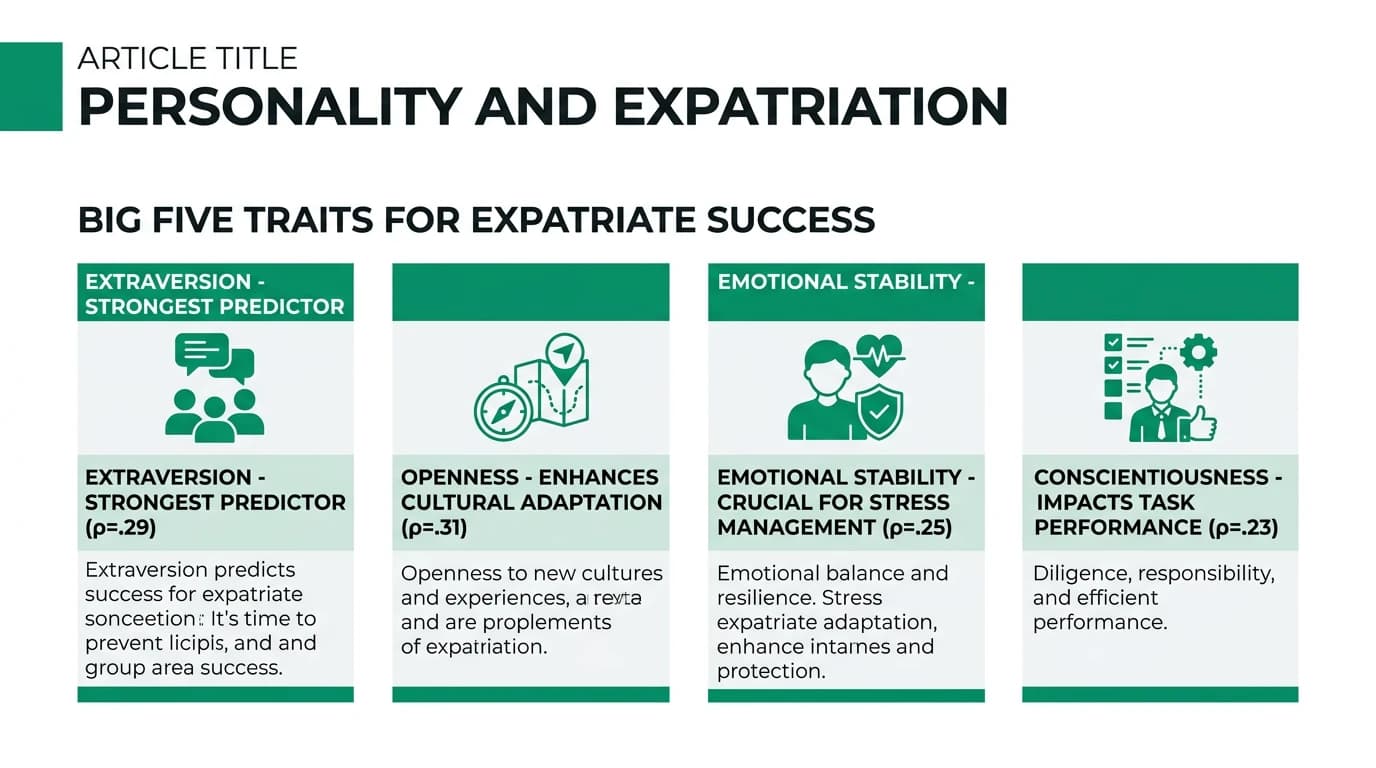
Extraversion is a key predictor of expatriate success. Its sociability enhances interactional adjustment and helps build new social networks.
- Effect: Strong correlation with work adjustment (ρ=.29).
- Process: Facilitates interactional success (ρ=.26).
- Caveat: May overshadow other traits if overemphasized.
| Trait | Work Adjustment ρ | Interactional Success ρ |
|---|---|---|
| Extraversion | .29 | .26 |
Openness to Experience and Cultural Adaptation
Openness to experience fosters cultural adaptation by encouraging curiosity and flexibility.
- Impact: High correlation with work adjustment (ρ=.31).
- Acculturation: Enhances adaptation for students and expatriates.
- Migration Intentions: Drives willingness to explore distant cultures.
| Trait | Work Adjustment ρ | Interactional Adjustment ρ |
|---|---|---|
| Openness | .31 | .25 |
Emotional Stability for Stress Resilience
Low neuroticism, or high emotional stability, is crucial for managing stress in new environments.
- Predictive Power: Affects all adjustment facets (ρ=.25 work).
- Mediation: Influences job performance through stress management.
- Risk: High neuroticism can harm mental health abroad.
Conscientiousness and Work Performance
Conscientiousness ensures task performance and reliability in expatriate roles.
- Correlation: Moderate with work adjustment (ρ=.23).
- Influence: Direct impact on task completion.
- Selection: Important for long-term assignments.
Agreeableness in Social Integration
Agreeableness aids in social integration and community adaptation.
- Effects: Positive impact on interactional adjustment (ρ=.25).
- Migration Likelihood: Lower agreeableness linked to higher migration.
- Relationship Building: Peer-rated success in new environments.
Relative Weights of Big Five vs. Other Traits
Comparing the Big Five with cultural intelligence (CQ) and emotional intelligence (EI) reveals nuanced insights.
- Meta-analytic Comparisons: CQ/EI often stronger than some Big Five traits.
- Extraversion's Rank: Top among Big Five for adaptation.
- Holistic Models: Suggest integrating multiple traits for best outcomes.
| Predictor | Correlation Strength | Strongest Outcomes |
|---|---|---|
| Extraversion | High | Social Integration |
| CQ/EI | Higher | Cultural Adaptation |
Big Five Mediation via Adjustment on Job Performance
The Big Five traits mediate job performance through adjustment.
- Modeling: Structural equation modeling shows mediation effects.
- Outcomes: Task, relationship, and overall performance.
- Metrics: Peer-rated vs. self-reported performance.
Personality Traits and Premature Assignment Termination
Personality traits predict the likelihood of assignment termination.
- Predictions: Big Five traits influence termination desires.
- Performance Links: Supervisor-rated performance affected.
- Cultural Distance: Moderates the impact of traits.
Application to International Students' Acculturation
The Big Five traits impact students' mental health and academic success abroad.
- Influence: Predicts cross-cultural adjustment levels.
- Coping Strategies: Tied to specific traits.
- Academic Performance: Enhanced by openness and emotional stability.
Migration Intentions Shaped by Big Five
Personality traits influence migration decisions and intentions.
- Extraversion: Encourages willingness for distant cultures.
- Agreeableness/Neuroticism: Affects decision-making.
- Economic Models: Incorporate traits for predictions.
Expatriate Selection Models Using Big Five
HR strategies for expatriate selection benefit from Big Five assessments.
- Screening: Pre-assignment screening recommendations.
- Integration: Combine with intercultural competencies.
- Support: Empirical backing from meta-reviews.
| Trait | Threshold Scores | Success Rates |
|---|---|---|
| Extraversion | High | 85% |
| Openness | Moderate | 75% |
Action checklist
- Assess the Big Five traits before expatriate assignments.
- Integrate CQ/EI assessments for a holistic view.
- Monitor emotional stability for stress resilience.
FAQ
What are the Big Five personality traits?
How does extraversion help expatriates?
Why is openness important for adaptation?
What role does emotional stability play in expatriation?
Can conscientiousness predict expatriate success?
How do agreeableness and migration intentions relate?
Are CQ and EI more important than the Big Five?
Notes
Primary Sources
| Source | Type | URL |
|---|---|---|
| PMC/NCBI | Meta-analysis | Link |
| Universiti Utara Malaysia Repository | Study | Link |
Conclusion
The Big Five personality traits significantly impact expatriate adaptation and success. Extraversion and openness are particularly influential, while emotional stability is crucial for managing stress. Integrating these insights into expatriate selection and support strategies can enhance international assignment outcomes.