personality-tests
How Personality Changes Over Your Lifespan
Science shows the Big Five traits shift predictably with age. Learn when each trait peaks, how change happens, and what it means for health and longevity.
Quick answer
Does personality change over a lifetime?
Yes. Longitudinal studies show that all five Big Five traits shift measurably across the lifespan. On average, people become more conscientious, more agreeable, and less neurotic as they age — a pattern researchers call the maturity principle. These changes continue well past age 30 and have real effects on health and longevity.
Executive Summary
For decades, the popular belief was that personality solidifies by age 30. Longitudinal research has decisively overturned that claim. Every Big Five dimension — Openness, Conscientiousness, Extraversion, Agreeableness, and Neuroticism — changes measurably across the adult lifespan, and the direction of change is remarkably consistent across cultures 1.
The dominant pattern is called the maturity principle: people become more agreeable, more conscientious, and less neurotic as they age. These are not trivial shifts — they predict real-world outcomes including career success, relationship quality, and even how long you live 2.
The bottom line: Personality is not fixed. Understanding your trait trajectory helps you anticipate changes, invest in growth areas, and build environments that support positive development.
Critical: Personality change is probabilistic, not guaranteed. Averages mask wide individual variation. Some people change a great deal; others stay remarkably stable. Genes, life events, and deliberate effort all play a role.
The Big Five Trajectory at a Glance
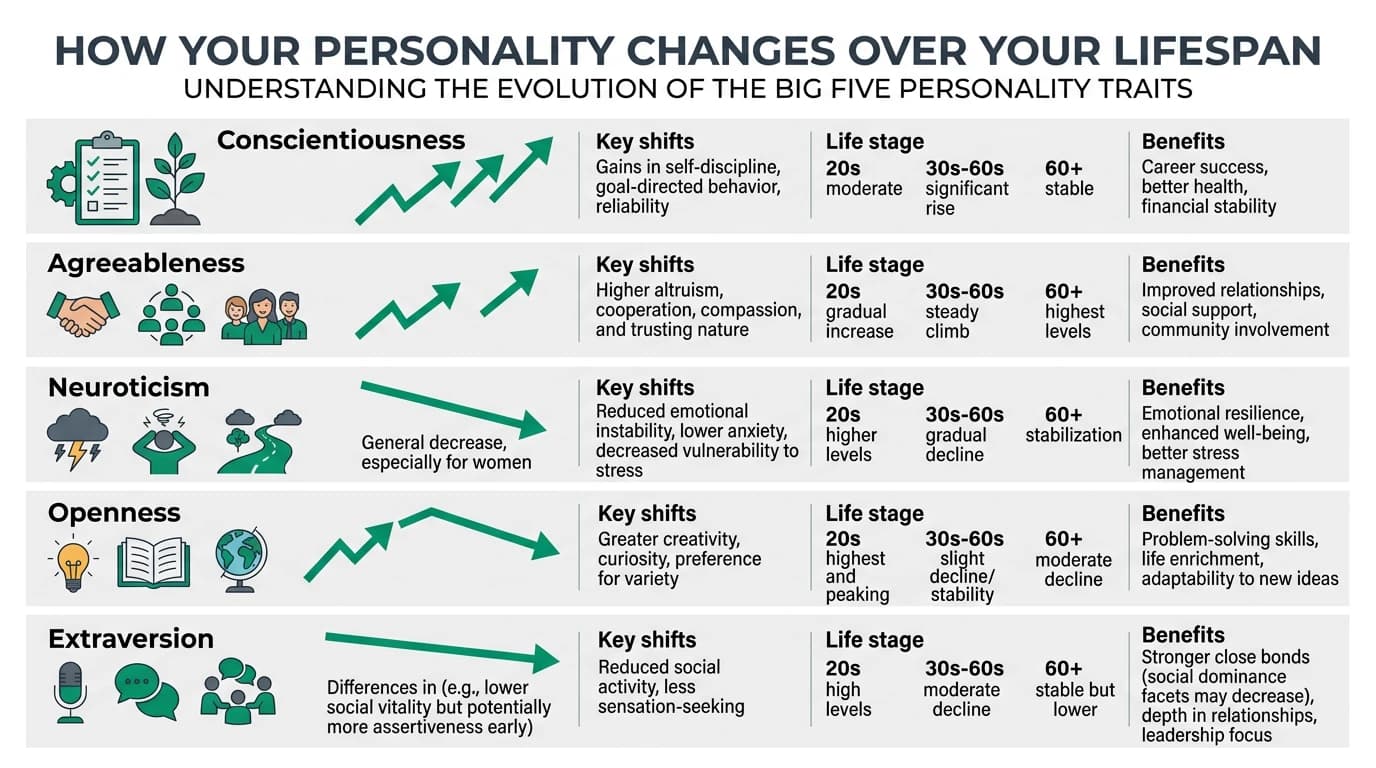
The table below summarizes the average direction and timing of change for each dimension based on cross-cultural longitudinal data 1 3.
| Dimension | 20s | 30s–40s | 50s–60s | 70s+ | Overall trend |
|---|---|---|---|---|---|
| Conscientiousness | Rising sharply | Continues rising | Peaks, then plateau | Slight decline | Strong increase |
| Agreeableness | Stable or low | Begins rising | Continues rising | Peaks | Steady increase |
| Neuroticism | Declining | Continues declining | Low and stable | Stable or slight rise | Strong decrease |
| Extraversion | High | Gradual decline | Moderate decline | Lower | Gradual decrease |
| Openness | High | Stable | Begins declining | Moderate decline | Gradual decrease |
- Key point: The 20s are the decade of most rapid change. But meaningful shifts continue into the 60s and beyond.
- Gender differences: Men and women follow the same general pattern, though women tend to score higher on Agreeableness and Neuroticism at every age 1.
For a full introduction to the model, see our Big Five complete guide.
Conscientiousness: The Steady Rise
Conscientiousness shows the most positive and consistent increase across the lifespan. It rises sharply in the 20s — often driven by workforce entry and adult responsibilities — and continues to climb through middle age 1.
| Life stage | Conscientiousness driver | Observable behavior |
|---|---|---|
| Late teens | Academic demands | Better study habits |
| 20s | Career entry, first management roles | Meeting deadlines, financial planning |
| 30s–40s | Parenthood, mortgage, career advancement | Long-term planning, health routines |
| 50s–60s | Peak career responsibility | Mentoring, organizational leadership |
| 70s+ | Retirement, reduced external demands | Slight decline as structure decreases |
- Longevity link: Conscientiousness is as strong a predictor of longevity as IQ or socioeconomic status. High scorers live longer because they exercise more, eat better, avoid risky behavior, and follow medical advice 2.
- Practical implication: If you score low on Conscientiousness in your 20s, the data suggests you will likely increase — especially if you enter structured environments (jobs, relationships, parenthood) that reward planning and reliability.
Important: The rise is not automatic. People who avoid adult responsibilities (stable employment, relationships) show less Conscientiousness growth than peers who take them on 3.
Agreeableness: The Late Bloomer
Agreeableness increases more slowly than Conscientiousness, with the steepest gains occurring from the 30s through the 60s. This contradicts the stereotype that older people become "grumpier" — on average, the opposite is true 1.
| Age range | Agreeableness shift | Likely mechanism |
|---|---|---|
| 20s | Stable or low | Competition for career and status |
| 30s | Begins rising | Relationship deepening, parenthood |
| 40s–50s | Continues rising | Mentoring roles, reduced status competition |
| 60s | Peaks | Generativity, community focus |
| 70s+ | Stable | Maintained by social engagement |
- Visibility: Agreeableness changes are among the most noticeable to others. Partners and colleagues often comment on increased warmth and patience over the decades.
- Gender note: Women score higher on Agreeableness at every age, but the rate of increase is similar for both genders 1.
Neuroticism: The Decline Toward Stability
Neuroticism — the tendency toward negative emotions, anxiety, and emotional reactivity — declines steadily from early adulthood through middle age. This is one of the most robust findings in personality psychology 1.
| Neuroticism facet | Change direction | Practical impact |
|---|---|---|
| Anxiety | Decreases | Better decision-making under uncertainty |
| Anger/hostility | Decreases | Fewer interpersonal conflicts |
| Depression vulnerability | Decreases | Improved baseline mood |
| Self-consciousness | Decreases | Greater social confidence |
| Impulsiveness | Decreases | Better financial and health decisions |
| Vulnerability to stress | Decreases | Higher resilience to setbacks |
- The mixed picture: While most Neuroticism facets decline, some research suggests a slight uptick in the 70s and 80s, potentially driven by health challenges, social losses, and reduced independence 3.
- Health connection: Chronic high Neuroticism is linked to cardiovascular disease, inflammation, and shorter lifespan. The natural decline with age is protective — but deliberate interventions (therapy, mindfulness, exercise) can accelerate it 2.
For strategies on managing stress through personality awareness, see our stress management guide.
Extraversion: The Gradual Quieting
Extraversion is the only positive-valence trait that declines with age. The decline is gradual — not a dramatic shift — and primarily affects the social vitality facets (gregariousness, excitement-seeking) rather than the assertiveness facets 1.
| Extraversion facet | Age trend | Explanation |
|---|---|---|
| Gregariousness | Declines | Smaller but deeper social circles |
| Excitement-seeking | Declines | Reduced novelty drive |
| Assertiveness | Stable or increases | Career authority, confidence |
| Positive emotions | Stable | Maintained through meaningful relationships |
| Warmth | Stable or increases | Overlaps with Agreeableness gains |
- Quality over quantity: Older adults do not become asocial — they become more selective. Research on socioemotional selectivity theory shows that as time horizons shorten, people invest in fewer but more emotionally meaningful relationships 4.
- Remote work implication: The natural decline in social energy with age may explain why older workers often adapt more easily to remote and asynchronous work. For more on this, see our remote work guide.
Openness: Early Peak, Slow Decline
Openness to experience is highest in late adolescence and early adulthood, then slowly declines. The decline accelerates modestly after age 60 1.
| Openness facet | Peak age | Decline pattern |
|---|---|---|
| Fantasy/imagination | Late teens | Gradual after 30 |
| Intellectual curiosity | 20s | Slower decline; maintained by education |
| Aesthetic sensitivity | 20s–30s | Stable if actively engaged |
| Preference for variety | 20s | Steady decline |
| Values flexibility | 20s | Declines as worldview consolidates |
- Use it or lose it: The decline in Openness is not inevitable. People who remain intellectually engaged — through education, creative hobbies, or diverse social circles — maintain higher Openness scores into old age 3.
- Career implication: The natural Openness decline may explain why mid-career professionals sometimes resist organizational change. Awareness of this trend can help leaders design change management strategies that acknowledge and address it.
Personality and Longevity: The Health Connection
The way personality changes with age has direct consequences for physical health and how long you live.
| Trait pattern | Health outcome | Mechanism | Effect size |
|---|---|---|---|
| High Conscientiousness | Longer lifespan | Healthier behaviors, medication adherence | Comparable to IQ 2 |
| Low Neuroticism | Lower cardiovascular risk | Reduced chronic stress, inflammation | Medium-large |
| High Extraversion | Better immune function | Social support, positive affect | Small-medium |
| High Agreeableness | Lower inflammation | Fewer interpersonal stressors | Small |
| Hostility (low Agreeableness facet) | Shorter lifespan | Cardiovascular disease risk | Medium |
| Optimism (Extraversion facet) | Up to 7.6 extra years | Lower inflammation, better recovery | Large 2 |
- The maturity bonus: Because Conscientiousness and Agreeableness naturally increase while Neuroticism decreases, the aging process itself pushes people toward a healthier personality profile. This is one reason health risks moderate with age for many people.
- Intervention opportunity: If you score high on Neuroticism or low on Conscientiousness in your 20s–30s, targeted interventions (therapy, habit formation, social accountability) can accelerate the natural maturation trajectory.
What Drives Personality Change?
Personality change results from a combination of biological maturation, life experiences, and deliberate effort.
| Change driver | Mechanism | Evidence strength |
|---|---|---|
| Biological maturation | Brain development, hormonal shifts | Strong (especially in 20s) |
| Social roles | Employment, parenthood, partnerships | Strong 3 |
| Major life events | Marriage, divorce, job loss, health crises | Moderate |
| Deliberate intervention | Therapy, coaching, mindfulness practice | Moderate (growing evidence) |
| Cultural context | Societal norms, economic conditions | Moderate |
| Genetics | Heritability sets baseline range | Strong for baseline; weak for change |
- The social investment principle: Taking on new social roles (first job, first child, community leadership) is one of the strongest drivers of personality maturation. People change because their environments demand it 3.
- Therapy works: A 2017 meta-analysis found that therapeutic interventions produced measurable Big Five changes — particularly reduced Neuroticism — in as little as 8 weeks 5.
Myths vs. Reality
| Myth | Reality | Key source |
|---|---|---|
| "Personality is fixed by age 30" | All five traits continue changing into the 60s and beyond | Roberts et al. (2006) 1 |
| "Older people become grumpy" | Agreeableness increases steadily with age | Srivastava et al. (2003) 3 |
| "You cannot change your personality" | Therapy, life events, and deliberate effort all produce measurable change | Roberts et al. (2017) 5 |
| "Personality change is random" | Changes follow the maturity principle across cultures | Cross-cultural longitudinal studies 1 |
| "Genes determine everything" | Heritability explains 40-60 percent of baseline, but environment drives most change | Behavioral genetics research |
Action checklist
- Take a validated Big Five assessment to establish your current baseline.
- Identify which traits are likely to shift based on your age and life stage.
- Invest in social roles (career, relationships, community) that drive maturation.
- If high on Neuroticism, explore evidence-based interventions (CBT, mindfulness).
- Maintain intellectual engagement (education, creative hobbies) to preserve Openness.
- Reassess your personality every 3-5 years to track meaningful changes.
FAQ
Does personality really change after age 30?
Which personality trait changes the most with age?
Can you deliberately change your personality?
Do men and women change differently?
How does personality affect how long you live?
Why do people become less extraverted with age?
Is the decline in Openness inevitable?
What role do life events play in personality change?
Notes
Primary Sources
| Source | Type | URL |
|---|---|---|
| Roberts et al. (2006) — Psychological Bulletin | Peer-reviewed meta-analysis | doi.org/10.1037/0033-2909.132.1.1 |
| Jokela et al. (2013) — JECH | Peer-reviewed meta-analysis | doi.org/10.1136/jech-2013-202783 |
| Srivastava et al. (2003) — JPSP | Peer-reviewed journal | doi.org/10.1037/0022-3514.84.5.1041 |
| American Psychological Association — Personality change | Professional association | apa.org/monitor/julaug03/personality |
| Roberts et al. (2017) — Personality change through intervention | Peer-reviewed systematic review | doi.org/10.1037/bul0000088 |
Conclusion
Personality is not a life sentence. The Big Five traits shift predictably across the lifespan, and the dominant pattern — the maturity principle — pushes most people toward greater emotional stability, reliability, and warmth. These changes are not just academic; they predict career outcomes, relationship quality, and even how long you live.
The most empowering finding is that change is not purely passive. Therapy, deliberate habit formation, and investment in new social roles can all accelerate positive personality development. Start by knowing where you are, understand where the trajectory is heading, and build environments that support the person you want to become.
Footnotes
-
Roberts, B. W., Walton, K. E., & Viechtbauer, W. (2006). "Patterns of mean-level change in personality traits across the life course." Psychological Bulletin, 132(1), 1–25. ↩ ↩2 ↩3 ↩4 ↩5 ↩6 ↩7 ↩8 ↩9 ↩10 ↩11 ↩12 ↩13 ↩14
-
Jokela, M., et al. (2013). "Personality and all-cause mortality: Individual participant meta-analysis of 76,150 adults." Journal of Epidemiology and Community Health, 67(11). ↩ ↩2 ↩3 ↩4 ↩5 ↩6
-
Srivastava, S., John, O. P., Gosling, S. D., & Potter, J. (2003). "Development of personality in early and middle adulthood." Journal of Personality and Social Psychology, 84(5), 1041–1053. ↩ ↩2 ↩3 ↩4 ↩5 ↩6 ↩7 ↩8 ↩9
-
Carstensen, L. L. (2006). "The influence of a sense of time on human development." Science, 312(5782), 1913–1915. ↩ ↩2
-
Roberts, B. W., et al. (2017). "A systematic review of personality trait change through intervention." Psychological Bulletin, 143(2), 117–141. ↩ ↩2 ↩3