personality-tests
Big Five Traits and Friendship Dynamics
Research-backed guide to how each Big Five personality trait shapes friendships, social networks, relationship satisfaction, and conflict resolution patterns.
Quick answer
How do Big Five traits shape friendships?
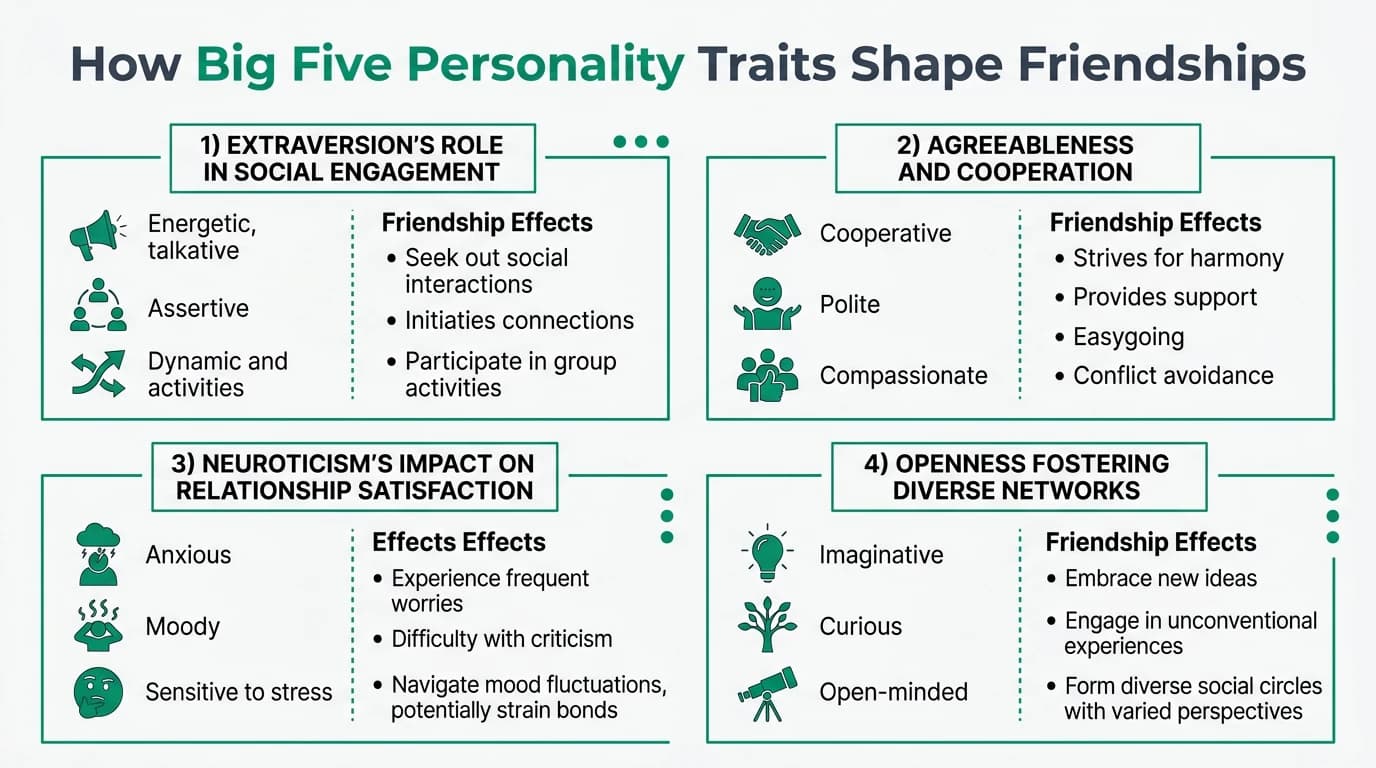
Extraversion and agreeableness are the strongest predictors of friendship quantity and quality. Neuroticism negatively impacts relationship satisfaction, while conscientiousness and openness contribute to stability and diversity in social networks.
Source: Frontiers in Psychology
Executive Summary
Friendships are not random. Research shows that personality traits systematically predict who we befriend, how many close relationships we maintain, how we handle conflict, and how satisfied we feel in our social lives 1.
Among the Big Five traits, extraversion and agreeableness have the strongest positive effects on social connection. Neuroticism is the strongest negative predictor of relationship satisfaction. Conscientiousness contributes to reliability and trust, while openness drives diversity in social networks.
Key takeaway: Understanding your Big Five profile helps you recognize your natural social strengths and address specific vulnerabilities in your relationships.
Important: Personality traits are tendencies, not deterministic rules. Any trait combination can support fulfilling friendships with awareness and effort.
The Big Five Traits and Social Behavior
Each Big Five trait influences a distinct aspect of social functioning. Here is how they map to friendship dynamics.
- Extraversion: Drives social initiative, network size, and energy for group interaction.
- Agreeableness: Shapes cooperation, empathy, and conflict resolution quality.
- Conscientiousness: Contributes to dependability, follow-through, and trust.
- Neuroticism: Affects emotional volatility, sensitivity to rejection, and relationship distress.
- Openness: Influences curiosity about others, willingness to explore new social contexts, and network diversity.
| Trait | Primary Social Function | Friendship Impact | Relationship Satisfaction Correlation |
|---|---|---|---|
| Extraversion | Social energy and initiative | Larger network, more frequent contact | Moderate positive (r = 0.25-0.35) 1 |
| Agreeableness | Cooperation and warmth | Deeper bonds, less conflict | Moderate positive (r = 0.20-0.30) 2 |
| Conscientiousness | Reliability and commitment | Trust and long-term stability | Weak to moderate positive (r = 0.15-0.25) |
| Neuroticism | Emotional reactivity | Conflict escalation, dissatisfaction | Moderate negative (r = -0.25 to -0.45) 3 |
| Openness | Curiosity and exploration | Network diversity, shared activities | Weak positive (r = 0.10-0.20) |
Extraversion: The Social Network Builder
Extraversion is the trait most directly linked to social behavior. It predicts both the quantity and breadth of friendships 4.
How extraversion drives friendship:
- Initiates conversations and social plans with ease.
- Generates positive emotional energy that attracts others.
- Maintains larger, more diverse social circles through regular contact.
Limits of extraversion in friendship:
- Breadth can come at the cost of depth.
- High social energy may overwhelm lower-energy friends.
- Risk of superficial connections that lack emotional intimacy.
| Extraversion Level | Network Size | Contact Frequency | Friendship Depth | Satisfaction |
|---|---|---|---|---|
| High | Large (20+ active contacts) | Daily to weekly | Variable; some shallow | Generally high |
| Moderate | Medium (8-15 active contacts) | Weekly | Balanced | High |
| Low | Small (3-7 close friends) | Monthly to weekly | Deep and selective | Moderate to high |
For a deeper exploration, see our extraversion guide.
Agreeableness: The Relationship Glue
Agreeableness is the strongest predictor of friendship quality, conflict resolution effectiveness, and prosocial behavior within relationships 2.
Strengths of high agreeableness:
- Naturally empathetic and attuned to others' emotional states.
- Facilitates compromise during disagreements.
- Builds trust through consistent warmth and kindness.
Risks of very high agreeableness:
- Over-accommodation can lead to self-neglect and resentment.
- Difficulty setting boundaries when others take advantage.
- Avoidance of necessary confrontation can allow problems to grow.
| Agreeableness Level | Conflict Style | Trust Building | Friendship Maintenance | Vulnerability |
|---|---|---|---|---|
| High | Accommodating, seeks harmony | Rapid through warmth | Active, attentive | Over-giving, burnout |
| Moderate | Balanced, firm but fair | Steady through reliability | Consistent | Occasional boundary issues |
| Low | Direct, competitive | Slow, evidence-based | Selective, transactional | Social friction |
For a complete profile, see our agreeableness guide.
Conscientiousness: Trust and Reliability
Conscientious individuals are perceived as dependable, which is foundational for long-term friendship maintenance 5.
- Follow-through: Keeps promises and shows up when expected.
- Reciprocity: Invests proportionally in relationships that matter.
- Predictability: Provides a stable foundation that fosters emotional safety.
| Conscientiousness Facet | Friendship Benefit | Behavioral Example |
|---|---|---|
| Dependability | Friends feel they can rely on you | Arrives on time, follows through on plans |
| Orderliness | Organized social calendar, fewer forgotten commitments | Remembers birthdays, sends check-in messages |
| Achievement striving | Inspires friends through goal-oriented energy | Motivates workout partners, study groups |
| Self-discipline | Manages social obligations without overcommitting | Declines extra plans when energy is low |
Caveat: Very high conscientiousness without flexibility can make someone seem rigid or judgmental. Balance structure with spontaneity in social contexts.
Neuroticism: The Relationship Challenge
Neuroticism is consistently the strongest negative predictor of relationship satisfaction across friendship, romantic, and family domains 3.
How high neuroticism disrupts friendships:
- Emotional volatility creates unpredictability that strains others.
- Rejection sensitivity leads to misinterpreting neutral cues as hostile.
- Rumination about social interactions erodes enjoyment of time together.
- Excessive reassurance-seeking can exhaust friends over time.
| Challenge | Mechanism | Observable Behavior | Coping Strategy |
|---|---|---|---|
| Rejection sensitivity | Hypervigilant threat detection | Withdrawing after a perceived slight | Check interpretations with a trusted friend |
| Emotional contagion | High negative emotionality spreads to others | Friends feel drained after interactions | Practice containment and journaling |
| Conflict escalation | Disproportionate emotional response | Small disagreements become major fights | Use a 24-hour rule before responding |
| Social comparison | Frequent unfavorable self-comparisons | Jealousy, withdrawal from groups | Limit social media exposure, focus on values |
| Reassurance-seeking | Need for constant validation | Asking "are we okay?" repeatedly | Develop internal self-validation practices |
Research finding: Neuroticism correlates with friendship dissatisfaction at r = -0.25 to -0.55 across longitudinal studies, making it the most impactful trait for relationship quality 3.
Openness: Diversity and Exploration in Friendships
Openness to experience predicts the variety rather than the size of social networks 6.
- Curiosity about others: Open individuals seek out friends from different backgrounds and perspectives.
- Shared activities: Drives interest in trying new experiences together (travel, art, intellectual discussions).
- Acceptance of difference: Tolerates and values non-conformity in friends.
| Openness Level | Network Diversity | Shared Activities | Friendship Style |
|---|---|---|---|
| High | Diverse backgrounds, interests, and cultures | Art, travel, philosophical debate | Stimulating but potentially unstable |
| Moderate | Balanced mix of similar and different friends | Mix of routine and novel activities | Adaptable |
| Low | Homogeneous, familiar | Routine activities and traditions | Stable and predictable |
Trait Combinations and Friendship Compatibility
Friendship satisfaction depends not just on individual traits but on the interaction between friends' personality profiles.
- High extraversion with high extraversion: Energetic, activity-rich friendships. Risk of competition for social attention.
- High agreeableness with high agreeableness: Harmonious but may avoid necessary difficult conversations.
- High openness with high openness: Intellectually stimulating. Risk of impractical or overly abstract interactions.
- Complementary traits: High extraversion with low extraversion can work well when both respect energy differences.
| Combination | Strengths | Risks | Recommendation |
|---|---|---|---|
| Both high E | High-energy social plans, mutual enthusiasm | Over-scheduling, competition | Alternate leadership in planning |
| High E with low E | Balance of social and quiet time | Energy mismatch | Communicate preferences openly |
| Both high A | Deep empathy, mutual support | Conflict avoidance | Practice constructive disagreement |
| High A with low A | Candor meets compassion | Friction in communication styles | Establish shared norms for feedback |
| High N with low N | Emotional depth meets stability | Drain on the stable partner | Set boundaries around emotional labor |
| Both high O | Intellectual richness, adventurous | May neglect practical obligations | Balance novelty with reliability |
How Personality Affects Social Support Perception
Big Five traits predict not only how much social support you receive but how much support you perceive, which is the stronger predictor of well-being 7.
- Extraversion: Increases both actual and perceived support through active network maintenance.
- Agreeableness: Enhances perceived support through reciprocal relationship investment.
- Neuroticism: Reduces perceived support even when objective support levels are adequate.
| Trait | Effect on Actual Support | Effect on Perceived Support | Mediation on Well-Being |
|---|---|---|---|
| Extraversion | Positive (builds networks) | Positive (feels supported) | Significant positive (beta = 0.25) 7 |
| Agreeableness | Positive (reciprocal bonds) | Positive (trusts support) | Significant positive (beta = 0.26) 7 |
| Neuroticism | Negative (alienates supporters) | Strongly negative (discounts support) | Significant negative (beta = -0.31) |
| Conscientiousness | Neutral to positive | Weakly positive | Indirect through reliability |
| Openness | Neutral | Weakly positive | Indirect through diverse connections |
Age and Life Stage Effects
The relationship between personality and friendship changes across the lifespan 8.
- Young adulthood (18-30): Extraversion dominates; large networks, frequent socializing, friendship as exploration.
- Middle adulthood (30-50): Conscientiousness and agreeableness become more important; friendships center on reliability and mutual support.
- Older adulthood (50+): Network size shrinks. Quality over quantity. Agreeableness and emotional stability predict satisfaction.
| Life Stage | Most Important Trait | Network Trend | Friendship Priority |
|---|---|---|---|
| Young adult | Extraversion | Expanding | Exploration and social identity |
| Early career | Conscientiousness | Stabilizing | Professional networking and reliability |
| Mid-life | Agreeableness | Selective pruning | Deep mutual support |
| Retirement | Emotional stability (low N) | Small, close circle | Companionship and shared meaning |
Romantic vs. Platonic Friendship Patterns
Big Five traits influence romantic and platonic relationships differently, though the patterns overlap 9.
Romantic relationships:
- Neuroticism is the strongest negative predictor of romantic satisfaction.
- Agreeableness and conscientiousness predict long-term relationship stability.
- Partner similarity in openness predicts shared lifestyle satisfaction.
Platonic friendships:
- Extraversion is the strongest predictor of friendship quantity.
- Agreeableness drives friendship quality and conflict resolution.
- Openness predicts diversity and intellectual stimulation in friendships.
| Trait | Romantic Impact | Platonic Impact | Key Difference |
|---|---|---|---|
| Extraversion | Moderate positive | Strong positive | Stronger effect in friendships (more choice) |
| Agreeableness | Strong positive | Strong positive | Similar across both domains |
| Conscientiousness | Strong positive (long-term) | Moderate positive | Greater weight in romantic commitment |
| Neuroticism | Strong negative | Moderate negative | Greater impact on romantic satisfaction |
| Openness | Moderate positive | Moderate positive | Drives shared activities in both |
For more on romantic compatibility, see our dating compatibility guide.
Practical Strategies for Better Friendships
Evidence-based approaches for leveraging your trait profile to build stronger relationships.
For high extraversion: Invest in depth, not just breadth. Schedule one-on-one time with close friends rather than only group events.
For low extraversion: Initiate contact through low-pressure channels (text, email) to maintain connections without draining energy.
For high agreeableness: Practice saying no. Protecting your boundaries strengthens relationships by preventing resentment.
For high neuroticism: Build a "reality check" habit. Before reacting to a perceived slight, consult a trusted friend for perspective.
For high openness: Balance novelty-seeking with consistency. Friends value reliability alongside intellectual stimulation.
For high conscientiousness: Allow for spontaneity. Over-planning social time can make friendships feel transactional.
Friendship improvement action plan
- Complete a Big Five assessment and review your social trait profile.
- Identify your top two friendship strengths from the trait tables above.
- Identify your primary friendship vulnerability (often linked to neuroticism or low agreeableness).
- Select one trait-specific strategy to practice for 30 days.
- Schedule regular (monthly minimum) one-on-one time with your closest friends.
- Review your social satisfaction quarterly and adjust your approach.
FAQ
Which Big Five trait is most important for friendships?
Extraversion is the strongest predictor of friendship quantity, while agreeableness is the strongest predictor of friendship quality. Both contribute significantly to overall social satisfaction 1.
Can introverts have fulfilling friendships?
Yes. Introverts typically maintain fewer but deeper friendships. Research shows that friendship quality, not quantity, is the stronger predictor of life satisfaction. Introverts often excel at the depth dimension 4.
How does neuroticism damage friendships?
High neuroticism increases emotional volatility, rejection sensitivity, and reassurance-seeking behavior, all of which can strain relationships over time. The correlation between neuroticism and friendship dissatisfaction ranges from r = -0.25 to -0.55 3.
Do similar personalities make better friends?
Generally, moderate similarity in extraversion and openness predicts friendship formation. However, complementary traits can also work well. The key is mutual understanding and respect for differences rather than strict personality matching 6.
How do friendships change with age?
Network size typically peaks in young adulthood and declines thereafter. The traits that matter most shift from extraversion (youth) to agreeableness and emotional stability (older adulthood). Friendship focus shifts from quantity to quality 8.
Can personality changes improve social relationships?
Yes. Research shows that decreases in neuroticism and increases in agreeableness, both of which occur naturally with age, improve relationship satisfaction. Intentional personality development through therapy or coaching can accelerate these changes 10.
How does agreeableness affect conflict resolution?
Agreeable individuals prefer cooperative conflict strategies, which generally produce better relationship outcomes. However, very high agreeableness can lead to conflict avoidance, allowing problems to grow. The optimal approach combines empathy with assertiveness 2.
What personality combination is best for long-lasting friendships?
The research points to moderate similarity in core values (openness) combined with complementary social styles. A combination of high agreeableness in both friends, moderate extraversion, and low neuroticism creates the most stable long-term bonds 9.
Notes
Primary Sources
| Source | Type | URL |
|---|---|---|
| Malouff et al. (2010) | Meta-analysis of personality and relationship satisfaction | doi.org/10.1016/j.jrp.2009.09.004 |
| Asendorpf and Wilpers (1998) | Longitudinal study of personality and social relationships | doi.org/10.1037/0022-3514.74.6.1531 |
| Swickert, Hittner, and Foster (2010) | Big Five and perceived social support | doi.org/10.1016/j.paid.2009.12.021 |
| Dyrenforth et al. (2010) | Personality and life satisfaction nationally representative study | doi.org/10.1037/a0019915 |
| Roberts, Walton, and Viechtbauer (2006) | Lifespan personality change meta-analysis | doi.org/10.1037/0033-2909.132.1.1 |
Conclusion
Your Big Five profile shapes every dimension of your social life, from how many friends you make to how satisfied you feel in those relationships. Extraversion and agreeableness open doors. Conscientiousness keeps them open. Neuroticism is the primary factor that closes them.
The good news is that every trait combination can support rich friendships with the right awareness and strategies. Start by understanding your profile, then apply targeted actions from this guide.
Footnotes
-
Harris, K., & Vazire, S. (2016). On friendship development and the Big Five personality traits. Social and Personality Psychology Compass, 10(11), 647-667. ↩ ↩2 ↩3
-
Graziano, W. G., & Tobin, R. M. (2009). Agreeableness. In M. R. Leary & R. H. Hoyle (Eds.), Handbook of Individual Differences in Social Behavior (pp. 46-61). Guilford Press. ↩ ↩2 ↩3
-
Malouff, J. M., Thorsteinsson, E. B., Schutte, N. S., Bhullar, N., & Rooke, S. E. (2010). The Five-Factor Model of personality and relationship satisfaction of intimate partners: A meta-analysis. Journal of Research in Personality, 44(1), 124-127. ↩ ↩2 ↩3 ↩4
-
Asendorpf, J. B., & Wilpers, S. (1998). Personality effects on social relationships. Journal of Personality and Social Psychology, 74(6), 1531-1544. ↩ ↩2
-
Roberts, B. W., Jackson, J. J., Fayard, J. V., Edmonds, G., & Meints, J. (2009). Conscientiousness. In M. R. Leary & R. H. Hoyle (Eds.), Handbook of Individual Differences in Social Behavior (pp. 369-381). Guilford Press. ↩
-
McCrae, R. R. (1996). Social consequences of experiential openness. Psychological Bulletin, 120(3), 323-337. ↩ ↩2
-
Swickert, R. J., Hittner, J. B., & Foster, A. (2010). Big Five traits interact to predict perceived social support. Personality and Individual Differences, 48(6), 736-741. ↩ ↩2 ↩3
-
Carstensen, L. L. (1992). Social and emotional patterns in adulthood: Support for socioemotional selectivity theory. Psychology and Aging, 7(3), 331-338. ↩ ↩2
-
Dyrenforth, P. S., Kashy, D. A., Donnellan, M. B., & Lucas, R. E. (2010). Predicting relationship and life satisfaction from personality in nationally representative samples. Journal of Personality and Social Psychology, 99(4), 690-702. ↩ ↩2
-
Roberts, B. W., Walton, K. E., & Viechtbauer, W. (2006). Patterns of mean-level change in personality traits across the life course: A meta-analysis of longitudinal studies. Psychological Bulletin, 132(1), 1-25. ↩