personality-tests
Big Five Personality & Social Media Behavior
How do the Big Five traits shape social media habits? Research-backed guide on posting patterns, platform preferences, and digital well-being by personality type.
Quick answer
How do the Big Five traits predict social media behavior?
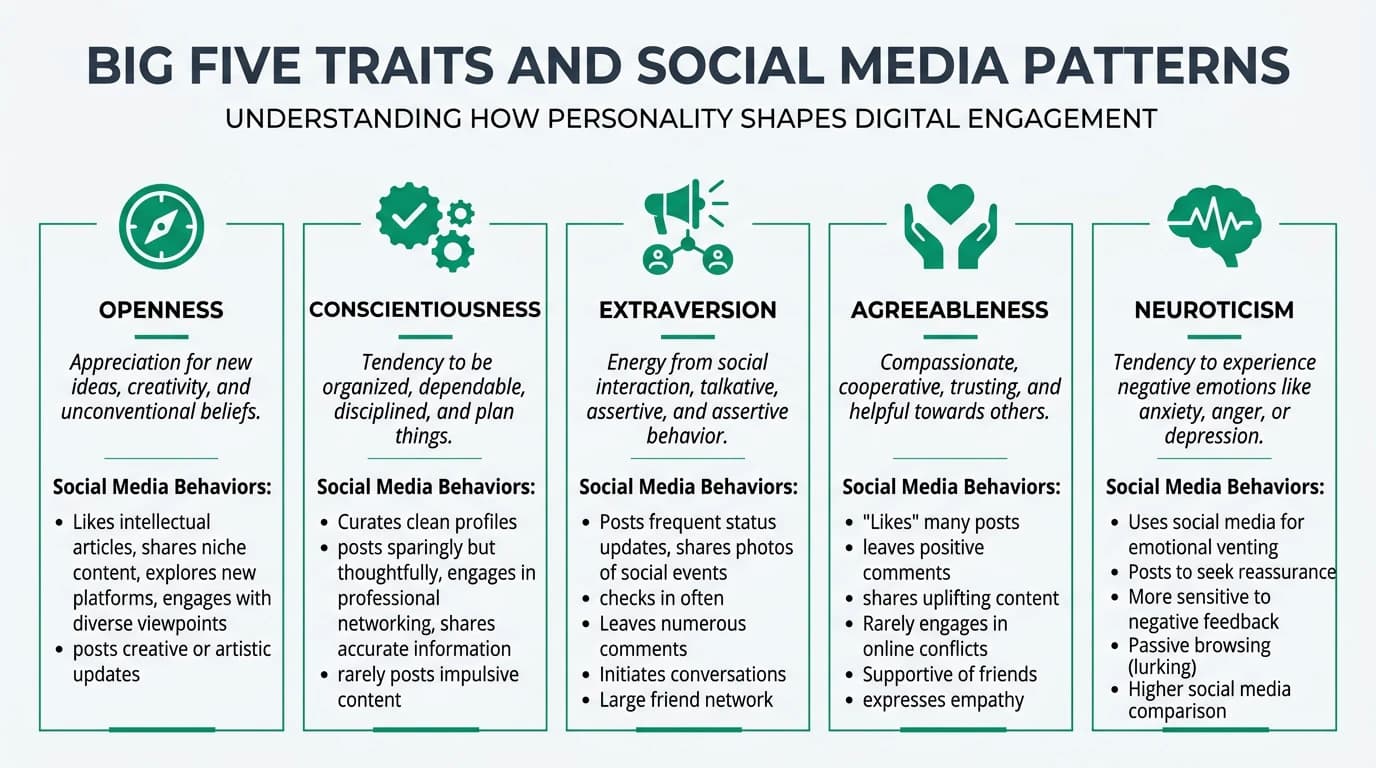
Each Big Five dimension predicts distinct social media patterns. Extraversion drives higher posting frequency and larger networks. Neuroticism predicts emotional posting and problematic use. Openness correlates with diverse content and platform experimentation. Conscientiousness predicts structured, lower-frequency use. Agreeableness shapes sharing decisions and community engagement.
Executive Summary
Social media is not a neutral tool — how people use it is shaped by who they are. A growing body of research links the Big Five personality traits to specific patterns of social media behavior, from posting frequency and content type to platform preference and susceptibility to problematic use 1.
The implications extend beyond academic curiosity. Marketers use personality-behavior links to target content. Employers analyze digital footprints in hiring. Mental health professionals use them to identify at-risk individuals. Understanding the personality-social media connection helps you make more intentional choices about your own digital life.
The bottom line: Your Big Five profile predicts how you use social media — but awareness of these patterns gives you the power to shape your habits rather than be shaped by them.
Critical: Correlations between personality and social media behavior are statistically significant but modest. Personality explains roughly 5 to 15 percent of the variance in most social media behaviors. Context, platform design, and social norms explain the rest.
The Big Five and Social Media: Overview
The table below summarizes the primary behavioral pattern predicted by each Big Five dimension, based on a synthesis of research from 2015 to 2025 1 2 3.
| Dimension | Primary social media pattern | Platform affinity | Risk profile |
|---|---|---|---|
| Extraversion | High posting, large networks, photo sharing | Instagram, TikTok, Facebook | Over-sharing, attention dependence |
| Neuroticism | Emotional posting, passive scrolling, comparison | All platforms (especially Instagram) | Problematic use, anxiety spirals |
| Openness | Diverse content, platform experimentation, creative sharing | YouTube, Reddit, Substack | Filter bubbles (paradoxically, less) |
| Conscientiousness | Low frequency, curated content, purposeful use | LinkedIn, professional forums | Missing social opportunities |
| Agreeableness | Supportive engagement, low conflict, positive comments | Facebook groups, community platforms | Avoiding necessary disagreement |
- Key insight: Extraversion and Neuroticism show the strongest and most consistent links to social media behavior. Conscientiousness and Agreeableness show weaker but meaningful effects.
- Platform matters: The same trait can produce different behaviors on different platforms. Extraversion drives photo sharing on Instagram but drives discussion participation on Twitter/X.
For how personality shapes offline communication at work, see our workplace communication guide.
Extraversion: The Social Amplifier
Extraversion is the single strongest personality predictor of social media activity. Extraverts post more, interact more, have larger follower networks, and spend more time on social platforms 1.
| Behavior | High Extraversion | Low Extraversion (Introversion) |
|---|---|---|
| Posting frequency | Multiple times daily | A few times per week or less |
| Content type | Selfies, group photos, event check-ins | Articles, long-form text, niche interests |
| Network size | Large, broad | Smaller, curated |
| Interaction style | Comments, tags, stories, live video | Likes, saves, DMs |
| Platform preference | Instagram, TikTok, Snapchat | Reddit, forums, newsletters |
| Primary motivation | Social connection, self-expression | Information gathering, passive entertainment |
- The visibility gap: Extraverts dominate visible social media activity (posts, stories, comments), creating a perception that "everyone" is constantly posting. Introverts often consume more content than they create — a pattern called "lurking" that is actually the majority behavior on most platforms.
- Marketing implication: Extraverts are more responsive to social proof, influencer marketing, and community-driven campaigns. Introverts respond better to long-form content, detailed reviews, and private recommendation channels.
Neuroticism: The Vulnerability Factor
Neuroticism is the trait most consistently linked to problematic social media use — including excessive screen time, social comparison, anxiety after posting, and difficulty disconnecting 2.
| Neuroticism pattern | Mechanism | Consequence |
|---|---|---|
| Passive scrolling | Seeking reassurance without active engagement | Increased social comparison and envy |
| Emotional posting | Venting as coping mechanism | Regret, social backlash |
| Checking frequency | Anxiety-driven need for validation | Attention fragmentation |
| Comparison spirals | Upward comparison with curated feeds | Decreased self-esteem |
| Difficulty disconnecting | FOMO (fear of missing out) | Sleep disruption, chronic stress |
- The feedback loop: High-Neuroticism individuals use social media to regulate emotions, but the platform design (algorithmic feeds, variable reinforcement) often amplifies anxiety rather than reducing it. This creates a vicious cycle of anxious checking 2.
- Protective factors: Higher Conscientiousness and stronger offline social support buffer the negative effects of Neuroticism on social media well-being.
Important: If you score high on Neuroticism, consider implementing usage boundaries: screen time limits, notification batching, and scheduled "no-phone" periods. These structural interventions work better than willpower alone.
For strategies on managing emotional reactivity through personality awareness, see our stress management guide.
Openness: The Explorer
High-Openness individuals use social media more diversely — they follow a wider range of topics, experiment with new platforms earlier, and create more varied content 3.
| Openness behavior | Platform expression | Example |
|---|---|---|
| Content diversity | Follows art, science, politics, niche interests | Subscribing to 20+ subreddits across different fields |
| Platform experimentation | Early adopter of new platforms | Joined Threads, BlueSky, or Mastodon early |
| Creative content | Original posts, photography, writing | Publishing essays, short films, illustrations |
| Intellectual engagement | Long-form content, debates | Commenting on research papers, book reviews |
| Filter bubble resistance | Follows diverse viewpoints | Lower algorithmic echo chamber effect |
- The attention cost: High Openness can lead to platform overload — maintaining accounts on too many platforms simultaneously. This dilutes attention and can reduce depth of engagement on any single platform.
- Content creation: High-Openness individuals are overrepresented among content creators, especially in creative and educational niches.
For how Openness drives creativity in professional settings, see our creativity research guide.
Conscientiousness: The Intentional User
Highly conscientious individuals use social media less frequently, more purposefully, and with greater self-regulation. They are less likely to develop problematic use patterns 1.
| Behavior | High Conscientiousness | Low Conscientiousness |
|---|---|---|
| Usage frequency | Scheduled, purposeful | Impulsive, frequent |
| Content type | Professional updates, curated shares | Spontaneous posts, memes, reposts |
| Time management | Set limits, batch consumption | Unlimited scrolling |
| Platform choice | LinkedIn, professional networks | Entertainment-focused platforms |
| Self-regulation | Rarely posts impulsively | Regrets posts more often |
| Notification handling | Disabled or batched | Always on |
- The discipline advantage: High Conscientiousness is the strongest protective factor against social media addiction. Conscientious individuals are better at maintaining boundaries between productive and recreational screen time.
- Downside: Very high Conscientiousness can lead to under-engagement, missing social cues, trending topics, and community-building opportunities that social media enables.
Agreeableness: The Community Builder
Agreeableness shapes the social and relational aspects of social media use — how people interact with others' content, handle disagreements, and contribute to online communities 3.
| Agreeableness pattern | High Agreeableness | Low Agreeableness |
|---|---|---|
| Comment tone | Supportive, encouraging | Challenging, critical |
| Conflict behavior | Avoids or de-escalates | Engages in debates |
| Sharing motivation | Help others, strengthen bonds | Express opinions, signal status |
| Group behavior | Active in support groups | Active in debate forums |
| Content sharing | Shares positive/helpful content | Shares controversial/provocative content |
| Blocking/unfollowing | Rare (tolerance of different views) | More frequent (curates aggressively) |
- Community moderation: High-Agreeableness individuals make excellent community moderators and group admins because they prioritize harmony and inclusiveness.
- Vulnerability: High Agreeableness correlates with difficulty setting boundaries online — accepting too many friend requests, struggling to mute/block toxic users, and overextending emotional labor in support communities.
Offline vs. Online Personality Expression
Research reveals a consistent gap between how people express their personality offline versus online. Most people present a slightly different version of themselves on social media 3.
| Dimension | Offline expression | Online expression | Gap explanation |
|---|---|---|---|
| Extraversion | Full social energy | Selective presentation | Curation reduces spontaneity |
| Agreeableness | Nuanced, context-dependent | Amplified positivity (or hostility) | Platform norms push toward extremes |
| Conscientiousness | Consistent behavior | Lower than offline | Platforms reward impulsivity |
| Neuroticism | Managed through social cues | Can be amplified | Lack of nonverbal feedback |
| Openness | Limited by social context | Higher expression | Anonymity enables exploration |
- The authenticity question: The gap between offline and online personality is not inherently problematic. Some people use social media to explore aspects of themselves they cannot express offline (especially for Openness). But large gaps can create cognitive dissonance and social stress.
- Finsta phenomenon: The rise of secondary "private" accounts (finstas) allows users — especially younger ones — to express higher Neuroticism and lower Agreeableness than on their public profiles.
Predicting Personality from Social Media Data
Researchers and companies can infer Big Five traits from social media behavior with moderate accuracy 4.
| Prediction method | Data source | Accuracy | Ethical concern |
|---|---|---|---|
| Language analysis (NLP) | Posts, comments, bios | Explains 5-15 percent variance | Privacy, consent |
| Network analysis | Friend count, group membership | Moderate for Extraversion | Surveillance risk |
| Usage pattern analysis | Posting frequency, time-of-day | Moderate for Conscientiousness, Neuroticism | Behavioral profiling |
| Content analysis | Photo types, topics shared | Moderate for Openness | Algorithmic manipulation |
| Like/reaction patterns | What content users engage with | Moderate across all traits | Political targeting |
- Recruitment use: Some employers screen candidates' social media for personality signals. This practice raises significant ethical and legal questions — especially around bias, consent, and the validity of inferences from curated online personas.
- Marketing use: Personalized advertising based on inferred personality is widespread and largely unregulated. Awareness of how your online behavior reveals your personality can help you make more informed choices about data sharing.
Important: Personality predictions from social media are far less reliable than validated psychometric tests. They should never replace proper assessments in high-stakes contexts like hiring or clinical evaluation.
Digital Well-Being by Personality Type
| Trait profile | Primary risk | Recommended strategy |
|---|---|---|
| High Extraversion | Over-sharing, attention dependence | Schedule "deep work" offline blocks |
| High Neuroticism | Anxiety spirals, comparison, sleep disruption | Screen time limits, notification batching, curate feed aggressively |
| High Openness | Platform overload, attention dilution | Limit active platforms to 2-3 at a time |
| Low Conscientiousness | Impulsive posting, excessive scrolling | Use app timers, remove apps from home screen |
| High Agreeableness | Emotional over-extension, boundary issues | Practice blocking/muting, limit support group commitments |
Action checklist
- Identify your Big Five profile and map it to the behavioral patterns in this guide.
- Audit your current social media habits — posting frequency, content type, platform time.
- Compare your online behavior with your offline personality. Note any significant gaps.
- Implement one structural intervention from the digital well-being table above.
- If you score high on Neuroticism, set up screen time limits and notification batching this week.
- Review your social media privacy settings to control what personality data platforms can infer.
FAQ
Which personality trait most predicts social media usage?
Does social media make you more neurotic?
Can employers really infer personality from social media?
Do introverts use social media differently?
How does Conscientiousness protect against social media addiction?
Is your online personality the same as your real personality?
Can understanding your personality improve your social media experience?
Which platform is best for my personality type?
Notes
Primary Sources
| Source | Type | URL |
|---|---|---|
| Azucar et al. (2018) — Personality and Individual Differences | Peer-reviewed journal | doi.org/10.1016/j.paid.2017.12.018 |
| Marino et al. (2018) — Addictive Behaviors | Peer-reviewed journal | doi.org/10.1016/j.addbeh.2018.03.028 |
| Seidman (2013) — Personality and Individual Differences | Peer-reviewed journal | doi.org/10.1016/j.paid.2012.10.009 |
| Kosinski et al. (2013) — PNAS | Peer-reviewed journal | doi.org/10.1073/pnas.1218772110 |
| Cyberpsychology journal (2022) | Peer-reviewed journal | cyberpsychology.eu/article/view/14216 |
Conclusion
The Big Five personality model provides a powerful lens for understanding why people use social media so differently. Extraversion drives visibility and connection. Neuroticism creates vulnerability to comparison and addiction. Openness fuels creative exploration. Conscientiousness protects through self-regulation. Agreeableness shapes community participation.
The most practical takeaway is self-awareness. Knowing your trait profile helps you design a social media experience that serves your goals rather than exploiting your tendencies. Set structural boundaries, curate your feed intentionally, and remember that the version of yourself you see online is just one slice of who you are.
Footnotes
-
Azucar, D., Marengo, D., & Settanni, M. (2018). "Predicting the Big 5 personality traits from digital footprints on social media." Personality and Individual Differences, 124, 150–159. ↩ ↩2 ↩3 ↩4 ↩5 ↩6 ↩7 ↩8
-
Marino, C., Gini, G., Vieno, A., & Spada, M. M. (2018). "The associations between problematic Facebook use, psychological distress and well-being." Addictive Behaviors, 83, 114–119. ↩ ↩2 ↩3 ↩4
-
Seidman, G. (2013). "Self-presentation and belonging on Facebook." Personality and Individual Differences, 54(3), 402–407. See also: Cyberpsychology (2022), cyberpsychology.eu/article/view/14216. ↩ ↩2 ↩3 ↩4 ↩5
-
Kosinski, M., Stillwell, D., & Graepel, T. (2013). "Private traits and attributes are predictable from digital records of human behavior." PNAS, 110(15), 5802–5805. ↩ ↩2