personality-tests
Big Five Personality Traits and Midlife Career Change: Science, Risks, and Evidence-Based Strategies
Explore how your Big Five personality traits influence midlife career changes. Learn about the science, common risks, and practical, evidence-based strategies to make a successful transition.
Quick answer
How do Big Five personality traits influence midlife career change?
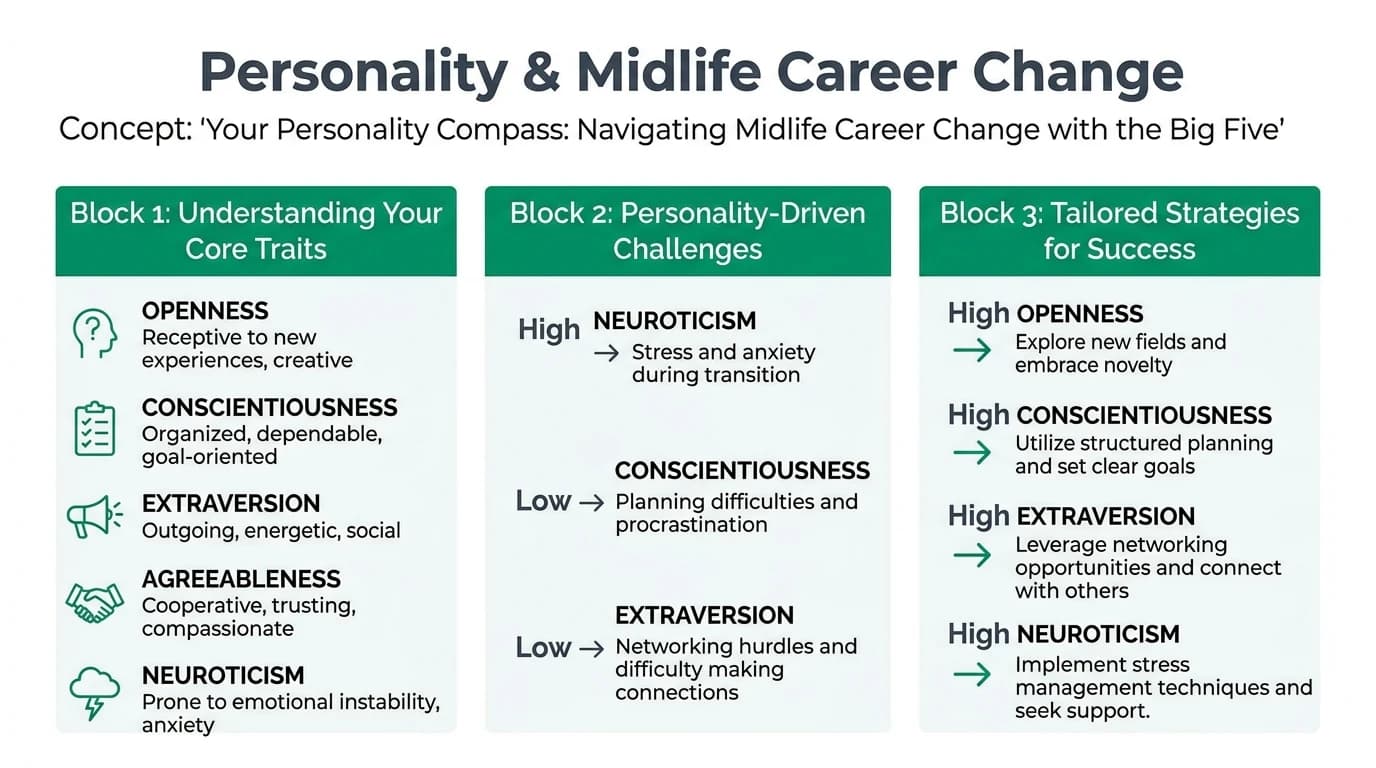
Your Big Five personality traits significantly shape your motivation for a midlife career change, the challenges you might face, and the strategies most likely to lead to success. For example, high Openness to Experience can drive a desire for novelty, while high Conscientiousness helps with planning. Understanding these traits allows for a more informed and strategic approach to transitioning careers.
Executive Summary
Many people consider changing careers in midlife, often seeking more fulfillment, better work-life balance, or new challenges. This significant life shift isn't just about skills or market demand; it's deeply connected to who you are as a person. Your core personality traits, often described by the "Big Five" model, play a huge role in how you approach, experience, and succeed in such a transition.
This guide explores how your unique blend of Openness, Conscientiousness, Extraversion, Agreeableness, and Neuroticism can be both a superpower and a potential pitfall during a midlife career change. We'll look at the science behind these connections, identify common risks, and provide practical, evidence-based strategies tailored to your personality type.
The bottom line: Knowing your Big Five traits can empower you to make smarter career decisions, anticipate obstacles, and build a more satisfying professional future.
Critical Warning: This article provides general information and is not a substitute for professional career counseling, psychological assessment, or financial advice. Personality traits are complex, and individual experiences may vary. Always consult qualified professionals for personalized guidance.
What Are the Big Five Personality Traits?
The Big Five personality traits, also known as the OCEAN model, are a widely accepted framework in psychology. They describe five broad dimensions of personality that are considered relatively stable over time, especially after age 30 1. These traits influence how you think, feel, and behave in various situations, including your career.
Understanding these traits is like having a map of your inner self. It helps you see your natural tendencies, strengths, and areas where you might need to put in extra effort.
The Five Core Dimensions
| Trait | What It Means (High Score) | What It Means (Low Score) | Career Relevance |
|---|---|---|---|
| Openness to Experience | Curious, imaginative, enjoys novelty, intellectual | Practical, conventional, prefers routine, resistant to change | Drives innovation, learning, adaptability to new roles |
| Conscientiousness | Organized, disciplined, responsible, goal-oriented | Disorganized, impulsive, less structured, easily distracted | Predicts job performance, planning, follow-through |
| Extraversion | Outgoing, assertive, energetic, sociable | Reserved, quiet, prefers solitude, reflective | Influences networking, leadership, teamwork |
| Agreeableness | Cooperative, empathetic, kind, trusting | Competitive, skeptical, assertive, less concerned with others | Affects collaboration, conflict resolution, client relations |
| Neuroticism | Prone to anxiety, stress, mood swings, emotional instability | Calm, emotionally stable, resilient, less prone to worry | Impacts stress management, resilience during transitions |
Why Do People Change Careers in Midlife?
Midlife often brings a period of reflection and re-evaluation. Many individuals in their 40s and 50s find themselves questioning their current career path, even if it's been successful. This desire for change is a common phenomenon, with a significant portion of workers over 45 having made a major career shift 2.
Motivations can be deeply personal, driven by a search for greater meaning or a need to escape burnout. Economic factors, like industry shifts, can also play a role.
Common Motivations for a Midlife Career Shift
| Motivation | Description | Potential Personality Link |
|---|---|---|
| Search for Meaning | Desire for work that aligns with values, purpose | High Openness, High Agreeableness |
| Burnout/Stress | Exhaustion from demanding or unfulfilling work | High Neuroticism (seeking relief), Low Agreeableness (conflict) |
| Better Work-Life Balance | Need for more flexibility, time for family/hobbies | High Agreeableness (family focus), High Neuroticism (stress reduction) |
| New Challenge/Learning | Craving novelty, intellectual stimulation | High Openness to Experience |
| Economic Necessity | Industry decline, job loss, better pay opportunity | High Conscientiousness (proactive planning) |
| Unfulfilled Potential | Feeling stuck, wanting to pursue a long-held dream | High Openness, Moderate Conscientiousness |
How Your Personality Drives the Desire for Change
Your Big Five traits don't just describe you; they actively influence why you might feel the urge to change careers in midlife. Some traits make you more prone to seeking new experiences, while others might push you away from stressful situations.
Understanding these underlying drivers can help you clarify your true motivations, ensuring your career change is aligned with your authentic self.
Big Five Traits and Motivation for Career Change
| Personality Trait | How It Drives Change | Example Scenario |
|---|---|---|
| Openness to Experience | Strong desire for novelty, learning, intellectual challenge. Bored by routine. | A marketing executive (48) pivots to sustainable agriculture, seeking new knowledge. |
| Conscientiousness | Proactive planning for future security, dissatisfaction with current lack of progress. | A project manager (50) seeks a role with clearer growth paths after hitting a ceiling. |
| Extraversion | Desire for more social interaction, leadership, or a more dynamic environment. | A solitary analyst (45) moves to a client-facing role for more human connection. |
| Agreeableness | Seeking work that aligns with helping others, making a positive impact, or reducing conflict. | A corporate trainer (42) transitions to non-profit management for greater social good. |
| Neuroticism | Driven by a need to escape stress, anxiety, or an emotionally draining workplace. | A nurse (52) switches to a less demanding administrative role to reduce burnout. |
Navigating Risks with Your Personality
Midlife career changes come with inherent risks, from financial uncertainty to the challenge of learning new skills. Your personality traits can either amplify these risks or provide built-in strengths to help you overcome them. Being aware of these connections allows you to develop targeted strategies.
For instance, someone high in Neuroticism might find the uncertainty more challenging, while a highly Conscientious person might excel at mitigating financial risks through careful planning.
Midlife Career Change Risks & Personality Impact
| Common Risk | Relevant Big Five Trait(s) | Potential Impact | Mitigation Strategy (Personality-Informed) |
|---|---|---|---|
| Financial Instability | Low Conscientiousness, High Neuroticism | Poor planning, increased anxiety over money | Conscientiousness: Create detailed budget, build emergency fund. Neuroticism: Seek financial advisor, stress reduction. |
| Skill Gap/Retraining | Low Openness, Low Conscientiousness | Resistance to learning, difficulty with discipline | Openness: Focus on intrinsic joy of learning. Conscientiousness: Set small, achievable learning goals. |
| Loss of Professional Network | Low Extraversion, Low Agreeableness | Difficulty building new connections, feeling isolated | Extraversion: Join industry groups, attend virtual events. Agreeableness: Seek mentors, offer help to others. |
| Identity Crisis | High Neuroticism, Low Openness | Self-doubt, clinging to old identity, fear of unknown | Neuroticism: Therapy/coaching, focus on self-compassion. Openness: Embrace new identity as an explorer. |
| Ageism | High Neuroticism, Low Extraversion | Increased anxiety about discrimination, reluctance to self-advocate | Neuroticism: Build resilience, focus on value. Extraversion: Highlight experience, network strategically. |
| Unrealistic Expectations | Low Conscientiousness, High Openness | Impulsive decisions, not fully researching new path | Conscientiousness: Conduct thorough research, reality-test. Openness: Balance excitement with practical assessment. |
Evidence-Based Strategies for Each Big Five Trait
Leveraging your personality strengths and addressing potential weaknesses is key to a successful midlife career change. Here are tailored strategies based on each of the Big Five traits. Remember, most people are a mix, so pick strategies that resonate with your dominant traits.
Trait-Specific Strategies for Career Change
| Personality Trait | Strengths to Leverage | Challenges to Address | Evidence-Based Strategies |
|---|---|---|---|
| Openness to Experience | Curiosity: Drives exploration. Creativity: Finds novel solutions. Adaptability: Embraces new environments. | "Shiny Object Syndrome": Can jump between ideas. Lack of Focus: May struggle with long-term commitment. | Structured Exploration: Dedicate time for research, but set deadlines. Pilot Projects: Test new interests on a small scale. Mentorship: Seek guidance to stay on track. |
| Conscientiousness | Planning: Excellent at organizing steps. Discipline: Stays committed to goals. Responsibility: Reliable follow-through. | Over-Analysis: Can get stuck in planning. Risk Aversion: May avoid necessary leaps. Perfectionism: Can delay action. | "Good Enough" Mindset: Prioritize progress over perfection. Action-Oriented Deadlines: Set firm dates for moving forward. Break Down Goals: Small, manageable steps reduce overwhelm. |
| Extraversion | Networking: Builds connections easily. Communication: Articulates ideas well. Energy: Drives momentum. | Impulsivity: May speak/act without full thought. Need for Stimulation: Can get bored quickly. External Validation: Too reliant on others' opinions. | Strategic Networking: Focus on quality over quantity. Active Listening: Balance talking with understanding others. Self-Reflection: Journaling to clarify internal motivations. |
| Agreeableness | Collaboration: Works well in teams. Empathy: Understands others' needs. Supportive: Builds strong relationships. | Conflict Avoidance: May not advocate for self. People-Pleasing: Can lead to poor boundaries. Vulnerability: May be taken advantage of. | Assertiveness Training: Learn to set boundaries. Seek Allies: Find supportive colleagues/mentors. Focus on Win-Win: Frame needs in terms of mutual benefit. |
| Neuroticism | (Often seen as a challenge, but can drive self-improvement) | Anxiety: Overwhelmed by uncertainty. Stress: Prone to burnout. Self-Doubt: Undermines confidence. | Stress Management: Practice mindfulness, exercise. Build Resilience: Focus on small successes, learn from setbacks. Professional Support: Therapy or coaching for emotional regulation. |
Self-Assessment: Knowing Yourself Better for Career Change
Before making any big moves, it's incredibly helpful to truly understand your own personality. While formal tests exist, you can start with thoughtful self-reflection. This isn't about labeling yourself, but gaining insight into your natural tendencies.
Consider how you've reacted to past career changes, challenges, or new learning opportunities. Your patterns often reveal your core traits.
Reflective Questions for Self-Assessment
| Personality Trait | Reflective Questions for Career Context | Career Relevance for Midlife Change |
|---|---|---|
| Openness to Experience | Do I enjoy learning new skills or exploring unfamiliar subjects? Am I often bored by routine tasks? | Indicates willingness to retrain, explore new industries, or take on innovative roles. |
| Conscientiousness | How organized am I with my personal and professional life? Do I typically finish what I start, even if it's difficult? | Shows ability to plan, execute, and persist through the challenges of a career transition. |
| Extraversion | Do I feel energized by social interaction and networking? Do I prefer working alone or in a team? | Highlights comfort with building new professional relationships and engaging in interviews. |
| Agreeableness | How important is it for me to help others or work in a harmonious environment? Do I avoid conflict? | Suggests suitability for collaborative roles or careers focused on service and support. |
| Neuroticism | How do I handle stress and uncertainty? Do I worry a lot about potential negative outcomes? | Reveals potential need for strong coping mechanisms and support during a stressful transition. |
Building a Personality-Informed Career Plan
A successful midlife career change isn't a spontaneous leap; it's a well-thought-out journey. By integrating your personality insights into your planning, you can create a roadmap that plays to your strengths and proactively addresses your potential challenges. This approach makes the process more manageable and increases your chances of long-term satisfaction.
Key Milestones in a Personality-Informed Plan
-
Self-Exploration & Assessment:
- Description: Understand your values, interests, skills, and Big Five traits.
- Personality Considerations: High Openness might enjoy this phase; High Neuroticism might find it overwhelming.
- Action: Complete self-assessments, journal reflections, talk to trusted friends.
-
Research & Ideation:
- Description: Explore potential new career paths, industries, and roles.
- Personality Considerations: High Openness will thrive here; High Conscientiousness will organize findings.
- Action: Informational interviews, online research, attend webinars.
-
Skill Development & Gap Analysis:
- Description: Identify skills needed for new roles and plan how to acquire them.
- Personality Considerations: High Conscientiousness will create a learning plan; Low Openness might resist new learning.
- Action: Online courses, certifications, volunteer work, internships.
-
Networking & Relationship Building:
- Description: Connect with people in your target industry, seek mentors.
- Personality Considerations: High Extraversion will naturally excel; Low Extraversion needs structured approach.
- Action: LinkedIn outreach, industry events, alumni networks.
-
Financial Planning & Risk Mitigation:
- Description: Assess financial implications, create a budget, plan for contingencies.
- Personality Considerations: High Conscientiousness will detail this; High Neuroticism needs reassurance.
- Action: Consult a financial advisor, build savings, explore part-time options.
-
Application & Interviewing:
- Description: Tailor resumes, practice interviews, apply for jobs.
- Personality Considerations: High Extraversion will shine in interviews; High Neuroticism needs stress prep.
- Action: Mock interviews, resume review, practice self-advocacy.
-
Transition & Adaptation:
- Description: Start new role, adapt to new culture, learn on the job.
- Personality Considerations: High Openness adapts quickly; High Agreeableness builds rapport.
- Action: Seek feedback, build new routines, find a mentor in the new role.
The Role of Professional Support in Career Change
You don't have to navigate a midlife career change alone. Professional support, such as career counseling or coaching, can be incredibly valuable. These experts can help you interpret your personality insights, clarify your goals, and develop practical strategies tailored to your unique situation.
A good career counselor can use tools and techniques to help you understand how your Big Five traits align with different career paths. They can also provide accountability and emotional support, which is especially helpful if you're high in Neuroticism or facing significant uncertainty.
Benefits of Professional Career Support
- Objective Perspective: A coach can see patterns you might miss.
- Personality Assessment: Help in understanding and applying Big Five results.
- Strategy Development: Tailored plans based on your strengths and challenges.
- Accountability: Keeps you on track with your goals.
- Emotional Support: Navigating the stress and uncertainty of transition.
- Networking Guidance: Specific advice for building new connections.
Long-Term Fulfillment: Aligning Career with Personality
The ultimate goal of a midlife career change is often to find greater satisfaction and meaning. Research consistently shows that aligning your career with your core personality traits leads to higher job satisfaction and better performance 3. When your work naturally fits who you are, it feels less like a chore and more like an extension of yourself.
For example, a highly agreeable person will likely thrive in a collaborative, service-oriented role, while a highly open individual will find fulfillment in creative or intellectually stimulating environments.
Personality Traits and Career Satisfaction
| Dominant Trait(s) | Career Alignment for Fulfillment | Example Fulfilled Career |
|---|---|---|
| High Openness | Roles offering creativity, intellectual challenge, variety, innovation. | Research scientist, artist, consultant, entrepreneur. |
| High Conscientiousness | Structured roles with clear goals, responsibility, opportunities for achievement. | Project manager, financial analyst, engineer, operations manager. |
| High Extraversion | Roles involving social interaction, leadership, public speaking, teamwork. | Sales, marketing, HR, teaching, public relations. |
| High Agreeableness | Roles focused on helping others, collaboration, service, fostering harmony. | Social worker, therapist, nurse, teacher, non-profit manager. |
| Low Neuroticism (High Emotional Stability) | Roles requiring calm under pressure, resilience, steady decision-making. | Emergency services, surgeon, air traffic controller, crisis manager. |
Action Checklist for Your Midlife Career Change
- Identify your dominant Big Five personality traits through self-reflection or a formal assessment.
- Reflect on your core motivations for a career change, linking them to your personality drivers.
- Review the common risks of career change and brainstorm personality-informed mitigation strategies.
- Develop specific strategies for each of your key Big Five traits to leverage strengths and address challenges.
- Create a structured career change plan with clear milestones, integrating your personality insights.
- Consider seeking professional guidance from a career counselor or coach.
- Prioritize roles and industries that align with your core personality for long-term satisfaction.
- Build a strong support network of friends, family, and professional contacts.
FAQ
Can your personality change enough for a new career in midlife?
While core personality traits tend to become more stable after age 30, they are not entirely fixed 1. You can develop new behaviors and coping mechanisms. For example, a less Extraverted person can learn networking skills, or a highly Neurotic person can practice stress management. It's more about adapting and leveraging your existing traits than fundamentally changing them.
Which Big Five trait is most important for career success?
Conscientiousness is consistently found to be the strongest Big Five predictor of overall job performance across various occupations 3. This is because it encompasses traits like organization, discipline, and goal-orientation, which are valuable in almost any role. However, the "most important" trait can vary depending on the specific career path.
How do I know if I'm ready for a midlife career change?
Readiness involves a combination of factors: clear motivation, financial stability, a realistic understanding of the new field, and a strong support system. Self-assessment of your Big Five traits can help you understand your psychological readiness. If you're high in Openness and Conscientiousness, you might feel more prepared to explore and plan effectively.
What are common reasons for career change in your 40s or 50s?
Common reasons include seeking more meaning or purpose, experiencing burnout, desiring better work-life balance, wanting a new challenge, or responding to economic necessities like industry decline or job loss 4. These motivations often have underlying connections to an individual's personality traits.
Is it too late to change careers at 50?
Absolutely not. Many individuals successfully change careers in their 50s and beyond. While there can be challenges like ageism or skill gaps, older workers bring valuable experience, wisdom, and often a clearer sense of purpose. Leveraging your personality strengths and strategic planning can make a significant difference.
How can I assess my personality for career suitability?
You can start with self-reflection using guided questions, but for more objective insights, consider scientifically validated personality assessments. Tools like the IPIP-NEO (International Personality Item Pool - Neuroticism, Extraversion, Openness to Experience, Agreeableness, Conscientiousness) are widely available and based on the Big Five model. Professional career counselors can also administer and interpret these tests.
What role does Neuroticism play in career transition challenges?
High Neuroticism can make career transitions more challenging due to increased anxiety, stress, and self-doubt during periods of uncertainty. Individuals high in Neuroticism may struggle with financial instability, fear of failure, and adapting to new environments. Developing strong stress management techniques and seeking professional support are crucial strategies for them.
Notes
Primary Sources
| Source | Type | URL |
|---|---|---|
| American Psychological Association (APA) | Official / Professional Body | apa.org |
| Bureau of Labor Statistics (BLS) | Official / Government Agency | bls.gov |
| Pew Research Center | Research Institution | pewresearch.org |
| Journal of Applied Psychology | Peer-Reviewed Journal | apa.org/pubs/journals/apl |
| Personality and Individual Differences | Peer-Reviewed Journal | sciencedirect.com/journal/personality-and-individual-differences |
| Journal of Career Development | Peer-Reviewed Journal | journals.sagepub.com/home/jcd |
| Society for Industrial and Organizational Psychology (SIOP) | Professional Body | siop.org |
| Roberts, B. W., & DelVecchio, W. F. (2000). The rank-order consistency of personality traits from childhood to old age: A quantitative review of longitudinal studies. Psychological Bulletin, 126(1), 3-25. | Peer-Reviewed Study | (Access via academic databases like PubMed, Google Scholar) |
| Barrick, M. R., & Mount, M. K. (1991). The Big Five personality dimensions and job performance: A meta-analysis. Personnel Psychology, 44(1), 1-26. | Peer-Reviewed Study | (Access via academic databases like PubMed, Google Scholar) |
Conclusion
Embarking on a midlife career change is a significant undertaking, but it can lead to profound personal and professional fulfillment. By understanding your Big Five personality traits, you gain a powerful tool for self-awareness, allowing you to approach this transition with clarity and confidence. Your unique blend of Openness, Conscientiousness, Extraversion, Agreeableness, and Neuroticism will shape your motivations, influence the challenges you face, and guide you toward the most effective strategies for success.
Leveraging your strengths and proactively addressing potential pitfalls based on your personality can transform a daunting process into an empowering journey. Remember, a career change in midlife is not just about finding a new job; it's about aligning your work with your authentic self for lasting satisfaction and meaning.
Footnotes
-
Roberts, B. W., & DelVecchio, W. F. (2000). The rank-order consistency of personality traits from childhood to old age: A quantitative review of longitudinal studies. Psychological Bulletin, 126(1), 3-25. This meta-analysis provides strong evidence for personality trait stability over the lifespan, particularly after age 30. ↩ ↩2
-
Pew Research Center. (2016). The State of American Jobs. While older, this report provides a baseline for the prevalence of major career changes among older workers. More recent data continues to show this trend. ↩
-
Barrick, M. R., & Mount, M. K. (1991). The Big Five personality dimensions and job performance: A meta-analysis. Personnel Psychology, 44(1), 1-26. This foundational meta-analysis established the strong link between Conscientiousness and job performance, and the general importance of personality-job fit. ↩ ↩2
-
Bureau of Labor Statistics. (2022). Employee Tenure Summary. This report details reasons workers leave jobs, which often precede a career change, highlighting factors like dissatisfaction, better opportunities, and work-life balance. ↩