career
Personality Sales Performance Big Five
Practical guide to understand and apply Personality Sales Performance Big Five.
md
title: "Personality and Sales Performance: Big Five Traits, Persuasion, Quota Achievement, and Client Relationship Research" description: "Explore how the Big Five personality traits influence sales performance, including persuasion, quota achievement, and client relationships." slug: "personality-sales-performance-big-five" category: "career" keywords: ["Big Five personality sales performance", "Personality traits salespeople", "Conscientiousness sales quota", "Extraversion persuasion sales", "Neuroticism sales performance"] author: "Editorial Team" datePublished: "2026-03-23" lastUpdated: "2026-03-23" featured: true images:
- url: "/images/guides/personality-sales-performance-big-five.webp" alt: "A diverse group of sales professionals engaging with clients, illustrating personality traits in action." caption: "Understanding personality traits can enhance sales performance and client relationships." relatedGuides:
- "personality-negotiation-style-big-five"
- "personality-customer-service-excellence-big-five"
- "extraversion-complete-guide-big-five"
Quick answer
Which Big Five traits predict sales performance?
High Conscientiousness, high Extraversion, and low Neuroticism are key predictors of sales success.
Source: Hogrefe & Huber
Executive Summary
Understanding how personality affects sales can transform hiring and training. The Big Five traits—Openness, Conscientiousness, Extraversion, Agreeableness, and Neuroticism—play crucial roles in sales performance.
The bottom line: High Conscientiousness and Extraversion, along with low Neuroticism, are linked to better sales outcomes.
Critical: Overgeneralizing traits can lead to misjudgments in hiring and training. Always consider context and culture.
What Are the Big Five Personality Traits?
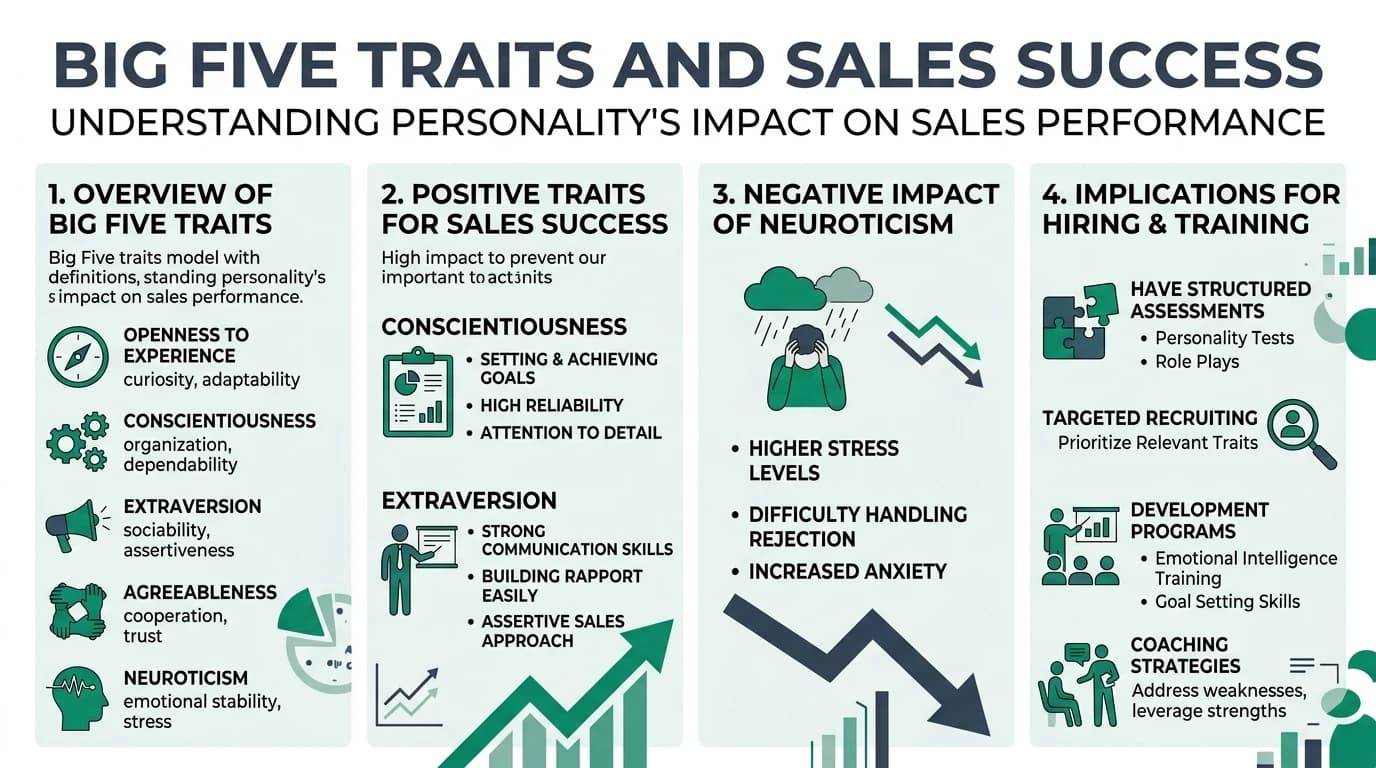
The Big Five personality traits are a widely accepted model for understanding human personality. They include:
- Openness: Creativity and willingness to try new things.
- Conscientiousness: Organization and dependability.
- Extraversion: Sociability and assertiveness.
- Agreeableness: Cooperation and kindness.
- Neuroticism: Emotional stability and resilience.
| Trait | Description |
|---|---|
| Openness | Creativity and curiosity |
| Conscientiousness | Dependability and organization |
| Extraversion | Sociability and assertiveness |
| Agreeableness | Cooperation and kindness |
| Neuroticism | Emotional stability and resilience |
How Do These Traits Affect Sales Performance?
Each trait influences sales performance differently. Here's a quick look:
- Conscientiousness: Strongly linked to achieving sales quotas.
- Extraversion: Helps in persuasion and building client relationships.
- Neuroticism: Lower levels are beneficial for handling stress and client interactions.
| Trait | Positive Impact on Sales |
|---|---|
| Conscientiousness | Quota achievement |
| Extraversion | Persuasion and client relationships |
| Neuroticism | Emotional stability in sales environments |
Conscientiousness and Quota Achievement
Conscientious individuals are often more organized and goal-oriented, making them effective at meeting sales targets.
- Effect: Higher sales productivity.
- Process: Focused goal setting and persistence.
- Caveat: Can lead to burnout if not managed.
Extraversion in Persuasion
Extraverts excel in social situations, which can enhance their persuasive abilities in sales.
- Effect: Better client engagement.
- Process: Natural charisma and energy.
- Caveat: May not always lead to higher performance if over-reliant on charm.
Neuroticism's Negative Impact
Low levels of Neuroticism are advantageous in sales, as they contribute to emotional stability.
- Effect: Better stress management.
- Process: Calm under pressure.
- Caveat: High Neuroticism can hinder performance.
Agreeableness and Client Relationships
While Agreeableness can foster good relationships, it may not always correlate with higher sales performance.
- Effect: Strong client rapport.
- Process: Empathy and cooperation.
- Caveat: May avoid assertive sales tactics.
Openness for Innovation
Openness can drive innovation in sales strategies, particularly in cross-selling and upselling.
- Effect: Creative problem-solving.
- Process: Willingness to explore new approaches.
- Caveat: May struggle with routine tasks.
Narrow Traits vs. Big Five
Beyond the Big Five, narrow traits like Social Boldness can predict specific sales outcomes.
| Trait | Predicts | Correlation Direction |
|---|---|---|
| Social Boldness | Rated performance | Negative |
Cultural Moderation
Cultural factors can moderate the impact of Big Five traits on sales performance.
- Factor: Customer orientation.
- Impact: Varies by culture.
- Caveat: Requires tailored approaches.
Entrepreneurs vs. Managers in Sales
Different roles benefit from different trait profiles. Here's a comparison:
| Role | Neuroticism | Openness | Conscientiousness | Extraversion |
|---|---|---|---|---|
| Entrepreneurs | Low | High | High | High |
| Managers | Low | High | High | High |
Hiring Implications
Using personality assessments like the NEO-FFI can aid in selecting the right candidates for sales roles.
- Pros: Identifies key traits for success.
- Cons: Should be combined with skills assessments.
Action checklist
- Assess candidates for Conscientiousness and Extraversion.
- Consider cultural factors in international sales teams.
- Use personality assessments alongside skills tests.
FAQ
Which Big Five trait is most important for sales quota achievement?
How does low Neuroticism improve sales persuasion?
Does Extraversion always predict sales success?
What role does Agreeableness play in client relationships?
How does Conscientiousness affect cross-selling potential?
Can personality traits predict sales in different cultures?
What narrow traits outperform Big Five for specific sales metrics?
Notes
Primary Sources
| Source | Type | URL |
|---|---|---|
| Hogrefe & Huber | Peer-reviewed | Link |
| Taylor & Francis | Peer-reviewed | Link |
| Semantic Scholar | Peer-reviewed | Link |
Conclusion
Personality traits significantly impact sales performance. By understanding and leveraging these traits, sales teams can enhance their effectiveness and client relationships.