relationships
Personality and Sibling Relationships: Big Five Traits, Birth Order Debates, Rivalry, Lifelong Family Ties Research
Explore how personality traits and sibling relationships intertwine with birth order theories, rivalry, and lifelong family ties.
Quick answer
Does birth order affect personality?
Research shows birth order affects specific traits like intellect and non-cognitive skills but not broad personality traits such as extraversion or agreeableness.
Source: PNAS
Executive Summary
Understanding how personality and sibling relationships are shaped by birth order is a fascinating topic. While popular culture often suggests that birth order has a major impact on personality, research tells a more nuanced story.
The bottom line: Birth order influences specific traits like intellect but doesn't broadly affect personality.
Critical: Remember, individual differences are often larger than any birth order effects.
What is Birth Order Theory?
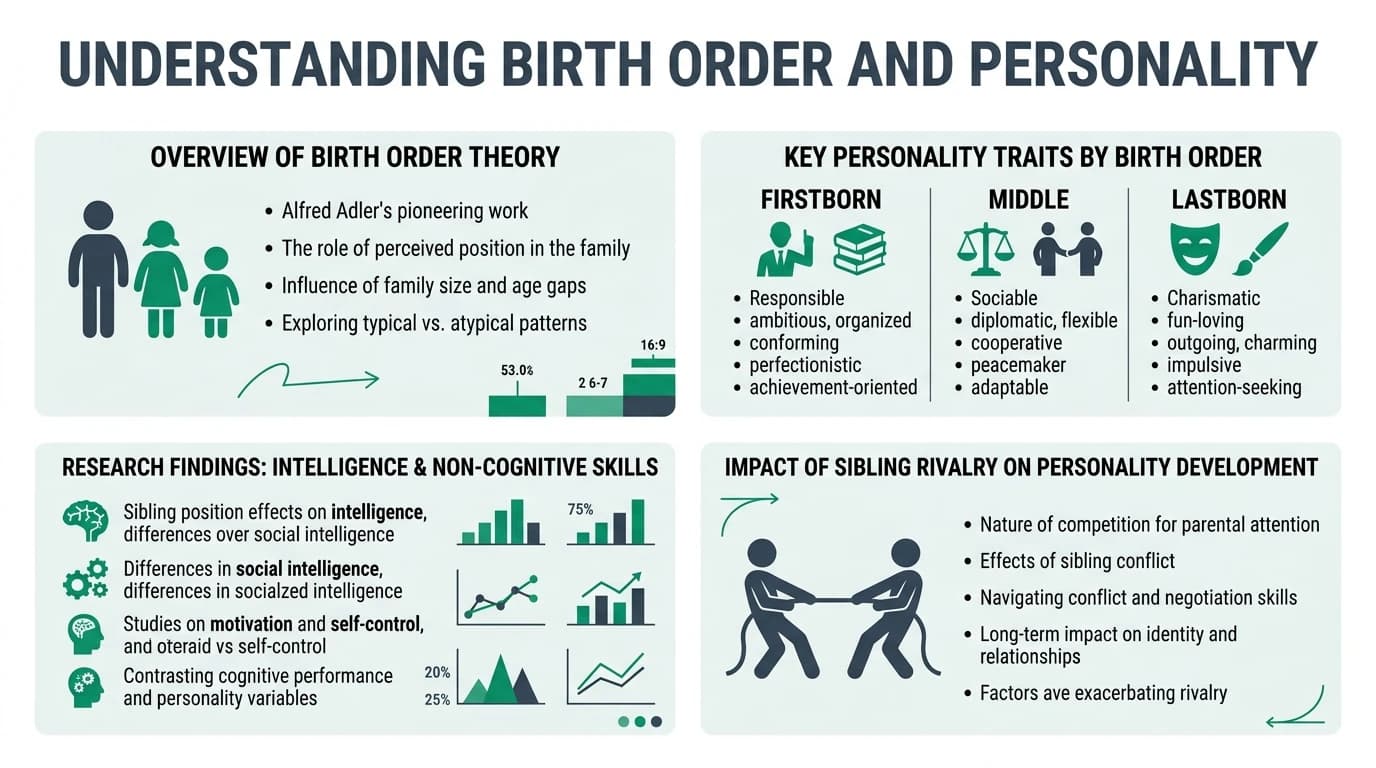
Birth order theory, developed by Alfred Adler, suggests that a person's position among siblings influences their personality. Adler believed that firstborns, middle children, and lastborns develop distinct traits based on their family roles.
Key Points:
- Firstborns: Often seen as leaders.
- Middle Children: Perceived as peacemakers.
- Lastborns: Viewed as free spirits.
Table 1: Adler's Birth Order Traits
| Birth Order | Common Traits |
|---|---|
| Firstborn | Responsible, leader |
| Middle | Diplomatic, flexible |
| Lastborn | Outgoing, creative |
How Does Birth Order Affect Intelligence?
Research shows that birth order can influence cognitive abilities, with firstborns often scoring higher on IQ tests.
Why Firstborns Score Higher:
- Parental Attention: Firstborns often receive more focused attention.
- Teaching Role: They may teach younger siblings, reinforcing their knowledge.
Table 2: Birth Order and Intelligence
| Birth Order | IQ Trend |
|---|---|
| Firstborn | Higher |
| Later-born | Slightly Lower |
Do Personality Traits Vary by Birth Order?
Contrary to popular belief, birth order doesn't significantly affect broad personality traits like extraversion or agreeableness.
Traits Affected:
- Intellect: Higher in firstborns.
- Non-cognitive Skills: Slightly lower in later-borns.
Traits Not Affected:
- Extraversion, Agreeableness: No significant differences found.
Table 3: Supported vs. Unsupported Traits
| Trait Category | Supported | Not Supported |
|---|---|---|
| Cognitive | Intellect | — |
| Non-cognitive | Emotional Stability | — |
| Broad Traits | — | Extraversion |
What About Sibling Rivalry?
Sibling rivalry often links to birth order, with lastborns experiencing more academic rivalry.
Factors Influencing Rivalry:
- Parental Expectations: Can vary by birth order.
- Sibling Dynamics: Older siblings may feel competitive.
Table 4: Sibling Rivalry by Birth Order
| Birth Order | Rivalry Experience |
|---|---|
| Firstborn | Lower |
| Lastborn | Higher |
How Does Psychological Birth Order Differ?
Psychological birth order refers to the role a child perceives they play, which can differ from their actual birth order.
Influences:
- Family Dynamics: Large age gaps or blended families can alter perceived roles.
- Individual Perception: Personal experiences shape psychological birth order.
Table 5: Psychological vs. Chronological Birth Order
| Context | Effect on Perception |
|---|---|
| Large Age Gap | Functions as firstborn |
| Blended Family | Varies significantly |
Does Gender Influence Birth Order Effects?
Gender can modify how birth order impacts personality, with boys experiencing different effects than girls.
Gender-Specific Findings:
- Boys with Older Brothers: More non-cognitive impact.
- Girls: Effects less pronounced.
Table 6: Gender and Birth Order Effects
| Gender | Effect |
|---|---|
| Boys | More non-cognitive impact |
| Girls | Less pronounced impact |
Are There Career Implications?
Birth order can influence career paths, with firstborns often pursuing leadership roles.
Career Trends:
- Firstborns: More likely to become managers.
- Later-borns: Tend toward self-employment.
Table 7: Career Outcomes by Birth Order
| Career Path | Firstborn | Later-born |
|---|---|---|
| Leadership Roles | More likely | — |
| Self-Employment | — | More likely |
How Reliable is Birth Order Research?
Research on birth order is mixed, with some studies showing effects and others not.
Methodological Considerations:
- Sample Size: Larger studies tend to show more reliable results.
- Design: Within-family designs provide clearer insights.
Table 8: Research Methodology Overview
| Study Type | Reliability |
|---|---|
| Large Sample | High |
| Small Sample | Moderate |
Action checklist
- Consider family dynamics when evaluating birth order effects.
- Focus on specific traits like intellect, not broad personality.
- Use birth order insights for self-understanding, not rigid predictions.
FAQ
Does birth order affect personality?
What traits do firstborns typically have?
Are middle children really the 'forgotten' ones?
How does birth order affect sibling rivalry?
Can psychological birth order differ from actual birth order?
Does birth order influence career choices?
What did Alfred Adler say about birth order?
Notes
Primary Sources
| Source | Type | URL |
|---|---|---|
| PNAS | Peer-reviewed journal | Link |
| NBER | Research institute | Link |
Conclusion
Birth order offers intriguing insights into personality and sibling dynamics, but its effects are more specific than broad. Understanding these nuances can help in personal development and family relationships.