career
Personality Workplace Bullying Big Five
Practical guide to understand and apply Personality Workplace Bullying Big Five.
md
title: "Personality and Workplace Bullying: Big Five Traits, Mobbing Targets and Perpetrators, Reporting Behavior, and Recovery Research" description: "Explore how personality traits influence workplace bullying, identify mobbing targets and perpetrators, understand reporting behavior, and discover recovery strategies." slug: "personality-workplace-bullying-big-five" category: "career" keywords: ["workplace bullying", "Big Five personality", "mobbing at work", "bullying perpetrators traits", "workplace bullying targets"] author: "Editorial Team" datePublished: "2026-03-25" lastUpdated: "2026-03-25" featured: true images:
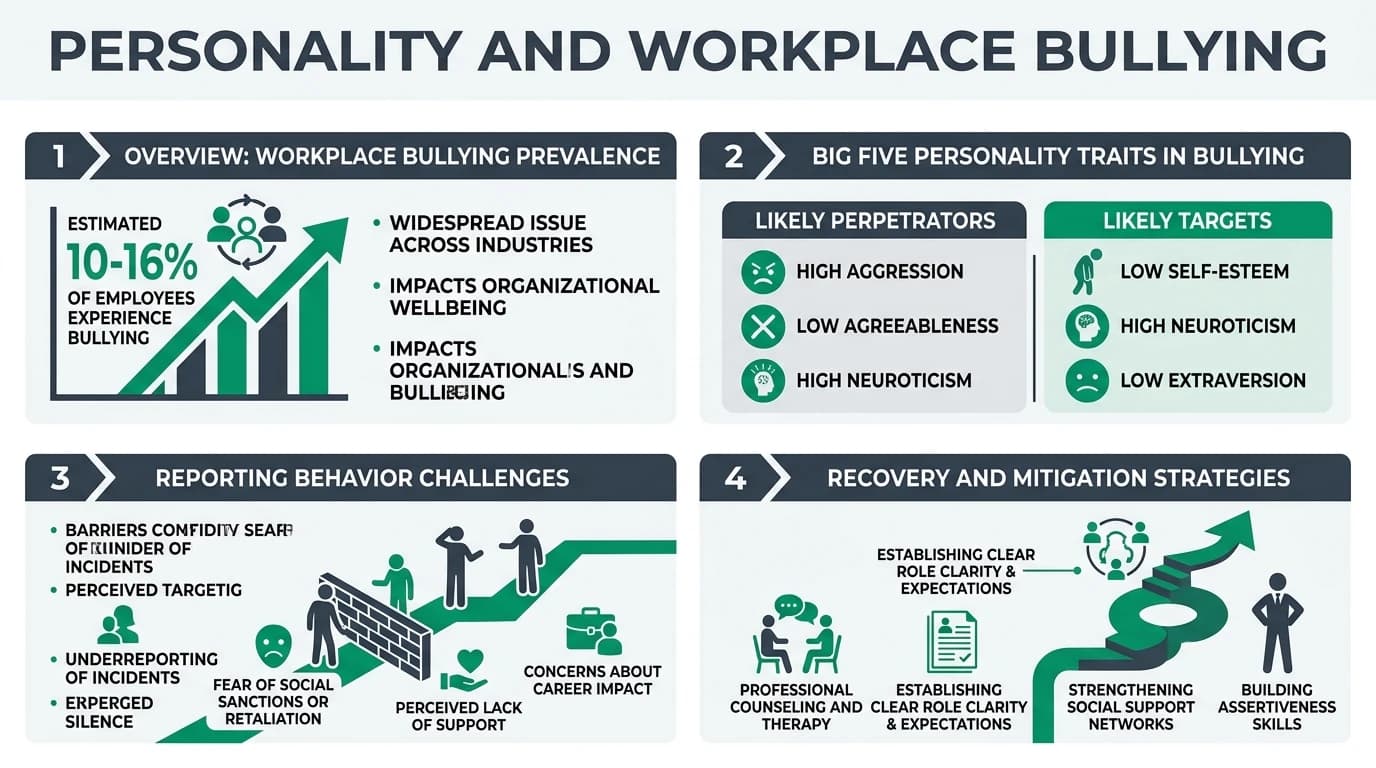
- url: "/images/guides/personality-workplace-bullying-big-five.webp" alt: "An illustration showing various personality traits affecting workplace dynamics, including bullying scenarios." caption: "Understanding personality traits can help prevent workplace bullying and improve recovery strategies." relatedGuides:
- "personality-conflict-resolution-workplace"
- "personality-assertiveness-big-five"
- "personality-burnout-prevention-big-five"
Quick answer
How does personality affect workplace bullying?
Personality traits like high aggression and low agreeableness in perpetrators, and low self-esteem and high neuroticism in targets, strongly influence workplace bullying dynamics.
Source: SIOP White Paper
Executive Summary
Workplace bullying is a significant issue affecting many employees. It's closely linked to personality traits, especially those in the Big Five model. Understanding these traits can help identify both perpetrators and targets, and guide effective reporting and recovery strategies.
The bottom line: Workplace bullying is complex, with personality playing a key role. Recognizing these traits can help prevent and address bullying effectively.
Critical Warning: Workplace bullying can have severe psychological and professional impacts. It's crucial to address it promptly and seek professional guidance when needed.
What is Workplace Bullying?
Workplace bullying involves repeated, harmful actions by one or more employees towards another. It can manifest as verbal abuse, exclusion, or undermining someone's work.
- Prevalence: Affects about 10-16% of employees.
- Forms: Includes mobbing, where a group targets an individual.
| Aspect | Description |
|---|---|
| Types | Verbal, physical, social |
| Impact | Psychological, professional |
| Prevention | Awareness, policies |
What are the Big Five Personality Traits?
The Big Five personality traits are a widely recognized model for understanding human behavior. They include:
- Openness: Creativity and open-mindedness.
- Conscientiousness: Organization and dependability.
- Extraversion: Sociability and assertiveness.
- Agreeableness: Cooperation and kindness.
- Neuroticism: Emotional instability and anxiety.
| Trait | Description |
|---|---|
| Openness | Creativity, curiosity |
| Conscientiousness | Organization, reliability |
| Extraversion | Sociability, assertiveness |
| Agreeableness | Kindness, cooperation |
| Neuroticism | Emotional instability, anxiety |
How Do Personality Traits Influence Bullying?
Certain personality traits are more common in both perpetrators and targets of workplace bullying.
- Perpetrators: High aggression, low agreeableness, high neuroticism.
- Targets: Low self-esteem, high neuroticism, low social competency.
| Aspect | Perpetrators | Targets |
|---|---|---|
| Traits | High aggression, low agreeableness | Low self-esteem, high neuroticism |
| Stress | High role stress | High role stress |
Who Becomes a Target or Perpetrator?
Understanding who is likely to become a target or perpetrator can help in prevention and intervention.
- Targets: Often have low self-esteem and high neuroticism.
- Perpetrators: Tend to have high aggression and low agreeableness.
| Group | Traits |
|---|---|
| Targets | Low self-esteem, high neuroticism |
| Perpetrators | High aggression, low agreeableness |
What is Mobbing?
Mobbing is a form of workplace bullying where a group targets an individual. It often involves power imbalances and can be particularly damaging.
- Dynamics: Group behavior, power imbalance.
- Impact: Severe psychological effects.
| Aspect | Description |
|---|---|
| Dynamics | Group targeting, power imbalance |
| Impact | Psychological, professional damage |
How Does Reporting Behavior Affect Outcomes?
Many employees hesitate to report bullying due to fear of retaliation or social sanctions.
- Barriers: Fear of retaliation, lack of support.
- Encouragement: Clear policies, supportive environment.
| Factor | Impact |
|---|---|
| Fear | Reduces reporting likelihood |
| Support | Encourages reporting |
What Are the Recovery Strategies?
Recovery from workplace bullying involves both personal and organizational efforts.
- Personal: Counseling, stress management.
- Organizational: Policy changes, support systems.
| Strategy | Outcome |
|---|---|
| Counseling | Improved self-esteem |
| Policy Changes | Reduced bullying incidents |
Action checklist
- Recognize signs of bullying early.
- Encourage open communication and reporting.
- Implement supportive policies and training.
FAQ
What Big Five traits predict workplace bullying?
Why do bullying perpetrators become targets?
How does low self-esteem relate to bullying victims?
What role does power imbalance play in mobbing?
Are aggressive people more likely to bully at work?
How common is role stress in bullying targets?
Do bullies report higher aggression levels?
Notes
Primary Sources
| Source | Type | URL |
|---|---|---|
| PubMed/Violence Vict. | Peer-reviewed | https://pubmed.ncbi.nlm.nih.gov/18225386/ |
| Sage Journals | Peer-reviewed | https://journals.sagepub.com/doi/10.1177/10596011221143263 |
Conclusion
Understanding the role of personality in workplace bullying is crucial for prevention and recovery. By recognizing key traits and dynamics, organizations can create healthier work environments.