personality-tests
The 16 Personality Types Explained: MBTI Complete Guide
Discover what each MBTI type means in plain language, including strengths, blind spots, and how it connects to the Big Five. Perfect for those who just took the test and want clear answers.
Quick answer
What are the 16 MBTI personality types?
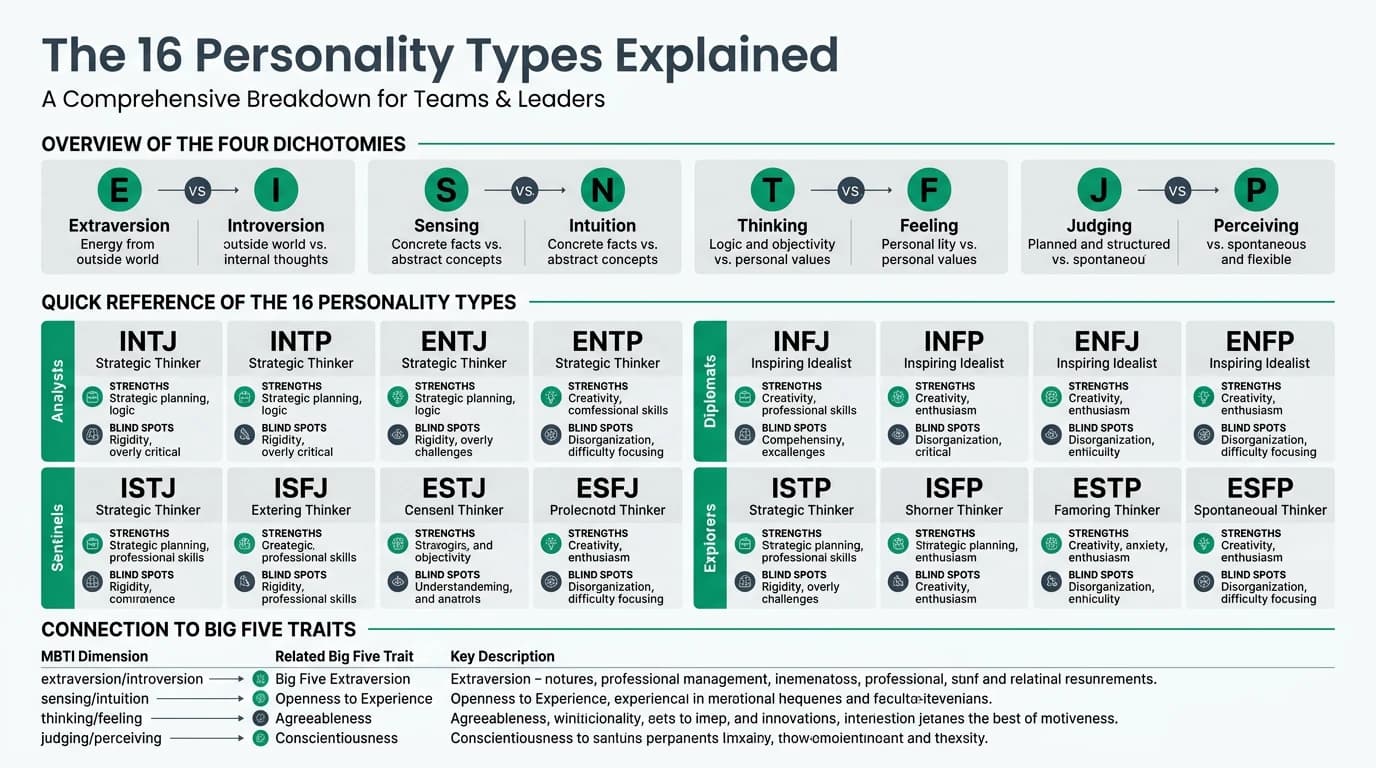
The 16 MBTI types are: ISTJ, ISFJ, INFJ, INTJ, ISTP, ISFP, INFP, INTP, ESTP, ESFP, ENFP, ENTP, ESTJ, ESFJ, ENFJ, ENTJ.
Source: Myers & Briggs Foundation
Executive Summary
The Myers-Briggs Type Indicator (MBTI) categorizes personalities into 16 distinct types based on four dichotomies: Extraversion/Introversion, Sensing/Intuition, Thinking/Feeling, and Judging/Perceiving. Each type has unique strengths and blind spots, offering insights into personal and professional life.
The bottom line: MBTI is a tool for understanding preferences, not a scientific predictor. For accurate results, consider professional guidance.
Critical: MBTI is not a diagnostic tool. It's best used for self-awareness and personal growth.
What is MBTI?
The MBTI is a personality assessment that identifies preferences in how people perceive the world and make decisions. It is based on Carl Jung's theory of psychological types.
Key Components
- Extraversion (E) vs. Introversion (I): Where you focus your attention.
- Sensing (S) vs. Intuition (N): How you take in information.
- Thinking (T) vs. Feeling (F): How you make decisions.
- Judging (J) vs. Perceiving (P): How you deal with the outside world.
| Dichotomy | Pole 1 | Description | Pole 2 | Description |
|---|---|---|---|---|
| Extraversion | E | Draws energy from others | I | Draws energy from solitude |
| Sensing | S | Focuses on present facts | N | Focuses on future possibilities |
| Thinking | T | Decisions based on logic | F | Decisions based on values |
| Judging | J | Prefers structure | P | Prefers flexibility |
The 16 Personality Types
Here's a quick overview of the 16 types, their strengths, and blind spots.
| Type | Nickname | Strengths | Blind Spots |
|---|---|---|---|
| ISTJ | Logistician | Practical, reliable | May be inflexible |
| ISFJ | Defender | Loyal, nurturing | May avoid confrontation |
| INFJ | Advocate | Insightful, principled | Can be overly idealistic |
| INTJ | Architect | Strategic, independent | May overlook emotions |
| ISTP | Virtuoso | Analytical, adaptable | Can be insensitive |
| ISFP | Adventurer | Artistic, flexible | May be unpredictable |
| INFP | Mediator | Empathetic, idealistic | Can be overly sensitive |
| INTP | Thinker | Innovative, logical | May be socially detached |
| ESTP | Entrepreneur | Energetic, perceptive | May take unnecessary risks |
| ESFP | Entertainer | Enthusiastic, sociable | Can be unfocused |
| ENFP | Campaigner | Creative, outgoing | May struggle with routine |
| ENTP | Debater | Charismatic, energetic | Can be argumentative |
| ESTJ | Executive | Organized, efficient | May be inflexible |
| ESFJ | Consul | Caring, sociable | Can be overly concerned |
| ENFJ | Protagonist | Inspiring, supportive | May neglect self-care |
| ENTJ | Commander | Bold, strategic | Can be domineering |
How Does MBTI Connect to the Big Five?
The Big Five personality traits—Openness, Conscientiousness, Extraversion, Agreeableness, and Neuroticism—offer a scientifically validated framework. Here's how MBTI aligns:
| MBTI Dichotomy | Big Five Trait | Correlation Notes |
|---|---|---|
| E/I | Extraversion | Directly maps to Extraversion |
| S/N | Openness | N correlates with higher Openness |
| T/F | Agreeableness | F aligns with higher Agreeableness |
| J/P | Conscientiousness | J correlates with higher Conscientiousness |
Important: MBTI focuses on preferences, while the Big Five measures traits on a spectrum.
INFJ Deep Dive
INFJs are known for their empathy and vision. They often pursue meaningful goals and can inspire others.
- Strengths: Deep understanding of others, strong principles.
- Blind Spots: Over-idealism, potential burnout from over-helping.
| Aspect | INFJ Strengths | INFJ Blind Spots |
|---|---|---|
| Empathy | Deeply understands others | May overextend themselves |
| Vision | Sees the bigger picture | Can become overwhelmed |
INTJ Profile
INTJs are strategic thinkers with a knack for planning and organization. They thrive in environments that value logic and efficiency.
- Strengths: Innovative, strategic planning.
- Weaknesses: Can be insensitive to emotions.
| Aspect | INTJ Strengths | INTJ Weaknesses |
|---|---|---|
| Strategy | Excellent planners | May overlook emotions |
| Independence | Self-reliant | Can be dismissive of others' input |
ENFP Breakdown
ENFPs are imaginative and enthusiastic, often bringing creativity to their endeavors. However, they may struggle with routine tasks.
- Strengths: Creative, adaptable.
- Pitfalls: Disorganization, difficulty with routine.
| Aspect | ENFP Strengths | ENFP Pitfalls |
|---|---|---|
| Creativity | Brings new ideas | May lack follow-through |
| Adaptability | Thrives on change | Can be easily distracted |
Practical Applications of MBTI
Understanding your MBTI type can guide career choices, improve relationships, and aid in personal development.
Career Guidance
- ISTJ: Suited for roles requiring attention to detail.
- ENFP: Thrives in creative and dynamic environments.
| Type | Ideal Careers | Careers to Avoid |
|---|---|---|
| ISTJ | Accounting, Engineering | Unstructured roles |
| ENFP | Marketing, Counseling | Rigid, routine tasks |
Taking the MBTI Test
For the most accurate results, consider taking the official MBTI test through a certified practitioner. This ensures a comprehensive understanding of your results.
Important: Free online tests may not provide the same accuracy or depth as the official MBTI assessment.
Action checklist
- Identify your MBTI type using a certified test.
- Explore your strengths and blind spots.
- Consider professional guidance for deeper insights.
FAQ
What are the 16 MBTI types in order?
Which MBTI type is the rarest?
Is MBTI scientifically valid?
How accurate is the MBTI test?
Can your MBTI type change?
How does MBTI relate to Big Five?
What MBTI type is most common?
Notes
Primary Sources
| Source | Type | URL |
|---|---|---|
| The Myers-Briggs Company | Official | MBTI Personality Types |
| Myers & Briggs Foundation | Official | The 16 MBTI Personality Types |
| NCBI/NIH (StatPearls) | Peer-reviewed | MBTI Overview |
Conclusion
Understanding the 16 MBTI personality types can offer valuable insights into your preferences and behaviors. Whether you're exploring career paths or improving personal relationships, knowing your type can be a helpful guide.