comparisons
MBTI vs Big Five: Which Framework Should You Use?
A practical comparison of MBTI and Big Five to choose the right framework for coaching, communication, hiring, and structured talent decisions.
Quick answer
Should you choose MBTI or Big Five?
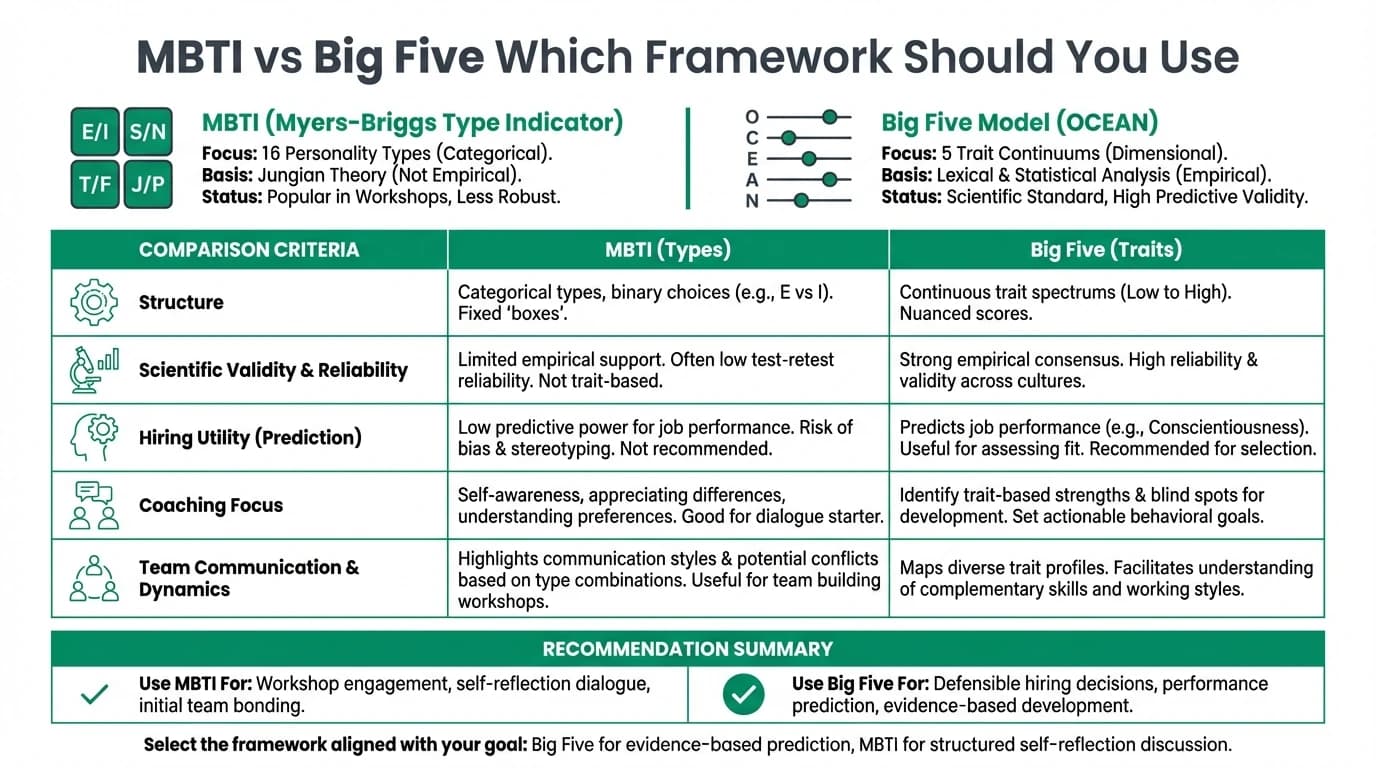
For structured decisions with real stakes, Big Five is usually the stronger baseline. MBTI can still be useful as a shared communication language in workshops and team reflection.
Source: APA Dictionary of Psychology
Quick Comparison
| Criterion | MBTI | Big Five |
|---|---|---|
| Model style | Typological (16 types) | Dimensional (5 continua) |
| Ease of communication | Very high | Medium |
| Psychometric support | Debated | Strong |
| Best fit | Team language and reflection | Assessment and decision support |
MBTI is often easier to explain and remember. Big Five is generally stronger when you need defensible, evidence-aligned interpretation.
When MBTI is useful
- Team-building workshops
- Communication preference discussions
- Shared vocabulary in coaching sessions
MBTI is most helpful when used as a conversation framework, not as a high-stakes decision engine.
When Big Five is a better fit
- Structured hiring discussions
- Leadership and role-fit coaching
- Talent mobility hypotheses
- Research-backed assessment contexts
For full score interpretation rules, read Big Five Personality Test: Complete Interpretation Guide.