personality-tests
Big Five Personality Test: Complete Interpretation Guide
Learn how to interpret Big Five scores correctly using OCEAN dimensions, percentile ranges, practical use cases, and key methodological limits.
Quick answer
How should you interpret a Big Five score?
Treat each score as a tendency, not a label. Interpret dimensions on a continuum, compare against a relevant norm group, and always contextualize results with role requirements and real behavior.
Source: APA Dictionary of Psychology
Executive Summary
The Big Five model (also called OCEAN or FFM) is one of the most evidence-backed frameworks for describing personality traits 1. Its main strength is dimensional measurement: people are described by degree, not by rigid type.
In practice, many mistakes come from binary interpretation. A high Neuroticism score does not mean "unfit," and low Extraversion does not mean "poor leadership potential." Trait scores are context-sensitive tendencies, not fixed outcomes.
Key takeaway: use Big Five as a structured decision aid, not as an automated filter.
Important: personality tests should support decisions, not replace interviews, work samples, or professional judgment.
1) What the Big Five actually measures
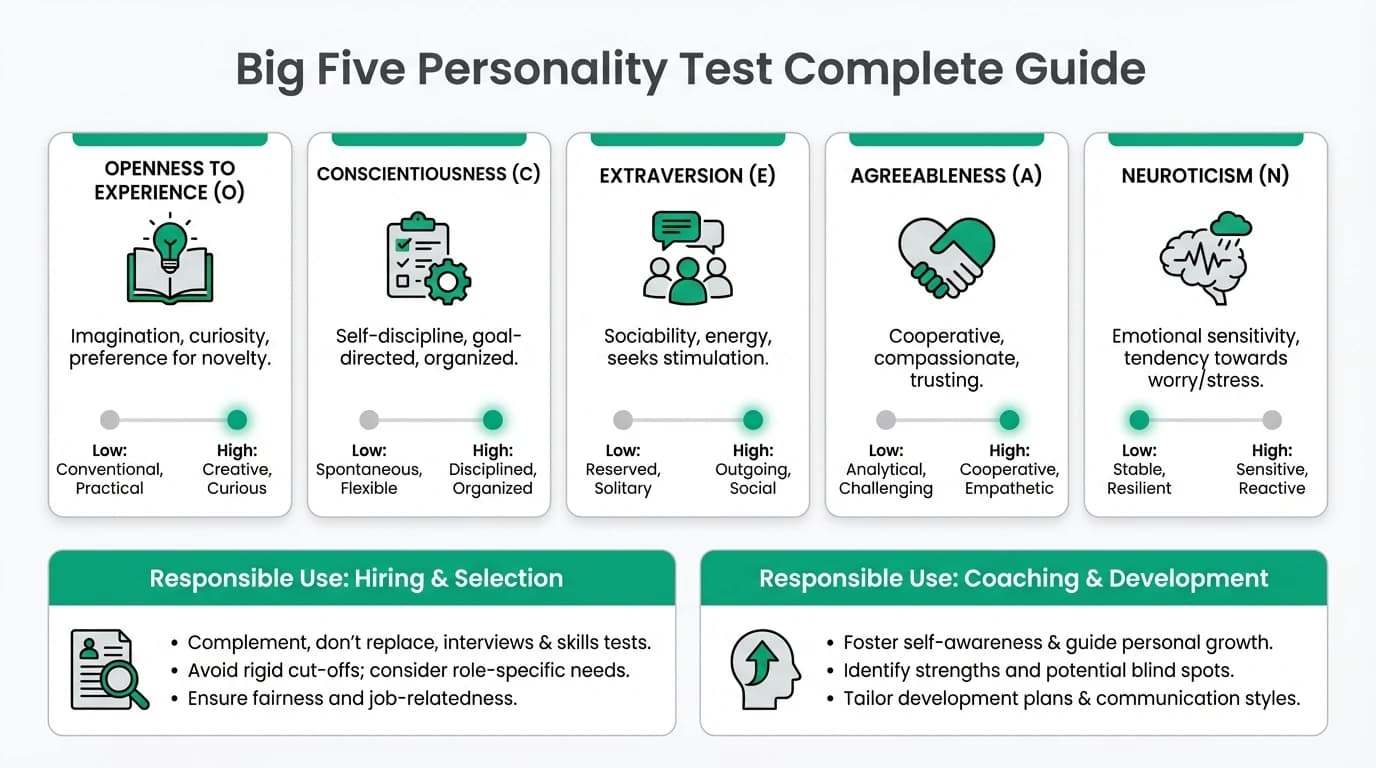
The five dimensions are:
- Openness: curiosity, imagination, novelty preference.
- Conscientiousness: discipline, planning, reliability.
- Extraversion: social energy, assertiveness, stimulation-seeking.
- Agreeableness: cooperation, empathy, interpersonal style.
- Neuroticism: emotional reactivity and stress sensitivity.
Each trait sits on a continuum, which is why Big Five is often more actionable than typological systems. If you are comparing frameworks, start with MBTI vs Big Five.
2) Test formats, length, and precision
Longer instruments usually improve reliability, but increase respondent fatigue and time cost.
| Format | Typical items | Time | Best use case |
|---|---|---|---|
| Ultra-short | 10-20 | 3-6 min | Awareness and content funnels |
| Short | 30-60 | 8-12 min | Light screening and reflection |
| Standard | 80-120 | 15-25 min | HR, coaching, structured feedback |
| Long-form | 150+ | 30+ min | Research and deep profiling |
Before operational use, verify psychometric documentation (internal consistency, validity evidence, and norm sample quality).
3) Score interpretation without overreach
A score only becomes meaningful when you know:
- the scoring method (percentile, standard score, sten),
- the norm group,
- the decision context.
| Percentile range | Practical reading | Common misuse |
|---|---|---|
| 0-25 | Relatively lower tendency | Framing as a "defect" |
| 26-49 | Lower-mid tendency | Overgeneralizing performance risk |
| 50-74 | Mid-high tendency | Assuming universal fit |
| 75-100 | Relatively higher tendency | Stereotyping behavior |
Always read interactions across traits. For example, high Conscientiousness + low Extraversion may fit independent analytical roles very well.
4) HR and leadership applications
Big Five can improve hiring, onboarding, team communication, and coaching quality when used responsibly.
| Use case | Good use of Big Five | Misuse to avoid |
|---|---|---|
| Hiring | Structure behavioral interviews | Auto-rejecting candidates |
| Onboarding | Personalize ramp-up plans | Predicting performance alone |
| Team leadership | Adapt communication style | Permanent labeling |
| Mobility | Identify fit hypotheses | Ignoring skills evidence |
A robust process combines personality data with interview evidence, competency checks, and role constraints.
For responsible implementation patterns, review Personality Test Reliability.
5) Big Five vs MBTI vs DISC in practice
These tools are not interchangeable.
| Criterion | Big Five | MBTI | DISC |
|---|---|---|---|
| Model type | Dimensional | Typological | Typological |
| Research support | Strong | Debated | Varies by instrument |
| Operational simplicity | Medium | High | High |
| Best fit | Structured assessment | Team communication language | Day-to-day management style |
If your decisions carry medium-to-high impact, Big Five should usually be your baseline model. DISC is often useful for tactical communication alignment; compare directly in DISC personality test guide.
6) Methodological limits you should document
Big Five remains self-report data. It captures declared tendencies, not exhaustive behavior in all environments.
Main constraints:
- social desirability bias,
- instrument quality variance,
- cross-cultural adaptation limits,
- confusion between correlation and causation.
Responsible interpretation checklist
- Verify psychometric evidence before operational use.
- Interpret all five dimensions together, not in isolation.
- Cross-check with real behavioral examples.
- Document assumptions and uncertainty before decisions.
- Do not use trait scores as clinical diagnosis.
FAQ
Is Big Five more reliable than MBTI?
In most research contexts, Big Five has stronger psychometric support and more stable validation across populations. MBTI can still be useful as a communication aid.
Is high Neuroticism always negative?
No. It often signals higher emotional sensitivity, which can be a risk or an advantage depending on role demands, support systems, and stress exposure.
Can I use Big Five alone for hiring?
No. Use it as one input among structured interviews, skills evidence, and work-sample evaluation.
How often should someone retake a Big Five test?
A 12-24 month cadence is usually enough for development use. Traits are relatively stable but can shift with experience and context.
Are free Big Five tests useful?
Some are useful for initial reflection, but check scoring transparency, norm quality, and validation evidence before professional use.
Can Big Five support coaching?
Yes. It works well for habit design, communication awareness, and growth planning when framed as tendencies rather than labels.
Primary Sources
| Source | Type | URL |
|---|---|---|
| APA Dictionary of Psychology - Five-Factor Model | Institutional definition | dictionary.apa.org/five-factor-model |
| McCrae & John (1992) | Foundational scientific paper | doi.org/10.1111/j.1467-6494.1992.tb00970.x |
| Soto & John (2017), BFI-2 | Modern instrument validation | doi.org/10.1037/pspp0000092 |
| IPIP-NEO Keying | Measurement reference | ipip.ori.org/newBigFive5broadKey.htm |
| EFPA Test Review Model | Assessment quality standards | efpa.eu/working-groups/test-review-model |
Conclusion
Big Five is a strong decision-support framework when used probabilistically, contextually, and in combination with behavioral evidence.
Notes
Footnotes
-
In scientific literature, Big Five is often called the Five-Factor Model (FFM). ↩