methodology
Personality Test Reliability: How to Evaluate Quality
Before using any personality test, verify reliability, validity, and norm quality. A practical framework to reduce weak conclusions and decision errors.
Quick answer
How do you know whether a personality test is reliable?
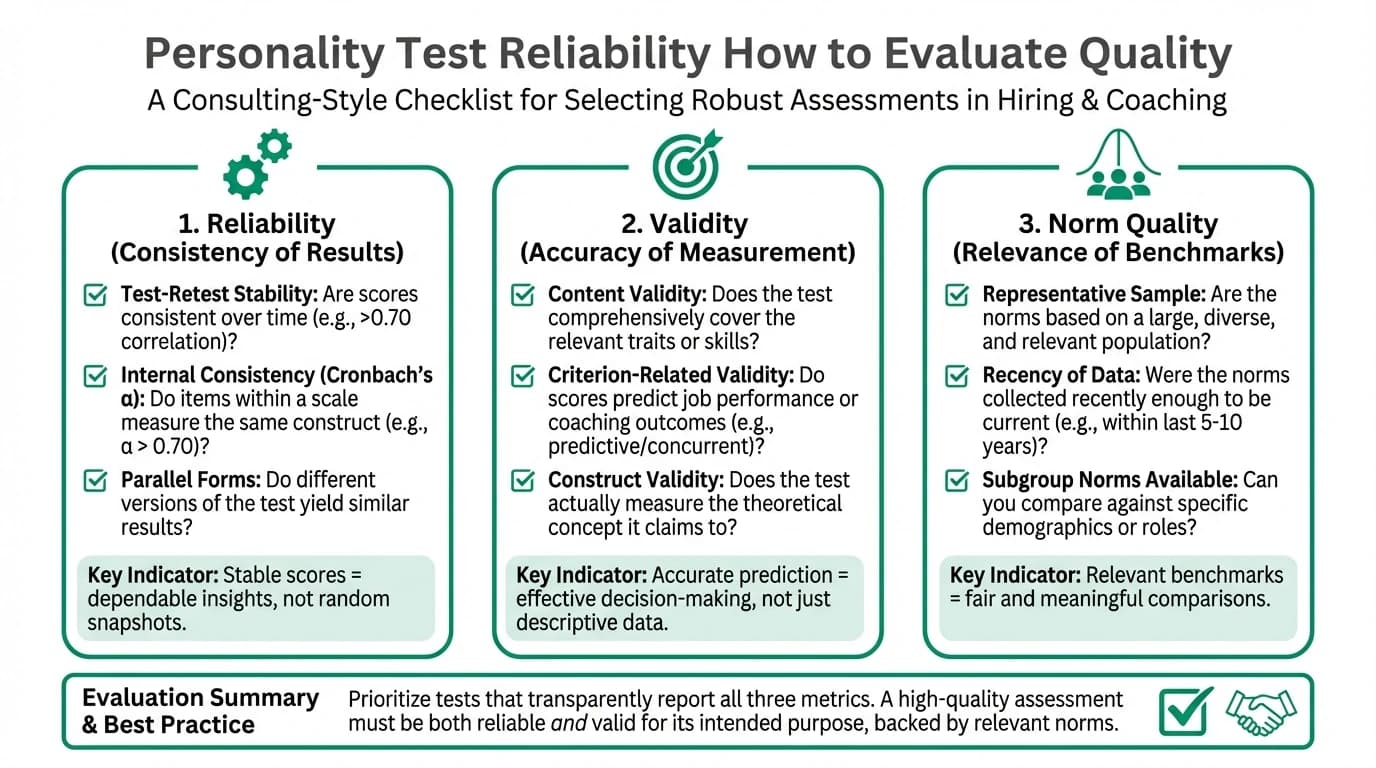
Check three core pillars: reliability, validity, and norm quality. If one pillar is missing, conclusions should be treated as low confidence.
Source: Soto & John (2017)
The 3 Core Validation Checks
| Check | Key question | Warning signal |
|---|---|---|
| Reliability | Are scores consistent and stable enough? | No coefficients reported |
| Validity | Does the test measure what it claims? | Marketing claims without evidence |
| Norm quality | Is the benchmark population transparent and relevant? | No sample description |
Without these three checks, decisions can become arbitrary and hard to defend.
Best practices in hiring and talent workflows
- Use test output as one signal, not a verdict.
- Combine results with structured interviews and work evidence.
- Document limits, assumptions, and uncertainty in decision notes.
Minimum documentation to require from a vendor
- exact instrument name and version,
- reliability and validity evidence,
- norm sample characteristics,
- update date,
- accessible scientific references.
To apply this framework in detail, read Big Five Personality Test: Complete Interpretation Guide.