personality-tests
The Power of Combined Personality and Cognitive Assessments in Hiring
Discover how integrating personality and cognitive assessments can revolutionize your hiring process.
Quick answer
What are the benefits of combining personality and cognitive assessments in hiring?
Combining these assessments predicts job performance more accurately, reduces bad hires, minimizes bias, and streamlines screening.
Source: Predictive Index
Executive Summary
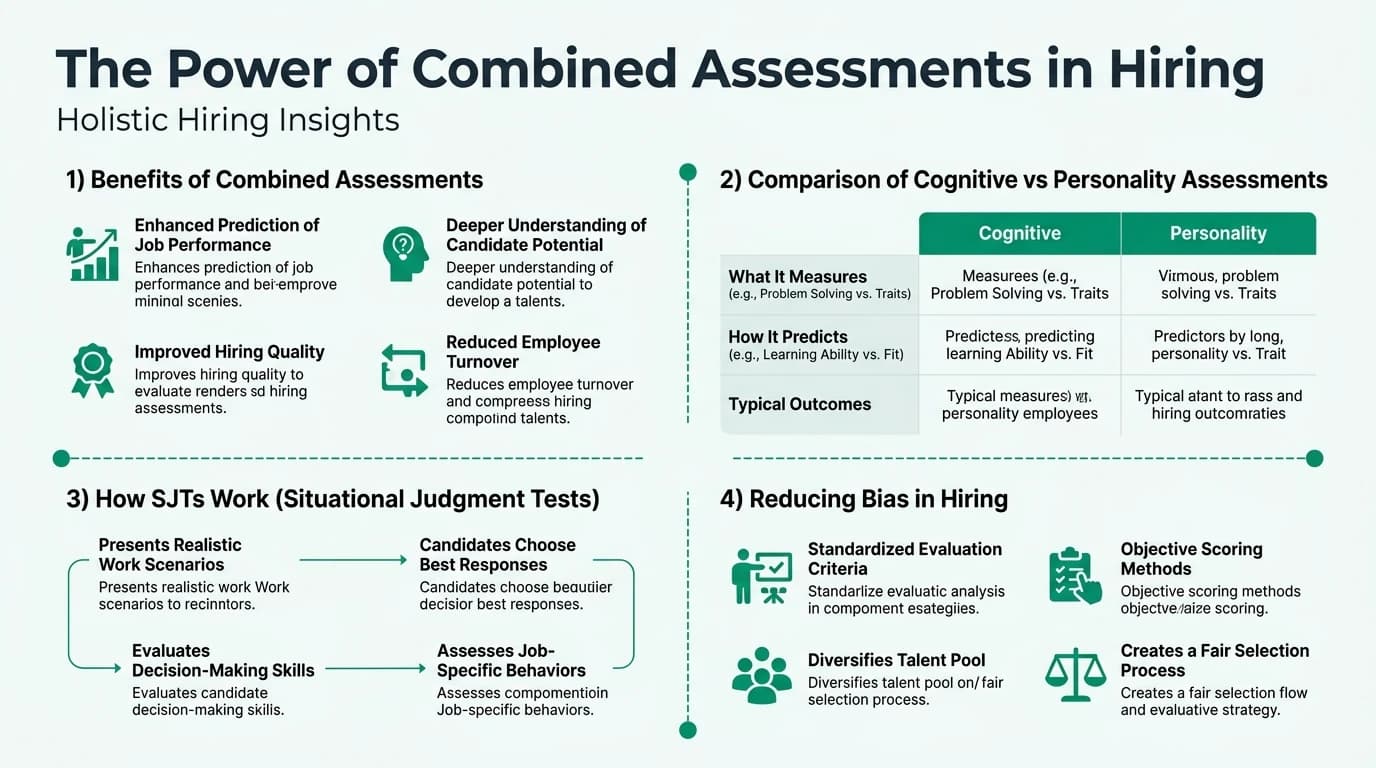
Combining personality and cognitive assessments in hiring offers a more complete view of candidates. This approach predicts job performance accurately, reduces hiring mistakes, and minimizes bias.
The bottom line: These assessments complement each other, providing a balanced view of both skills and traits.
Critical: Always ensure assessments are validated and comply with legal standards.
What Are Personality and Cognitive Assessments?
Personality Assessments:
- Traits Measured: Extraversion, dominance, patience.
- Purpose: Evaluate behavioral fit and interpersonal skills.
Cognitive Assessments:
- Skills Measured: Reasoning, problem-solving, learning.
- Purpose: Assess logic-heavy roles and quick adaptation.
| Aspect | Cognitive Assessments | Personality Assessments |
|---|---|---|
| Measures | Reasoning, problem-solving, learning | Traits like dominance, extraversion, patience |
| Use Case | Logic-heavy roles, quick adaptation | Team fit, interpersonal skills |
| Combined Benefit | Higher accuracy in job success prediction |
Why Combine These Assessments?
- Holistic View: Offers a complete picture of candidate capabilities.
- Improved Prediction: Both assessments together predict job performance better.
- Reduced Bias: Objective measures decrease subjective hiring errors.
Key Takeaways:
- Accuracy: Higher job success prediction.
- Efficiency: Streamlines the hiring process.
- Bias Reduction: Objective and validated.
How Do Situational Judgement Tests (SJTs) Work?
Situational Judgement Tests (SJTs) assess candidates' responses to workplace scenarios, evaluating both cognitive skills and personality traits.
Benefits of SJTs:
- Comprehensive: Test both cognitive and personality aspects.
- Time-Efficient: Single assessment for dual insights.
- Data-Driven: Provides actionable insights for hiring decisions.
| Format | Assesses | Time | Accuracy |
|---|---|---|---|
| SJTs | Both cognitive and personality | Short | High |
| Traditional | Separate tests | Longer | Varied |
Reducing Bias and Bad Hires
- Objective Measures: Reduce reliance on gut instinct.
- Behavioral Fit: Prevent mismatches by evaluating compatibility.
Important: While assessments reduce bias, they do not eliminate it entirely. Regular validation is crucial.
Best Practices for Implementation
- Pre-Hire Use: Integrate assessments early in the hiring process.
- Combine with Interviews: Use results to guide interview questions.
- Continuous Validation: Regularly update and validate assessments.
Checklist for Implementation:
- Select Validated Tools: Ensure tools are scientifically backed.
- Train Hiring Teams: Educate on interpreting results.
- Monitor Outcomes: Track hiring success and adjust as needed.
Predicting Long-Term Success
- Comprehensive Profiling: Combines cognitive and personality data for better role alignment.
- Motivational Insights: Understand motivations and potential derailers.
| Factor | Description | Hiring Impact |
|---|---|---|
| Best Performance | High cognitive and personality alignment | Increased job satisfaction and retention |
| Derailers | Poor interpersonal skills | Potential for conflict and turnover |
Tools and Providers Overview
- Predictive Index: Offers cognitive and personality assessments.
- Bryq: Blends data for comprehensive candidate profiling.
- Criteria Corp: Provides a range of pre-employment tests.
Pros and Cons of Combined Assessments:
| Pros | Cons |
|---|---|
| Accuracy | Cost |
| Bias Reduction | Complexity |
| Efficiency | Training Needs |
Limitations and Ethical Use
- No Guaranteed Interactions: Additive effects are supported, but interactions are not always confirmed.
- Focus on Validation: Ensure assessments are legally compliant and validated.
Critical: Consult with legal experts to ensure compliance with employment laws.
Conclusion
Combining personality and cognitive assessments provides a balanced view of candidates, predicting job performance more accurately and reducing hiring biases.
FAQ
What is the difference between cognitive and personality assessments?
Should you use both cognitive and behavioral assessments in hiring?
How do situational judgement tests (SJTs) work in recruitment?
Can combining assessments reduce hiring bias?
What traits do behavioral assessments measure?
How accurate are personality and cognitive tests for predicting job performance?
When should you use pre-employment cognitive assessments?
Notes
Primary Sources
| Source | Type | URL |
|---|---|---|
| PMC/NCBI (NIH) | Peer-reviewed | pmc.ncbi.nlm.nih.gov/articles/PMC6480750/ |
| Predictive Index | Industry | predictiveindex.com |
| Hogan Assessments | Industry | hoganassessments.com |
| Bryq | Industry | bryq.com |
| Criteria Corp | Industry | criteriacorp.com |