personality-tests
Cognitive Ability vs Personality Tests in Hiring: How to Combine Both Without Overfitting
Explore the balance between cognitive ability and personality tests in hiring, and learn how to combine them effectively without overfitting.
Quick answer
How can cognitive ability and personality tests be combined in hiring without overfitting?
Combining cognitive ability and personality tests in hiring requires a balanced approach that leverages the strengths of both, avoiding over-reliance on one type. Structured interviews and job-specific assessments should complement these tests to enhance predictive accuracy.
Source: Society for Industrial and Organizational Psychology
Executive Summary
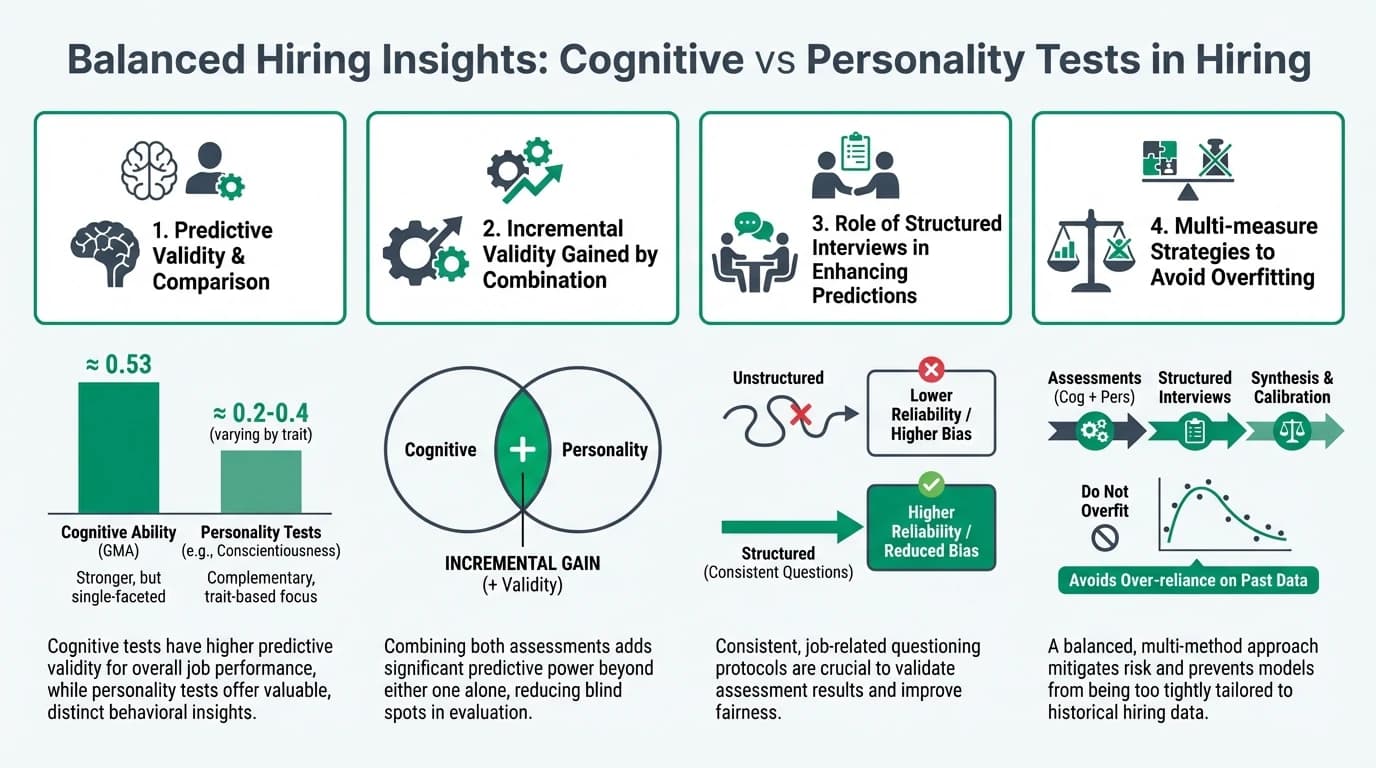
In the dynamic landscape of hiring, cognitive ability and personality tests offer complementary insights into a candidate's potential. Cognitive tests are known for their predictive power, explaining over 25% of job performance variance[^1]. However, personality assessments add incremental validity by capturing motivation and work style, which cognitive tests miss[^5]. The challenge lies in combining these tools effectively without overfitting the model to one type of test.
Key takeaway: A multi-measure approach that integrates cognitive and personality assessments, along with structured interviews, can enhance hiring accuracy and reduce turnover by up to 50%[^4].
Use this model alongside Personality Test Reliability, then calibrate trait interpretation with Big Five Personality Test: Complete Interpretation Guide and translate profile output into role hypotheses through the Big Five Role-Fit Calculator.
Understanding Predictive Validity
Predictive validity refers to how well a test predicts future job performance. Cognitive ability tests have a validity coefficient of about 0.53, making them strong predictors[^4]. However, relying solely on cognitive tests can overlook other critical factors.
| Test Type | Predictive Validity Coefficient |
|---|---|
| Cognitive Ability | 0.53 |
| Structured Interviews | ~0.40 |
| Job Knowledge | 0.40 |
For instance, a company hiring for a creative role might find that personality traits such as openness are better indicators of success than cognitive scores alone.
The Role of Incremental Validity
Incremental validity is the additional predictive power gained by combining different assessments. While cognitive tests measure problem-solving and reasoning, personality tests assess traits like conscientiousness and agreeableness.
Consider a sales position where both cognitive ability (for strategic thinking) and personality (for interpersonal skills) are crucial. Combining these assessments provides a fuller picture of a candidate's potential.
| Assessment Type | Incremental Validity Contribution |
|---|---|
| Personality Tests | Adds independent variance |
| Cognitive Tests | Base predictive power |
Ability Tilt and Cognitive Profiles
Ability tilt refers to the dominance of one cognitive ability over others, influencing job performance. For example, a verbal tilt benefits roles requiring strong communication skills[^1].
Employers can use cognitive profiles to match candidates' strengths to job demands, ensuring a better fit and higher performance.
| Cognitive Profile | Job Match Example |
|---|---|
| Verbal Tilt | Communication roles |
| Quantitative Tilt | Analytical positions |
Structured Interviews as a Complementary Tool
Structured interviews, with a validity of ~0.40, can outperform general cognitive tests when tailored to job-specific contexts[^6]. They assess intangibles like cultural fit and teamwork capabilities.
For example, a tech company might use structured interviews to evaluate a candidate's problem-solving approach in real-world scenarios, complementing cognitive test results.
| Interview Type | Validity |
|---|---|
| Structured | ~0.40 |
| Unstructured | Lower |
Contextualizing Personality Tests
Contextualizing personality tests to the workplace enhances their validity. For example, framing questions to reflect "at work" scenarios can double the predictive power[^6].
A practical application is using the Big Five personality test with a focus on workplace behaviors, providing insights into how a candidate might handle stress or collaboration.
| Personality Context | Validity Enhancement |
|---|---|
| At Work | Doubles predictive power |
| General | Baseline |
Multi-Measure Strategies to Avoid Overfitting
Overfitting occurs when a model is too closely tailored to specific data, reducing its generalizability. A multi-measure strategy that includes cognitive tests, personality assessments, and structured interviews mitigates this risk.
For instance, a balanced hiring process might involve initial cognitive screening, followed by personality assessments and structured interviews, ensuring a comprehensive evaluation.
For communication-heavy roles, review model positioning tradeoffs in MBTI vs Big Five before assigning final interview score weights.
| Strategy Component | Purpose |
|---|---|
| Cognitive Tests | Initial screening |
| Personality Tests | Assess motivation and fit |
| Structured Interviews | Evaluate real-world application |
Action checklist
- Integrate cognitive and personality tests in hiring processes.
- Use structured interviews to assess intangibles.
- Contextualize personality tests for workplace relevance.
- Employ a multi-measure strategy to avoid overfitting.
FAQ
What is the predictive validity of cognitive ability tests?
How do personality tests add value in hiring?
What is ability tilt?
Why are structured interviews important?
How can overfitting be avoided in hiring assessments?
Primary Sources
| Source | Type | URL |
|---|---|---|
| Society for Industrial and Organizational Psychology (SIOP) | Professional research summary | siop.org/tip-article/is-cognitive-ability-the-best-predictor-of-job-performance-new-research-says-its-time-to-think-again |
| NCBI (PMC) | Cognitive and hiring evidence | pmc.ncbi.nlm.nih.gov/articles/PMC12194090 |
| APA Dictionary of Psychology | Construct-level definition reference | dictionary.apa.org/five-factor-model |
| Schmidt & Hunter references (via SIOP) | Validity meta-analysis context | siop.org |