personality-tests
Conscientiousness: Complete Big Five Guide
Everything about conscientiousness, the Big Five trait most predictive of academic success, career performance, and long-term health outcomes explained.
Quick answer
What is conscientiousness in the Big Five?
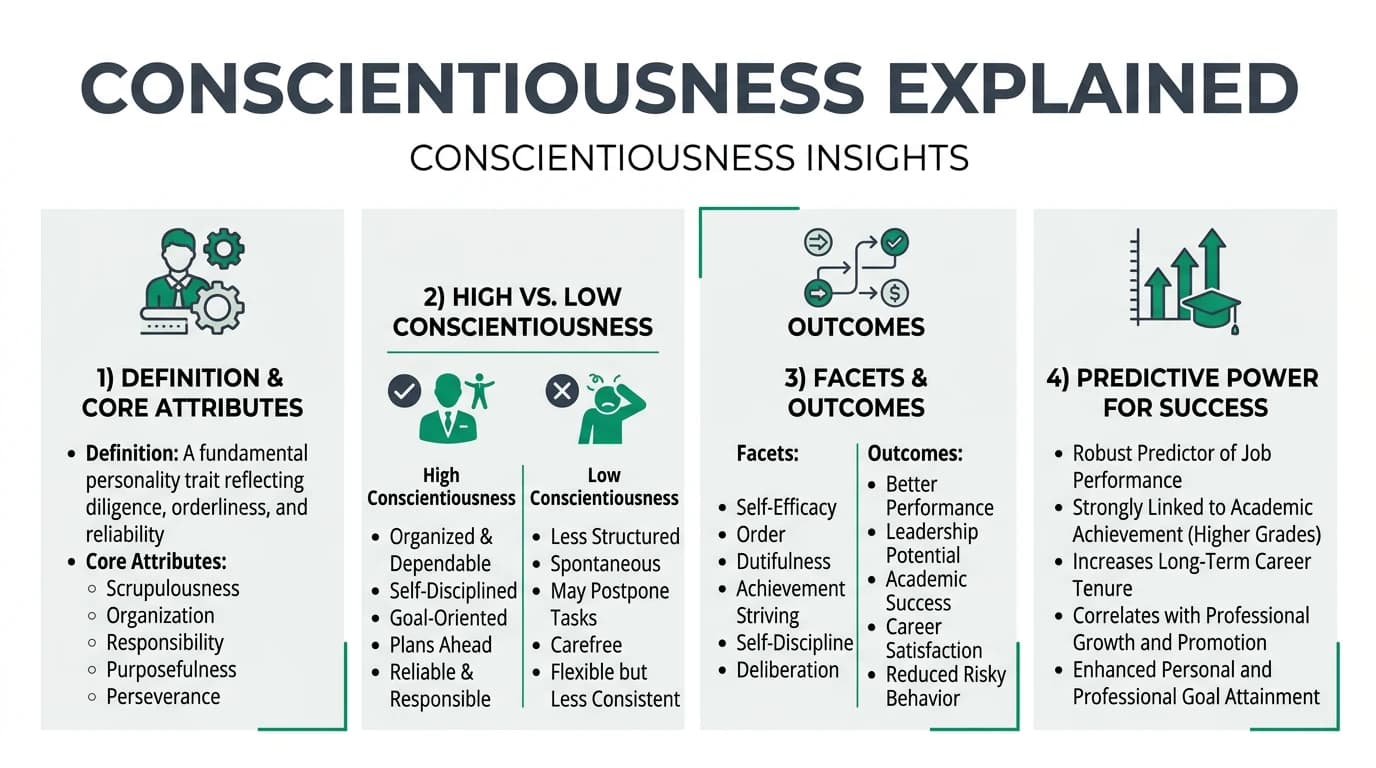
Conscientiousness is a personality trait defined by self-discipline, organization, goal-directed behavior, and deliberate decision-making. Among all Big Five traits, it is the strongest and most consistent predictor of academic achievement, job performance, financial stability, health outcomes, and relationship longevity.
Source: Costa, P. T. & McCrae, R. R. (1992). NEO-PI-R Professional Manual
Key Takeaways
- Conscientiousness is the most powerful Big Five predictor of success across life domains including academics, career, finances, health, and relationships.
- The trait comprises six distinct facets: competence, orderliness, dutifulness, achievement striving, self-discipline, and deliberation.
- High scorers excel in structured environments through reliability, planning, and impulse control, but risk rigidity and workaholism.
- Low scorers bring adaptability and spontaneity, but face risks of impulsivity, procrastination, and lower performance.
- Conscientiousness increases naturally with age (the maturity principle), and can be deliberately developed through habit-building strategies.
- The trait predicts lower divorce rates, greater longevity, and reduced delinquency after controlling for other personality factors.
- Conscientiousness is not inherently superior. Its value is context-dependent, and excessive conscientiousness carries its own costs.
For the full framework of all five personality traits, see our complete Big Five personality test guide.
Disclaimer: This article summarizes personality psychology research for educational purposes. Personality assessments should complement, not replace, professional psychological evaluation when clinical decisions are involved.
What Is Conscientiousness?
Conscientiousness is one of the five broad personality dimensions in the Big Five (OCEAN) model. It captures individual differences in the tendency to be organized, disciplined, goal-directed, and careful in decision-making.
The trait was first formalized by Costa and McCrae in their NEO Personality Inventory (1985, revised 1992) and has since become the most studied Big Five trait in applied psychology1.
| Core Component | Definition | Behavioral Indicator |
|---|---|---|
| Organization | Systematic approach to tasks and environments | Clean workspace, detailed calendars |
| Self-discipline | Ability to resist impulses and maintain focus | Completes tasks despite distractions |
| Goal-orientation | Persistent pursuit of objectives | Sets deadlines, tracks milestones |
| Deliberation | Careful thinking before acting | Weighs pros and cons, avoids snap decisions |
| Thoroughness | Attention to detail and completeness | Double-checks work, follows through |
| Reliability | Consistency in fulfilling commitments | On-time delivery, kept promises |
- Conscientiousness correlates moderately with academic performance (r = 0.22) across meta-analyses, making it the strongest personality predictor of grades2.
- The trait shows high test-retest reliability, meaning scores remain relatively stable over time while still allowing for developmental growth1.
High vs. Low Conscientiousness
Neither end of the conscientiousness spectrum is universally better. Each profile carries distinct advantages and risks depending on context.
High Conscientiousness Profile
- Strengths: Reliable, detail-oriented, disciplined, goal-focused, organized.
- Career fit: Thrives in structured roles requiring precision (accounting, engineering, project management).
- Risk factors: Rigidity, perfectionism, workaholism, difficulty adapting to sudden change.
Low Conscientiousness Profile
- Strengths: Flexible, spontaneous, creative, adaptable to dynamic environments.
- Career fit: Thrives in roles requiring improvisation, creativity, and rapid pivoting (entrepreneurship, creative arts, crisis management).
- Risk factors: Procrastination, impulsivity, difficulty with long-term planning, lower academic performance.
| Dimension | High Conscientiousness | Low Conscientiousness |
|---|---|---|
| Planning style | Detailed schedules, lists | Spontaneous, in-the-moment |
| Response to deadlines | Meets or beats consistently | Often rushes at the last minute |
| Workspace organization | Neat, systematic | Cluttered, flexible layout |
| Decision-making | Deliberate, researched | Quick, intuitive |
| Impulse control | Strong | Weak to moderate |
| Stress pattern | From over-commitment | From missed deadlines |
| Social perception | Seen as dependable | Seen as easygoing or unreliable |
| Context | Advantage Goes To | Why |
|---|---|---|
| Routine deadline-driven work | High C | Consistency and reliability |
| Creative brainstorming | Low C | Spontaneity and divergent thinking |
| Emergency response | Low C | Rapid adaptation without over-analysis |
| Long-term project management | High C | Sustained planning and follow-through |
| Startup environment | Mixed | Need both structure and flexibility |
| Artistic production | Low C | Freedom from rigid process |
The Six Facets of Conscientiousness
Conscientiousness is not a single trait but a composite of six distinct facets, originally identified by Costa and McCrae in the NEO-PI-R framework1. Understanding facets provides more actionable insight than the overall trait score alone.
| Facet | High Scorer | Low Scorer | Outcome Prediction |
|---|---|---|---|
| Competence | Confident in abilities, self-assured | Doubts capabilities, hesitant | Higher task performance |
| Orderliness | Neat, organized, structured | Disorganized, casual environment | Better planning, lower chaos |
| Dutifulness | Strong sense of responsibility | Casual about obligations | Reliable team member |
| Achievement striving | Driven to excel, ambitious | Content with adequate performance | Career advancement |
| Self-discipline | Persists through difficulty | Gives up under pressure | Task completion rate |
| Deliberation | Thinks carefully before acting | Acts impulsively | Fewer regretted decisions |
Facet Interactions and Profiles
- Goal-striving vs. carefulness are two higher-order clusters within conscientiousness. Goal-striving (achievement striving, competence, self-discipline) predicts proactive success. Carefulness (orderliness, dutifulness, deliberation) predicts mistake avoidance3.
- A person can score high on achievement striving but low on orderliness, creating a profile of ambitious but chaotic productivity.
- Facet-level scoring reveals these distinctions, which aggregate scores miss entirely.
| Profile Type | High Facets | Low Facets | Behavioral Pattern |
|---|---|---|---|
| Organized achiever | All six | None | Classic high-C performer |
| Ambitious but messy | Achievement striving, competence | Orderliness, deliberation | Productive but disorganized |
| Careful but passive | Orderliness, dutifulness, deliberation | Achievement striving, competence | Follows rules, avoids risk |
| Spontaneous performer | Competence, self-discipline | Orderliness, deliberation | High output without structure |
How Conscientiousness Is Measured
Several validated instruments measure conscientiousness, ranging from comprehensive clinical tools to brief screening assessments.
| Assessment Tool | Items | Facet Detail | Reliability | Cost | Best For |
|---|---|---|---|---|---|
| NEO-PI-R | 240 (48 for C) | All 6 facets | Very high (alpha 0.86-0.92) | Licensed | Clinical and research use |
| NEO-FFI | 60 (12 for C) | Domain-level only | High (alpha 0.78-0.86) | Licensed | Quick professional screening |
| BFI-2 | 60 (12 for C) | 3 facets | High | Free for research | Academic studies |
| IPIP-NEO | 120 or 300 | Full facet coverage | High | Free | Self-assessment, open access |
| Big Five Inventory (BFI) | 44 (9 for C) | Domain-level only | Good | Free | Brief screening |
- The NEO-PI-R remains the gold standard, but open-access alternatives like the IPIP-NEO provide comparable facet-level detail at no cost1.
- Self-report measures can be complemented by informant reports (spouse, colleague) for more accurate assessment, especially in hiring contexts.
- For guidance on interpreting personality test results, see our personality test complete guide.
Reflective Self-Assessment Questions
These questions can help estimate your conscientiousness level before formal testing:
- Do you consistently meet deadlines without last-minute rushes?
- Is your workspace organized in a way that others would recognize as systematic?
- Do you think through decisions carefully before committing?
- Can you maintain focus on a task even when it becomes tedious?
- Do others describe you as reliable and dependable?
Conscientiousness and Academic Success
Conscientiousness is the strongest personality predictor of academic performance, surpassing even intelligence in some meta-analyses when predicting grades in structured educational settings2.
How Conscientiousness Drives Academic Outcomes
- Study discipline translates to regular preparation rather than cramming.
- Goal-setting behavior helps students break large assignments into manageable milestones.
- Self-regulation reduces procrastination and off-task behavior during study sessions.
- Homework completion rates are significantly higher in conscientious students.
| Academic Metric | High C Outcome | Low C Risk | Effect Size |
|---|---|---|---|
| Grade point average | Higher (meta-analytic r = 0.22) | Lower, inconsistent performance | Medium |
| Homework completion | Near-complete | Frequently missed | Large |
| Exam preparation | Spaced, systematic | Last-minute, cramming | Medium to large |
| Class attendance | Regular | Irregular | Medium |
| Assignment quality | Thorough, detail-oriented | Adequate or rushed | Medium |
| Graduate school admission | Stronger applications | Weaker follow-through | Medium |
- A 2011 meta-analysis by Poropat found conscientiousness predicted academic performance at a magnitude comparable to intelligence, particularly at the university level2.
- For more on how personality predicts student outcomes, see our academic performance guide.
Conscientiousness in the Workplace
In occupational psychology, conscientiousness is the most valid personality predictor of job performance across virtually all job types. Meta-analyses by Barrick and Mount (1991) established this finding, which has been replicated consistently4.
Workplace Impact
- Job performance correlations are positive across all occupational categories.
- Counterproductive behavior (absenteeism, theft, dishonesty) is significantly lower in highly conscientious employees.
- Leadership potential is enhanced through reliability and follow-through.
- Team contribution improves because conscientious members meet commitments and reduce coordination costs.
| Job Category | Ideal C Level | Why It Fits | Performance Correlation |
|---|---|---|---|
| Accounting and finance | High | Precision, compliance, deadlines | Strong positive |
| Software engineering | Moderate to high | Systematic problem-solving, code quality | Moderate positive |
| Sales | Moderate | Follow-up discipline, but needs flexibility | Moderate positive |
| Creative direction | Low to moderate | Needs freedom from rigid process | Weak to neutral |
| Emergency medicine | Moderate | Protocols matter, but rapid adaptation critical | Moderate positive |
| Entrepreneurship | Mixed | Need vision (low C) and execution (high C) | Variable |
| Workplace Behavior | High C Pattern | Low C Pattern | Organizational Impact |
|---|---|---|---|
| Meeting deadlines | Consistently early or on time | Frequently late | Project timeline reliability |
| Email response time | Same day, structured | Delayed, sporadic | Communication efficiency |
| Task prioritization | Systematic, list-based | Reactive, mood-driven | Resource allocation |
| Feedback incorporation | Immediate, documented | Selective, informal | Quality improvement cycle |
| Conflict with colleagues | Low (reliable expectations) | Higher (broken commitments) | Team cohesion |
Health and Longevity Outcomes
Conscientiousness predicts health behaviors and longevity more consistently than any other Big Five trait. The mechanisms are behavioral: conscientious individuals are more likely to exercise, eat healthily, avoid substance abuse, and follow medical advice.
| Health Outcome | High C Advantage | Mechanism | Key Citation |
|---|---|---|---|
| Longevity | Increased lifespan | Healthier behavior patterns | Kern and Friedman (2008)5 |
| Substance use | Lower rates | Impulse control | Roberts et al. (2007)6 |
| Exercise adherence | Higher consistency | Routine and goal-setting | Menzies et al. (2025) |
| Medication compliance | Better adherence | Dutifulness, scheduling | Multiple meta-analyses |
| Divorce rate | Lower | Reliability, commitment | Roberts et al. (2007)6 |
| BMI management | More controlled | Eating discipline | Sutin et al. (2011) |
- The Terman Life Cycle Study followed participants for decades and found that childhood conscientiousness predicted longevity into old age, even after controlling for health, intelligence, and socioeconomic status5.
- For insight into how personality connects to sleep, which mediates many health outcomes, see our sleep quality guide.
The Dark Side of High Conscientiousness and Health
Excessive conscientiousness can become counterproductive for health:
- Workaholism leads to chronic stress, burnout, and relationship strain.
- Perfectionism creates anxiety when standards cannot be met.
- Rigidity prevents necessary adaptation to health setbacks or changing circumstances.
- Overcommitment to routines can mean ignoring injury warning signs.
Relationships and Social Dynamics
Conscientiousness shapes relationship quality through reliability, commitment, and structured partnership behavior.
How Conscientiousness Affects Relationships
- Stable partnerships benefit from the planning and follow-through that conscientious partners provide.
- Lower divorce rates are documented in couples where at least one partner scores high in conscientiousness6.
- Conflict reduction occurs because conscientious individuals meet commitments, reducing trust violations.
- Financial stability from conscientious money management removes a common relationship stressor.
| Relationship Aspect | High C Partner Effect | Low C Partner Risk | Combined Effect |
|---|---|---|---|
| Financial management | Budget adherence, savings growth | Impulse spending, debt risk | High C partner stabilizes finances |
| Household maintenance | Organized, routines established | Chaotic, tasks forgotten | Complementary or conflicting |
| Parenting approach | Structured, consistent rules | Flexible but inconsistent | Can balance if communicated |
| Social commitments | Reliable, plans honored | Cancellations, last-minute changes | High C partner manages social calendar |
| Conflict resolution | Systematic, solution-focused | Avoidant or impulsive | Depends on trait interaction |
- High agreeableness paired with low conscientiousness can create a pattern of well-intentioned but unreliable behavior, which erodes trust over time7.
- Low conscientiousness paired with high neuroticism increases antisocial risk in some research models7.
Development and Improvement Strategies
Conscientiousness is not fixed. It increases naturally with age (the maturity principle), and targeted strategies can accelerate development.
Age-Related Changes
- Conscientiousness increases from adolescence through middle adulthood, peaking around ages 50-60.
- This increase reflects growing social demands (career, family, financial responsibility) that reward conscientious behavior.
- For the full picture of how personality changes across the lifespan, see our personality changes guide.
Practical Improvement Strategies
| Strategy | How It Works | Starting Level | Expected Timeline |
|---|---|---|---|
| Implementation intentions | Pre-decide when, where, and how you will act | Any | 2-4 weeks for habit formation |
| Environment design | Remove friction for desired behaviors (e.g., lay out gym clothes) | Low C | Immediate effect |
| Accountability partnerships | External commitment increases follow-through | Low C | 1-2 weeks |
| Micro-commitments | Start with tiny actions that build momentum | Low C | 1-2 weeks |
| Checklists and systems | Externalize planning from memory to tools | Any | Immediate |
| Reward scheduling | Pair boring tasks with immediate small rewards | Low C | 2-4 weeks |
- Building habits works by converting effortful conscientious behavior into automatic routines, reducing the willpower cost over time.
- Low-C individuals should focus on environment design and external systems rather than relying on internal discipline, which is precisely what they lack.
- High-C individuals who want to reduce rigidity should practice deliberate unstructured time and flexibility exercises (e.g., changing routine intentionally).
Conscientiousness in Broader Personality Models
Conscientiousness maps onto dimensions in virtually every major personality framework, suggesting it captures a fundamental aspect of human variation.
| Personality Model | Equivalent Dimension | Key Overlap | Distinction |
|---|---|---|---|
| Cloninger's TCI | Persistence and self-directedness | Goal pursuit and self-regulation | TCI separates these into two dimensions |
| Cattell's 16PF | Rule consciousness, perfectionism | Duty and order | Cattell offers finer-grained factors |
| Zuckerman's model | Impulse sensation seeking (inverse) | Impulse control | Zuckerman frames as absence of impulsivity |
| HEXACO | Conscientiousness | Nearly identical | HEXACO adds Honesty-Humility as separate |
| Grit (Duckworth) | Perseverance of effort | Sustained pursuit | Grit is narrower, lacks orderliness facet |
- Grit is best understood as a subset of conscientiousness, specifically the achievement striving and self-discipline facets, without the orderliness and deliberation components3.
- Understanding these overlaps helps interpret results across different assessment systems.
Criticisms and Nuances
Conscientiousness is not without legitimate criticism, and sophisticated interpretation requires acknowledging these points.
- Context dependency: High conscientiousness is advantageous in structured, predictable environments but can be maladaptive in rapidly changing situations requiring improvisation.
- Cultural variation: Expressions of conscientiousness differ across cultures. What counts as organized or disciplined varies significantly by cultural norms.
- Perfectionism link: Very high conscientiousness scores, especially on orderliness and achievement striving facets, correlate with maladaptive perfectionism and anxiety.
- Overvaluation risk: Hiring practices that over-weight conscientiousness may inadvertently select against creative, innovative candidates.
| Criticism | Validity | Practical Implication |
|---|---|---|
| High C is always better | Partially valid in structured contexts only | Match C level to role demands |
| Conscientiousness is fixed | False (maturity principle) | Investment in development is worthwhile |
| C predicts everything | Overstatement (other traits matter too) | Use full Big Five profile, not C alone |
| All high-C people are alike | False (facet profiles vary widely) | Use facet-level assessment |
| Low C equals failure | False (context-dependent) | Value low-C strengths in appropriate roles |
Conscientiousness action checklist
- Take a validated Big Five assessment (IPIP-NEO is free) to determine your conscientiousness level and facet profile.
- Identify whether your profile leans toward goal-striving or carefulness facets.
- If high in conscientiousness, monitor for perfectionism and rigidity warning signs.
- If low in conscientiousness, implement environment design and external accountability systems.
- Match your career path to your conscientiousness profile using the workplace table above.
- Review your relationship patterns for conscientiousness-driven dynamics (both positive and negative).
- Build one new habit per month using implementation intentions.
- Reassess your conscientiousness strategies every six months as life demands change.
FAQ
How is conscientiousness measured accurately?
The gold standard is the NEO-PI-R, which measures all six facets across 48 items. For free alternatives, the IPIP-NEO provides comparable facet-level detail. Brief instruments like the BFI-2 capture domain-level scores but miss facet distinctions. Self-report can be supplemented with informant ratings for more accurate assessment, especially in high-stakes contexts like hiring1.
What are the main benefits of high conscientiousness?
High conscientiousness predicts better academic performance (meta-analytic r = 0.22), stronger job performance across all occupational categories, higher financial stability, lower divorce rates, greater longevity, and reduced substance use. It is the most consistently positive Big Five predictor across life domains246.
Can conscientiousness be developed over time?
Yes. Conscientiousness increases naturally with age through the maturity principle, typically peaking around age 50-60. It can also be deliberately developed through implementation intentions, environment design, accountability partnerships, and habit-building strategies. The trait is malleable, though change requires sustained effort13.
What are the downsides of very high conscientiousness?
Potential downsides include perfectionism-driven anxiety, workaholism, rigidity in the face of change, overcommitment to routines at the expense of relationships, and difficulty accepting "good enough" outcomes. Brummett et al. (2008) found that excessive conscientiousness can drive compulsive neatness and inflexibility that undermines well-being5.
How does conscientiousness affect relationships?
Conscientiousness promotes relationship stability through reliability, financial management, and commitment to shared goals. Roberts et al. (2007) found lower divorce rates among highly conscientious individuals. However, mismatched conscientiousness levels between partners can create friction around planning, tidiness, and commitment styles6.
Is conscientiousness the same as grit?
No. Grit (as defined by Duckworth) is best understood as a subset of conscientiousness, encompassing the achievement striving and self-discipline facets. Conscientiousness is broader, also including orderliness, dutifulness, deliberation, and competence. Most research shows that grit does not predict outcomes beyond what conscientiousness already captures3.
Which careers benefit most from high conscientiousness?
Careers requiring precision, compliance, and sustained effort benefit most, including accounting, engineering, healthcare, project management, and quality assurance. However, creative and entrepreneurial roles may require moderate rather than high conscientiousness to preserve flexibility and divergent thinking4.
Does conscientiousness predict health and longevity?
Yes. The Terman Life Cycle Study and subsequent meta-analyses found that conscientiousness predicts greater longevity, lower substance use, better medication adherence, healthier BMI, and more consistent exercise habits. The mechanism is behavioral: conscientious individuals make healthier daily choices through impulse control and planning56.
Notes
Primary Sources
| Source | Type | Key Contribution | URL |
|---|---|---|---|
| Simply Psychology | Educational reference | Big Five model overview and trait descriptions | Link |
| Psychiatry and Psychotherapy Podcast | Research discussion | Conscientiousness facets and academic prediction | Link |
| Alva Labs | Workplace research | Conscientiousness in hiring and team performance | Link |
| Thomas International | HR insights | Conscientiousness as hiring benchmark | Link |
| Crystal Knows | Assessment platform | Free conscientiousness assessment and trait interactions | Link |
Conclusion
Conscientiousness is the Big Five trait with the most robust evidence base for predicting real-world outcomes. It drives academic achievement through study discipline, career success through reliability, financial stability through impulse control, health through behavioral consistency, and relationship longevity through commitment.
The practical implication is not that everyone should maximize conscientiousness. It is that understanding your conscientiousness profile, at the facet level, enables you to leverage your strengths, compensate for your weaknesses, and choose environments where your natural tendencies produce the best outcomes.
High-C individuals should guard against rigidity and burnout. Low-C individuals should build external systems rather than relying on willpower they do not naturally possess. Both profiles have genuine value in the right context.
Footnotes
-
Costa, P. T. & McCrae, R. R. (1992). NEO-PI-R Professional Manual. Psychological Assessment Resources. Summary available at: https://www.simplypsychology.org/big-five-personality.html ↩ ↩2 ↩3 ↩4 ↩5 ↩6 ↩7
-
Poropat, A. E. (2009). A meta-analysis of the five-factor model of personality and academic performance. Psychological Bulletin, 135(2), 322-338. Reviewed in: https://www.psychiatrypodcast.com/psychiatry-psychotherapy-podcast/episode-97-the-big-five-personality-traits-conscientiousness-part-1 ↩ ↩2 ↩3 ↩4
-
Alva Labs (2024). Conscientiousness explained: The Big Five workplace guide. Available at: https://www.alvalabs.io/blog/alva-guide-to-the-big-five-conscientiousness-explained ↩ ↩2 ↩3 ↩4
-
Barrick, M. R. & Mount, M. K. (1991). The Big Five personality dimensions and job performance: A meta-analysis. Personnel Psychology, 44(1), 1-26. Referenced in: https://www.thomas.co/resources/type/hr-blog/conscientiousness-personality-trait ↩ ↩2 ↩3
-
Kern, M. L. & Friedman, H. S. (2008). Do conscientious individuals live longer? A quantitative review. Health Psychology, 27(5), 505-512. Overview at: https://www.simplypsychology.org/big-five-personality.html ↩ ↩2 ↩3 ↩4
-
Roberts, B. W., Kuncel, N. R., Shiner, R., Caspi, A. & Goldberg, L. R. (2007). The power of personality: The comparative validity of personality traits, socioeconomic status, and cognitive ability for predicting important life outcomes. Perspectives on Psychological Science, 2(4), 313-345. Referenced in: https://en.wikipedia.org/wiki/Conscientiousness ↩ ↩2 ↩3 ↩4 ↩5 ↩6
-
Crystal Knows. Big Five conscientiousness: Trait interactions and assessment. Available at: https://www.crystalknows.com/big-five/conscientiousness ↩ ↩2