personality-tests
Personality Assessments and Employee Wellbeing: Big Five Links to Job Satisfaction and Mental Health
Explore how Big Five personality assessments impact job satisfaction, mental health, and ethical HR practices.
Quick answer
How do Big Five personality traits affect employee wellbeing?
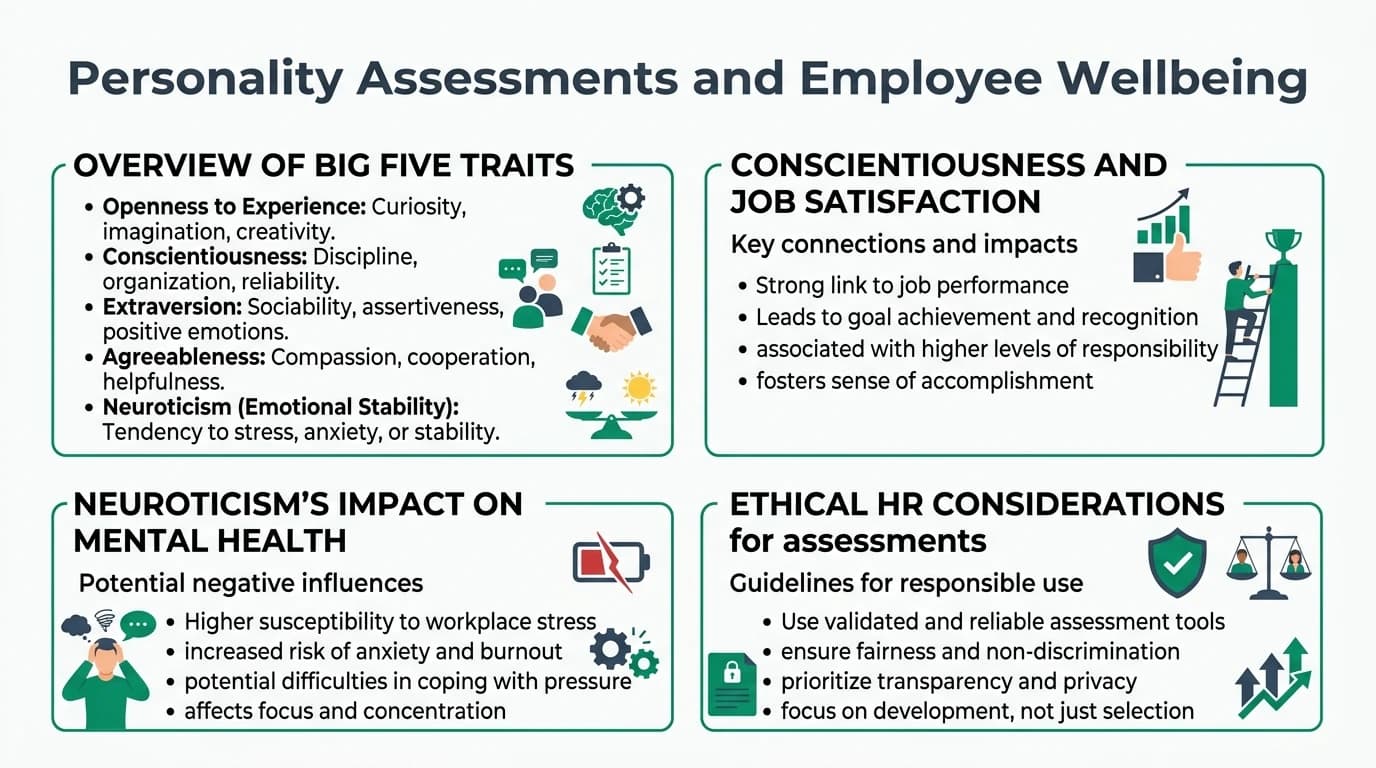
The Big Five traits—Openness, Conscientiousness, Extraversion, Agreeableness, and Neuroticism—impact job satisfaction and mental health. Conscientiousness and Agreeableness often enhance satisfaction, while Neuroticism can increase stress and dissatisfaction.
Source: Simply Psychology
Executive Summary
Personality assessments, especially the Big Five model, offer insights into employee wellbeing. Traits like Conscientiousness and Agreeableness are linked to higher job satisfaction, while Neuroticism is often associated with stress and lower satisfaction.
The bottom line: Using these insights ethically in HR can improve workplace outcomes, but privacy and bias must be considered.
Critical Warning: Personality assessments should not be used for diagnosing mental health issues or making employment decisions without context.
What is the Big Five Personality Model?
The Big Five personality traits, also known as the OCEAN model, include:
- Openness to Experience
- Conscientiousness
- Extraversion
- Agreeableness
- Neuroticism
These traits describe behavior, emotions, and thinking patterns, helping predict outcomes like job performance and wellbeing1.
| Trait | Description |
|---|---|
| Openness | Creativity and willingness to try new things |
| Conscientiousness | Organization and dependability |
| Extraversion | Sociability and enthusiasm |
| Agreeableness | Cooperation and kindness |
| Neuroticism | Emotional instability and tendency to experience negative emotions |
How Do Big Five Traits Affect Job Satisfaction?
Different traits influence job satisfaction in various ways:
- Conscientiousness: Strong positive link with job satisfaction and performance.
- Agreeableness: Generally positive across job aspects.
- Extraversion: Mixed effects; positive for engagement but weak for pay satisfaction.
- Neuroticism: Strong negative impact on satisfaction and mental health2.
| Trait | Job Satisfaction Impact | Key Aspects Affected |
|---|---|---|
| Conscientiousness | Positive | Performance, engagement |
| Agreeableness | Positive | Team dynamics |
| Extraversion | Mixed | Engagement, pay |
| Neuroticism | Negative | Stress, dissatisfaction |
How Does Neuroticism Affect Mental Health at Work?
Neuroticism is linked to:
- Higher burnout and stress: Individuals may experience more anxiety and depression.
- Lower job satisfaction: Emotional instability can lead to dissatisfaction3.
| Impact | Description |
|---|---|
| Burnout | Increased risk due to stress and anxiety |
| Job Satisfaction | Lower due to emotional instability |
Why Use Personality Assessments in HR?
Personality assessments can help:
- Match employees to roles: Align traits with job demands.
- Improve team dynamics: Balance different personalities for better collaboration.
- Predict performance: Use traits like Conscientiousness to foresee job success4.
| Application | Benefit |
|---|---|
| Role Matching | Better fit and reduced turnover |
| Team Dynamics | Enhanced collaboration |
| Performance Prediction | Improved hiring decisions |
What Are the Ethical Considerations?
Ethical use of personality assessments involves:
- Informed consent: Employees should know how their data will be used.
- Avoiding discrimination: Ensure assessments don't unfairly disadvantage any group.
- Maintaining privacy: Comply with regulations like GDPR5.
| Practice | Allowed? | Conditions |
|---|---|---|
| Individual Scoring | No | Use aggregate data only |
| Consent | Yes | Must be explicit and informed |
How Can HR Set Boundaries for Wellness Programs?
To ethically integrate personality assessments:
- Combine with other data: Avoid reliance on personality scores alone.
- Respect privacy: Ensure compliance with privacy laws.
- Avoid diagnosis: Use assessments for support, not diagnosis6.
| Boundary | Description |
|---|---|
| Data Integration | Combine with other metrics for a holistic view |
| Privacy | Follow legal requirements for data protection |
| Non-Diagnostic | Use for support, not medical diagnosis |
Key Takeaways
- Conscientiousness and Agreeableness boost job satisfaction.
- Neuroticism is a risk factor for stress and dissatisfaction.
- Ethical use of assessments is crucial for privacy and fairness.
Action checklist
- Ensure informed consent for assessments.
- Use personality data to improve role matching.
- Maintain privacy and comply with regulations.
FAQ
What is the Big Five personality model?
How does Conscientiousness affect job performance?
Why is Neuroticism linked to workplace stress?
Can personality tests improve employee wellbeing?
What are ethical guidelines for using Big Five in HR?
How do Big Five traits predict mental health at work?
Does Extraversion help or hurt job satisfaction?
Notes
Primary Sources
| Source | Type | URL |
|---|---|---|
| PMC/NCBI | Peer-reviewed | Link |
| Journal of Personality and Social Psychology | Peer-reviewed | Link |
| Florida Tech Online | Academic/Industry | Link |
| Simply Psychology | Academic | Link |
| PMC/NCBI | Peer-reviewed meta-analysis | Link |
| Michigan State University Online | Academic/Industry | Link |
Conclusion
Understanding the Big Five personality traits can significantly enhance employee wellbeing and job satisfaction when used ethically. HR professionals should integrate these insights carefully, respecting privacy and avoiding bias.
Footnotes
-
Simply Psychology, "Big Five Personality Traits" ↩
-
PMC, "Big Five-job satisfaction associations" ↩
-
Florida Tech Online, "Work behavior, burnout, performance predictions" ↩
-
Michigan State University Online, "Workplace applications" ↩
-
Journal of Personality and Social Psychology, "Lifespan satisfaction links" ↩
-
Healthline, "Personality traits and happiness" ↩