personality-tests
Big Five Traits and Work-Life Balance
Evidence-based guide to how each Big Five personality trait shapes work-life balance, with tailored strategies, boundary-setting tools, and burnout prevention tips.
Quick answer
How do Big Five traits affect work-life balance?
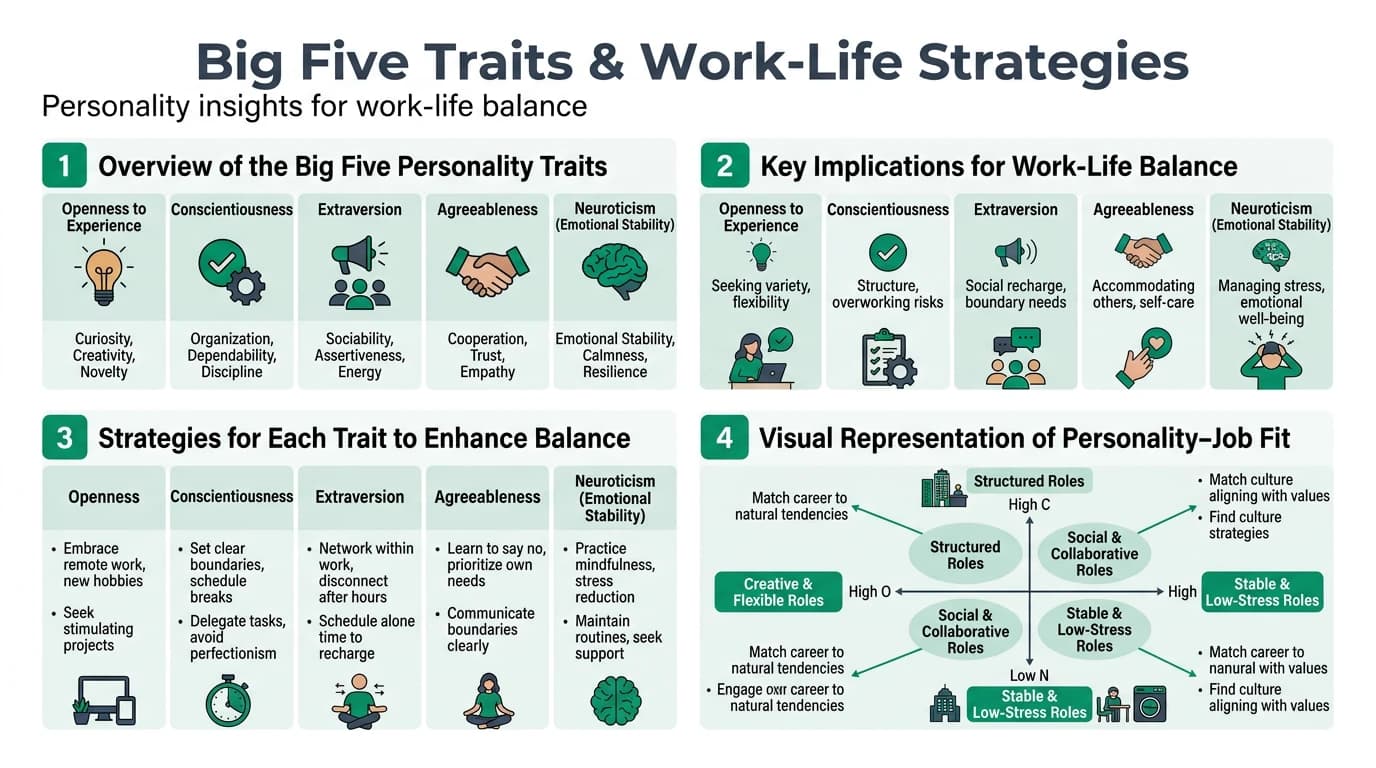
Conscientiousness predicts overwork and difficulty disconnecting, neuroticism amplifies work-related stress and burnout risk, extraversion affects energy management in remote versus in-person settings, agreeableness influences boundary-setting difficulty, and openness shapes adaptability to flexible work arrangements.
Executive Summary
Work-life balance is not a one-size-fits-all outcome. Research consistently shows that Big Five personality traits predict how individuals experience, manage, and struggle with the boundary between professional and personal life 1.
High conscientiousness drives productivity but creates overwork patterns. Neuroticism amplifies stress spillover between work and home. Extraversion shapes energy needs that differ between remote and in-person environments. Agreeableness creates difficulty saying no. Openness enables flexibility but may resist routine.
Key takeaway: Effective work-life balance strategies must be personality-informed. A strategy that works for a high-extraversion individual may backfire for an introvert, and vice versa.
Important: Work-life balance challenges often involve structural workplace factors beyond individual control. Personality strategies complement but do not replace organizational policy changes.
What Work-Life Balance Actually Means
Work-life balance is not about equal time allocation. Research defines it as the perceived satisfaction and effective functioning across work and non-work roles simultaneously 2.
- Work-to-life conflict: Work demands interfere with personal and family life.
- Life-to-work conflict: Personal obligations interfere with work performance.
- Work-life enrichment: Positive experiences in one domain improve functioning in the other.
- Boundary management: The strategies individuals use to segment or integrate work and personal life.
| Dimension | Definition | Personality Driver | Example |
|---|---|---|---|
| Work-to-life conflict | Work demands spill into personal time | High conscientiousness, high neuroticism | Checking email during family dinner |
| Life-to-work conflict | Personal issues reduce work effectiveness | High neuroticism, low conscientiousness | Worrying about family finances during meetings |
| Work-life enrichment | Skills from one domain benefit the other | High openness, high extraversion | Leadership skills from work improving community involvement |
| Boundary management | Control over role transitions | High conscientiousness (segmentation), high openness (integration) | Strict "no work after 6 PM" rule versus fluid blending |
For strategies on managing workplace stress specifically, see our stress management guide.
The Big Five Traits: Work-Life Impact Summary
Each trait creates distinct patterns of work-life interaction. Understanding your profile reveals which specific challenges you face and which strategies will be most effective.
- Openness: Adapts easily to flexible work but may resist structured boundaries.
- Conscientiousness: Drives productivity but creates overcommitment and guilt about downtime.
- Extraversion: Needs social energy replenishment that varies by work format.
- Agreeableness: Struggles to set boundaries and decline additional work requests.
- Neuroticism: Amplifies negative spillover between work and personal domains.
| Trait | Primary Work-Life Challenge | Protective Factor | Risk Factor |
|---|---|---|---|
| Openness | May resist routine self-care practices | Adaptability to change | Difficulty with consistent boundaries |
| Conscientiousness | Overwork and difficulty disconnecting | High productivity and reliability | Guilt about rest, perfectionism |
| Extraversion | Energy management across contexts | Social support mobilization | Isolation distress in remote work |
| Agreeableness | Saying no to requests | Strong workplace relationships | Over-accommodation and resentment |
| Neuroticism | Stress amplification and rumination | Problem awareness and vigilance | Burnout, anxiety, negative spillover |
Conscientiousness: The Overwork Trap
Conscientiousness is positively associated with job performance, but it carries a hidden cost. Highly conscientious individuals are prone to overwork, difficulty delegating, and guilt about personal time 3.
Why conscientiousness creates work-life imbalance:
- Perfectionism drives continued work beyond reasonable standards.
- Duty orientation makes it difficult to leave tasks incomplete.
- Achievement striving sets ever-increasing performance standards.
- Internal locus of control creates self-blame when outcomes fall short.
| Conscientiousness Pattern | Work-Life Impact | Intervention Strategy | Implementation Example |
|---|---|---|---|
| Perfectionism | Extends work hours to polish output | Set explicit "good enough" criteria | Define three quality checkpoints per project |
| Overcommitment | Accepts every task and deadline | Practice structured decline scripts | "I can take this on if we deprioritize X" |
| Guilt about rest | Feels unproductive during leisure | Schedule recovery as a work task | Block "recharge" time in your calendar |
| Difficulty delegating | Retains tasks others could handle | Create delegation protocols | Identify three tasks to delegate this week |
| Always-on mentality | Checks communications outside hours | Set technology boundaries | Remove work email from personal phone |
For a deeper exploration of this trait, see our conscientiousness guide.
Neuroticism and Burnout Vulnerability
Neuroticism is the strongest personality predictor of work-life conflict and burnout 4. High-neuroticism individuals experience greater emotional spillover between work and home domains.
- Rumination: Replaying work problems during personal time prevents psychological detachment.
- Catastrophizing: Minor work setbacks feel like career-ending events.
- Anticipatory anxiety: Worrying about tomorrow's work challenges disrupts evening relaxation.
- Physiological stress response: Elevated cortisol levels extend recovery time between stressors.
| Neuroticism Facet | Work-Life Consequence | Evidence-Based Strategy | Expected Outcome |
|---|---|---|---|
| Anxiety | Cannot relax after work | Structured wind-down routine (exercise, journaling) | Reduced physiological arousal |
| Depression | Withdraws from social and family activities | Scheduled social commitments with accountability | Maintained social connections |
| Vulnerability | Overwhelmed by normal work demands | Workload negotiation with supervisor | Manageable task volume |
| Angry hostility | Snaps at family after stressful workday | Transition ritual between work and home | Emotional reset before family time |
| Self-consciousness | Constantly worries about performance evaluations | Regular feedback-seeking to reduce uncertainty | Lower ambient anxiety |
Transition rituals for high-neuroticism individuals:
- Physical activity between work and personal time, even a 15-minute walk.
- Journaling three things that went well during the workday.
- Changing clothes to create a psychological boundary between roles.
- A brief mindfulness exercise to reset emotional state.
For detailed burnout prevention strategies, see our burnout prevention guide.
Extraversion and Energy Management
Extraversion affects work-life balance primarily through energy management. Extraverts and introverts deplete and restore energy through different activities 5.
- Social energy: Extraverts recharge through interaction; introverts through solitude.
- Stimulation needs: Extraverts need variety and external stimulation to maintain engagement.
- Remote work challenges: Forced isolation disproportionately affects extraverts.
- Work format preferences: Extraverts prefer collaborative, in-person environments.
| Work Setting | Extravert Experience | Introvert Experience | Balanced Solution |
|---|---|---|---|
| Fully remote | Energy-depleting, isolating | Energy-preserving, productive | Optional co-working or social check-ins |
| Fully in-office | Energizing, socially rewarding | Draining, overstimulating | Designated quiet spaces and focus time |
| Hybrid | Best of both if social days are scheduled | Best of both if solo days are protected | Flexible scheduling with team coordination |
| Open-plan office | Stimulating, accessible | Distracting, anxiety-inducing | Noise-canceling options and private rooms |
Extraversion-informed work-life strategies:
- Extraverts should schedule social activities after remote work days.
- Introverts should protect recovery time after high-interaction days.
- Both benefit from awareness of their energy patterns and planning accordingly.
For insights on introversion in the workplace, see our introversion workplace guide.
Agreeableness and Boundary Difficulties
Agreeable individuals prioritize harmony and others' needs, which creates specific boundary challenges in work-life balance 6.
- Difficulty declining: Cannot say no to extra work requests without feeling guilty.
- Emotional labor: Takes on others' emotional burdens at work and home.
- Self-sacrifice: Prioritizes colleagues' and family members' needs over personal rest.
- Conflict avoidance: Does not address unfair workload distribution.
| Agreeableness Challenge | Work-Life Impact | Boundary Strategy | Script Example |
|---|---|---|---|
| Cannot say no | Chronic overcommitment | Delayed response technique | "Let me check my schedule and get back to you" |
| Absorbs others' stress | Emotional exhaustion | Empathy with limits | "I hear you, and I want to help. I can offer 15 minutes today." |
| Avoids workload negotiation | Unfair task distribution | Factual framing | "My current projects require X hours. Adding this means Y must be delayed." |
| Guilt about personal time | Never fully disconnects | Reframe as capacity-building | "Resting now means I can give more quality effort tomorrow" |
Openness and Flexible Work Adaptation
Openness to experience predicts adaptability to new work arrangements, creative problem-solving around work-life challenges, and comfort with non-traditional schedules 7.
- Flexibility: Adapts well to changing work formats and schedules.
- Creative solutions: Finds novel approaches to work-life integration.
- Routine resistance: May struggle with the consistent self-care routines needed for sustainable balance.
- Boundary fluidity: Tends to integrate rather than segment work and personal life.
| Openness Level | Work-Life Style | Strength | Vulnerability | Strategy |
|---|---|---|---|---|
| High | Integration-oriented | Adapts quickly to change | Inconsistent boundaries | Schedule non-negotiable personal time |
| Moderate | Context-dependent | Balanced flexibility | May over-adapt to others' preferences | Define your preferred integration style |
| Low | Segmentation-oriented | Clear, consistent boundaries | May struggle with forced flexibility | Gradually increase comfort with ambiguity |
Personality-Job Fit and Sustainable Balance
Research on person-environment fit shows that alignment between personality traits and job characteristics predicts both job satisfaction and work-life balance outcomes 8.
- Supplementary fit: Working with people who share your traits increases comfort.
- Complementary fit: Your traits supply what the environment needs, creating value.
- Demands-abilities fit: Job demands match your personality-driven capabilities.
| Trait Profile | Optimal Work Environment | High-Risk Environment | Balance Recommendation |
|---|---|---|---|
| High C, Low N | Structured, autonomous, goal-oriented | Chaotic, ambiguous, constantly shifting | Protect planning time, resist scope creep |
| High E, High A | Collaborative, team-based, social | Isolated, competitive, adversarial | Build social connections outside toxic settings |
| High O, Low C | Creative, flexible, project-based | Rigid, repetitive, micromanaged | Pair creative work with external structure tools |
| High N, Low E | Predictable, supportive, quiet | High-pressure, public-facing, unpredictable | Negotiate role boundaries, build stress buffers |
| Low A, High C | Independent, results-oriented, meritocratic | Consensus-driven, relationship-heavy | Develop collaboration skills for required teamwork |
Measuring Your Work-Life Balance
Self-assessment helps identify where personality patterns create specific imbalances 9.
| Assessment Domain | Key Questions | Trait Connection | Warning Signs |
|---|---|---|---|
| Time boundaries | Do you stop working at a consistent time? | Conscientiousness | Regularly working 2 or more hours past planned stop time |
| Psychological detachment | Can you stop thinking about work? | Neuroticism | Replaying work events during personal time |
| Energy recovery | Do you feel rested after non-work time? | Extraversion match | Consistently tired despite adequate sleep |
| Relationship quality | Are personal relationships maintained? | Agreeableness | Increasing conflict or withdrawal at home |
| Role satisfaction | Are you satisfied in both domains? | Openness | Feeling trapped or bored in either role |
Work-life balance action plan
- Complete a Big Five assessment to identify your trait profile.
- Identify your two most relevant trait-based work-life challenges from the tables above.
- Select one boundary strategy to implement this week.
- Establish a transition ritual between work and personal time.
- Schedule protected personal time in your calendar as a non-negotiable commitment.
- Review your work-life satisfaction monthly and adjust strategies accordingly.
- Discuss workload and flexibility needs with your manager using factual framing.
FAQ
Which Big Five trait has the biggest impact on work-life balance?
Neuroticism has the strongest negative impact, predicting higher work-to-life conflict, lower psychological detachment from work, and greater burnout risk. Conscientiousness has the most complex relationship, driving productivity but also overwork 4.
Can personality-based strategies really improve work-life balance?
Yes. Research shows that interventions tailored to individual differences are more effective than generic work-life balance advice. Understanding your trait profile helps you anticipate specific challenges and select strategies with the highest likelihood of success for your personality 1.
How does remote work affect different personality types?
Extraverts typically find full-time remote work energy-depleting due to reduced social interaction. Introverts often find it energizing. Highly conscientious individuals may struggle to disconnect when the office is always accessible. Neurotic individuals may experience increased anxiety without in-person reassurance from colleagues 5.
Why do agreeable people struggle with work-life boundaries?
High agreeableness drives a desire for harmony and responsiveness to others' needs. This makes it difficult to decline requests, negotiate workload, or prioritize personal time over colleagues' expectations. Assertiveness training and structured decline scripts are effective countermeasures 6.
Is work-life balance the same for everyone?
No. Research distinguishes between work-life segmenters (prefer clear boundaries) and integrators (prefer fluid blending). Personality traits, particularly openness and conscientiousness, predict which style an individual prefers and which will be most effective for them 7.
How does conscientiousness lead to overwork?
Conscientious individuals have strong duty orientation, perfectionist tendencies, and achievement striving that drive continued work beyond reasonable standards. They experience guilt about resting and difficulty delegating, which extends work hours and reduces recovery time 3.
What role do organizations play in personality-informed work-life balance?
Organizations can support diverse personality needs by offering flexible work arrangements, providing quiet spaces alongside collaborative areas, training managers to recognize different boundary styles, and creating policies that protect recovery time without penalizing any personality type 8.
Can personality traits change to improve work-life balance?
Personality traits show modest change across the lifespan, with neuroticism tending to decrease and conscientiousness increasing. However, the primary approach is developing trait-appropriate coping strategies rather than trying to change core personality. Targeted skill-building, such as assertiveness for agreeable individuals, produces measurable improvements 10.
Notes
Primary Sources
| Source | Type | URL |
|---|---|---|
| Allen et al. (2013) | Work-family conflict and flexibility research | doi.org/10.1111/peps.12012 |
| Bakker & Demerouti (2017) | Job demands-resources theory | doi.org/10.1037/ocp0000056 |
| Kristof-Brown et al. (2005) | Person-environment fit meta-analysis | doi.org/10.1111/j.1744-6570.2005.00672.x |
| Sonnentag & Fritz (2007) | Recovery experience research | doi.org/10.1037/1076-8998.12.3.204 |
| Roberts, Walton, & Viechtbauer (2006) | Personality change meta-analysis | doi.org/10.1037/0033-2909.132.1.1 |
Conclusion
Work-life balance is a personality-shaped outcome. The same job demands create different experiences depending on your Big Five profile. Conscientious individuals need deliberate boundaries. Neurotic individuals need stress-buffering routines. Extraverts and introverts need different energy management strategies. Agreeable individuals need assertiveness skills.
Identify your specific trait-based vulnerabilities, select strategies designed for your profile, and implement them consistently. Sustainable balance comes from working with your personality rather than against it.
Footnotes
-
Allen, T. D., Johnson, R. C., Kiburz, K. M., & Shockley, K. M. (2013). Work-family conflict and flexible work arrangements: Deconstructing flexibility. Personnel Psychology, 66(2), 345-376. ↩ ↩2
-
Greenhaus, J. H., & Allen, T. D. (2011). Work-family balance: A review and extension of the literature. In J. C. Quick & L. E. Tetrick (Eds.), Handbook of Occupational Health Psychology (2nd ed., pp. 165-183). American Psychological Association. ↩
-
Witt, L. A., Burke, L. A., Barrick, M. R., & Mount, M. K. (2002). The interactive effects of conscientiousness and agreeableness on job performance. Journal of Applied Psychology, 87(1), 164-169. ↩ ↩2
-
Bakker, A. B., & Demerouti, E. (2017). Job demands-resources theory: Taking stock and looking forward. Journal of Occupational Health Psychology, 22(3), 273-285. ↩ ↩2
-
Grant, A. M. (2013). Rethinking the extraverted sales ideal: The ambivert advantage. Psychological Science, 24(6), 1024-1030. ↩ ↩2
-
Graziano, W. G., & Tobin, R. M. (2009). Agreeableness. In M. R. Leary & R. H. Hoyle (Eds.), Handbook of Individual Differences in Social Behavior (pp. 46-61). Guilford Press. ↩ ↩2
-
Ashforth, B. E., Kreiner, G. E., & Fugate, M. (2000). All in a day's work: Boundaries and micro role transitions. Academy of Management Review, 25(3), 472-491. ↩ ↩2
-
Kristof-Brown, A. L., Zimmerman, R. D., & Johnson, E. C. (2005). Consequences of individuals' fit at work: A meta-analysis of person-job, person-organization, person-group, and person-supervisor fit. Personnel Psychology, 58(2), 281-342. ↩ ↩2
-
Sonnentag, S., & Fritz, C. (2007). The Recovery Experience Questionnaire: Development and validation of a measure for assessing recuperation and unwinding from work. Journal of Occupational Health Psychology, 12(3), 204-221. ↩
-
Roberts, B. W., Walton, K. E., & Viechtbauer, W. (2006). Patterns of mean-level change in personality traits across the life course: A meta-analysis of longitudinal studies. Psychological Bulletin, 132(1), 1-25. ↩