relationships
Personality and Blended Families: Navigating the Big Five Traits
Explore how the Big Five personality traits impact stepfamily dynamics, co-parenting stress, loyalty conflicts, and family adjustment.
Quick answer
How do personality traits affect blended family dynamics?
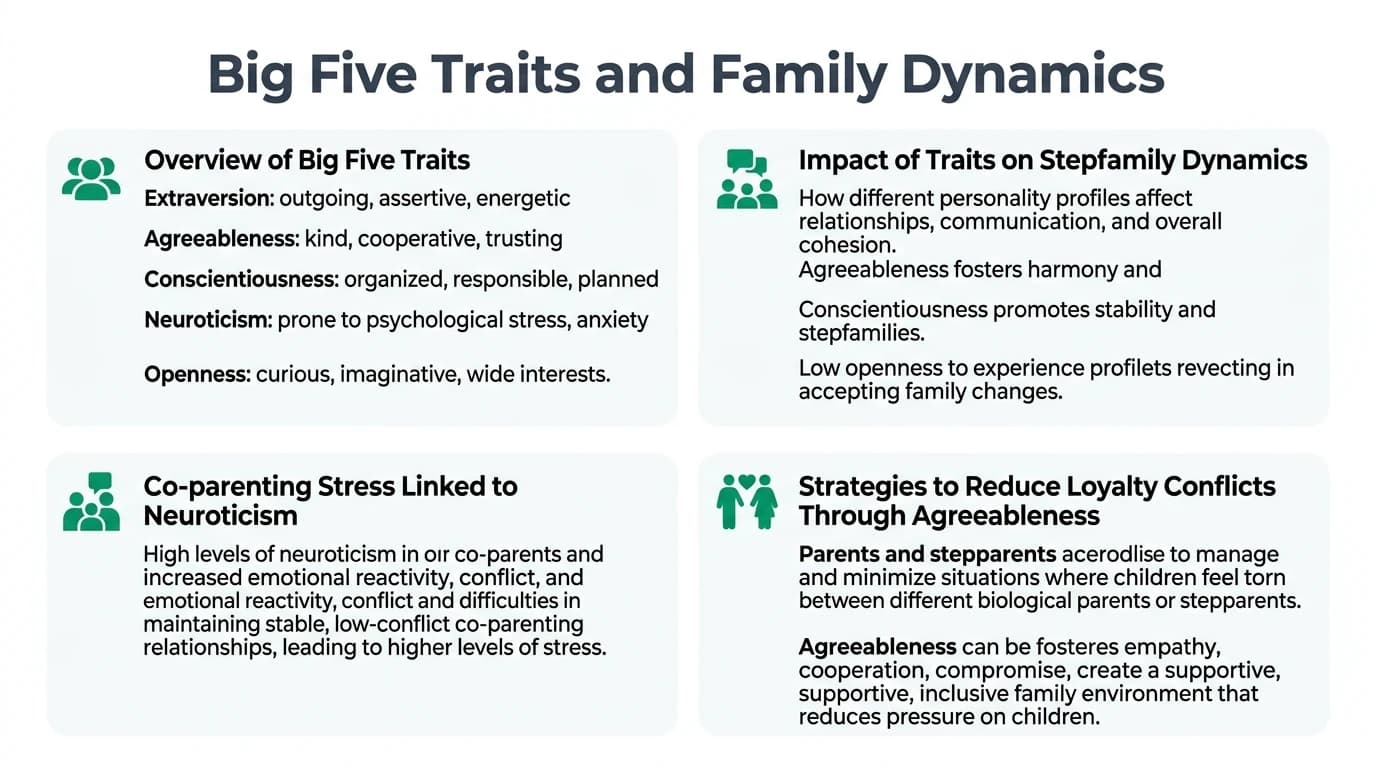
The Big Five traits—extraversion, agreeableness, conscientiousness, neuroticism, and openness—impact family interactions, co-parenting stress, and adjustment in blended families.
Source: PMC/NCBI
Executive Summary
Blended families face unique challenges, and personality traits play a significant role in navigating these dynamics. The Big Five traits—extraversion, agreeableness, conscientiousness, neuroticism, and openness—affect how family members interact, manage stress, and adjust to new family structures.
The bottom line: Understanding these traits can help reduce conflict and improve family cohesion.
Critical: Always consider consulting a family therapist for personalized advice.
What Are the Big Five Personality Traits?
The Big Five, also known as the OCEAN model, includes:
- Extraversion: Outgoing, energetic.
- Agreeableness: Cooperative, compassionate.
- Conscientiousness: Organized, responsible.
- Neuroticism: Anxious, moody.
- Openness: Creative, imaginative.
These traits can predict family interactions, with agreeableness often reducing arguments12.
| Trait | Description |
|---|---|
| Extraversion | Outgoing, energetic |
| Agreeableness | Cooperative, compassionate |
| Conscientiousness | Organized, responsible |
| Neuroticism | Anxious, moody |
| Openness | Creative, imaginative |
How Do Big Five Traits Influence Stepfamily Dynamics?
Key Influences
- Conscientiousness: Mediates family dynamics and sleep quality3.
- Extraversion: Links to work-family facilitation4.
- Neuroticism: Increases conflict and stress42.
| Trait | Effect on Dynamics | Example |
|---|---|---|
| Conscientiousness | Better sleep, organized family | Structured routines |
| Extraversion | Work-family balance | Social activities |
| Neuroticism | Higher stress, conflicts | Frequent arguments |
What Is the Impact of Co-Parenting Stress?
Co-parenting stress is often linked to neuroticism, leading to:
- Increased conflict: Emotional instability can heighten disputes.
- Loyalty conflicts: Children may feel torn between parents.
Important: Addressing neuroticism through therapy can reduce stress.
How Do Loyalty Conflicts Arise in Blended Families?
Loyalty conflicts often emerge when children feel divided between biological and step-parents. Agreeableness in parents and children can help:
- Reduce arguments: Promotes harmony.
- Foster loyalty: Encourages family unity.
| Factor | Impact on Loyalty |
|---|---|
| High Agreeableness | Fewer arguments |
| Low Agreeableness | Increased tension |
How Does Family Adjustment Occur?
Family adjustment is mediated by traits like conscientiousness and agreeableness:
- Conscientiousness: Promotes organized routines.
- Agreeableness: Encourages positive interactions.
| Mediator Trait | Effect on Adjustment |
|---|---|
| Conscientiousness | Improved routines |
| Agreeableness | Positive interactions |
How Do Parental Traits Affect Child Outcomes?
Parental traits significantly influence child development:
- Extraversion and Agreeableness: Boost academic and social success.
- Neuroticism: May lead to emotional challenges.
| Parental Trait | Child Outcome |
|---|---|
| Extraversion | Social success |
| Agreeableness | Academic achievement |
| Neuroticism | Emotional challenges |
How Does Socioeconomic Status (SES) Interact with Personality?
High SES can enhance traits like extraversion and emotional stability in children5.
| SES Level | Traits Boosted |
|---|---|
| High | Extraversion, stability |
| Low | Fewer trait enhancements |
What Are the Effects of Work-Family Spillover?
Personality traits predict about 15% of the variance in work-family conflict and facilitation4.
| Direction | Predictive Traits | Variance Explained |
|---|---|---|
| Conflict | Neuroticism | 15% |
| Facilitation | Extraversion | 15% |
Action checklist
- Identify key personality traits in your family.
- Focus on enhancing agreeableness and conscientiousness.
- Seek professional guidance for managing neuroticism-related stress.
FAQ
How do Big Five traits influence stepfamily loyalty conflicts?
Agreeableness helps reduce loyalty conflicts by fostering cooperation and understanding. 2
What role does agreeableness play in blended family adjustment?
Agreeableness promotes harmony and reduces arguments, aiding in smoother adjustments. 2
Does neuroticism increase co-parenting stress in stepfamilies?
Yes, neuroticism is linked to higher stress and conflict in co-parenting situations. 4
How does conscientiousness affect family dynamics?
Conscientiousness leads to better organization and stability in family routines. 3
Can parental personality predict child outcomes in blended families?
Yes, traits like extraversion and agreeableness in parents can boost children's social and academic success. 2
What Big Five traits reduce work-family conflict for stepparents?
Extraversion and agreeableness help reduce work-family conflict by fostering balance and cooperation. 4
How does family SES impact Big Five traits in children?
High SES often enhances traits like extraversion and emotional stability in children. 5
Notes
Primary Sources
| Source | Type | URL |
|---|---|---|
| PMC/NCBI | Peer-reviewed | https://pmc.ncbi.nlm.nih.gov/articles/PMC8953608/ |
| Taylor & Francis | Peer-reviewed | https://www.tandfonline.com/doi/full/10.1080/00221325.2025.2584995 |
| MIDUS (U. Wisconsin) | Peer-reviewed | https://midus.wisc.edu/wp-content/uploads/2024/04/262.pdf |
Conclusion
Understanding the Big Five personality traits can greatly enhance the dynamics within blended families. By focusing on traits like agreeableness and conscientiousness, families can foster better relationships and reduce stress.