personality-tests
Personality Tests for Remote Teams: Implementation Playbook for Managers
Explore how to effectively implement personality tests in remote teams to enhance collaboration, communication, and productivity.
Quick answer
How can personality tests benefit remote teams?
Personality tests improve communication, collaboration, and conflict resolution in remote teams, leading to increased productivity and engagement.
Source: Journal of Occupational and Organizational Psychology
Executive Summary
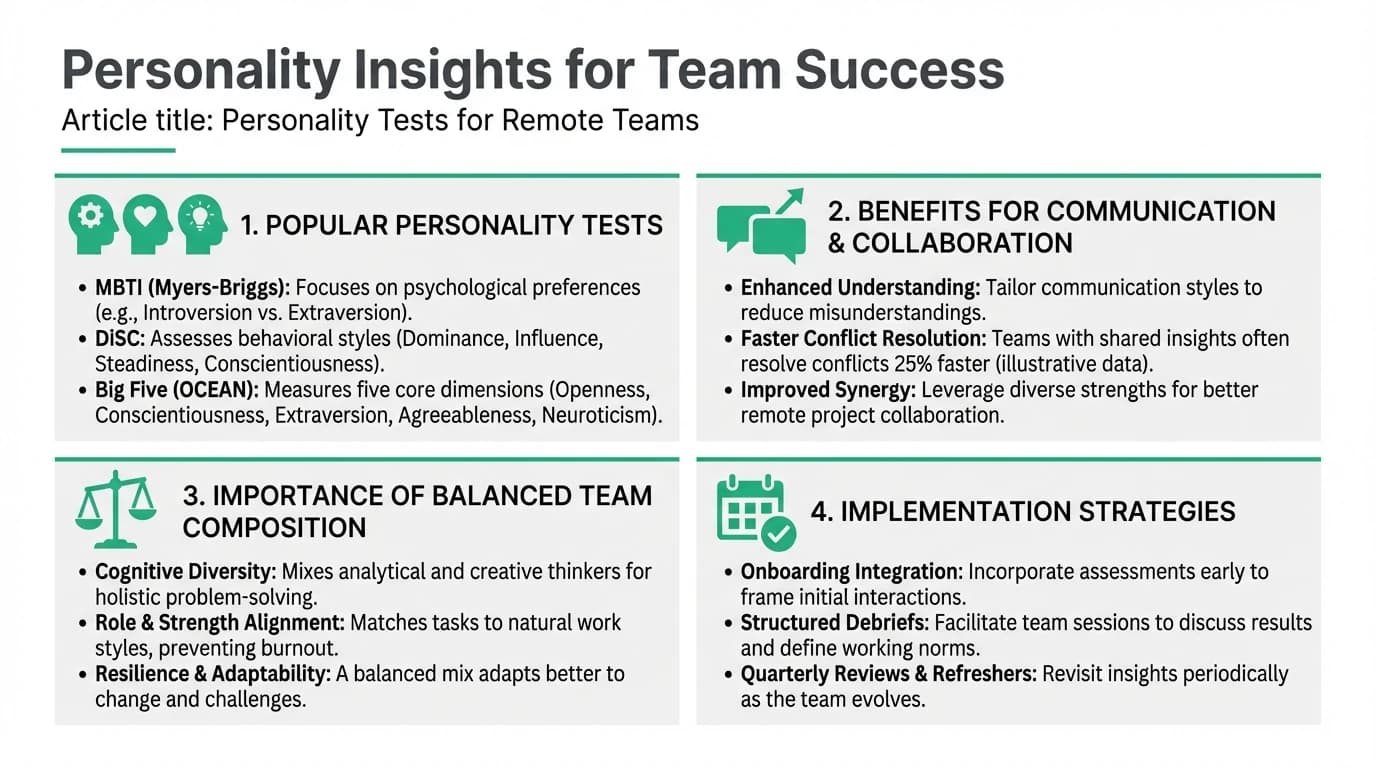
Personality tests have become a pivotal tool for enhancing the dynamics of remote teams. By understanding individual traits and preferences, managers can foster an environment of mutual respect and effective communication. Popular assessments like MBTI, DiSC, and Big Five offer insights that are crucial for virtual collaboration.
Key takeaway: Implementing personality tests in remote teams can lead to faster conflict resolution, improved productivity, and a more harmonious work environment.
To avoid weak implementation patterns, pair this playbook with Personality Test Reliability, use Big Five Personality Test: Complete Interpretation Guide for trait-level decisions, and run workshops with the Big Five Role-Fit Calculator.
Understanding Popular Personality Assessments
Personality assessments such as MBTI, DiSC, Big Five, and TypeFinder are widely used in remote teams to understand individual differences. Each test provides unique insights into team members' communication styles and work preferences.
| Assessment | Focus | Key Benefit |
|---|---|---|
| MBTI | Psychological preferences | Enhances understanding of team dynamics |
| DiSC | Behavior styles | Improves communication and reduces conflict |
| Big Five | Traits like openness and conscientiousness | Predicts productivity and work-from-home success |
| TypeFinder | Personality types | Facilitates team building and role alignment |
For example, a team using the DiSC assessment might discover that having a balanced profile of Dominance, Influence, Steadiness, and Conscientiousness leads to better performance and satisfaction1.
Benefits for Virtual Communication and Collaboration
Understanding personality types can significantly improve virtual communication. Teams that leverage these insights report resolving conflicts 25% faster and experiencing higher collaboration satisfaction2.
Consider a scenario where a remote team uses the Big Five assessment. Members with high openness and conscientiousness tend to adapt better to remote work, enhancing overall team productivity.
Team Composition and Balance
A balanced team composition is crucial for success in virtual settings. For instance, a team with a mix of DiSC profiles (Dominant, Inducement, Submission, Compliance) performs better than an imbalanced one3.
| Team Composition | Performance Metrics | Outcome |
|---|---|---|
| Balanced DiSC | Higher satisfaction, less conflict | Enhanced communication and project outcomes |
| Imbalanced DiSC | Increased conflict, stalled development | Lower satisfaction and effectiveness |
Managers should aim for a diverse mix of personality types to optimize team dynamics.
Implementation Strategies
Effective implementation of personality tests involves strategic timing and integration with existing platforms. Conduct assessments during onboarding and quarterly reviews to ensure up-to-date insights4.
For example, integrating TypeFinder results into team meetings can help tailor communication strategies, making interactions more effective and personalized.
Linking Personality to Remote Productivity
Research shows that certain personality traits, such as conscientiousness and openness, are positively linked to remote work productivity5. Teams that recognize and leverage these traits can enhance their overall performance.
Consider a remote team where members with high conscientiousness are assigned task management roles, leading to improved efficiency and output.
Psychological Safety and Personality Interplay
Psychological safety is a critical factor in remote team success. Teams with high psychological safety report better collaboration and platform adoption6.
| Safety Level | Collaboration Quality | Platform Adoption |
|---|---|---|
| High | Strong | Positive |
| Low | Weak | Negative |
Managers should foster an environment where team members feel safe to express themselves, enhancing both collaboration and productivity.
Modern Assessment Formats
Modern personality assessments are evolving with technology, offering AI-based, video, and gamified formats that increase engagement and accuracy2.
For instance, a gamified assessment might reduce anxiety and capture non-verbal cues, providing a more comprehensive understanding of team dynamics.
If your team still relies on typology-based language, compare limitations and benefits in MBTI vs Big Five before standardizing your remote collaboration rituals.
Action checklist
- Identify the right personality test for your team.
- Conduct assessments during onboarding and quarterly reviews.
- Discuss results openly to enhance team understanding.
- Ensure a balanced team composition for optimal performance.
- Foster psychological safety to improve collaboration.
FAQ
What are the best personality tests for remote teams?
How do personality tests improve remote work?
When should personality assessments be conducted?
What is the role of psychological safety in remote teams?
How do modern assessment formats benefit remote teams?
Primary Sources
| Source | Type | URL |
|---|---|---|
| APA Dictionary of Psychology | Institutional definition | dictionary.apa.org/five-factor-model |
| Journal of Occupational and Organizational Psychology | Research reference | onlinelibrary.wiley.com/journal/20448325 |
| IZA Institute of Labor Economics | Remote productivity study | docs.iza.org/dp15486.pdf |
| Truity / Luxembourg Institute references | Remote team personality context | truity.com/blog/when-your-team-remote-does-personality-even-matter |