personal-development
Personality and Creativity: What the Research Says About Big Five and Innovation
Evidence-based guide on how Openness, Extraversion, and other Big Five traits predict creative thinking, idea generation, and innovation outcomes.
Quick answer
Which personality trait predicts creativity?
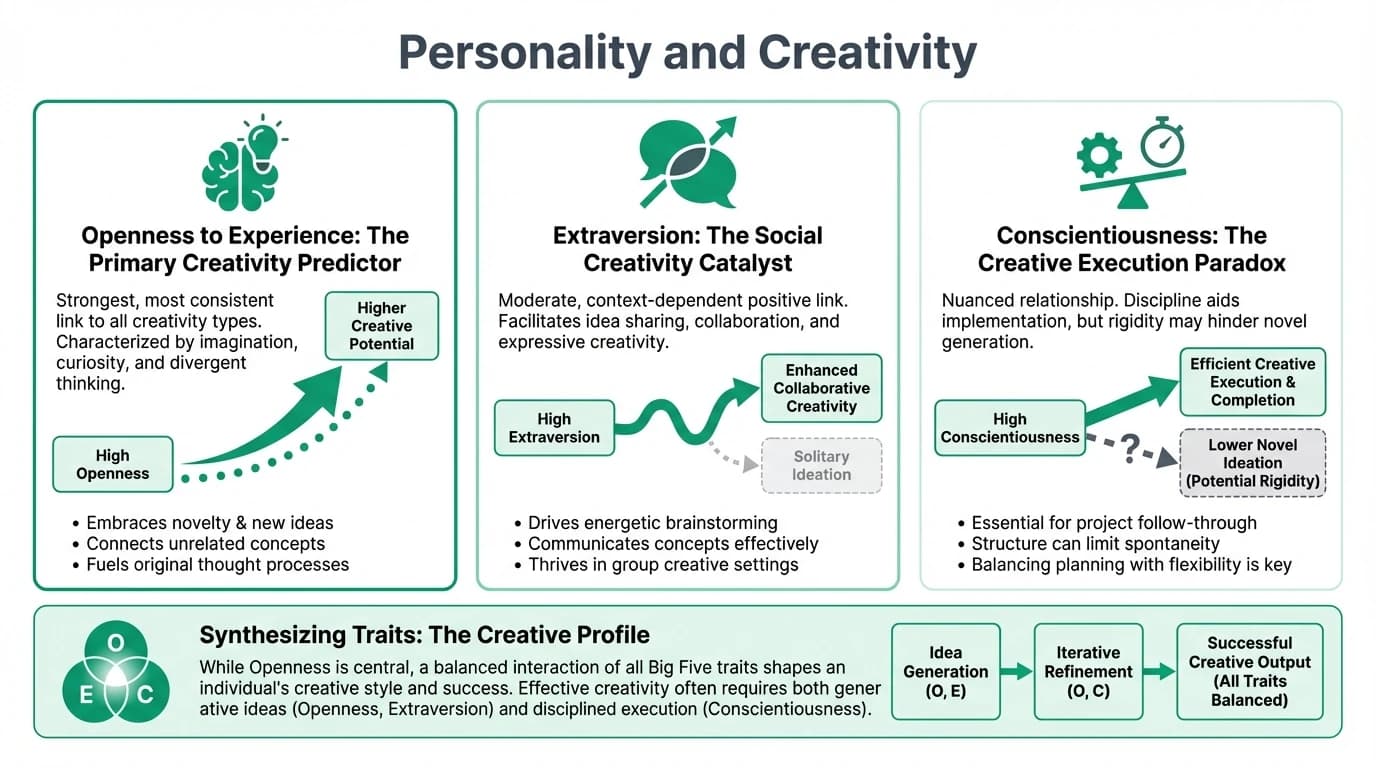
Openness to Experience is the strongest and most consistent predictor of creativity across studies. Extraversion and low Conscientiousness also correlate with some creative outcomes—but Openness dominates.
Source: Feist (1998), Meta-analysis
Executive Summary
Creativity isn't random. Decades of research link personality to creative achievement. Openness to Experience tops the list—but the full picture is nuanced. Different traits support different kinds of creativity.
The bottom line: Your profile shapes how you create. Awareness helps you leverage strengths and compensate for gaps.
Important: Traits predict tendencies, not ceilings. Creative skills can be developed regardless of personality.
Big Five and Creativity: The Evidence
| Trait | Correlation with creativity | Type of creativity |
|---|---|---|
| Openness | Strong (r ≈ .30–.40) | Divergent thinking, artistic, scientific |
| Extraversion | Moderate | Idea generation, collaborative creativity |
| Conscientiousness | Mixed/negative for some | Execution; may constrain brainstorming |
| Agreeableness | Weak or negative | Group harmony vs. disruptive ideas |
| Neuroticism | Weak; complex | Artistic expression; can hinder focus |
- Openness is the most replicated predictor across domains: art, science, everyday problem-solving.
- Extraversion helps in group ideation and performance contexts.
- Conscientiousness supports follow-through but can reduce risk-taking in idea phase.
Openness: The Creativity Engine
Openness captures curiosity, imagination, and preference for novelty. It predicts:
- Divergent thinking (many ideas from one prompt)
- Artistic and scientific achievement
- Willingness to explore unconventional solutions
| Openness facet | Creative contribution |
|---|---|
| Ideas | Abstract thinking, conceptual leaps |
| Aesthetics | Sensitivity to design, pattern, beauty |
| Feelings | Emotional depth in expression |
| Actions | Willingness to try new methods |
| Values | Challenge to status quo |
Caveat: High Openness without follow-through can mean many ideas, few shipped. Pair with Conscientiousness or external accountability.
Extraversion: Idea Generation and Collaboration
Extraverts tend to generate more ideas in group settings. They're energized by interaction and often think out loud.
| Context | Extraversion helps | Extraversion hinders |
|---|---|---|
| Brainstorming | Volume of ideas; energy | May dominate; shut down introverts |
| Solo deep work | — | May seek distraction |
| Pitching ideas | Confidence; persuasion | — |
| Networking | Cross-pollination | — |
- Research: Extraversion predicts self-reported creative achievement more than objective tests.
- Practical: In teams, balance extravert energy with structured "quiet time" for introverts to contribute.
Conscientiousness: The Double-Edged Sword
Conscientiousness supports execution—planning, persistence, quality control. For idea generation, it can be a constraint.
| Phase | High Conscientiousness | Low Conscientiousness |
|---|---|---|
| Ideation | May self-censor; prefer "safe" ideas | More wild ideas; less filter |
| Execution | Strong follow-through | May abandon projects |
| Refinement | Attention to detail | May ship rough drafts |
- Insight: The most creative achievers often have high Openness + moderate Conscientiousness—enough to finish, not so much that they kill ideas early.
Agreeableness and Neuroticism: Nuanced Roles
| Trait | Creative role | Caveat |
|---|---|---|
| Agreeableness | Team creativity; builds on others' ideas | May avoid conflict needed for breakthrough thinking |
| Neuroticism | Emotional intensity in art; sensitivity | Can undermine focus and persistence |
- Agreeableness: Helps in collaborative contexts. May reduce willingness to challenge assumptions.
- Neuroticism: Linked to artistic creativity in some studies—but also to burnout and abandonment.
Creativity Type by Trait Profile
| Profile | Typical creative strength | Typical weakness |
|---|---|---|
| High O, High E | Ideation; collaboration; pitching | May lack depth; spread thin |
| High O, High C | Sustained projects; refinement | May over-edit; delay shipping |
| High O, Low C | Raw ideas; experimentation | May not finish |
| High O, High N | Emotional art; intensity | May struggle with consistency |
How to Boost Creativity Regardless of Profile
| Strategy | Works especially for | Why |
|---|---|---|
| Constraints | High O, low C | Focuses ideation; forces decisions |
| Solo incubation | Introverts | Reduces social pressure; allows depth |
| Structured brainstorming | High C | Legitimizes "wild" phase before critique |
| Cross-domain exposure | All | Triggers novel associations |
| Accountability partners | Low C | Offsets follow-through gap |
- Constraints: "Solve X in 3 ways" or "Use only Y" often sparks more creativity than "do anything."
- Incubation: Stepping away and returning later improves insight—especially for those who overthink.
Team Creativity: Balancing Traits
| Team goal | Trait mix to aim for | Avoid |
|---|---|---|
| Ideation | High O, mix of E and I | All high C (may kill ideas early) |
| Execution | High C, some O | All low C (nothing ships) |
| Innovation | O + C + diverse perspectives | Homogeneous high A (no constructive conflict) |
- Principle: Diversity of traits beats homogeneity. Introverts + extraverts, high O + high C, creates tension that yields better outcomes.
Common Myths vs. Research
| Myth | Reality |
|---|---|
| "Creative people are disorganized" | Mixed. High O + low C exists, but many creative achievers are conscientious. |
| "You're either creative or not" | Openness is partly heritable, but creative skills can be trained. |
| "Brainstorming requires no criticism" | Deferring criticism helps volume; critique later improves quality. |
| "Artists are neurotic" | Some correlation, but causation is unclear. Neuroticism can hinder as much as help. |
Self-Assessment: Your Creative Profile
| If you're high in… | Ask yourself |
|---|---|
| Openness | Do I finish? Do I need more structure or accountability? |
| Extraversion | Do I create space for others' ideas? Do I need solo time for depth? |
| Conscientiousness | Do I kill ideas too early? Do I need "wild" phases without critique? |
| Agreeableness | Do I challenge assumptions? Do I need permission to disagree? |
| Neuroticism | Does anxiety block me? Do I need stress-management to create consistently? |
Creativity and personality action list
- Take a Big Five assessment to know your profile.
- Identify your creative strength (ideation vs. execution vs. refinement).
- Choose one strategy that compensates for your weaker trait.
- In teams, ensure trait diversity—not just skill diversity.
- Use constraints to focus ideation.
FAQ
Is Openness the only trait that matters for creativity?
Can you become more creative if you're low in Openness?
Do creative people have to be messy or disorganized?
Does Neuroticism help or hurt creativity?
How do introverts contribute to team creativity?
Why do some high-Openness people struggle to finish projects?
What's the best personality profile for innovation?
Primary Sources
| Source | Type | URL |
|---|---|---|
| Feist (1998) | Meta-analysis of personality and creativity | APA PsycNet |
| Batey & Furnham (2006) | Creativity, intelligence, personality | ScienceDirect |
| APA – Creativity | Definition | dictionary.apa.org |
Conclusion
Openness drives creativity—but the full Big Five profile shapes how you generate ideas, collaborate, and ship. Use self-knowledge to leverage strengths and compensate for gaps. Start with our Big Five Personality Test Complete Guide.