leadership
Leadership and Personality: How Big Five Traits Predict Leadership Success and Leadership Style
Explore how the Big Five personality traits influence leadership success and style, with insights into trait theory and real-world applications.
Quick answer
How do the Big Five personality traits predict leadership success?
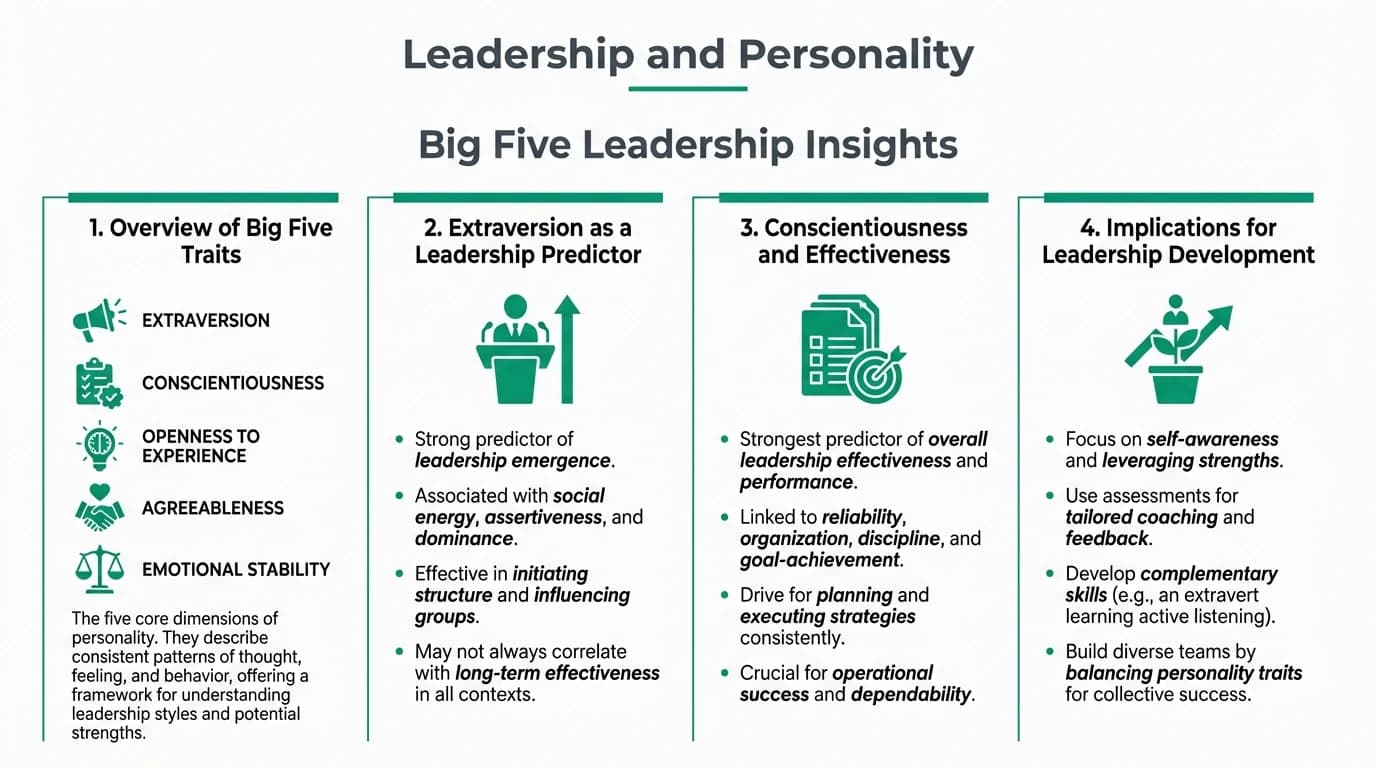
The Big Five personality traits—Extraversion, Conscientiousness, Openness to Experience, Agreeableness, and Emotional Stability—predict leadership success by correlating with leadership emergence and effectiveness. Extraversion and Conscientiousness are particularly strong predictors, influencing traits like dominance and dependability.
Source: Center for Creative Leadership
Executive Summary
Understanding the connection between personality and leadership can significantly enhance leadership development and team dynamics. The Big Five personality traits—Extraversion, Conscientiousness, Openness to Experience, Agreeableness, and Emotional Stability—provide a robust framework for predicting leadership success and style. Studies have shown that these traits correlate with leadership emergence and effectiveness, offering valuable insights for both aspiring leaders and organizations.
Extraversion and Conscientiousness are particularly influential, with Extraversion linked to leadership emergence due to traits like sociability and dominance, and Conscientiousness associated with leadership effectiveness through dependability and achievement orientation. These traits, along with Openness to Experience, Agreeableness, and Emotional Stability, form a composite picture of potential leadership capabilities.
The bottom line: While personality traits offer predictive insights into leadership potential, it's crucial to recognize the role of developable skills and situational factors in shaping effective leadership.
Critical Warning: Over-reliance on personality traits without considering situational and skill-based factors can lead to misjudgments in leadership selection and development.
1) Overview of Big Five Traits in Leadership
What is the Big Five Model?
The Big Five model categorizes personality into five broad traits: Extraversion, Conscientiousness, Openness to Experience, Agreeableness, and Emotional Stability (inverse of Neuroticism). These traits have been validated through extensive research and are used to predict various life outcomes, including leadership.
How Does the Big Five Model Work?
The model works by grouping personality characteristics into five factors, each representing a spectrum. For instance, Extraversion encompasses traits like sociability and assertiveness, while Conscientiousness includes dependability and discipline.
Key Mechanics
- Extraversion: Linked to sociability and leadership emergence.
- Conscientiousness: Associated with reliability and leadership effectiveness.
- Openness: Encourages creativity and adaptability in leadership.
- Agreeableness: Involves empathy and cooperation.
- Emotional Stability: Reflects resilience and calmness under pressure.
Example of Trait Application
Consider a team leader high in Conscientiousness and Openness. They are likely to excel in planning and innovative problem-solving, crucial for project management roles.
Key Takeaways
- Extraversion and Conscientiousness are strong predictors of leadership success.
- Openness to Experience fosters innovative leadership styles.
- Agreeableness and Emotional Stability contribute to team cohesion and resilience.
2) Extraversion as the Strongest Leadership Predictor
What is Extraversion?
Extraversion refers to traits such as sociability, assertiveness, and enthusiasm. It is the strongest predictor of leadership emergence, with a correlation of r=.31.
How Does Extraversion Influence Leadership?
Extraverted leaders often inspire and motivate their teams through their dynamic presence and communication skills. They are more likely to take charge in group settings and influence organizational culture.
Key Mechanics
- Dominance: Extraverts often take leadership roles naturally.
- Sociability: Facilitates networking and team building.
- Influence: Extraverts can shape company culture through their interactions.
Example of Extraversion in Leadership
A CEO with high Extraversion may drive company culture by fostering open communication and a collaborative environment, thus enhancing employee engagement.
Key Takeaways
- Extraversion is crucial for leadership emergence.
- Sociability and assertiveness are key traits for motivating teams.
- Cultural influence is often stronger with extraverted leaders.
3) Conscientiousness and Leadership Effectiveness
What is Conscientiousness?
Conscientiousness includes traits like dependability, organization, and goal-orientation. It correlates with leadership effectiveness (r=.28).
How Does Conscientiousness Affect Leadership?
Leaders high in Conscientiousness are often seen as reliable and disciplined, making them effective in strategic planning and execution.
Key Mechanics
- Dependability: Ensures consistent performance and trust.
- Achievement-Orientation: Drives goal-setting and accomplishment.
- Attention to Detail: Enhances precision in decision-making.
Example of Conscientiousness in Leadership
A project manager with high Conscientiousness ensures deadlines are met and quality standards are maintained, leading to successful project outcomes.
Key Takeaways
- Conscientiousness is vital for leadership effectiveness.
- Dependability and discipline enhance strategic execution.
- Goal-orientation supports achievement and progress.
4) Openness to Experience in Innovative Leadership
What is Openness to Experience?
Openness to Experience involves traits such as creativity, curiosity, and open-mindedness. It positively correlates with innovative leadership (r=.24).
How Does Openness Influence Leadership?
Leaders high in Openness are often more adaptable and willing to explore new ideas, making them effective in dynamic and innovative environments.
Key Mechanics
- Creativity: Encourages novel solutions and approaches.
- Adaptability: Supports flexibility in changing circumstances.
- Curiosity: Drives continuous learning and improvement.
Example of Openness in Leadership
An R&D director with high Openness may lead a team to develop groundbreaking products by fostering a culture of experimentation and innovation.
Key Takeaways
- Openness is key for innovative leadership.
- Creativity and adaptability drive change and progress.
- Curiosity supports learning and development.
5) Neuroticism (Emotional Stability) as a Hindrance
What is Neuroticism?
Neuroticism, or low Emotional Stability, involves traits like anxiety and emotional volatility. It negatively correlates with leadership effectiveness (r=-.24).
How Does Neuroticism Affect Leadership?
Leaders with high Neuroticism may struggle with stress and decision-making, impacting their effectiveness and team morale.
Key Mechanics
- Emotional Volatility: Can lead to inconsistent leadership.
- Stress Management: Affects decision-making under pressure.
- Resilience: Low levels may hinder crisis management.
Example of Neuroticism in Leadership
A leader with low Emotional Stability may react poorly to setbacks, causing team uncertainty and reducing overall effectiveness.
Key Takeaways
- Low Emotional Stability can hinder leadership effectiveness.
- Resilience and calmness are crucial for effective leadership.
- Stress management is essential for decision-making.
6) Agreeableness: Mixed Effects on Leadership
What is Agreeableness?
Agreeableness encompasses traits like empathy, cooperation, and trust. It has a weak correlation with leadership effectiveness (r=.08).
How Does Agreeableness Influence Leadership?
While high Agreeableness can foster a supportive team environment, it may also lead to challenges in making tough decisions.
Key Mechanics
- Empathy: Builds strong team relationships.
- Cooperation: Enhances team collaboration.
- Decision-Making: May struggle with difficult choices.
Example of Agreeableness in Leadership
A team leader with high Agreeableness may excel in team-building but need support in making strategic decisions that require toughness.
Key Takeaways
- Agreeableness supports team cohesion and trust.
- Empathy enhances interpersonal relationships.
- Decision-making can be challenging for highly agreeable leaders.
7) Big Five Predictors of Leadership Emergence vs. Effectiveness
What is Leadership Emergence vs. Effectiveness?
Leadership emergence refers to the process by which individuals become recognized as leaders, while effectiveness pertains to their performance in leadership roles.
How Do the Big Five Predict These Outcomes?
Extraversion is a strong predictor of emergence, while a combination of traits predicts effectiveness. Meta-analyses show confidence intervals excluding zero for four traits.
Key Mechanics
- Emergence: Driven by Extraversion and sociability.
- Effectiveness: Requires a composite of traits, including Conscientiousness and Openness.
- Meta-Analysis: Confirms predictive power across multiple studies.
Example of Emergence vs. Effectiveness
An extraverted individual may quickly rise to a leadership position, but effectiveness will depend on their Conscientiousness and Emotional Stability.
Key Takeaways
- Extraversion is key for leadership emergence.
- Effectiveness requires a blend of traits.
- Meta-analyses validate these predictive relationships.
8) Personality Profiles by Leadership Role
What are Personality Profiles?
Personality profiles describe the typical trait combinations found in different leadership roles, such as entrepreneurs vs. managers.
How Do Profiles Differ by Role?
Entrepreneurs often exhibit high Openness and Conscientiousness, while managers may show lower Agreeableness but high Conscientiousness.
Key Mechanics
- Entrepreneurs: High Openness, low Neuroticism.
- Managers: High Conscientiousness, lower Agreeableness.
- Supervisors: Balance traits for team management.
Example of Role-Specific Profiles
An entrepreneur may thrive in a startup environment with high Openness, while a manager excels in structured corporate settings with high Conscientiousness.
Key Takeaways
- Profiles vary by leadership role.
- Openness and Conscientiousness are common in entrepreneurs.
- Managers often require high Conscientiousness.
9) Big Five and Transformational Leadership Styles
What is Transformational Leadership?
Transformational leadership involves inspiring and motivating teams to achieve extraordinary outcomes through vision and influence.
How Do the Big Five Influence Transformational Leadership?
Traits like Extraversion and Agreeableness can mediate transformational leadership effects, enhancing team motivation and knowledge creation.
Key Mechanics
- Extraversion: Drives emotional expressiveness and influence.
- Agreeableness: Enhances empathy and team cohesion.
- Mediation: Traits influence transformational outcomes.
Example of Transformational Leadership
A transformational leader with high Extraversion and Agreeableness may inspire a team to exceed goals through vision and empathy.
Key Takeaways
- Transformational leadership is influenced by Extraversion and Agreeableness.
- Emotional expressiveness enhances leadership impact.
- Team cohesion is strengthened by empathy.
10) Applying Big Five for Team Leadership and Hiring
How Can the Big Five Be Used in Hiring?
The Big Five can guide hiring decisions by aligning personality traits with job requirements, ensuring role fit and team dynamics.
How Does This Application Work?
By assessing candidates' Big Five profiles, organizations can predict job performance and leadership potential, enhancing team effectiveness.
Key Mechanics
- Trait Alignment: Matches roles with personality traits.
- Performance Prediction: Uses profiles to forecast success.
- Team Dynamics: Enhances compatibility and cohesion.
Example of Hiring Application
A company hiring a creative director may prioritize high Openness and Extraversion to foster innovation and team collaboration.
Key Takeaways
- Big Five guides hiring and team leadership.
- Trait alignment ensures role fit and performance.
- Team dynamics are enhanced through compatibility.
Action checklist
- Assess leadership candidates using the Big Five model.
- Align leadership roles with corresponding personality traits.
- Provide training to develop non-trait leadership skills.
FAQ
What are the Big Five personality traits?
How does Extraversion predict leadership success?
Can leadership skills be developed beyond personality traits?
How is Conscientiousness linked to leadership effectiveness?
Why is Neuroticism considered a hindrance in leadership?
What role does Agreeableness play in leadership?
How can the Big Five be applied in hiring decisions?
Notes
Primary Sources
| Source | Type | URL |
|---|---|---|
| Center for Creative Leadership | Article | cclinnovation.org |
| PMC / NIH | Article | pmc.ncbi.nlm.nih.gov |
| Michigan State University | Article | michiganstateuniversityonline.com |
| Stanford GSB | Article | gsb.stanford.edu |
| University of Baltimore | home.ubalt.edu | |
| EconStor | econstor.eu |
Conclusion
The Big Five personality traits offer valuable insights into leadership success and style, with Extraversion and Conscientiousness as key predictors. While these traits provide a foundation, effective leadership also requires the development of skills and adaptability to situational factors.