personality-tests
Personality and Decision-Making Styles: Big Five Guide
Explore how the Big Five personality traits shape decision-making styles, including risk-taking, analytical vs intuitive thinking, and group dynamics.
Quick answer
How do Big Five traits influence decision-making?
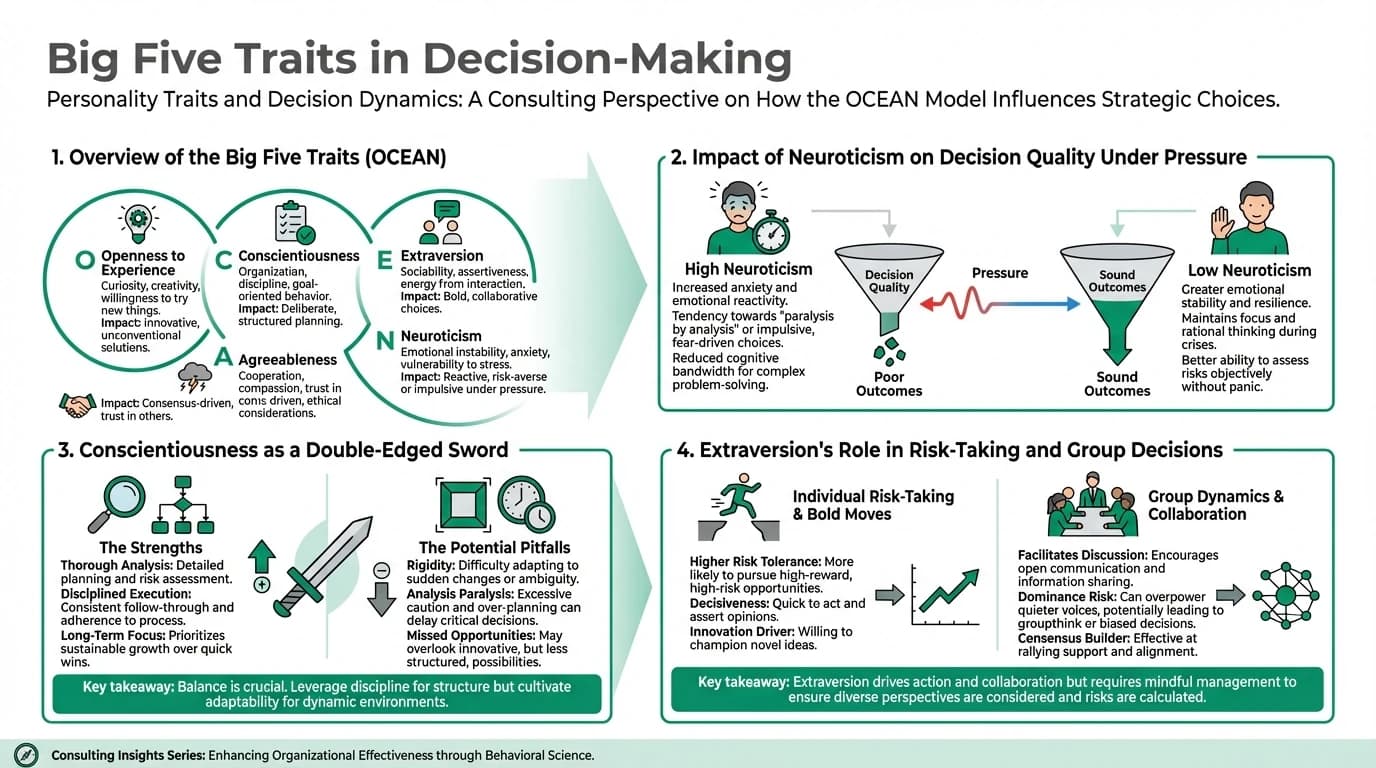
The Big Five traits—openness, conscientiousness, extraversion, agreeableness, and neuroticism—impact decision-making by shaping risk-taking, analytical vs intuitive thinking, and group dynamics. For instance, neuroticism often undermines decision quality under pressure, while extraversion can enhance social decision-making.
Source: NCBI/PMC
Executive Summary
Understanding the Big Five personality traits provides valuable insights into decision-making styles. These traits influence how individuals approach risk, balance analytical and intuitive thinking, and make group decisions.
The bottom line: Personality traits are critical in shaping decision-making styles, impacting both personal and professional outcomes.
What Are the Big Five Personality Traits?
The Big Five model includes:
- Openness to Experience: Creativity and willingness to try new things.
- Conscientiousness: Organization and dependability.
- Extraversion: Sociability and assertiveness.
- Agreeableness: Cooperation and compassion.
- Neuroticism: Emotional instability and anxiety.
Table 1: Big Five Traits Overview
| Trait | Description | Key Behaviors |
|---|---|---|
| Openness | Creativity, curiosity | Embracing new ideas |
| Conscientiousness | Organization, reliability | Planning ahead |
| Extraversion | Sociability, assertiveness | Engaging with others |
| Agreeableness | Compassion, cooperation | Prioritizing harmony |
| Neuroticism | Anxiety, moodiness | Emotional reactivity |
How Neuroticism Affects Decision Quality
- Effect: Negative impact under pressure.
- Process: Emotional stress leads to frantic decisions.
- Caveat: May be mitigated with coping strategies.
Table 2: Neuroticism and Decision-Making
| Scenario | Impact | Mitigation |
|---|---|---|
| High-pressure tasks | Decreased performance | Stress management techniques |
| Routine decisions | Minimal impact | Consistent routines |
Conscientiousness: A Double-Edged Sword
Conscientiousness is linked to career success but can hinder flexibility under pressure.
- Strengths: Planning and organization.
- Weaknesses: Inflexibility in dynamic situations.
Table 3: Conscientiousness in Decision Contexts
| Context | Benefit | Drawback |
|---|---|---|
| Structured tasks | High efficiency | Rigidity |
| Unstructured tasks | Over-preparation | Lack of adaptability |
Extraversion and Risk-Taking
Extraversion can enhance social decision-making and risk assessment.
- Role: Balances neuroticism effects.
- Outcome: Improved group dynamics.
Table 4: Extraversion's Influence
| Aspect | Effect | Example |
|---|---|---|
| Social decisions | Positive | Team leadership |
| Risk assessment | Balanced | Calculated risks |
Agreeableness and Group Decisions
Agreeableness predicts socially conscious decisions but may compromise individual optimization.
- Strength: Promotes group welfare.
- Weakness: May neglect personal goals.
Table 5: Agreeableness in Group Settings
| Decision Type | Benefit | Limitation |
|---|---|---|
| Group welfare | Enhanced cooperation | Personal sacrifice |
| Individual goals | Potential neglect | Reduced assertiveness |
Openness: Creativity vs. Execution
Openness fosters creativity but may struggle with execution.
- Strengths: Innovative solutions.
- Weaknesses: Implementation challenges.
Table 6: Openness in Decision-Making
| Phase | Advantage | Challenge |
|---|---|---|
| Idea generation | High creativity | Overlooking practicalities |
| Execution | Visionary | Execution difficulties |
Decision-Making Styles: Vigilance and Avoidance
Different styles include vigilance, hypervigilance, buck-passing, and procrastination.
- Vigilance: Thorough and deliberate.
- Hypervigilance: Frantic and rushed.
Table 7: Decision Styles and Personality
| Style | Description | Personality Link |
|---|---|---|
| Vigilance | Comprehensive evaluation | Low neuroticism |
| Hypervigilance | Rushed decisions | High neuroticism |
Analytical vs. Intuitive Thinking
Personality influences whether individuals lean towards analytical or intuitive thinking.
- Conscientiousness: Analytical depth.
- Openness: Intuitive insights.
Table 8: Thinking Styles
| Style | Trait Influence | Example |
|---|---|---|
| Analytical | Conscientiousness | Data-driven decisions |
| Intuitive | Openness | Creative problem-solving |
Action checklist
- Take a Big Five assessment to understand your decision-making tendencies.
- Identify situations where your traits may help or hinder decisions.
- Adapt feedback and collaboration styles to team members' traits.
Conclusion
Personality traits significantly influence decision-making styles, impacting risk-taking, analytical thinking, and group decisions. Understanding these traits can enhance decision quality in personal and professional contexts.
FAQ
How does neuroticism affect decision-making?
Can conscientiousness be a disadvantage?
What role does extraversion play in group decisions?
Is agreeableness always beneficial in decision-making?
How does openness affect decision-making?
What is the difference between analytical and intuitive thinking?
How can understanding personality improve decision-making?
Primary Sources
| Source | Type | URL |
|---|---|---|
| NCBI/PMC | Peer-reviewed research | https://pmc.ncbi.nlm.nih.gov/articles/PMC5376094/ |
| Belmont University | Thesis/Research repository | https://repository.belmont.edu/surs/157/ |