professional-development
Personality and Freelancing: Who Thrives Solo with Big Five Traits
Explore how the Big Five personality traits influence freelancing success, identifying who thrives in solo work.
Quick answer
Which Big Five traits help freelancers succeed?
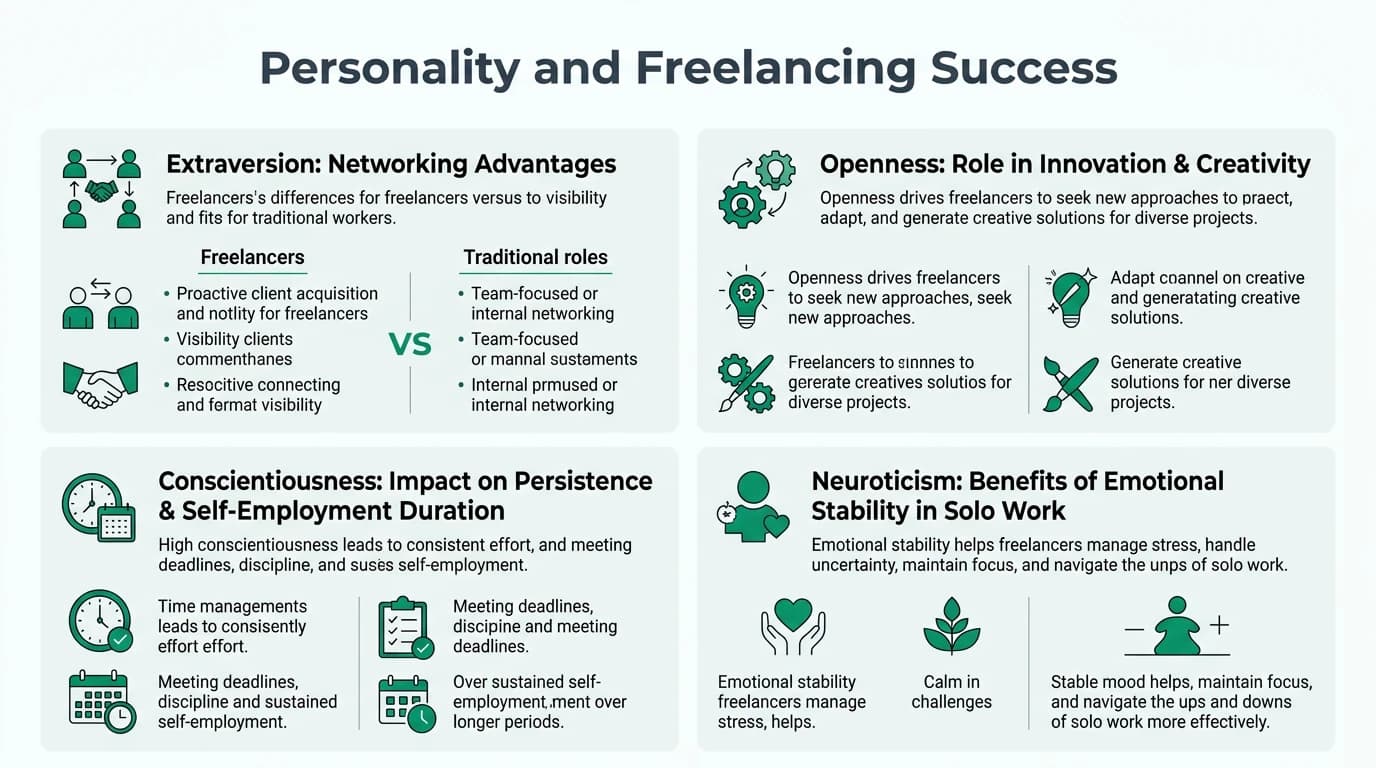
Freelancers often succeed with high Extraversion, Openness, and Conscientiousness, and low Neuroticism.
Source: Skynova
Executive Summary
Freelancers who thrive in solo work environments typically exhibit distinct Big Five personality traits. Higher levels of Extraversion, Openness to Experience, and Conscientiousness are common, while Neuroticism is generally lower. These traits aid in persistence, innovation, and client networking, essential for freelancing success.
The bottom line: Understanding your personality traits can guide you to more effective freelance strategies and better career satisfaction.
Extraversion in Freelancing
Extraversion plays a crucial role in securing clients and maintaining business relationships. Freelancers with high extraversion levels often excel in networking, which is vital for client acquisition and retention.
- Effect: Enhanced networking capabilities.
- Process: Builds positive client relationships.
- Caveat: Risk of burnout if not managed.
| Aspect | Freelancers (Score/100) | Traditional Workers (Score/100) | Key Advantage |
|---|---|---|---|
| Extraversion | 80 | 60 | Networking and client retention |
Openness to Experience for Solo Success
Openness to Experience is linked to creativity and the ability to adapt to the variability of freelance work. Freelancers with high openness are often more innovative and can pivot effectively in changing markets.
- Role: Drives innovation and adaptability.
- Link: Strong correlation with creativity.
- Hypothesis: Prolonged self-employment survival.
| Trait | Entrepreneurs | Managers | Source | Implication for Freelancing |
|---|---|---|---|---|
| Openness | High | Moderate | Zhao and Seibert (2006) | Innovation and adaptability |
Conscientiousness and Persistence
High Conscientiousness predicts longer self-employment stints, even when freelancers are dissatisfied. It is associated with achievement orientation, crucial for overcoming challenges in solo work.
- Effect: Prolongs self-employment.
- Process: Achievement-driven persistence.
- Caveat: May prolong unsatisfactory situations.
| Exit Type | High Conscientiousness Effect | High Openness Effect | Low Neuroticism Effect |
|---|---|---|---|
| Successful Exit | Sustained effort | Innovative solutions | Emotional stability |
| Unsuccessful Exit | Persistence despite dissatisfaction | Creativity in adversity | Stability under stress |
Low Neuroticism for Stability
Freelancers with low Neuroticism experience greater emotional stability, which is beneficial in the unpredictable world of freelancing. High neuroticism can be detrimental, although moderate levels may offer some benefits.
- Benefit: Emotional stability.
- Risk: High levels lead to stress.
- Interaction: Education may prolong unsuccessful stints.
| Trait | Entrepreneurs | Traditional Workers | Source |
|---|---|---|---|
| Neuroticism | Low | Higher | Zhao and Seibert (2006) |
Agreeableness Trade-offs
Lower Agreeableness can provide an entrepreneurial edge, especially in virtual and independent tasks. While it may not be beneficial for teamwork, it aids in solo decision-making.
- Advantage: Better for independent tasks.
- Trade-off: Less beneficial for teamwork.
- Inconsistencies: Meta-analysis shows varying results.
| Trait | Entrepreneurs | Managers | Source | Implication for Freelancing |
|---|---|---|---|---|
| Agreeableness | Low | Moderate | Zhao and Seibert (2006) | Solo decision-making |
Big Five Comparisons: Freelancers vs. Employees/Managers
Freelancers often score higher on Extraversion and Openness compared to traditional employees. These traits support the dynamic and often unpredictable nature of freelance work.
- Profiles: Entrepreneurs show distinct trait profiles.
- Survival Data: Longitudinal studies support these findings.
| Role | High Traits | Low Traits | Study Finding (2023 PMC) |
|---|---|---|---|
| Entrepreneurs | Extraversion, Openness, Conscientiousness | Neuroticism | Distinct profiles |
Trait Interactions in Self-Employment Survival
The interaction of Big Five traits can predict successful exits from self-employment. Achievement motivation and trait combinations play a critical role in performance.
- Effect: Combined trait impact.
- Role: Achievement motivation.
- Predictive Power: Strong indicator of success.
| Scenario | Traits Involved | Outcome |
|---|---|---|
| Necessity-driven | Low Conscientiousness, High Neuroticism | Early exit |
| Opportunity-driven | High Openness, Low Neuroticism | Prolonged success |
Openness and Creativity in Freelancing
Openness is strongly related to creativity, which is essential for generating new ideas in freelancing. This trait encourages novelty-seeking and innovation.
- Relation: Strongest evidence among traits.
- Application: Emphasis on novelty-seeking.
- Nuance: Weaker extraversion link.
| Trait | High Description | Low Description | Freelance Fit |
|---|---|---|---|
| Openness | Innovative | Routine-bound | Creative projects |
Conscientiousness in Virtual/Solo Environments
Freelancers with high Conscientiousness excel in self-discipline without supervision, a vital trait for remote work success. However, it may negatively impact creativity.
- Vital: For remote freelancing.
- Prediction: Career success.
- Balance: Potential negative creativity link.
| Aspect | High Conscientiousness | Low Conscientiousness | Freelance Scenario |
|---|---|---|---|
| Self-discipline | Strong | Weak | Effective remote work |
Extraversion Nuances for Introverted Freelancers
Introverted freelancers can also thrive by leveraging their strengths in individualized roles. While extraversion aids in networking, introverts may excel in communication through written or virtual means.
- Advantages: Communication and client-building.
- Adaptations: Individualized virtual roles.
- Energy: Higher in social vs. solo tasks.
| Trait | High Description | Low Description | Freelance Fit |
|---|---|---|---|
| Extraversion | Socially adept | Reserved | Networking roles |
Neuroticism Management Strategies
Managing Neuroticism is crucial for freelancers. Moderate levels can be beneficial, but high neuroticism often leads to early exits from freelancing.
- Strategy: Moderate levels beneficial.
- Pattern: Early exits with high neuroticism.
- Opportunity: Reduced stressors in virtual work.
| Trait | High Description | Low Description | Freelance Fit |
|---|---|---|---|
| Neuroticism | Emotionally reactive | Stable | Stress management |
Action checklist
- Identify your Big Five traits using a reliable personality test.
- Leverage high Extraversion for networking opportunities.
- Utilize Openness to adapt and innovate in your freelance work.
- Maintain Conscientiousness for consistent productivity.
- Manage Neuroticism to ensure emotional stability.
FAQ
What are the Big Five personality traits?
How does Extraversion benefit freelancers?
Can introverts succeed in freelancing?
Why is Openness important for freelancers?
How does Conscientiousness impact freelancing?
What role does Neuroticism play in freelancing?
Are lower Agreeableness levels beneficial for freelancers?
Notes
Primary Sources
| Source | Type | URL |
|---|---|---|
| Skynova | Blog | Skynova |
| PubMed Central (PMC) - NIH | Article | PMC Article |
| QIP Journal | Journal | QIP Journal |
Conclusion
Understanding the Big Five personality traits can significantly impact freelancing success. By leveraging strengths such as Extraversion, Openness, and Conscientiousness, freelancers can enhance their adaptability, client relationships, and persistence.
Footnotes
-
Source and explanation. ↩
-
Skynova, "Top Personality Traits of Successful Freelancers." ↩
-
Zhao and Seibert (2006) meta-analysis. ↩
-
QIP Journal, "Openness and Creativity in Freelancing." ↩
-
Sackett & Walmsley (2014), "Career Success Prediction." ↩
-
Zhao et al. (2010) meta-analysis. ↩
-
Zhao and Seibert (2006) findings on Agreeableness. ↩