personality-tests
The Introvert Advantage at Work
How introverts leverage deep processing, ethical decision-making, and sustained focus for workplace success, with neuroscience-backed strategies and measurable outcomes.
Quick answer
What are the key advantages of introverts in the workplace?
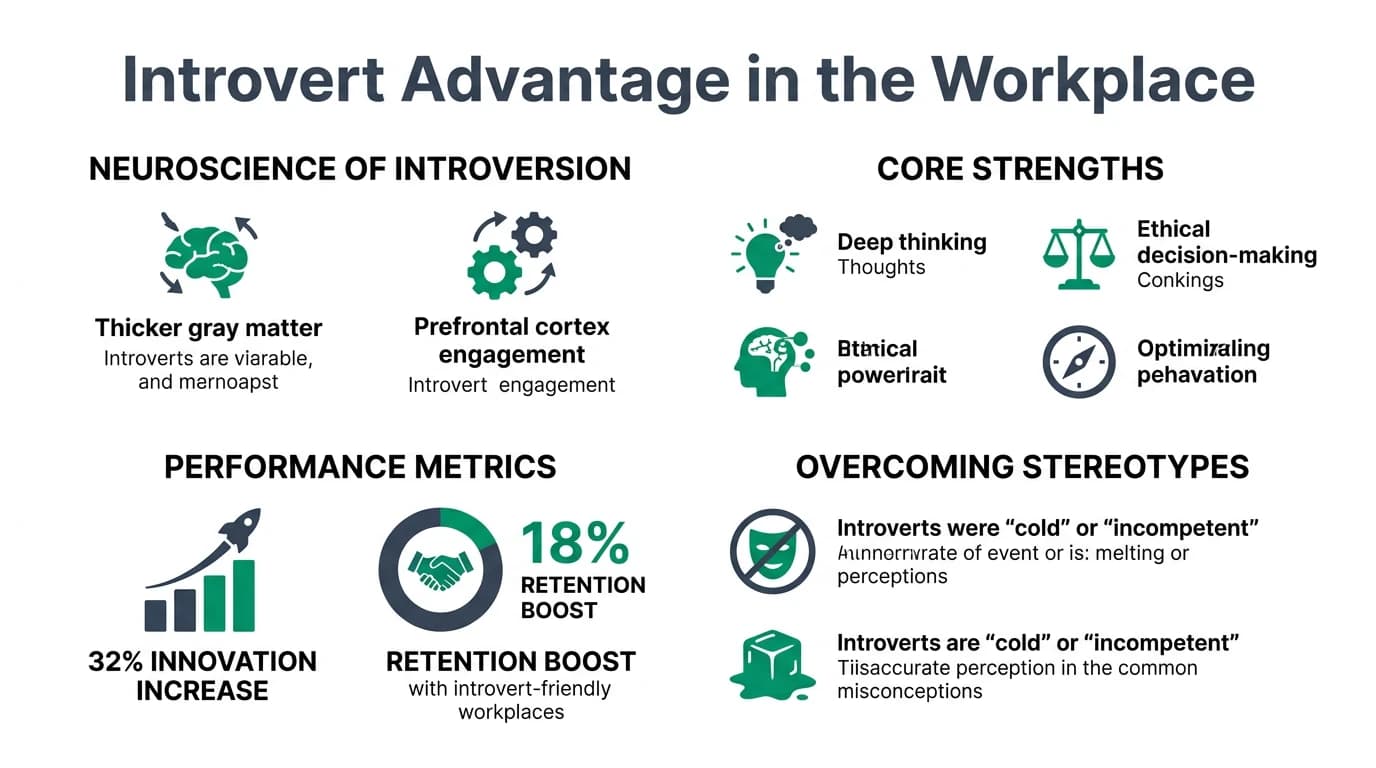
Introverts excel through deep processing (higher prefrontal cortex activity), sustained focus, ethical decision-making, and pattern recognition. Organizations with introvert-friendly policies report 32 percent increases in innovative outputs, 18 percent higher employee retention, and 41 percent improvement in cross-functional problem resolution. Introverted leaders make thoughtful, risk-balanced decisions and foster inclusive team environments.
Source: Randstad Enterprise
Key Takeaways
- Neuroscience supports introvert advantages: introverts have thicker gray matter in prefrontal regions and higher prefrontal cortex activity during decision-making, enabling deeper processing and sustained focus1.
- Measurable business outcomes: organizations with introvert-friendly policies report 32 percent innovation gains, 18 percent retention improvements, and 41 percent better cross-functional problem resolution1.
- Introvert stereotypes are inaccurate: introverts are often perceived as cold or incompetent despite evidence of strong analytical and ethical capabilities2.
- Quiet leadership works: introverted leaders make thoughtful, risk-balanced decisions and foster inclusive environments that outperform in empowering contexts3.
- Interruption recovery is costly: introverts require up to 23 minutes to regain focus after interruptions, making boundary respect essential4.
- Remote and hybrid work benefits introverts: reduced social overstimulation and increased control over environment improve introvert productivity.
- Team complementarity matters: pairing introverts with extroverts creates teams that combine deep analysis with energetic networking for superior outcomes.
For how communication styles differ across personality types in the workplace, see our communication styles guide.
Disclaimer: This article summarizes personality psychology and neuroscience research for educational purposes. Introversion exists on a spectrum, and individual variation within introverts is substantial. Avoid using introversion as a limiting label. Consult an organizational psychologist for tailored workplace interventions.
The Neuroscience Behind Introvert Strengths
Introversion is not merely a preference for quiet. It reflects measurable neurological differences that create distinct cognitive advantages in the workplace14.
| Neurological Feature | Introverts | Extroverts | Workplace Implication |
|---|---|---|---|
| Gray matter thickness | Thicker in prefrontal regions | Thinner in prefrontal regions | Deeper analytical processing |
| Prefrontal cortex activity | Higher during decision-making | Lower during decision-making | More thorough risk assessment |
| Dopamine sensitivity | Higher (less stimulation needed) | Lower (more stimulation needed) | Sustained focus in quiet environments |
| Acetylcholine pathway | Dominant (pleasure from internal thought) | Less dominant | Intrinsic motivation for deep work |
| Focus duration | Longer sustained attention | Shorter before seeking stimulation | Superior performance on complex tasks |
- The prefrontal cortex advantage means introverts naturally engage in slower, more deliberate processing, ideal for risk assessment and strategic planning.
- Higher dopamine sensitivity explains why introverts feel overstimulated in noisy, high-activity environments that extroverts find energizing.
- These neurological differences are not deficits. They represent alternative cognitive strategies optimized for depth over breadth.
Core Workplace Strengths of Introverts
Research documents several distinct performance advantages for introverts in organizational settings12.
| Strength | Description | Evidence | Best Application |
|---|---|---|---|
| Deep thinking | Sustained focus on complex challenges | Thicker prefrontal gray matter1 | Strategic planning, R&D, analysis |
| Ethical decision-making | Internal moral compass over external pressures | Neuroscience of deliberate processing | Compliance, governance, risk management |
| Pattern recognition | Spotting trends and connections across data | Higher prefrontal engagement1 | Data analysis, market research, diagnostics |
| Active listening | Processing information thoroughly before responding | Acetylcholine-driven internal focus | Counseling, negotiation, conflict resolution |
| Written communication | Precise, well-structured messaging | Preference for considered expression | Technical writing, policy development, remote work |
| Independent work | Self-directed productivity without supervision | Intrinsic motivation pathway | Research, software development, creative work |
- Introverts do not merely tolerate independent work; they produce their best output in it.
- The deep thinking advantage becomes more pronounced as task complexity increases.
- For strategies on managing stress that can accompany deep processing, see our stress management guide.
The Einstein Principle
Mastery through sustained solitary practice is a hallmark of introvert achievement. Many breakthrough innovations emerge from extended periods of solo deep work rather than collaborative brainstorming sessions. Introverts naturally gravitate toward this work pattern.
Overcoming Introvert Stereotypes and Bias
Introverts face systematic biases in workplace evaluation, hiring, and promotion that contradict research on their actual capabilities2.
| Perception | How Introverts Are Viewed | How Extroverts Are Viewed | Reality |
|---|---|---|---|
| Social warmth | Cold, unfriendly, aloof | Warm, approachable, leader-like | Introverts build deeper one-on-one connections |
| Competence | Incompetent, lacking confidence | Intelligent, capable | No competence difference in research |
| Leadership potential | Not leadership material | Natural leaders | Introverted leaders outperform in empowering contexts3 |
| Team contribution | Not a team player | Collaborative and engaging | Introverts contribute through quality, not volume |
| Self-esteem | Low self-esteem assumed | High self-esteem assumed | Self-esteem distribution is similar |
- Introverts report higher rates of workplace bullying, ostracism, and unfair treatment compared to extroverts2.
- Hiring processes that weight "culture fit" often penalize introverted communication styles.
- Promotion criteria emphasizing visibility and self-promotion systematically disadvantage introverts who deliver through quiet consistency.
Countering Bias at the Organizational Level
- Implement structured interviews with standardized evaluation criteria to reduce extraversion bias.
- Evaluate contributions based on output quality, not meeting participation volume.
- Train managers to recognize introvert contributions that occur through written channels and one-on-one interactions.
- Include quiet reflection time in brainstorming sessions to capture introvert insights.
Introverted Leadership: The Quiet Boss Advantage
Research from Harvard Business Review documents significant advantages of introverted leadership, particularly in contexts requiring empowerment and team initiative3.
| Leadership Dimension | Introverted Leaders | Extroverted Leaders | Context Where Each Excels |
|---|---|---|---|
| Decision-making | Thoughtful, risk-balanced | Quick, action-oriented | Introverts excel in high-stakes, complex decisions |
| Listening | Deep, empathetic listening | Responsive, surface-level | Introverts build stronger one-on-one trust |
| Team empowerment | Fosters initiative in others | May dominate direction | Introverts outperform with proactive teams3 |
| Visibility | Leads by example, not charisma | High-profile, visible | Extroverts excel in public-facing roles |
| Conflict approach | Deliberate, seeks understanding | Direct, immediate | Introverts resolve root causes; extroverts resolve symptoms |
| Innovation culture | Creates space for diverse input | Drives own vision forward | Introverts foster more inclusive innovation |
- Introverted leaders outperform extroverted leaders when team members are proactive and self-directed3.
- They create psychological safety by listening more than directing, encouraging team members to share ideas.
- The limitation: introverted leaders may struggle with leadership emergence (being recognized as leaders) even when their effectiveness exceeds extroverted peers.
Measurable Business Outcomes of Introvert-Friendly Policies
A global pharmaceutical company case study documented significant performance gains after implementing introvert-friendly workplace policies1.
| Metric | Improvement | Mechanism | Policy Change |
|---|---|---|---|
| Innovative drug formulations | 32 percent increase | Solo reflection time before group sharing | Protected deep work periods |
| Employee retention | 18 percent improvement | Reduced social overstimulation and burnout | Flexible workspace options |
| Cross-functional problem resolution | 41 percent improvement | Leveraging introvert pattern recognition | Structured turn-taking in meetings |
| Job complexity performance | Significant positive correlation | Introvert deep processing advantage | Complex roles assigned to introvert strengths |
| Safety performance | Higher | Lower deviance and risk-taking | Introvert conscientiousness leveraged2 |
- These outcomes are not achieved by favoring introverts over extroverts. They result from removing barriers that prevent introverts from contributing fully.
- The 32 percent innovation gain came specifically from providing solo reflection time before group discussion, allowing introverts to develop ideas before social pressure shapes them.
- For an overview of how personality assessment enhances the Big Five framework, see our complete Big Five guide.
Workplace Strategies for Introverts
Creating an introvert-optimized work environment requires specific changes to physical space, communication norms, and meeting structures4.
| Environment Factor | Introvert Preference | Impact on Productivity | Implementation |
|---|---|---|---|
| Private office or quiet space | High | Significant productivity increase | Provide booking options for focus rooms |
| Open plan office | Low | Satisfaction and focus decrease | Offer noise-canceling headphone policies |
| Asynchronous communication | High | Reduces interruption cost | Default to async, sync only when necessary |
| Meeting structure | Structured agendas with advance materials | Better prepared contributions | Send agendas 24 hours before meetings |
| Creative scheduling | Blocks of uninterrupted time | Enables deep work flow states | Implement "no meeting" mornings |
| Social events | Optional, smaller gatherings | Prevents social fatigue | Offer variety: one-on-one coffee chats alongside team events |
The 23-Minute Recovery Problem
Research documents that introverts require up to 23 minutes to regain full focus after an interruption4. In open offices with frequent interruptions, this means introverts may spend more time recovering focus than doing deep work.
| Interruption Type | Average Recovery Time | Frequency in Open Office | Daily Productivity Cost | Strategy |
|---|---|---|---|---|
| Slack or email notification | Up to 23 minutes | 10-20 per day | 3-7 hours lost | Batch notifications, set focus hours |
| In-person interruption | Up to 23 minutes | 5-10 per day | 2-4 hours lost | "Do not disturb" signals, focus rooms |
| Scheduled meeting | Variable (context switching) | 3-6 per day | 1-3 hours in transitions | Cluster meetings, protect morning focus |
| Ambient noise | Continuous partial distraction | Constant in open plan | Persistent quality reduction | Quiet zones, noise-canceling equipment |
Building Introvert-Friendly Teams
Effective teams leverage the complementary strengths of introverts and extroverts rather than forcing one style on everyone1.
| Team Function | Introvert Contribution | Extrovert Contribution | Complementary Outcome |
|---|---|---|---|
| Planning | Deep analysis, risk assessment | Energizing, stakeholder engagement | Thorough plans with buy-in |
| Execution | Sustained focus, quality control | Networking, rapid coordination | Consistent delivery with momentum |
| Innovation | Pattern recognition, reflective ideation | Brainstorming, rapid prototyping | Ideas both novel and actionable |
| Conflict resolution | Root cause analysis, diplomatic solutions | Direct confrontation, quick resolution | Both immediate and lasting solutions |
| Client relationships | Deep understanding, trust building | Rapport building, social energy | Long-term, relationship-rich partnerships |
Team Design Principles
- Ensure meeting formats include both real-time discussion and written input channels.
- Assign roles based on cognitive strengths, not social style.
- Pair introverts and extroverts on complementary tasks rather than identical ones.
- Evaluate team contributions through multiple channels (written reports, code commits, client feedback) not just verbal participation.
- For insights on remote team effectiveness, see our remote work effectiveness guide.
Mentorship and Talent Development for Introverts
Introverts benefit from and contribute to different mentoring formats than extroverts1.
| Mentoring Approach | Fit for Introverts | Advantages | Limitations |
|---|---|---|---|
| One-on-one meetings | Excellent | Deep trust, personalized guidance, safe vulnerability | Resource-intensive for mentors |
| Small group (three to five) | Good | Peer learning with manageable social energy | Must be structured to prevent extrovert dominance |
| Large group workshops | Poor | Broad reach, networking opportunity | Energy drain, performance anxiety |
| Written mentoring (email, documents) | Excellent | Allows reflection before response | Lacks nonverbal warmth cues |
| Reverse mentoring | Good | Introverts share expertise on their terms | Requires psychological safety |
- One-on-one mentoring produces deeper trust and more impactful guidance for introverts than group formats.
- Written channels allow introverts to provide thoughtful, well-considered mentoring input.
- Talent development programs should offer multiple mentoring formats to accommodate both personality types.
Challenges Introverts Face and How to Address Them
Acknowledging real challenges prevents toxic positivity about introversion while offering practical solutions24.
| Challenge | Root Cause | Impact | Solution |
|---|---|---|---|
| Social fatigue in meetings | Dopamine oversensitivity to stimulation | Reduced afternoon productivity | Limit meetings, offer recovery time |
| Visibility deficit | Preference for quiet contribution | Missed promotions and recognition | Create visibility through written work and project leads |
| Brainstorming exclusion | Real-time verbal processing disadvantage | Ideas not captured | Pre-meeting written ideation, structured turn-taking |
| Networking reluctance | Energy cost of large social interactions | Weaker professional networks | Focus on deep one-on-one connections, leverage LinkedIn |
| Perception as disengaged | Less verbal participation in groups | Misjudged performance evaluations | Manager training on introvert communication patterns |
| Open office suffering | Environmental overstimulation | Focus disruption and stress | Quiet zones, remote work options, flexible scheduling |
Introvert workplace optimization checklist
- Assess your team's introversion-extraversion distribution using a validated Big Five assessment.
- Audit meeting structures: ensure agendas are shared in advance and written input channels exist.
- Provide quiet work spaces or focus rooms with booking systems for deep work.
- Implement asynchronous communication defaults (Slack threads, documented decisions) with synchronous meetings reserved for genuine discussion needs.
- Establish "no meeting" blocks of at least three hours for uninterrupted deep work.
- Train managers to evaluate contributions through output quality, not meeting participation volume.
- Offer multiple social event formats: small group, one-on-one, and optional large gatherings.
- Create one-on-one mentoring programs alongside group development options.
FAQ
How do introverts contribute to workplace innovation?
Introverts contribute through deep processing, pattern recognition, and sustained reflection. A global pharmaceutical company reported a 32 percent increase in innovative drug formulations after implementing solo reflection time before group sharing sessions. The neuroscience behind this advantage includes thicker prefrontal gray matter and higher prefrontal cortex activity during complex problem-solving1.
What are common misconceptions about introverts at work?
Introverts are commonly perceived as cold, unfriendly, incompetent, or lacking confidence. Research shows these perceptions are inaccurate. Introverts build deeper one-on-one relationships, demonstrate equal or higher competence in complex roles, and show no systematic self-esteem differences from extroverts. These stereotypes lead to bias in hiring, promotion, and daily evaluation2.
Can introverts be effective leaders?
Yes. Harvard Business Review research shows introverted leaders outperform extroverted leaders when team members are proactive and self-directed. Introverted leaders foster initiative in others, make thoughtful risk-balanced decisions, and create psychologically safe environments. The limitation is leadership emergence: introverts may not be recognized as leaders despite demonstrating leader-level effectiveness3.
How long does it take introverts to recover from interruptions?
Research documents that introverts require up to 23 minutes to regain full focus after an interruption. In open offices with frequent interruptions from Slack, email, and in-person visits, this means introverts can lose three to seven hours of productive deep work daily. Strategies include focus hours, notification batching, and quiet work spaces4.
What workplace policies help introverts succeed?
Effective policies include flexible workspaces with quiet zones, asynchronous communication defaults, structured meeting agendas with advance materials, "no meeting" time blocks, optional social events, and one-on-one mentoring programs. Organizations implementing these policies report 18 percent higher retention and 41 percent better cross-functional problem resolution14.
How do introvert and extrovert strengths complement each other on teams?
Introverts contribute deep analysis, risk assessment, quality control, and reflective ideation. Extroverts contribute energetic coordination, stakeholder engagement, rapid brainstorming, and networking. Together they produce plans that are both thorough and well-supported, ideas that are both novel and actionable, and relationships that are both deep and broad1.
Is introversion the same as shyness?
No. Introversion is a personality trait reflecting preference for lower-stimulation environments and deeper processing. Shyness is fear of social judgment. An introvert can be socially confident but choose solitary activities for energy management. A shy extrovert may want social interaction but fear it. The distinction matters because introvert-friendly policies address stimulation needs, not social anxiety2.
How does remote work affect introvert performance?
Remote work generally benefits introverts by reducing environmental overstimulation, eliminating open-office distractions, and providing greater control over their work environment. Introverts often report higher productivity and satisfaction in remote settings. However, fully remote work can reduce visibility, making it important for introverts to maintain regular written communication and project visibility. See our remote work effectiveness guide for detailed strategies4.
Notes
Primary Sources
| Source | Type | Key Contribution | URL |
|---|---|---|---|
| Randstad Enterprise | Industry research | Introvert advantage data: 32 percent innovation, 18 percent retention, 41 percent problem resolution | Link |
| Cambridge University Press | Peer-reviewed journal | Introvert stereotypes, workplace bias, safety and deviance data | Link |
| Harvard Business Review | Professional publication | Introverted leadership advantages in empowering contexts | Link |
| Inspiring Workplaces | Industry resource | 23-minute focus recovery, workplace strategy recommendations | Link |
| Carlson School of Management | Academic research | Extraversion advantages as comparison framework for introvert analysis | Link |
Conclusion
Introversion is not a workplace limitation. It is a distinct cognitive strategy backed by neuroscience, delivering measurable advantages in deep processing, ethical decision-making, pattern recognition, and sustained focus. Organizations that recognize and support these strengths gain innovation, retention, and problem-solving improvements that justify every accommodation made.
The practical path forward requires changes at three levels. Individual introverts should understand and communicate their working preferences rather than forcing extroverted behaviors. Managers should evaluate contributions through multiple channels and create space for deep work. Organizations should implement policies that accommodate personality diversity, from quiet zones to asynchronous communication defaults.
The most successful workplaces will be those that stop asking introverts to act like extroverts and start designing environments where both types contribute their best.
Footnotes
-
Randstad Enterprise. "The Introvert Advantage: Harnessing Overlooked Potential." Available at: https://www.randstadenterprise.com/insights/randstad-enterprise-insights/the-introvert-advantage-harnessing-overlooked-potential/ ↩ ↩2 ↩3 ↩4 ↩5 ↩6 ↩7 ↩8 ↩9 ↩10 ↩11 ↩12 ↩13
-
Cambridge University Press. "Enjoy the Silence: Providing Space for Introverted Employees to Thrive." Industrial and Organizational Psychology. Available at: https://www.cambridge.org/core/journals/industrial-and-organizational-psychology/article/enjoy-the-silence-providing-space-for-introverted-employees-to-thrive/4E40456FA77BA764B2770444A874EDD0 ↩ ↩2 ↩3 ↩4 ↩5 ↩6 ↩7 ↩8 ↩9
-
Grant, A. M., Gino, F., & Hofmann, D. A. (2010). "The Hidden Advantages of Quiet Bosses." Harvard Business Review. Available at: https://hbr.org/2010/12/the-hidden-advantages-of-quiet-bosses ↩ ↩2 ↩3 ↩4 ↩5 ↩6
-
Inspiring Workplaces. "Unlocking the Potential of Introverts in Your Workplace." Available at: https://www.inspiring-workplaces.com/content/unlocking-the-potential-of-introverts-in-your-workplace/ ↩ ↩2 ↩3 ↩4 ↩5 ↩6 ↩7 ↩8