personality-tests
Personality Tests and Remote Work Effectiveness: Evidence-Based Practices for Distributed Teams
Explore how personality tests can enhance remote work productivity and team dynamics, backed by evidence-based practices.
Quick answer
How do personality tests impact remote work effectiveness?
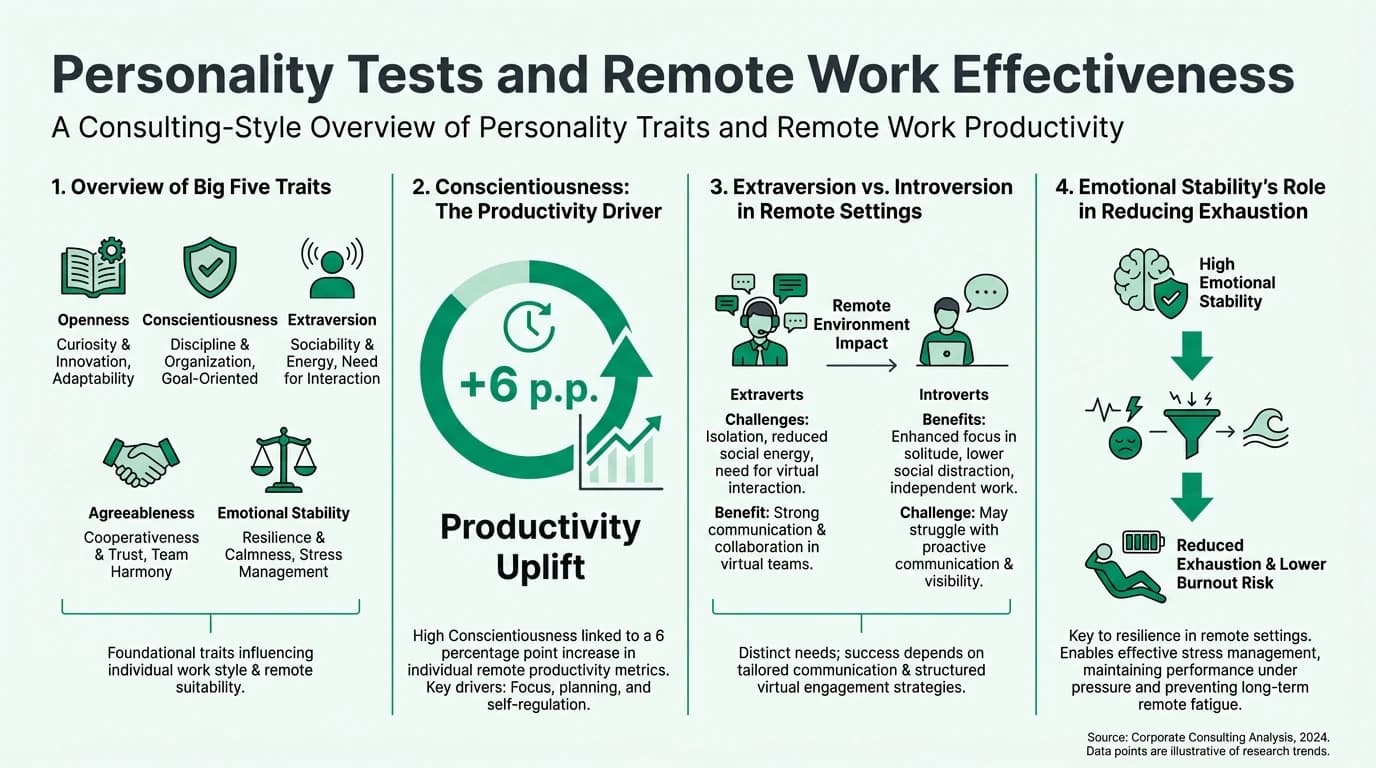
Personality tests, especially those measuring the Big Five traits, can significantly influence remote work productivity and team dynamics, with traits like Conscientiousness and Openness to Experience being key predictors of success.
Source: IZA Institute of Labor Economics
Executive Summary
Personality tests, particularly those assessing the Big Five traits, are crucial in understanding and improving remote work effectiveness. Traits like Conscientiousness and Openness to Experience have been linked to higher productivity and better adaptation in distributed teams.
The bottom line: Leveraging personality insights can optimize remote work strategies, enhancing team performance and individual satisfaction.
Critical Warning: Ignoring personality traits in remote setups can lead to mismatched roles and decreased productivity.
What Are the Big Five Personality Traits?
The Big Five personality traits are:
- Openness to Experience
- Conscientiousness
- Extraversion
- Agreeableness
- Emotional Stability
These traits provide a comprehensive framework for understanding individual differences in behavior and performance.
| Trait | Description | Impact on Remote Work |
|---|---|---|
| Openness | Creativity and open-mindedness | Adapts well to new tools and autonomy |
| Conscientiousness | Discipline and organization | Drives productivity and deadline adherence |
| Extraversion | Sociability and assertiveness | May struggle with lack of interaction |
| Agreeableness | Cooperation and empathy | Fosters teamwork but risks isolation |
| Emotional Stability | Calmness and resilience | Reduces exhaustion and stress |
Conscientiousness: The Key Predictor for Distributed Teams
Effect: Boosts productivity by 6 percentage points per standard deviation increase.
Process: Enhances self-discipline and organization.
Caveat: May need virtual check-ins to combat isolation.
| Trait Level | Pros in Remote Work | Cons in Remote Work | Productivity Change (p.p.) |
|---|---|---|---|
| High | Strong adherence to deadlines | Risk of burnout without breaks | +6 |
| Low | Flexible but may miss deadlines | Struggles with self-management | - |
Extraversion vs. Introversion in Remote Environments
Extraverts:
- Challenge: Lack of face-to-face interaction
- Solution: Hybrid models with video huddles
Introverts:
- Advantage: Thrive in solitary virtual work
- Outcome: Increased focus and productivity
| Scenario | Optimal Traits | Suboptimal Traits | Mitigation Strategy |
|---|---|---|---|
| Virtual Collaboration | Introversion | Extraversion | Regular virtual social events |
| Sales Cycle | Extraversion | Introversion | Hybrid model with in-person days |
Agreeableness and Team Dynamics in Virtual Settings
High Agreeableness:
- Pro: Empathy and cooperation
- Con: Risk of demotivation from isolation
Low Agreeableness:
- Pro: Independent decision-making
- Con: May appear unsympathetic remotely
| Trait Level | Team Dynamic Impact | Communication Style |
|---|---|---|
| High | Strong team cohesion | Collaborative |
| Low | Efficient but less empathetic | Direct |
Emotional Stability's Role in Remote Work Resilience
Effect: Low Neuroticism reduces remote work exhaustion.
Process: Stability mitigates productivity fluctuations.
Caveat: High stress can still affect performance.
| Trait Level | Stress Management | Productivity Impact |
|---|---|---|
| High | Excellent | Consistent |
| Low | Poor | Variable |
Openness to Experience and Innovation in Distributed Teams
Effect: Encourages adaptation to new tools.
Process: Drives innovation and creativity.
Caveat: May require structured guidance for low-Openness colleagues.
| Trait Level | Innovation Capability | Adaptation Speed |
|---|---|---|
| High | High | Fast |
| Low | Moderate | Slow |
Using Personality Assessments for Hiring
Personality assessments like TIPI and HEXACO can predict remote work success.
TIPI:
- Purpose: Measures Big Five traits
- Application: Quick surveys for hiring
HEXACO:
- Purpose: Evaluates performance predictors
- Application: In-depth analysis for role fit
| Assessment Tool | Focus Area | Best Use Case |
|---|---|---|
| TIPI | Big Five traits | Quick hiring decisions |
| HEXACO | Detailed personality | In-depth role analysis |
Heterogeneous Productivity Impacts Across Traits
Important: Different traits affect willingness and productivity differently.
Example: High Conscientiousness boosts productivity, but high Extraversion may not.
| Personality Trait | Link to Willingness | Link to Productivity | Source Year |
|---|---|---|---|
| Conscientiousness | Strong | Strong | 2022 |
| Extraversion | Moderate | Weak | 2022 |
Action checklist
- Implement personality assessments in hiring processes.
- Tailor remote work policies to individual traits.
- Regularly evaluate team dynamics and adapt strategies.
FAQ
How does Conscientiousness affect remote work productivity?
Why might Extraverts struggle with remote work?
What role does Emotional Stability play in remote work?
How can personality assessments improve hiring for remote roles?
What is the TIPI scale?
How do Agreeableness levels affect team dynamics?
Can personality traits change over time with remote work?
Notes
Primary Sources
| Source | Type | URL |
|---|---|---|
| IZA Institute of Labor Economics | Research Paper | IZA DP 15486 |
| International Labour Review | Journal Article | ILR-RIT |
Conclusion
Understanding and leveraging personality traits can significantly enhance remote work effectiveness. By aligning roles and responsibilities with individual traits, organizations can boost productivity and employee satisfaction.
Footnotes
-
IZA Institute of Labor Economics. "Conscientiousness and Remote Work Productivity." ↩
-
Stanton Chase Executive Search. "Extraversion and Remote Work Challenges." ↩ ↩2
-
International Labour Review. "Emotional Stability and Work Resilience." ↩ ↩2 ↩3
-
University of Tennessee at Chattanooga. "Personality Assessments for Hiring." ↩