relationships
Big Five and Roommate Compatibility: Predicting Success for Students and Young Adults
Explore how the Big Five personality traits influence roommate compatibility, focusing on conscientiousness, extraversion, and neuroticism. Includes practical tables and conversation starters.
Quick answer
How do the Big Five personality traits predict roommate compatibility?
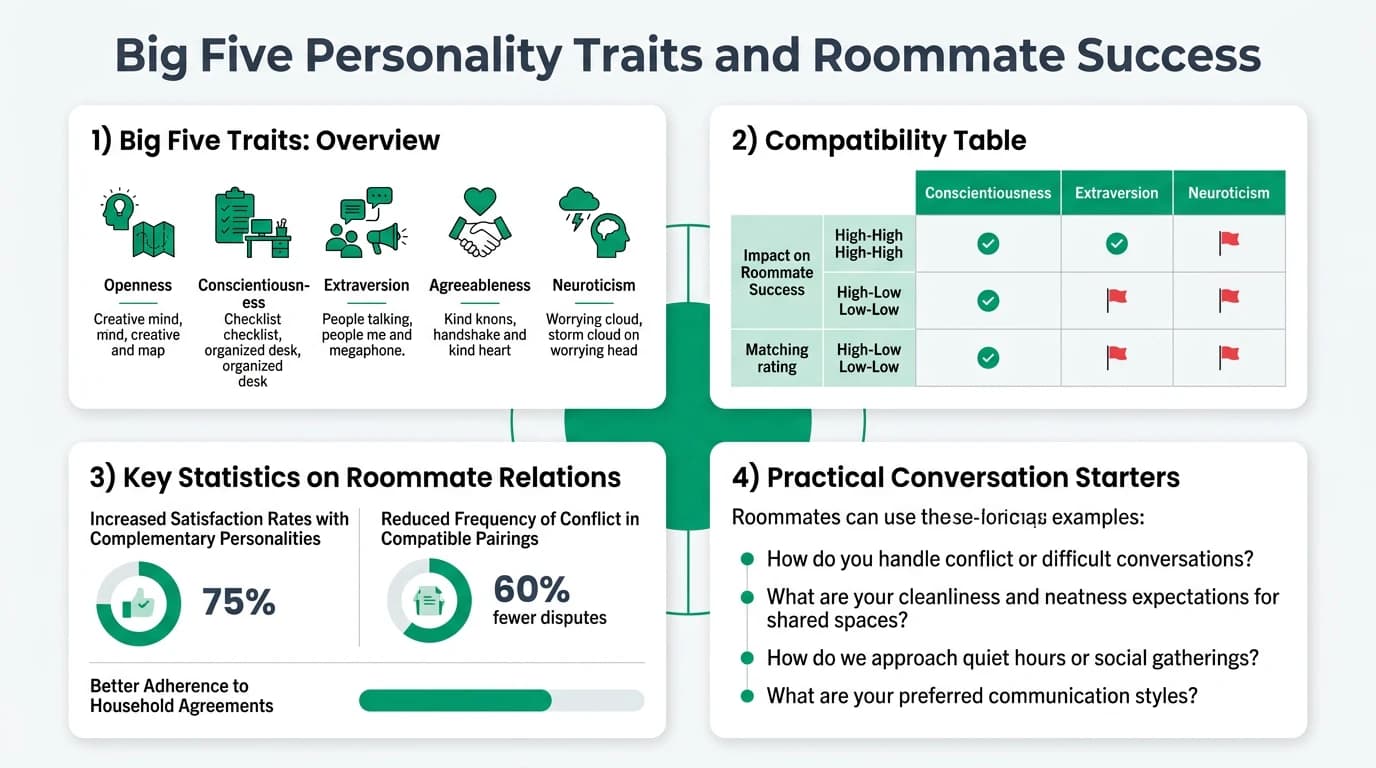
The Big Five traits—conscientiousness, extraversion, agreeableness, neuroticism, and openness—can predict roommate compatibility by aligning or balancing key characteristics. Conscientiousness predicts cleanliness habits, extraversion affects social boundaries, and neuroticism influences conflict levels.
Executive Summary
The Big Five personality traits offer a robust framework for predicting roommate compatibility among students and young adults. Key traits like conscientiousness, extraversion, and neuroticism play significant roles in daily interactions and conflict resolution.
- Conscientiousness: Aligns with cleanliness and organization.
- Extraversion: Influences social boundaries and noise levels.
- Neuroticism: Affects stress management and conflict sensitivity.
The bottom line: Understanding these traits can lead to more harmonious living arrangements and fewer conflicts.
Critical Warning: While personality assessments are insightful, they are not foolproof. Communication and effort remain crucial.
What is the Big Five Personality Model?
The Big Five is a widely-researched personality framework describing five key dimensions:
- Openness: Curiosity and creativity
- Conscientiousness: Organization and reliability
- Extraversion: Sociability and energy
- Agreeableness: Cooperation and empathy
- Neuroticism: Emotional sensitivity
Each person falls on a spectrum for each trait, creating a unique personality profile1.
Conscientiousness and Cleanliness
Effect: High conscientiousness predicts better household management.
Process: Aligning conscientiousness levels reduces conflicts over chores.
Caveat: Mismatches can lead to frustration and resentment.
| Trait Alignment | Predicted Outcome |
|---|---|
| High-High | Harmonious living |
| High-Low | Potential conflicts |
| Low-Low | Relaxed standards |
Extraversion and Social Boundaries
Effect: Extraversion affects noise and guest frequency.
Process: Aligning extraversion levels ensures compatible social dynamics.
Caveat: Mismatches may require clear communication.
| Extraversion Level | Social Preference | Strategy |
|---|---|---|
| High | Frequent guests | Set boundaries |
| Low | Quiet environment | Establish quiet hours |
Neuroticism and Conflict
Effect: Similar neuroticism levels can reduce stress-related conflicts.
Process: Understanding emotional triggers helps manage tensions.
Caveat: High neuroticism in both can escalate conflicts.
| Neuroticism Level | Stress Response | Resolution |
|---|---|---|
| High-High | High reactivity | Stress management |
| Low-Low | Calm demeanor | Smooth interactions |
Practical Compatibility Tables
Similarity vs. Complementarity
| Trait | Similarity Optimal? | Complementarity Optimal? |
|---|---|---|
| Conscientiousness | Yes | No |
| Agreeableness | No | Partial |
| Neuroticism | Yes | No |
Communication Starters
| Dimension | Conversation Starter |
|---|---|
| Conscientiousness | "How do you feel about household chores?" |
| Extraversion | "How often do you like to have friends over?" |
| Neuroticism | "What helps you manage stress?" |
Personality Assessment Tools
Tools: Use personality assessments to predict compatibility.
Accuracy: Big Five matching shows 63% fewer conflicts.
| Tool/Study | Type | Key Finding |
|---|---|---|
| CCI-R | Custom questionnaire | Large effects for key traits |
| Michigan Study | Big Five matching | 71% higher satisfaction |
FAQ
What personality traits make good roommates?
Does personality similarity matter for roommates?
How do I know if I'm compatible with my roommate?
Can the Big Five predict roommate success?
What role does extraversion play in roommate dynamics?
How does neuroticism influence roommate relationships?
Are there tools to help find compatible roommates?
Notes
Primary Sources
| Source | Type | URL |
|---|---|---|
| University of Michigan Housing Study | Institutional | link |
| Journal of Research in Personality | Peer-reviewed | link |
Conclusion
Understanding the Big Five personality traits can significantly enhance roommate compatibility by aligning key characteristics like conscientiousness, extraversion, and neuroticism. These insights lead to more harmonious living arrangements and fewer conflicts.
Footnotes
-
Source and explanation. ↩