personality-tests
Personality Tests for Teenagers: A Parent Guide
Evidence-based guide to Big Five personality assessments for teenagers, helping parents and educators understand adolescent development and academic outcomes.
Quick answer
Are Big Five personality tests useful for teenagers?
Yes. Validated Big Five assessments reliably measure personality traits in adolescents ages 7 to 18, with internal consistency of 0.79 to 0.88. They help predict academic success, identify mental health risks, and guide parenting strategies, though results should be interpreted as developmental snapshots rather than fixed labels.
Key Takeaways
- The Big Five model (OCEAN) is the most widely validated framework for measuring adolescent personality.
- Personality traits in teenagers are not fixed. They follow measurable developmental trajectories that differ by age and sex.
- Conscientiousness is the strongest predictor of academic success, financial stability, and positive life outcomes.
- Neuroticism signals risk for anxiety, depression, and suicidal ideation when scores are persistently elevated.
- Parenting style matters: authoritative parenting (warm and structured) positively shapes all five traits (meta-analysis of 11,061 adolescents)1.
- Assessment results are most useful when combined with behavioral observation and professional context.
Our complete guide to the Big Five personality test provides a thorough introduction to the model if you are encountering it for the first time.
Disclaimer: Personality assessments are screening tools, not diagnostic instruments. Always consult a qualified psychologist or counselor before making decisions based on test results, especially regarding mental health concerns.
Understanding the Big Five in Adolescents
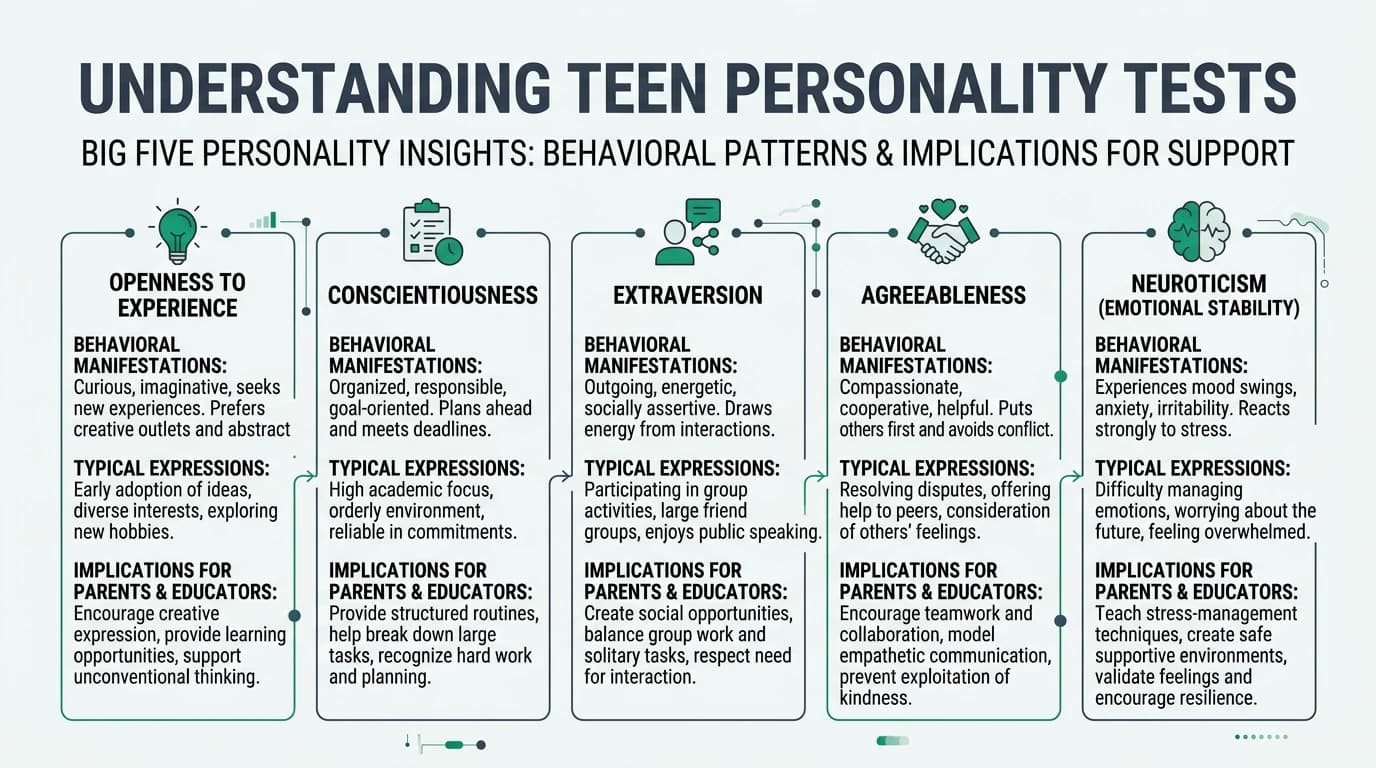
The Big Five model, also known as OCEAN, describes personality along five broad dimensions. Each dimension exists on a continuum, and teenagers express these traits differently than adults.
| Trait | Core Definition | High-Score Behaviors in Teens | Low-Score Behaviors in Teens |
|---|---|---|---|
| Openness | Imagination, curiosity, intellectual depth | Enjoys novelty, abstract thinking, artistic pursuits | Prefers routine, tradition, practical tasks |
| Conscientiousness | Self-discipline, organization, goal-directed behavior | Hardworking, reliable, planful, organized | Spontaneous, disorganized, procrastinating |
| Extraversion | Sociability, assertiveness, positive energy | Outgoing, talkative, energetic, seeks social stimulation | Reserved, quiet, prefers solitude |
| Agreeableness | Compassion, cooperation, trust | Cooperative, empathetic, conflict-avoidant | Competitive, critical, skeptical, direct |
| Neuroticism | Tendency toward negative emotions | Anxious, moody, emotionally reactive, sensitive to stress | Calm, resilient, emotionally stable |
- These traits are dimensional, not categorical. A teenager is not "an extravert" or "an introvert" but falls somewhere on the spectrum.
- All five traits are partially heritable (40 to 60 percent genetic influence) and partially shaped by environment2.
- The OCEAN framework has been validated across cultures, languages, and age groups, making it the gold standard for personality research.
Why Use Personality Tests for Teenagers?
Personality assessments serve three primary purposes for parents and educators: understanding behavior, predicting outcomes, and guiding development.
Understanding Behavior
A personality profile helps distinguish between temperament-driven behavior and situational issues. A teen who is disorganized and procrastinating may score low on conscientiousness rather than being "lazy." This reframing changes how adults respond.
Predicting Real-World Outcomes
Research links Big Five traits to measurable outcomes across multiple life domains.
| Outcome Domain | Key Trait(s) | Direction | Evidence Source |
|---|---|---|---|
| Academic grades (high school and university) | High conscientiousness | Positive | Simply Psychology3 |
| Financial planning and saving | High conscientiousness | Positive | Simply Psychology3 |
| Relationship stability | High conscientiousness, high agreeableness | Positive | Simply Psychology3 |
| Juvenile delinquency | Low conscientiousness | Risk factor | Simply Psychology3 |
| Depression and suicidal ideation | High neuroticism, low extraversion | Risk factor | IJIP4 |
| Career planning success | High agreeableness | Positive | IJIP4 |
| Substance use experimentation | High extraversion, high openness | Risk factor | PMC2 |
| Sales role suitability | Low neuroticism | Positive | IJIP4 |
- Conscientiousness appears in six of the eight outcome domains above, making it the most broadly predictive trait for adolescent success.
- These are probabilistic associations, not guarantees. A low conscientiousness score does not mean a teenager will struggle academically. It means the statistical risk is higher without intervention.
Guiding Development
Trait profiles help parents and educators target support. Instead of generic advice, interventions can be personality-matched. For practical approaches to learning styles, see our personality and learning style guide.
How Personality Develops During Adolescence
Adolescent personality is not fixed. It follows measurable developmental trajectories that differ by trait, age, and sex. A longitudinal study of 2,230 Dutch adolescents with up to 7 waves of data provides the most detailed picture5.
| Trait | Ages 12–16 | Ages 16–20 | Ages 20–25 | Sex Differences |
|---|---|---|---|---|
| Conscientiousness | Temporary dip (U-shaped in boys; linear increase in girls) | Recovery and increase | Continued increase | Girls increase earlier and more consistently |
| Agreeableness | Linear increase | Continued increase | Continued increase | Males consistently lower across all ages |
| Extraversion | Decline until approximately age 16 | Recovery and increase | Continued increase | Non-linear; males lower except mid-adolescence |
| Emotional stability | Girls decline; boys stable or slight increase | Girls: slight recovery; boys: stable | Continued stability and increase | Girls show more pronounced early decline |
| Openness | Decline or stable | Increase | Slight decrease toward middle adulthood | Males increase; females stable or decrease |
- Key insight for parents: temporary dips in conscientiousness, extraversion, and emotional stability during early adolescence (ages 12 to 16) are normal developmental patterns, not signs of permanent problems5.
- These U-shaped patterns mean a 14-year-old who seems unmotivated and emotionally volatile may be going through a typical developmental phase.
- Our personality changes across the lifespan guide covers how traits continue evolving into adulthood.
Choosing the Right Assessment Tool
Not all personality tests are appropriate for teenagers. A 2025 systematic review evaluated more than 10 self-report instruments validated for ages 7 to 186.
| Instrument | Age Range | Items | Administration Time | Reliability | Key Feature |
|---|---|---|---|---|---|
| Big Five Inventory (BFI) | 7–18 and older | 44 | 10–15 minutes | 0.79–0.88 | Most widely validated; multiple language versions |
| BFI-2 | 15 and older | 60 | 15–20 minutes | 0.80–0.90 | Updated version with facet-level detail |
| FFPI (Five-Factor Personality Inventory) | 12–18 | 100 | 20–25 minutes | 0.75–0.85 | Comprehensive; better for clinical contexts |
| Digital/online versions | 7–18 and older | Varies | 10–15 minutes | Comparable to paper | Real-time scoring and reporting |
- Avoid using adult instruments with teenagers. Language complexity and item content can introduce comprehension bias and invalid results6.
- Paper-pencil and digital formats show comparable reliability, so format choice should match the teen's preference and context.
- Always check that the instrument has published validation data for the specific age group.
| Validity Consideration | Detail | Implication |
|---|---|---|
| Internal consistency | 0.79–0.88 for validated tools | Results are stable enough for meaningful interpretation |
| Convergent validity | BFI scores align with peer ratings | Self-reports reflect how others perceive the teen |
| Age-appropriate language | Simplified wording for younger teens | Reduces comprehension errors |
| Response bias risk | Social desirability, acquiescence | Combine with behavioral observation |
Parenting Styles and Personality Development
A meta-analysis of 28 studies involving 11,061 adolescents demonstrates that parenting style significantly shapes personality trait development1.
| Parenting Style | Openness | Conscientiousness | Extraversion | Agreeableness | Neuroticism |
|---|---|---|---|---|---|
| Authoritative (warm and structured) | Positive | Positive | Positive | Positive | Decreased |
| Authoritarian (strict, low warmth) | No effect | No effect | No effect | No effect | Increased |
| Neglectful (low warmth, low structure) | No effect | Decreased | No effect | Decreased | Increased |
- Authoritative parenting is the only style associated with positive outcomes across all five traits.
- Neglectful parenting specifically undermines conscientiousness and agreeableness while raising neuroticism.
- These findings hold after controlling for moderating factors including age, ethnicity, and assessment mode1.
Adjusting Your Approach Based on Your Teen's Profile
| Teen's Trait Profile | Parenting Challenge | Recommended Approach | Rationale |
|---|---|---|---|
| Low conscientiousness, high openness | Resists structure, seems unmotivated | External structure with creative outlets; avoid rigid rules | Channels novelty-seeking while building accountability |
| High neuroticism, low extraversion | Anxious, withdrawn, emotionally reactive | Warm, validating, gradual social exposure | Reduces stress reactivity; builds social confidence |
| Low agreeableness, high neuroticism | Argumentative, dismissive of others' feelings | Explicit empathy teaching; model conflict resolution | Addresses emotional regulation and perspective-taking |
| High openness, high conscientiousness, low extraversion | Socially withdrawn but academically strong | Support intellectual interests; validate introversion | Leverages strengths without forced socialization |
| High extraversion, low conscientiousness | Impulsive, seeks constant stimulation | Structured activities; teach delayed gratification | Healthy outlets with self-regulation skill building |
Personality and Academic Performance
Conscientiousness is the single best personality predictor of academic performance in teenagers. For a deeper exploration, see our personality and academic performance guide.
| Trait | Academic Effect | Mechanism | Practical Application |
|---|---|---|---|
| High conscientiousness | Better grades at all levels | Self-discipline, time management, goal pursuit | Support study routines and planning skills |
| High openness | Stronger creative and abstract learning | Intellectual curiosity, receptiveness to new ideas | Offer diverse learning materials and project-based work |
| Low conscientiousness | Higher procrastination, lower grades | Weak self-regulation, inconsistent effort | Implement external structure (checklists, deadlines, accountability) |
| High neuroticism | Test anxiety, performance drops under stress | Emotional reactivity, worry | Teach test-taking strategies and stress reduction techniques |
| Low extraversion | May appear disengaged in group settings | Preference for independent work | Offer solo assignments alongside group work options |
- Academic underperformance in a bright teenager often reflects low conscientiousness rather than low ability. Assessment data can redirect adult attention from "not trying hard enough" to "needs structure-building support."
- High openness combined with low conscientiousness is a common profile in gifted-but-underperforming students.
Mental Health Screening Through Personality Assessment
Personality assessments are not diagnostic tools, but persistently extreme scores can signal mental health risk.
| Risk Pattern | Trait Signature | Associated Concern | Recommended Action |
|---|---|---|---|
| Persistent high neuroticism | Neuroticism at 85th percentile or above | Anxiety disorders, depression | Professional mental health evaluation |
| High neuroticism combined with low extraversion | Neuroticism high, extraversion low | Social withdrawal, suicidal ideation | Immediate counseling referral |
| Low conscientiousness combined with high extraversion | Conscientiousness low, extraversion high | Substance experimentation, risk-taking | Targeted prevention programs |
| Declining conscientiousness over time | Dropping scores across assessments | Potential depression, burnout, family stress | Investigate environmental factors |
- The International Journal of Indian Psychology found that high neuroticism combined with low conscientiousness, low extraversion, and low agreeableness was associated with depression and history of suicidal ideation in adolescents4.
- Critical distinction: a single assessment provides a snapshot. Trends across multiple assessments are far more informative.
- For understanding the emotional intelligence dimension, explore our personality and emotional intelligence guide.
Practical Administration Tips
Before the Assessment
- Choose an age-validated instrument (see the assessment tool table above).
- Explain the purpose in teen-friendly language: "This helps us understand how you naturally approach things, not whether you are good or bad at anything."
- Ensure a quiet, comfortable environment with no time pressure.
- Obtain informed consent from both parent and teenager.
During the Assessment
- Allow the teen to complete it independently (no parent hovering).
- Reassure that there are no right or wrong answers.
- For digital versions, ensure the device is free of distracting notifications.
After the Assessment
- Never share raw scores without context. Frame results as strengths, growth areas, and developmental patterns.
- Discuss results with a professional who can interpret them within the teen's developmental stage.
- Use results as conversation starters, not verdicts.
| Administration Factor | Best Practice | Common Mistake |
|---|---|---|
| Age appropriateness | Use instruments validated for teen's age | Using adult questionnaires with teens |
| Environment | Quiet, private, no time pressure | Administering during stressful periods |
| Framing | "Understanding your natural style" | "Testing what's wrong with you" |
| Interpretation | Professional context; developmental norms | Treating scores as fixed labels |
| Follow-up | Combine with behavioral observation | Relying solely on self-report |
| Frequency | Re-assess annually to track development | Single assessment treated as permanent |
Parent and educator action checklist
- Select a Big Five instrument validated for your teenager's age group (see comparison table).
- Administer the assessment in a private, low-pressure setting.
- Review results with a school counselor or psychologist for context.
- Identify one strength trait and one growth-area trait to focus on.
- Adjust parenting approach based on the trait-strategy table above.
- Re-assess in 12 months to track developmental changes.
- If neuroticism is persistently elevated, schedule a mental health screening.
- Use trait insights to support rather than label your teenager.
FAQ
At what age can a teenager take a Big Five personality test?
Validated Big Five instruments exist for children and adolescents as young as 7 years old. The Big Five Inventory (BFI) is validated from age 7 through adulthood, with age-appropriate language adaptations. For teenagers aged 12 and older, most standard instruments work reliably with internal consistency of 0.79 to 0.886.
Are personality traits in teenagers fixed or can they change?
Personality traits during adolescence are explicitly not fixed. Longitudinal research tracking 2,230 adolescents over multiple years shows measurable developmental trajectories including temporary dips in conscientiousness and emotional stability during early adolescence (ages 12 to 16) followed by recovery and growth. Environmental factors including parenting, schooling, and peer relationships all influence trait development5.
Which personality trait best predicts academic success in teenagers?
Conscientiousness is the strongest and most consistent personality predictor of academic performance across high school and university levels. It predicts better grades through mechanisms of self-discipline, time management, and consistent effort. Openness to experience also supports learning, particularly in creative and abstract domains3.
How does parenting style affect my teenager's personality development?
A meta-analysis of 28 studies (N = 11,061 adolescents) found that authoritative parenting, characterized by warmth combined with clear structure, is positively associated with higher openness, conscientiousness, extraversion, and agreeableness, and lower neuroticism. Neglectful parenting is linked to lower conscientiousness and agreeableness and higher neuroticism1.
Can personality tests identify mental health risks in teenagers?
Personality assessments are not diagnostic tools, but persistently elevated neuroticism scores, especially combined with low extraversion and low conscientiousness, are associated with anxiety, depression, and suicidal ideation in adolescents. These patterns warrant professional mental health evaluation rather than self-diagnosis4.
What is the best personality test instrument for a 14-year-old?
The Big Five Inventory (BFI) is the most widely validated instrument for this age group, with 44 items, a 10-to-15-minute administration time, and reliability of 0.79 to 0.88. It is available in multiple languages and has been extensively used in adolescent research. A 2025 systematic review evaluated more than 10 instruments, and the BFI consistently performs well6.
How should I talk to my teenager about personality test results?
Frame results as natural tendencies rather than judgments. Use language like "your results suggest you naturally prefer..." rather than "you scored low on..." Emphasize that traits are developmental and changeable. Discuss one strength and one growth area rather than reviewing all five traits at once. Always contextualize with professional guidance51.
Do boys and girls develop personality traits differently during adolescence?
Yes. Longitudinal research shows distinct sex-specific trajectories. Girls tend to show earlier and more consistent increases in conscientiousness and more pronounced early declines in emotional stability (rising neuroticism). Males report consistently lower agreeableness across ages 12 to 25. Extraversion follows non-linear, sex-specific patterns with males lower overall except during mid-adolescence25.
Notes
Primary Sources
| Source | Type | Key Contribution | URL |
|---|---|---|---|
| International Journal of Indian Psychology | Peer-reviewed journal | Depression, suicidal ideation, and career planning outcomes in adolescents | Link |
| PubMed Central / NIH | Peer-reviewed (Developmental Psychology) | Longitudinal trait trajectories ages 12–25; sex differences | Link |
| Vrije Universiteit Amsterdam | Peer-reviewed (Psychological Science) | N = 2,230 longitudinal study; stability and change patterns | Link |
| Scandinavian Journal of Psychology | Systematic review (2025) | Evaluation of 10 or more assessment instruments for ages 7–18 | Link |
| University of Kentucky | Meta-analysis (N = 11,061) | Parenting style effects on adolescent personality | Link |
| Simply Psychology | Educational resource | Accessible trait definitions and outcome summaries | Link |
Conclusion
Big Five personality assessments give parents and educators a research-backed lens for understanding adolescent behavior and development. They are most powerful when used as part of a broader picture, combining self-report data with behavioral observation, academic records, and professional interpretation.
The most actionable insight from the research is that parenting style is one of the strongest environmental levers for shaping personality development. Authoritative parenting consistently supports positive trait outcomes across all five dimensions. Combined with targeted strategies matched to a teenager's trait profile, personality assessments become practical tools for growth rather than fixed labels.
Footnotes
-
Prinzie, P. et al. (2024). Parenting styles and Big Five personality traits among adolescents: A meta-analysis. Personality and Individual Differences, University of Kentucky. Available at: https://scholars.uky.edu/en/publications/parenting-styles-and-big-five-personality-traits-among-adolescent/ ↩ ↩2 ↩3 ↩4 ↩5
-
Denissen, J. J. A. et al. (2022). Big Five personality trait development in adolescence and early adulthood. Developmental Psychology (PubMed Central). Available at: https://pmc.ncbi.nlm.nih.gov/articles/PMC9203596/ ↩ ↩2 ↩3
-
McLeod, S. (2024). Big Five personality traits: The OCEAN model explained. Simply Psychology. Available at: https://www.simplypsychology.org/big-five-personality.html ↩ ↩2 ↩3 ↩4 ↩5
-
International Journal of Indian Psychology (2024). Big Five personality traits, depression, and suicidal ideation in adolescents. IJIP, 12(1). Available at: https://ijip.in/wp-content/uploads/2024/02/18.01.119.20241201.pdf ↩ ↩2 ↩3 ↩4 ↩5
-
Klimstra, T. A. et al. (2021). Big Five personality stability, change, and codevelopment across adolescence and early adulthood. Psychological Science, Vrije Universiteit Amsterdam. Available at: https://research.vu.nl/files/276129599/Big_Five_personality_stability_change_and_codevelopment_across_adolescence_and_early_adulthood..pdf ↩ ↩2 ↩3 ↩4 ↩5
-
Soto, C. J. et al. (2025). Self-report Big Five personality questionnaires for children and adolescents: A systematic review. Scandinavian Journal of Psychology. Available at: https://pubmed.ncbi.nlm.nih.gov/40165737/ ↩ ↩2 ↩3 ↩4