personal-development
Personality and Stress Management: Evidence-Based Coping Strategies Tailored to Big Five Traits and Neuroticism
Explore how the Big Five personality traits influence stress management and discover tailored coping strategies for each trait, with a focus on neuroticism.
Quick answer
How do personality traits influence stress management?
The Big Five personality traits significantly impact how individuals perceive and manage stress, with neuroticism being most strongly associated with higher stress levels. Tailored coping strategies can enhance resilience.
Source: University of Illinois
Executive Summary
Personality traits play a crucial role in how individuals experience and manage stress. The Big Five personality traits—neuroticism, extraversion, agreeableness, conscientiousness, and openness—each influence stress perception and coping mechanisms differently. Neuroticism, in particular, is strongly linked to higher stress levels and maladaptive coping strategies.
Research indicates that tailored coping strategies based on individual personality profiles can significantly enhance stress management and resilience. For instance, individuals high in neuroticism may benefit from emotion regulation techniques, while those high in extraversion might leverage social support for stress relief.
The bottom line: Understanding your personality traits can guide you in selecting the most effective stress management strategies.
Critical Warning: Ignoring personality-driven coping strategies can lead to ineffective stress management and increased risk of burnout.
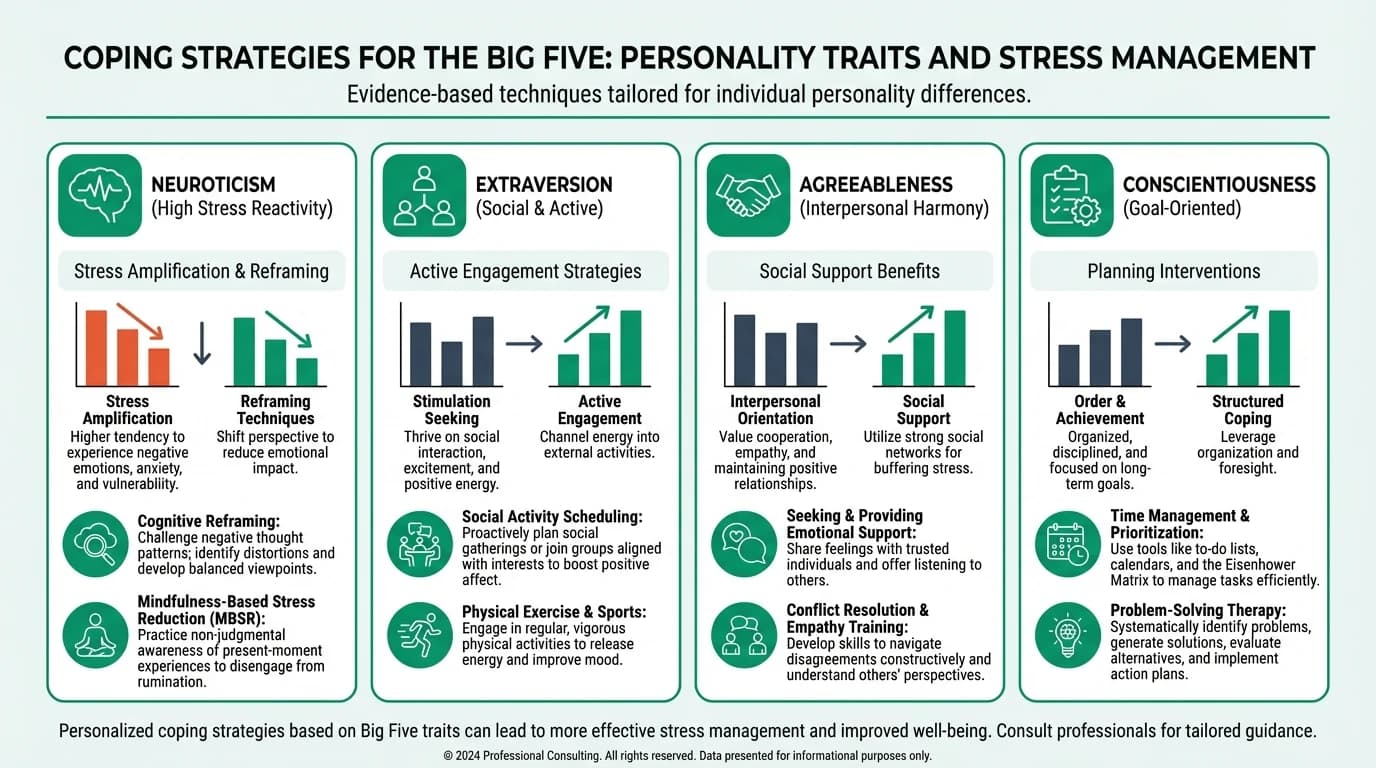
1) Neuroticism's Role in Stress Amplification
What is Neuroticism?
Neuroticism is a personality trait characterized by emotional instability, anxiety, and a tendency to experience negative emotions. It is one of the most significant predictors of stress perception and coping difficulties.
How Does Neuroticism Affect Stress?
Individuals high in neuroticism often perceive stressors as more severe and uncontrollable. Meta-analyses show that neuroticism explains a significant portion of variance in stress perception and emotional exhaustion12.
Key Mechanics
- Effect: Higher stressor variety and severity.
- Process: Increased emotional reactivity and threat perception.
Evidence-Based Reframing Techniques
- Identify Stress Triggers: Keep a journal to track stressors.
- Reframe Thoughts: Challenge negative perceptions with positive affirmations.
- Practice Mindfulness: Engage in mindfulness exercises to reduce anxiety.
Key Takeaways
- Neuroticism strongly predicts stress perception.
- Reframing and mindfulness can mitigate stress responses.
2) Extraversion and Active Stress Engagement
What is Extraversion?
Extraversion is characterized by sociability, assertiveness, and a tendency to seek out social interactions. It is associated with positive emotions and active engagement with stressors.
How Does Extraversion Reduce Stress?
Extraverted individuals often use problem-solving and social support to manage stress, reducing the likelihood of burnout34.
Key Mechanics
- Effect: Lower perceived stress and higher personal accomplishment.
- Process: Active problem-solving and social engagement.
Strategies for Leveraging Social Energy
- Build a Support Network: Engage with friends and family.
- Participate in Group Activities: Join clubs or social groups.
- Seek Feedback: Use social interactions for problem-solving.
Key Takeaways
- Extraversion aids in active stress management.
- Social support is crucial for extraverts.
3) Agreeableness as a Buffer Against Depersonalization
What is Agreeableness?
Agreeableness involves traits like kindness, empathy, and cooperation. It is linked to positive interpersonal relationships and stress mitigation.
How Does Agreeableness Protect Against Stress?
Agreeable individuals often use social support to buffer against stress and depersonalization, enhancing self-efficacy13.
Key Mechanics
- Effect: Lower anxiety and higher stressor control.
- Process: Utilization of social networks and conflict resolution.
Tailored Interpersonal Coping
- Enhance Communication Skills: Practice active listening.
- Develop Empathy: Engage in perspective-taking exercises.
- Foster Supportive Relationships: Build strong, positive connections.
Key Takeaways
- Agreeableness enhances stress resilience through social support.
- Interpersonal skills are vital for stress management.
4) Conscientiousness and Proactive Control
What is Conscientiousness?
Conscientiousness is characterized by organization, diligence, and goal-directed behavior. It is associated with effective stress management and resilience.
How Does Conscientiousness Influence Stress?
Conscientious individuals tend to experience fewer stressors due to their proactive and organized approach1.
Key Mechanics
- Effect: Fewer stressors and enhanced resilience.
- Process: Planning and goal-setting.
Planning-Based Interventions
- Set Clear Goals: Define specific, achievable objectives.
- Create Action Plans: Develop step-by-step strategies.
- Monitor Progress: Regularly review and adjust plans.
Key Takeaways
- Conscientiousness reduces stress through proactive strategies.
- Structured planning enhances stress control.
5) Openness to Experience and Adaptive Flexibility
What is Openness to Experience?
Openness involves creativity, curiosity, and a willingness to explore new ideas. It is linked to adaptive stress management and flexibility.
How Does Openness Reduce Stress?
Open individuals often use creative and flexible coping strategies, reducing perceived stress and anxiety54.
Key Mechanics
- Effect: Lower perceived stress and anxiety.
- Process: Creative problem-solving and adaptability.
Mindfulness Practices for Openness
- Engage in Creative Activities: Explore art or music.
- Practice Mindfulness Meditation: Focus on present-moment awareness.
- Explore New Experiences: Try new hobbies or travel.
Key Takeaways
- Openness fosters adaptive stress management.
- Creativity and mindfulness enhance stress resilience.
6) Personality States vs. Traits in Daily Stress Responses
What are Personality States?
Personality states are temporary expressions of traits that can fluctuate based on context and stress levels.
How Do States Differ from Traits?
While traits are stable, states can change in response to stress, impacting coping strategies1.
Key Mechanics
- Effect: Variability in stress responses.
- Process: Context-dependent shifts in behavior.
Real-Time Tracking for Personalized Interventions
- Use Apps: Track mood and stress levels daily.
- Adjust Strategies: Tailor coping methods to current states.
- Seek Feedback: Reflect on state changes and adapt.
Key Takeaways
- States offer insights into dynamic stress responses.
- Real-time tracking enhances personalized coping.
7) Coping Styles by Big Five Profile
Avoidant vs. Problem-Solving Patterns
Personality profiles influence whether individuals use avoidant or problem-solving coping strategies1.
Key Mechanics
- Effect: Different coping patterns based on traits.
- Process: Trait-driven strategy selection.
Evidence from Carver & Connor-Smith
- Identify Coping Style: Assess your primary coping methods.
- Develop Balanced Strategies: Combine problem-solving with emotional coping.
- Seek Professional Guidance: Consider therapy for tailored strategies.
Key Takeaways
- Coping styles vary by personality profile.
- Balanced strategies enhance stress management.
8) Mediators like Self-Efficacy and Burnout
What is Self-Efficacy?
Self-efficacy refers to the belief in one's ability to manage and control stressors effectively.
How Does Self-Efficacy Mediate Stress?
High self-efficacy can reduce anxiety and burnout by enhancing coping capabilities5.
Key Mechanics
- Effect: Reduced anxiety and burnout.
- Process: Enhanced confidence and control.
Interventions to Boost Self-Efficacy
- Set Achievable Goals: Build confidence with small successes.
- Practice Self-Reflection: Identify strengths and areas for growth.
- Seek Support: Engage with mentors or coaches.
Key Takeaways
- Self-efficacy mediates stress and enhances coping.
- Building self-efficacy is crucial for resilience.
9) Big Five in Professional High-Stress Contexts
Stress in High-Stress Professions
Certain professions, like healthcare, have high stress prevalence, influenced by personality traits34.
Key Mechanics
- Effect: Trait-driven stress responses in professional settings.
- Process: Occupation-specific stressors and coping.
Tailored Resilience Training
- Assess Trait Profiles: Identify dominant traits in employees.
- Develop Training Programs: Focus on trait-specific strategies.
- Evaluate Outcomes: Measure stress reduction and performance.
Key Takeaways
- Personality traits impact stress in professional contexts.
- Tailored training enhances occupational resilience.
10) Meta-Analytic Evidence on Trait-Stress Links
What Does the Research Say?
Meta-analyses provide robust evidence of the links between personality traits and stress26.
Key Mechanics
- Effect: Comprehensive understanding of trait-stress relationships.
- Process: Analysis of multiple studies and data points.
Temporal Trends in Findings
- Review Recent Studies: Focus on 2022–2024 publications.
- Identify Patterns: Look for consistent trait-stress correlations.
- Apply Insights: Use findings to inform coping strategies.
Key Takeaways
- Meta-analyses validate trait-stress links.
- Current research informs effective coping strategies.
Action checklist
- Identify your dominant personality traits.
- Choose coping strategies that align with your traits.
- Track your stress responses and adjust strategies as needed.
- Seek professional guidance if necessary.
FAQ
How does neuroticism affect stress management?
What coping strategies work for extraverts?
Can agreeableness reduce stress?
How does conscientiousness help with stress?
What role does openness play in stress management?
Are there differences between personality states and traits?
How can self-efficacy reduce stress?
Notes
Primary Sources
| Source | Type | URL |
|---|---|---|
| PMC/NCBI | Article | https://pmc.ncbi.nlm.nih.gov/articles/PMC11067701/ |
| PLOS One | Article | https://journals.plos.org/plosone/article?id=10.1371%2Fjournal.pone.0295118 |
| University of Illinois | News | https://las.illinois.edu/news/2022-12-16/paper-neurotic-personality-trait-key-risk-factor-stress-perception |
| SAGE Journals | Article | https://journals.sagepub.com/doi/abs/10.1177/10888683221104002 |
Conclusion
Understanding how personality traits influence stress management can lead to more effective coping strategies. By tailoring approaches to individual traits, such as leveraging social support for extraverts or planning for conscientious individuals, stress resilience can be significantly enhanced.
Footnotes
-
University of Illinois. "Neurotic Personality Trait as a Key Risk Factor for Stress Perception." ↩ ↩2 ↩3 ↩4 ↩5
-
University of Illinois. "Meta-Analysis on Personality and Stress Links." ↩ ↩2
-
PMC/NCBI. "Burnout in Residents: Stress Prevalence and Personality Links." ↩ ↩2 ↩3
-
JMSH. "Association of Big Five Personality with Perceived Stress in Medical Postgraduates." ↩ ↩2 ↩3
-
PLOS One. "Personality-Anxiety Chain: The Role of Self-Efficacy." ↩ ↩2
-
SAGE Journals. "Personality-Stress Meta-Analysis Findings." ↩