personality-tests
What is Psychometric Research? A Beginner's Guide to Validity, Reliability, and Assessment
Discover the essentials of psychometric research, including validity, reliability, and assessment methods, in this easy-to-understand guide.
Quick answer
What is psychometric validity?
Psychometric validity is the degree to which an assessment measures what it claims to measure, such as intended traits or skills. It requires evidence across types like construct, content, and criterion, confirmed via correlations and studies.
Source: Arctic Shores
Executive Summary
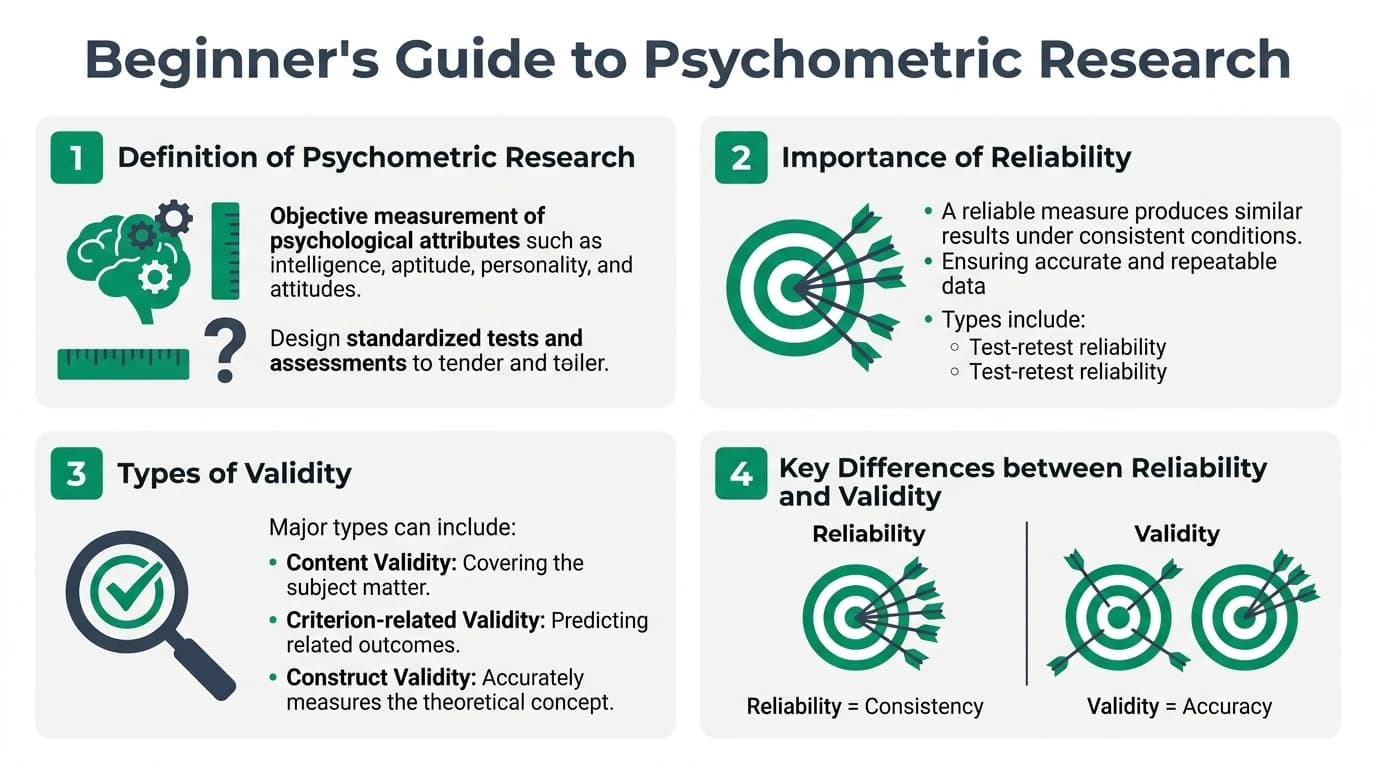
Psychometric research focuses on evaluating psychological tests, ensuring they are reliable and valid. Reliability means the test results are consistent over time, while validity ensures the test measures what it intends to.
The bottom line: Psychometric research is crucial for creating trustworthy assessments in fields like education, hiring, and clinical settings.
Critical Warning: Always ensure tests meet reliability and validity standards to avoid flawed decisions.
What is Psychometric Research?
Psychometric research is the scientific study of psychological tests and assessments. It examines:
- Purpose: To ensure tests are both reliable (consistent results) and valid (accurate measurements).
- Importance: Used in hiring, education, and clinical settings to make informed decisions.
| Aspect | Description |
|---|---|
| Reliability | Consistency of test results over time. |
| Validity | Accuracy in measuring the intended construct. |
Why is Reliability Important?
Reliability refers to the consistency of a test's results. A reliable test produces similar outcomes under consistent conditions.
- Test-retest Reliability: Measures stability over time.
- Internal Consistency: Ensures items within a test are consistent.
| Type | Description | Measurement | Threshold |
|---|---|---|---|
| Test-retest | Stability over time | ICC | >0.4 |
| Internal Consistency | Consistency within test items | Cronbach’s alpha | ≥0.6 |
| Parallel Forms | Consistency across different test versions | Correlation | High |
| Inter-rater | Agreement between different scorers | Kappa | >0.4 |
Understanding Validity
Validity ensures a test measures what it claims to. There are several types:
- Face Validity: Appears effective.
- Content Validity: Covers relevant areas.
- Construct Validity: Measures intended concept.
- Criterion Validity: Correlates with outcomes.
| Type | Subtype | Focus | Example |
|---|---|---|---|
| Face | N/A | Looks effective | Initial impression |
| Content | N/A | Comprehensive coverage | Exam questions |
| Construct | N/A | Psychological concept | Intelligence tests |
| Criterion | Predictive/Concurrent | Outcome correlation | Job performance prediction |
Evaluating Psychometric Tests
To evaluate a test, consider:
- Reliability: Consistency of results.
- Validity: Accuracy of measurement.
- Standardized Methods: Uniform test administration.
- Normative Data: Comparative data for interpretation.
| Criterion | Importance | Details |
|---|---|---|
| Reliability | High | Consistent results |
| Validity | High | Accurate measurements |
| Standardization | Essential | Uniform procedures |
| Norms | Important | Comparative benchmarks |
Measuring Reliability in Psychometrics
Reliability is measured using various methods:
- Test-retest Protocols: Repeating tests over time.
- Inter-rater Agreement: Consistency among different evaluators.
- Parallel Forms: Using equivalent test versions.
| Metric | Adequate Level | Source |
|---|---|---|
| Cronbach’s alpha | ≥0.6 | NCBI/NIH |
| ICC | >0.4 | NCBI/NIH |
| Kappa | >0.4 | NCBI/NIH |
Collecting Validity Evidence
Gathering evidence for validity involves:
- Correlations: With relevant criteria.
- Multi-study Requirements: Validity confirmed across studies.
| Form | Purpose | Data Needed |
|---|---|---|
| Content | Coverage | Expert review |
| Criterion | Outcome prediction | Statistical correlation |
| Construct | Concept measurement | Theoretical framework |
Applications in Research
Psychometric research is vital in:
- Neurodevelopment Studies: Assessing cognitive function.
- Epidemiological Use: Understanding population health trends.
| Application | Example | Importance |
|---|---|---|
| HR Hiring | Personality tests | Predict job performance |
| Education | Student assessments | Evaluate knowledge |
| Clinical Research | Neurodevelopment tests | Study CNS function |
Common Pitfalls in Assessment
Avoid these pitfalls:
- Low Coefficients: Ensure reliability and validity meet thresholds.
- Ignoring Norms: Use comparative data for interpretation.
| Pitfall | Description | Solution |
|---|---|---|
| Low Coefficients | Below threshold reliability | Verify metrics |
| Ignoring Norms | Lack of comparative data | Use normative data |
Modern Trends in Psychometrics
Current trends include:
- Reliability/Validity Spectrum: Ratings from excellent to poor.
- Vendor Transparency: Clear information on test metrics.
| Trend | Description | Example |
|---|---|---|
| Spectrum Ratings | Varying reliability/validity | Excellent to poor |
| Transparency | Information clarity | Vendor manuals |
Practical Test Selection
When selecting tests, balance:
- Criteria: Reliability and validity.
- Application Needs: Suitability for specific purposes.
| Criterion | Importance | Details |
|---|---|---|
| Reliability | High | Consistent results |
| Validity | High | Accurate measurements |
| Application Needs | Essential | Suitability for purpose |
Action checklist
- Verify test reliability and validity.
- Use standardized methods and norms.
- Consider application-specific needs.
FAQ
What is the difference between reliability and validity in psychometrics?
How do you test for reliability in psychometric assessments?
Why is reliability necessary for validity?
What is test-retest reliability?
What does Cronbach’s alpha measure?
Can a test be reliable but not valid?
What is construct validity in psychometrics?
Notes
Primary Sources
| Source | Type | URL |
|---|---|---|
| NCBI/NIH | Official/Peer-reviewed | NCBI/NIH |
| Arctic Shores | Industry | Arctic Shores |
Conclusion
Psychometric research is essential for developing reliable and valid assessments. By understanding and applying principles of reliability and validity, you can ensure that tests are both consistent and accurate.