personality-tests
Best Careers for Your Big Five Profile: 2026 Guide
Find the best career matches for each Big Five personality trait with evidence-based job recommendations, salary data, and fit strategies for 2026 and beyond.
Quick answer
What are the best careers for each Big Five trait?
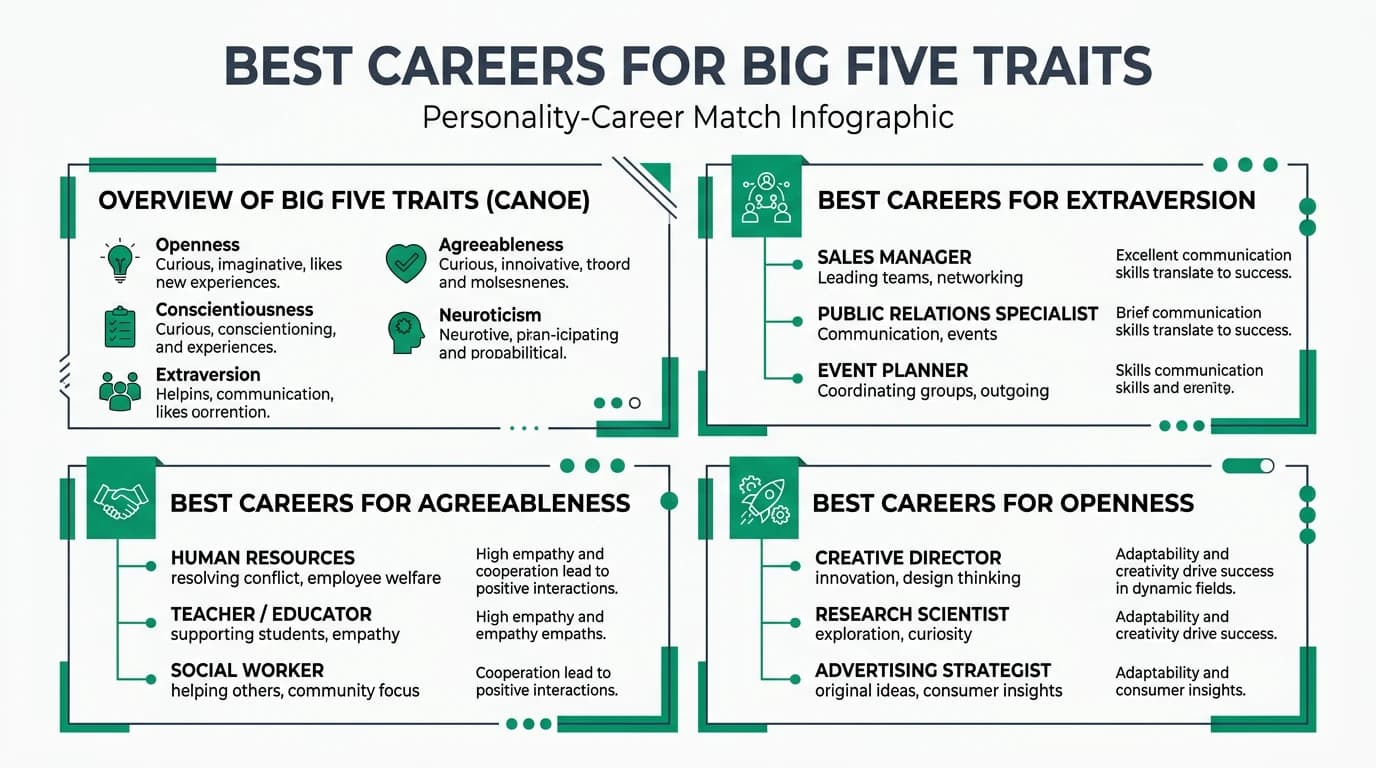
Conscientiousness predicts success in structured roles like accounting, engineering, and medicine. Extraversion suits sales, management, and public relations. Openness fits creative and research careers. Agreeableness aligns with counseling, teaching, and healthcare. Low neuroticism (emotional stability) is an advantage in high-pressure roles. A century of research confirms that personality-job fit boosts both performance and satisfaction.
Key Takeaways
- Conscientiousness is the single best Big Five predictor of job performance across virtually all occupations.
- Extraversion predicts success specifically in jobs requiring social interaction and leadership.
- Openness is the strongest differentiator for creative, artistic, and investigative careers.
- Agreeableness enhances performance in helping and cooperative roles but can limit effectiveness in competitive ones.
- Emotional stability (low neuroticism) matters most in high-stress environments.
- Personality-job fit is probabilistic, not deterministic — use it as a guide, not a ceiling.
The bottom line: Aligning your career with your Big Five profile increases the odds of both high performance and job satisfaction, but skills, values, and context matter too.
Disclaimer: Career decisions should integrate personality data with skills assessment, labor market trends, and personal values. This guide provides evidence-based starting points, not prescriptions.
The Science Behind Personality-Job Fit
The idea that personality predicts career outcomes has over a century of research behind it. Three landmark studies frame the modern evidence base.
- Barrick and Mount (1991): The first major meta-analysis linking Big Five traits to job performance across five occupational groups. Conscientiousness emerged as a valid predictor for all job types1.
- Judge et al. (2002): Extended the analysis to career success (salary, promotions, satisfaction), showing that conscientiousness and extraversion predicted extrinsic success while neuroticism predicted lower satisfaction2.
- Wilmot and Ones (2019): Synthesized a century of data (over 2,000 effect sizes) and confirmed conscientiousness as the most consequential trait for work outcomes3.
| Study | Sample Size | Key Finding | Effect Size |
|---|---|---|---|
| Barrick and Mount (1991) | 162 studies | Conscientiousness predicts performance in all jobs | r = 0.22 (corrected) |
| Judge et al. (2002) | 334 studies | Conscientiousness and extraversion predict career success | r = 0.20–0.29 |
| Wilmot and Ones (2019) | 2,000+ effect sizes | Century-long validation of conscientiousness | r = 0.19 (overall performance) |
For a broader overview of how personality shapes career decisions, see our career choice guide for job seekers.
Conscientiousness: The Universal Performance Predictor
Conscientiousness predicts job performance more consistently than any other Big Five trait13. It operates through reliable work habits, goal persistence, and organizational skills.
Best career matches for high conscientiousness:
- Accounting and finance
- Engineering (all specializations)
- Medicine and surgery
- Law and compliance
- Project management
- Military and law enforcement
| Career | Why It Fits | Performance Correlation | Median Salary (2025 US) |
|---|---|---|---|
| Accountant / Auditor | Demands precision, rule adherence | r = 0.23 | 79,880 |
| Civil Engineer | Structured problem-solving, safety compliance | r = 0.22 | 89,940 |
| Surgeon | Extreme attention to detail, perseverance | r = 0.20 | 229,300 |
| Compliance Officer | Rule-based, process-oriented | r = 0.24 | 75,670 |
| Project Manager | Planning, scheduling, execution | r = 0.25 | 98,580 |
Low conscientiousness considerations:
- Highly structured roles will feel confining. Look for careers with autonomy and variety.
- Creative freelancing, startup environments, and exploratory research can be better fits.
- Build external systems (checklists, deadlines, accountability partners) to compensate.
Extraversion: The Social Performance Advantage
Extraversion predicts success in jobs that require interpersonal interaction, leadership, and public visibility12. The effect is strongest in management and sales roles.
Best career matches for high extraversion:
- Sales and business development
- Management and executive leadership
- Public relations and marketing
- Teaching and training
- Real estate
- Event planning
| Career | Why It Fits | Performance Correlation | Median Salary (2025 US) |
|---|---|---|---|
| Sales Manager | Relationship building, persuasion, energy | r = 0.18 | 131,710 |
| Marketing Director | Public-facing, team leadership | r = 0.15 | 156,580 |
| Teacher (K–12) | Classroom engagement, student motivation | r = 0.12 | 63,570 |
| Real Estate Agent | Networking, client rapport | r = 0.14 | 56,620 |
| Event Planner | Social coordination, energy management | r = 0.13 | 56,920 |
Introverts in the workplace:
- Introversion is not a weakness — it predicts better performance in roles requiring deep focus, independent analysis, and written communication.
- Software engineering, research science, writing, and data analysis favor introverted profiles.
- For detailed strategies, see our introversion workplace guide.
Openness to Experience: The Creativity Differentiator
Openness shows the largest occupational differences of any Big Five trait — it sharply separates artistic and investigative workers from conventional ones45.
Best career matches for high openness:
- Graphic design and UX
- Writing and journalism
- Scientific research
- Architecture
- Film and media production
- University professor
| Career | Why It Fits | Trait Differentiation | Median Salary (2025 US) |
|---|---|---|---|
| UX Designer | Creative problem-solving, user empathy | Very high openness vs. average worker | 83,240 |
| Research Scientist | Curiosity-driven, exploratory | Highest openness scores among all occupations | 95,430 |
| Journalist | Storytelling, intellectual curiosity | High openness, moderate extraversion | 55,960 |
| Architect | Aesthetic sense, spatial innovation | High openness and conscientiousness | 93,310 |
| Film Director | Vision, artistic expression | Very high openness | 86,090 |
Low openness considerations:
- Routine-oriented roles in operations, logistics, and administration are natural fits.
- Consistency and reliability are valued in these environments.
- Avoid framing low openness as a limitation — it is a strength in roles requiring standardization.
For a full exploration of this trait, visit our openness to experience guide.
Agreeableness: The Helping Professions Advantage
Agreeableness predicts performance in cooperative, helping, and service-oriented roles. It is the trait most associated with teamwork, empathy, and client satisfaction16.
Best career matches for high agreeableness:
- Counseling and psychotherapy
- Nursing and patient care
- Social work
- Human resources
- Customer service management
- Non-profit leadership
| Career | Why It Fits | Key Trait Facets | Median Salary (2025 US) |
|---|---|---|---|
| Counselor | Empathy, active listening | Trust, altruism, tenderness | 53,490 |
| Registered Nurse | Patient care, team coordination | Compliance, altruism | 86,070 |
| Social Worker | Community support, advocacy | Altruism, modesty | 58,380 |
| HR Manager | Conflict resolution, employee wellbeing | Cooperation, trust | 136,350 |
| Non-profit Director | Mission-driven leadership | Altruism, straightforwardness | 74,680 |
Low agreeableness considerations:
- Competitive environments (trading, litigation, entrepreneurship) reward assertiveness and skepticism.
- Leadership roles that require making unpopular decisions favor lower agreeableness.
- Low agreeableness paired with high conscientiousness is a common executive profile.
Neuroticism (Emotional Stability): The Stress Resilience Factor
Low neuroticism (high emotional stability) is an advantage in high-pressure, high-stakes careers. It does not predict job performance as broadly as conscientiousness, but it matters enormously in specific contexts12.
Best career matches for high emotional stability (low neuroticism):
- Emergency medicine and paramedic work
- Air traffic control
- Military leadership
- Trial attorney
- Crisis management
| Career | Why Stability Matters | Stress Level | Emotional Stability Requirement |
|---|---|---|---|
| Emergency Physician | Split-second decisions under pressure | Very high | Critical |
| Air Traffic Controller | Sustained focus, error intolerance | Very high | Critical |
| Military Officer | Leadership under adversity | Very high | Critical |
| Trial Attorney | Adversarial pressure, public performance | High | Important |
| Crisis Manager | Rapid response, stakeholder communication | High | Important |
High neuroticism considerations:
- Avoid roles with chronic unpredictability, time pressure, and emotional labor.
- Structured environments with predictable routines reduce stress activation.
- Pair career choice with active stress management strategies to expand your viable career range.
Multi-Trait Career Profiles
Real people are not defined by a single trait. The most accurate career matching uses profile patterns.
| Profile Pattern | Description | Best-Fit Careers | Example Roles |
|---|---|---|---|
| High C + Low N | Reliable and calm | Finance, engineering, medicine | Surgeon, actuary, pilot |
| High E + High A | Social and empathetic | Service leadership, teaching | School principal, sales director |
| High O + High C | Creative and disciplined | Design, architecture, research | UX lead, patent attorney |
| High O + Low C | Imaginative but unstructured | Arts, writing, startup ideation | Novelist, concept artist |
| High E + Low A | Assertive and competitive | Entrepreneurship, trading, law | Founder, litigator |
| Low O + High C | Methodical and consistent | Operations, logistics, compliance | Supply chain manager, auditor |
Understanding your multi-trait profile provides far more actionable guidance than any single trait alone. Our job interview guide explains how to present your profile effectively to employers.
Career Satisfaction vs. Career Performance
Personality predicts both performance and satisfaction, but the strongest predictors differ for each outcome2.
| Outcome | Strongest Positive Predictor | Strongest Negative Predictor | Effect Size Range |
|---|---|---|---|
| Job performance | Conscientiousness | Low emotional stability | r = 0.19–0.25 |
| Job satisfaction | Extraversion | Neuroticism | r = 0.17–0.29 |
| Salary level | Conscientiousness, extraversion | Agreeableness (negative) | r = 0.12–0.20 |
| Promotion rate | Extraversion | Neuroticism | r = 0.10–0.18 |
| Career longevity | Conscientiousness | Low agreeableness (in team roles) | r = 0.14–0.22 |
A critical nuance: agreeableness negatively predicts salary. Agreeable people tend to negotiate less aggressively and prioritize harmony over compensation. This does not mean agreeableness is a career liability — it means highly agreeable individuals benefit from deliberate negotiation training.
For those considering entrepreneurship, where agreeableness trade-offs are especially relevant, see our entrepreneurship and personality guide.
Practical Steps for Career Exploration in 2026
Use this process to translate personality insights into career action.
- Assess your profile: Take a validated Big Five assessment (NEO-PI-R or IPIP-NEO). Free versions are available online.
- Identify your top two traits: Focus on the two traits where you score highest or lowest.
- Match to career families: Use the tables above to identify two or three career families aligned with your profile.
- Research specific roles: Investigate job descriptions, salary ranges, and growth projections within those families.
- Conduct informational interviews: Talk to people in target roles to validate fit beyond personality.
- Test with low-risk experiences: Volunteer, freelance, or intern before committing to a career pivot.
Conclusion
A century of research confirms that Big Five personality traits meaningfully predict career performance, satisfaction, and success. Conscientiousness is the universal predictor, extraversion matters for social roles, openness differentiates creative workers, agreeableness enhances helping professions, and emotional stability is essential in high-stress environments. Use your profile as a compass, not a cage — the best career decisions integrate personality with skills, values, and opportunity.
Career-personality alignment checklist
- Complete a validated Big Five personality assessment.
- Identify your two strongest and two weakest traits.
- Match your profile to two or three career families from the tables above.
- Research three specific roles within your best-fit career family.
- Conduct at least two informational interviews with professionals in target roles.
- Identify one low-risk way to test your career fit (volunteer, freelance, or shadow).
- Create a 90-day career exploration plan with concrete milestones.
FAQ
Which Big Five trait best predicts job performance?
Can introverts succeed in leadership roles?
Does agreeableness hurt your salary?
What careers suit high openness best?
How does neuroticism affect career choice?
Should I change careers if my personality does not match?
Are personality tests reliable enough for career decisions?
What is the best personality test for career matching?
Notes
Primary Sources
| Source | Type | URL |
|---|---|---|
| Barrick & Mount (1991) — Personnel Psychology | Meta-analysis (162 studies) | doi.org |
| Judge et al. (2002) — Journal of Applied Psychology | Meta-analysis (334 studies) | doi.org |
| Wilmot & Ones (2019) — Psychological Bulletin | Century-spanning review | doi.org |
| Barrick et al. (2003) — Personnel Psychology | Meta-analysis | doi.org |
| Mount et al. (1998) — Human Performance | Empirical study | doi.org |
Footnotes
-
Barrick, M. R., & Mount, M. K. (1991). The Big Five personality dimensions and job performance: A meta-analysis. Personnel Psychology, 44(1), 1–26. ↩ ↩2 ↩3 ↩4 ↩5
-
Judge, T. A., Heller, D., & Mount, M. K. (2002). Five-factor model of personality and job satisfaction: A meta-analysis. Journal of Applied Psychology, 87(3), 530–541. ↩ ↩2 ↩3 ↩4
-
Wilmot, M. P., & Ones, D. S. (2019). A century of research on conscientiousness at work. Psychological Bulletin, 145(3), 249–272. ↩ ↩2
-
Barrick, M. R., Mount, M. K., & Gupta, R. (2003). Meta-analysis of the relationship between the Five-Factor model of personality and Holland's occupational types. Personnel Psychology, 56(1), 45–74. ↩
-
Larson, L. M., Rottinghaus, P. J., & Borgen, F. H. (2002). Meta-analyses of Big Six interests and Big Five personality factors. Journal of Vocational Behavior, 61(2), 217–239. ↩
-
Mount, M. K., Barrick, M. R., & Stewart, G. L. (1998). Five-Factor model of personality and performance in jobs involving interpersonal interactions. Human Performance, 11(2-3), 145–165. ↩