personality-tests
HEXACO vs Big Five: Complete Comparison Guide
Compare HEXACO and Big Five personality models side by side. Learn which framework fits your goals for hiring, research, ethics screening, and coaching.
Quick answer
What is the key difference between HEXACO and Big Five?
HEXACO adds a sixth dimension — Honesty-Humility — that directly measures sincerity, fairness, greed avoidance, and modesty. It also redefines Emotionality and Agreeableness, producing a model that better predicts ethical and counterproductive behavior.
Source: Ashton & Lee (2007), European Journal of Personality
Executive Summary
The Big Five (OCEAN) and HEXACO are both dimensional personality frameworks rooted in lexical studies. They share substantial overlap, yet differ in three critical ways: HEXACO includes Honesty-Humility, redefines Emotionality (splitting it from Neuroticism), and rotates Agreeableness content 1.
For most general-purpose assessments, the Big Five remains the default. When integrity screening, ethics-sensitive roles, or Dark Triad prediction matter, HEXACO offers measurable advantages.
Key takeaway: neither model is universally "better." The right choice depends on the decision context, the behavior you need to predict, and the population you are assessing.
Important: No personality model replaces structured interviews, work samples, or professional judgment. Use either framework as a decision aid, not an automated filter.
Origins and Theoretical Foundations
Both models emerged from lexical research — analyzing personality-descriptive words across languages to find recurring trait clusters.
- Big Five / FFM: consolidated during the 1980s–1990s by Costa and McCrae, Goldberg, and John 2. Five factors (Openness, Conscientiousness, Extraversion, Agreeableness, Neuroticism) replicated across English-language studies and many translated instruments.
- HEXACO: proposed by Ashton and Lee in the early 2000s after cross-language lexical studies in Korean, French, Italian, Dutch, German, Hungarian, and other languages consistently revealed a sixth factor 1.
| Feature | Big Five (FFM) | HEXACO |
|---|---|---|
| Year introduced | 1980s–1990s | 2000–2004 |
| Number of factors | 5 | 6 |
| Lexical basis | Primarily English | Multi-language (12+ languages) |
| Key architects | Costa, McCrae, Goldberg, John | Ashton, Lee |
| Sixth factor | Absent | Honesty-Humility |
| Primary instrument | NEO-PI-R, BFI-2 | HEXACO-PI-R (60 or 100 items) |
The multi-language lexical foundation is one reason some researchers consider HEXACO a more cross-culturally robust starting point 3. For a broader framework comparison, see MBTI vs Big Five.
Dimension-by-Dimension Comparison
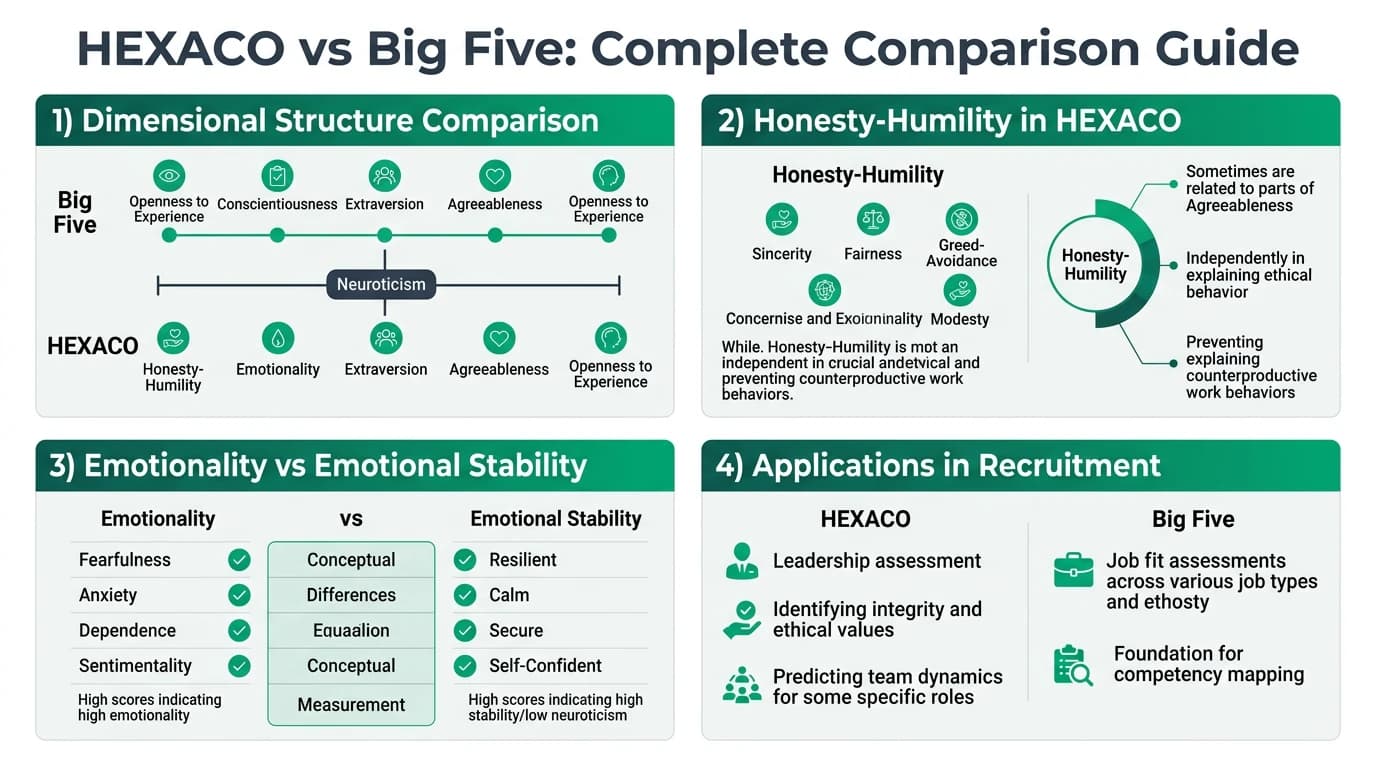
Five of the six HEXACO factors map loosely onto Big Five counterparts, but important content shifts occur in Emotionality, Agreeableness, and the addition of Honesty-Humility.
| HEXACO dimension | Closest Big Five match | What changed |
|---|---|---|
| Honesty-Humility (H) | No direct match | New factor measuring sincerity, fairness, greed avoidance, modesty |
| Emotionality (E) | Neuroticism (partial) | Adds sentimentality and attachment anxiety; removes anger (moved to Agreeableness) |
| Extraversion (X) | Extraversion | Nearly identical content |
| Agreeableness (A) | Agreeableness (rotated) | Absorbs anger/irritability from Neuroticism; loses some sentimentality content |
| Conscientiousness (C) | Conscientiousness | Nearly identical content |
| Openness (O) | Openness to Experience | Nearly identical content |
Understanding the Emotionality rotation is essential. In Big Five terms, a person high in Neuroticism might be both anxious and easily angered. HEXACO separates these: anxiety and sentimentality stay under Emotionality, while anger and irritability move to (low) Agreeableness 1.
Honesty-Humility: The Defining Difference
Honesty-Humility is the single largest structural addition HEXACO makes. It captures four facets that Big Five distributes — or misses entirely — across Agreeableness and Conscientiousness.
| Facet | What it measures | Behavioral example |
|---|---|---|
| Sincerity | Unwillingness to manipulate others | Avoids flattery to gain favors |
| Fairness | Resistance to cheating or bribery | Declines shortcuts that harm others |
| Greed Avoidance | Low interest in luxury and status | Does not pursue wealth as a primary motivator |
| Modesty | Absence of entitlement | Comfortable not being the center of attention |
Low Honesty-Humility scores predict counterproductive work behavior, workplace delinquency, and overlap substantially with the Dark Triad (narcissism, Machiavellianism, psychopathy) 4. For a deep dive, read Honesty-Humility: The Sixth Trait Big Five Misses.
Psychometric Properties Compared
Both models show strong internal consistency and test-retest reliability. HEXACO typically explains additional variance in ethics-related criteria.
| Property | Big Five (NEO-PI-R) | HEXACO-PI-R | Notes |
|---|---|---|---|
| Internal consistency (alpha) | 0.86–0.92 | 0.77–0.90 | Big Five slightly higher on some scales |
| Test-retest (6 months) | 0.80–0.90 | 0.79–0.87 | Comparable stability |
| Cross-cultural replication | 50+ countries | 20+ languages | HEXACO designed for cross-language fit |
| Incremental validity for CWB | Baseline | Adds 5–10 percent explained variance | Via Honesty-Humility 4 |
| Incremental validity for ethics | Limited | Strong | Fairness and sincerity facets |
| Number of facets | 30 (6 per factor) | 24 (4 per factor) | HEXACO uses fewer, broader facets |
If your primary concern is test reliability, both models meet standard psychometric thresholds. The practical question is whether you need the extra ethical lens.
Predictive Validity by Use Case
Different contexts favor different models. The table below summarizes evidence-based recommendations.
| Use case | Recommended model | Why | Key source |
|---|---|---|---|
| General hiring screen | Big Five | Broader normative data, more vendor options | Barrick & Mount (1991) 2 |
| Integrity / ethics roles | HEXACO | Honesty-Humility predicts CWB above Big Five | Lee et al. (2019) 4 |
| Leadership development | Big Five | Well-established links to transformational leadership | Judge et al. (2002) |
| Fraud-risk profiling | HEXACO | Low H predicts bribery acceptance and rule-breaking | Ashton & Lee (2008) 1 |
| Academic research | Either (specify) | Depends on criterion of interest | — |
| Clinical screening | Big Five (FFM) | Stronger clinical literature base | Widiger & Costa (2012) |
| Cross-cultural projects | HEXACO | Designed from multi-language lexical data | Ashton et al. (2004) 3 |
| Team coaching | Big Five | Simpler to debrief five dimensions | — |
For hiring-specific guidance, see Personality Test Validity in Hiring.
Emotionality vs Neuroticism: A Closer Look
This rotation is often misunderstood. The two scales share anxiety and vulnerability content, but differ in where anger and sentimentality reside.
| Content area | Big Five Neuroticism | HEXACO Emotionality |
|---|---|---|
| Anxiety | Included | Included |
| Vulnerability | Included | Included |
| Anger / Hostility | Included | Moved to low Agreeableness |
| Sentimentality | Spread across factors | Included |
| Attachment anxiety | Partially in Neuroticism | Included |
Practically, a person scoring high on HEXACO Emotionality is fearful and sentimental but not necessarily irritable. In Big Five, the same profile might register as high Neuroticism and moderate Agreeableness, blurring the picture.
- When this matters: roles requiring emotional sensitivity (counseling, caregiving) benefit from Emotionality's cleaner signal.
- When it does not matter: broad performance screening where the anger-anxiety distinction adds minimal decision value.
Adoption and Availability
Big Five dominates commercial and academic use. HEXACO is growing but remains niche in applied settings.
| Criterion | Big Five | HEXACO |
|---|---|---|
| Commercial vendors | Dozens (e.g., Hogan, SHL, Talogy) | Few specialized providers |
| Free validated instruments | IPIP-NEO, BFI-2 | HEXACO-PI-R (free from hexaco.org) |
| Published norms | Extensive (by country, age, role) | Limited but expanding |
| Typical item count | 44–240 | 60 or 100 |
| Completion time | 8–30 min | 10–15 min |
| HR integration | Widely supported | Requires custom setup |
| Academic citations | 100,000+ | 3,000+ and growing |
Organizations already using Big Five often find it impractical to switch entirely. A common middle ground is administering HEXACO for high-stakes integrity roles while keeping Big Five for general development programs.
When to Choose Each Model
Selecting the right framework requires matching the model to the decision context.
Decision checklist
- Identify the primary behavior you need to predict (performance, integrity, collaboration, clinical risk).
- Check whether Honesty-Humility adds decision value for your specific role or context.
- Evaluate available norms — does a validated norm group exist for your population?
- Consider respondent burden: can you add six dimensions without survey fatigue?
- Review vendor support: does your assessment platform support HEXACO scoring?
- Consult a qualified psychometrician before switching frameworks in high-stakes pipelines.
- Choose Big Five when you need broad normative benchmarks, vendor flexibility, and well-established leadership or performance links.
- Choose HEXACO when predicting ethical behavior, integrity violations, or Dark Triad tendencies is a primary goal.
- Use both when the decision stakes are high and the role involves fiduciary, compliance, or trust-critical responsibilities.
For additional guidance on assessment quality, review our Big Five Personality Test Complete Guide.
Common Misconceptions
Several persistent myths confuse practitioners choosing between these models.
- Myth: HEXACO replaces Big Five. HEXACO extends it. Five of the six factors map closely onto Big Five dimensions. In many applications the models produce similar conclusions.
- Myth: Big Five ignores ethics entirely. Big Five Agreeableness and Conscientiousness partially capture ethical tendencies; HEXACO simply isolates them more cleanly.
- Myth: HEXACO is only for research. The HEXACO-PI-R is publicly available, validated across languages, and used in applied screening by several European organizations.
- Myth: More factors always equals better. Additional factors increase precision only if the criterion of interest benefits from the new factor. For general job performance, the sixth factor adds modest incremental value.
FAQ
Is HEXACO more accurate than the Big Five?
Can I convert Big Five scores to HEXACO scores?
Not directly. Although five of the six dimensions share content, the rotation of Emotionality and Agreeableness means scores are not interchangeable. You would need to administer both instruments separately. Ashton and Lee (2007) provide detailed mapping tables 1.
How long does the HEXACO-PI-R take to complete?
The 60-item version takes approximately 10–12 minutes. The 100-item version takes 15–18 minutes. Both are freely available at hexaco.org for research and non-commercial use 3.
Does Honesty-Humility overlap with Big Five Agreeableness?
Partially. Correlations between Honesty-Humility and Big Five Agreeableness typically range from 0.30 to 0.45, indicating shared variance but substantial unique content — particularly in fairness and greed avoidance facets 1.
Which model works better across cultures?
HEXACO was designed from multi-language lexical studies across 12 or more languages, giving it a structural advantage in cross-cultural settings. Big Five has been validated across 50+ countries but was originally derived from English-language adjectives 3.
Is HEXACO useful for hiring decisions?
Yes, especially for roles where integrity is critical — finance, compliance, law enforcement, and healthcare. Honesty-Humility adds incremental validity for predicting counterproductive work behavior above Big Five Conscientiousness and Agreeableness alone 4.
Can HEXACO detect Dark Triad traits?
Low Honesty-Humility correlates strongly (negatively) with all three Dark Triad constructs: narcissism, Machiavellianism, and psychopathy. It is not a clinical diagnostic tool, but it flags risk profiles that Big Five may underestimate 4.
Should I switch from Big Five to HEXACO?
Not necessarily. If your current Big Five program serves its purpose and Honesty-Humility is not a critical decision variable, switching adds cost without proportional benefit. Consider adding HEXACO selectively for integrity-critical roles 1.
Notes
Primary Sources
| Source | Type | URL |
|---|---|---|
| Ashton & Lee (2007), European Journal of Personality | Foundational HEXACO paper | doi.org/10.1002/per.611 |
| Barrick & Mount (1991), Personnel Psychology | Big Five and job performance meta-analysis | doi.org/10.1111/j.1744-6570.1991.tb00688.x |
| Ashton et al. (2004), JPSP | Cross-language six-factor structure | doi.org/10.1037/0022-3514.86.2.356 |
| Lee, Ashton & de Vries (2005), Human Performance | HEXACO workplace delinquency prediction | doi.org/10.1207/s15327043hup1802_4 |
| Official HEXACO-PI-R | Free instrument | hexaco.org |
Conclusion
HEXACO and Big Five are complementary, not competing, frameworks. Big Five remains the global default for its breadth of norms and vendor support. HEXACO adds a sharper ethical lens through Honesty-Humility and a cleaner separation of emotionality from anger.
The practical recommendation: start with Big Five unless your decision context explicitly benefits from integrity prediction, in which case add or switch to HEXACO.
Footnotes
-
Ashton, M. C., & Lee, K. (2007). Empirical, theoretical, and practical advantages of the HEXACO model of personality structure. European Journal of Personality, 21(2), 150–166. https://doi.org/10.1002/per.611 ↩ ↩2 ↩3 ↩4 ↩5 ↩6 ↩7
-
Barrick, M. R., & Mount, M. K. (1991). The Big Five personality dimensions and job performance. Personnel Psychology, 44(1), 1–26. https://doi.org/10.1111/j.1744-6570.1991.tb00688.x ↩ ↩2 ↩3
-
Ashton, M. C., Lee, K., Perugini, M., et al. (2004). A six-factor structure of personality-descriptive adjectives: Solutions from psycholexical studies in seven languages. Journal of Personality and Social Psychology, 86(2), 356–366. https://doi.org/10.1037/0022-3514.86.2.356 ↩ ↩2 ↩3 ↩4
-
Lee, K., Ashton, M. C., & de Vries, R. E. (2005). Predicting workplace delinquency and integrity with the HEXACO and Five-Factor Models. Human Performance, 18(2), 179–197. https://doi.org/10.1207/s15327043hup1802_4 ↩ ↩2 ↩3 ↩4 ↩5 ↩6