personal-development
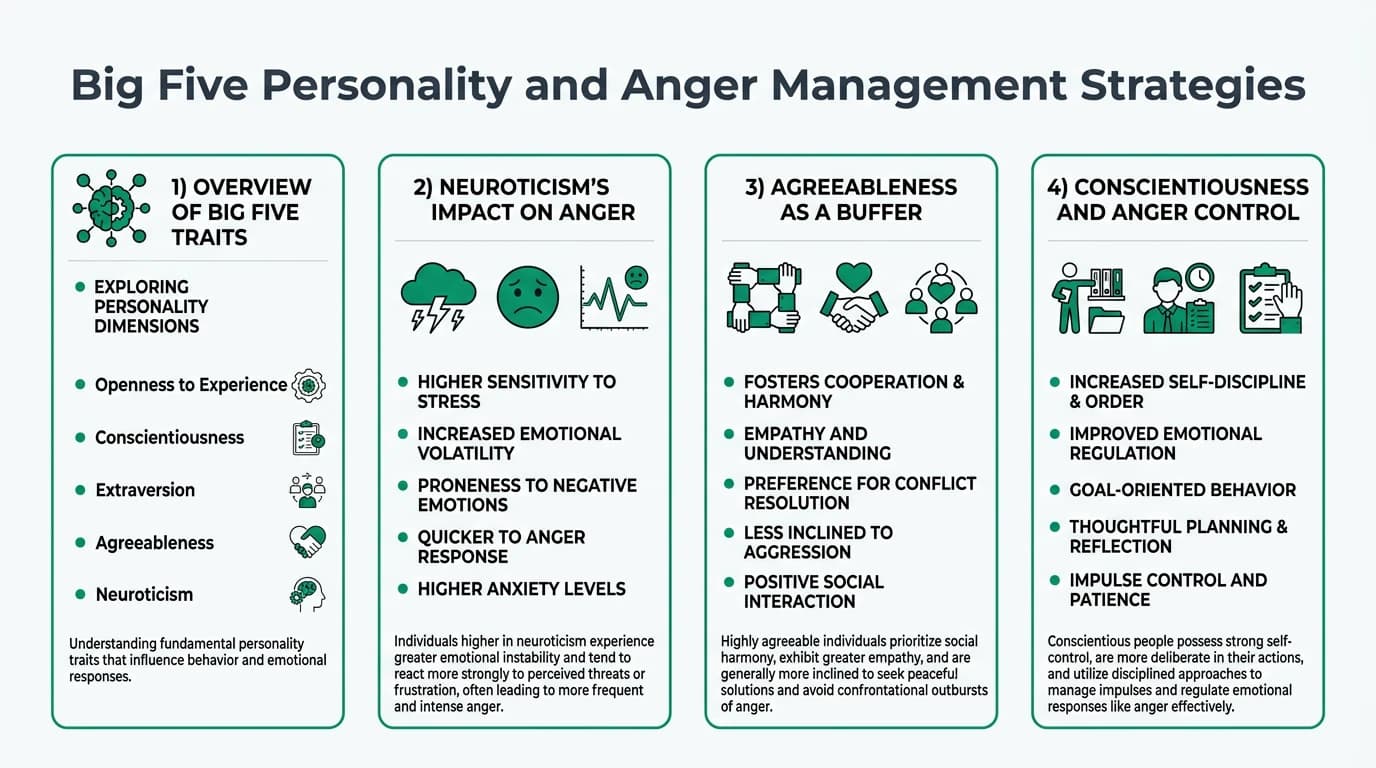
Big Five Personality and Anger Management Strategies
Explore how the Big Five personality traits influence anger management and discover effective strategies tailored to each trait.
Quick answer
How do the Big Five personality traits affect anger management?
The Big Five traits—Neuroticism, Extraversion, Openness, Agreeableness, and Conscientiousness—affect anger management by influencing how individuals express and control anger. High Neuroticism and low Agreeableness/Conscientiousness are linked to increased anger and aggression, while high Agreeableness and Conscientiousness help in managing anger effectively.
Source: MIDUS Study
Executive Summary
Understanding the Big Five personality traits can significantly enhance anger management strategies. Each trait influences how anger is expressed and controlled, with Neuroticism often linked to increased anger and aggression.
The bottom line: Tailoring anger management strategies to your personality traits can improve outcomes and help maintain emotional balance.
Critical Warning: Ignoring personality traits in anger management can lead to ineffective strategies and increased frustration.
Understanding the Big Five Personality Traits
The Big Five personality traits—Neuroticism, Extraversion, Openness to Experience, Agreeableness, and Conscientiousness—play a crucial role in how individuals manage anger.
- Neuroticism: High levels can lead to increased anger and aggression.
- Agreeableness: Low levels are associated with higher aggression.
- Conscientiousness: Helps in controlling anger effectively.
| Trait | Impact on Anger Management | Example Population |
|---|---|---|
| Neuroticism | Increased anger/aggression | US adults, offenders |
| Agreeableness | Decreased aggression | School students |
| Conscientiousness | Better anger control | Fitness practitioners |
Neuroticism and Anger Expression
High Neuroticism is strongly linked to increased anger expression and aggression. Studies show significant correlations between Neuroticism and anger traits.
- Effect: Increased outward/inward anger.
- Process: Emotional reactivity and sensitivity.
- Caveat: Requires targeted management strategies.
| Neuroticism Correlations | Sample | Strength (r) |
|---|---|---|
| Trait anger | US adults | -0.20 |
| Aggression | Offenders | Positive |
Agreeableness as a Buffer
Agreeableness acts as a buffer against aggression. Individuals with high Agreeableness tend to manage anger better.
- Effect: Reduced aggression.
- Process: Empathy and cooperation.
- Caveat: Low levels can increase conflict.
| Sample | Agreeableness Correlation | Aggression Level |
|---|---|---|
| US adults | Negative | Low |
| School students | Negative | Low |
Conscientiousness and Anger Control
Conscientiousness is associated with better anger suppression and control. It moderates the effects of Neuroticism.
- Effect: Improved anger management.
- Process: Self-discipline and organization.
- Caveat: Requires consistent practice.
| Conscientiousness Effects | Sample | Outcome |
|---|---|---|
| Anger control | US adults | Improved |
| Aggression moderation | Fitness groups | Reduced |
Extraversion and Anger Dynamics
Extraversion has mixed links to anger, with low levels sometimes predicting increased anger expression.
- Effect: Varied impact on anger.
- Process: Social interaction and energy levels.
- Caveat: Context-dependent.
| Extraversion Links | Sample | Correlation |
|---|---|---|
| Aggression | Students | Inverse |
| Anger expression | General pop. | Mixed |
Openness to Experience and Aggression
Openness is generally linked to reduced aggression, promoting adaptability and creative problem-solving.
- Effect: Lower aggression.
- Process: Flexibility and open-mindedness.
- Caveat: May vary by context.
| Openness Correlations | Sample | Aggression Level |
|---|---|---|
| Overall aggression | Students | Low |
| Emotional reactivity | Diverse groups | Reduced |
Trait Interactions and Anger Outcomes
Interactions between traits, such as Conscientiousness moderating Neuroticism, can predict anger outcomes.
- Effect: Complex trait interactions.
- Process: Combined trait influences.
- Caveat: Requires nuanced understanding.
| Interaction Effects | Sample | Outcome |
|---|---|---|
| Neuroticism x Conscientiousness | US adults | Better control |
| Agreeableness x Neuroticism | Offenders | Reduced anger |
Big Five Profiles in High-Risk Groups
High-risk groups, such as offenders, often exhibit elevated Neuroticism and low Agreeableness/Conscientiousness.
- Effect: Increased aggression risk.
- Process: Trait-driven behaviors.
- Caveat: Tailored interventions needed.
| High-Risk Profiles | Sample | Trait Levels |
|---|---|---|
| Offenders | Incarcerated | High N, Low A/C |
| Aggression scores | Diverse groups | Elevated |
Measurement Tools for Personality and Anger
Tools like the NEO-PI-R and Buss-Perry Aggression Questionnaire help measure personality traits and anger levels.
- NEO-PI-R: Assesses Big Five traits.
- BPAQ: Measures aggression subscales.
| Tool | Purpose | Application |
|---|---|---|
| NEO-PI-R | Personality assessment | General use |
| Buss-Perry Questionnaire | Aggression measurement | Research studies |
Implications for Anger Management
Understanding personality traits allows for targeted anger management interventions, enhancing effectiveness.
- Target: Low Conscientiousness/Agreeableness.
- Strategy: Personality-tailored approaches.
- Outcome: Reduced aggression and improved control.
| Strategy | Target Trait | Recommended Action |
|---|---|---|
| Journaling | High Neuroticism | Emotional regulation |
| Mindfulness | Low Agreeableness | Trait control |
Action checklist
- Identify your Big Five personality traits.
- Tailor anger management strategies to your traits.
- Use tools like NEO-PI-R for assessment.
FAQ
How does Neuroticism affect anger?
Can Agreeableness help manage anger?
What role does Conscientiousness play in anger control?
Are there tools to measure personality traits and anger?
How do trait interactions influence anger outcomes?
What strategies work for high Neuroticism?
How can personality-tailored interventions help?
Notes
Primary Sources
| Source | Type | URL |
|---|---|---|
| MIDUS (University of Wisconsin) | Study | Link |
| PMC (NCBI) | Study | Link |
| Journal of Clinical Psychology | Article | Link |
| Wiley Online Library | Article | Link |
Conclusion
Understanding the Big Five personality traits is essential for effective anger management. By tailoring strategies to individual traits, you can significantly improve emotional regulation and reduce aggression.