personality-tests
Neuroticism: Emotional Stability Big Five Guide
Complete guide to neuroticism in the Big Five model covering its six facets, genetic basis, mental health links, workplace impact, and coping strategies.
Quick answer
What is neuroticism in the Big Five?
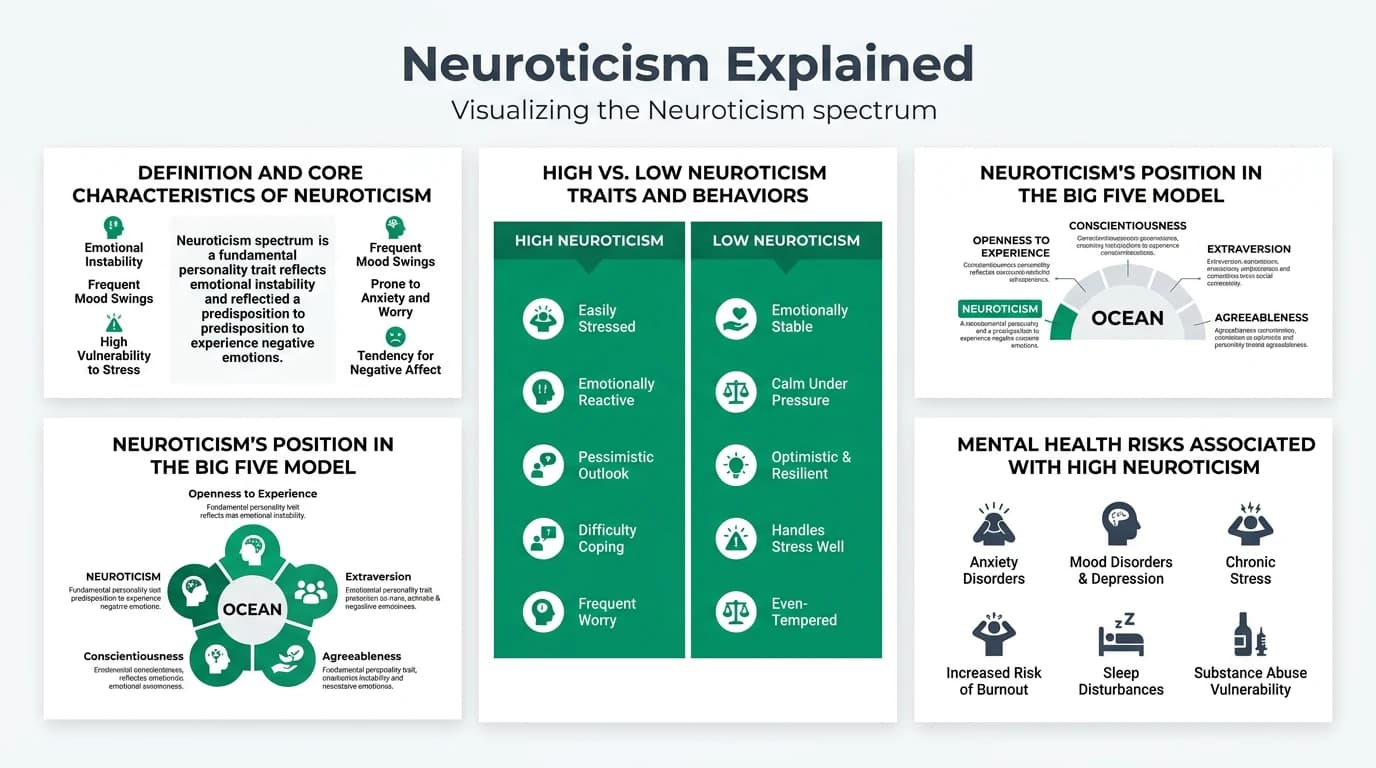
Neuroticism is one of five core personality dimensions in the Big Five (OCEAN) model. It measures emotional reactivity, stress sensitivity, and the tendency to experience negative emotions such as anxiety, sadness, and irritability.
Source: APA Dictionary of Psychology
Executive Summary
Neuroticism is the Big Five trait most strongly associated with mental health outcomes. It reflects how easily and intensely a person experiences negative emotions such as anxiety, anger, sadness, and self-consciousness 1.
A high score does not mean someone is "neurotic" in the clinical sense. It means they have a lower threshold for emotional distress and may require more deliberate coping strategies.
Key takeaway: Neuroticism is the strongest Big Five predictor of perceived stress and psychological distress. Managing it effectively requires understanding its facets, biological roots, and interaction with other traits.
Important: Neuroticism is a normal personality dimension, not a diagnosis. High scores warrant awareness and proactive coping, not pathologizing.
What Neuroticism Actually Measures
Neuroticism captures the tendency toward emotional instability and negative affect. It is sometimes framed as its inverse: emotional stability.
- Emotional reactivity: How strongly a person responds to stressors and perceived threats.
- Negative affect: Frequency of experiencing anxiety, sadness, anger, and guilt.
- Recovery speed: How quickly a person returns to baseline after an emotional event.
- Stress sensitivity: Threshold at which everyday pressures trigger distress.
The opposite pole, emotional stability, reflects calmness, resilience, and even-tempered responses. For a full framework overview, see our Big Five personality test guide.
| Dimension | High Neuroticism | Low Neuroticism (Emotional Stability) |
|---|---|---|
| Stress response | Intense, prolonged | Measured, quick recovery |
| Emotional baseline | Fluctuating, reactive | Stable, calm |
| Self-talk pattern | Self-critical, ruminative | Self-assured, solution-oriented |
| Risk perception | Overestimates threats | Realistic threat assessment |
| Social sensitivity | Hypervigilant to rejection | Comfortable with ambiguity |
The Six Facets of Neuroticism
The NEO PI-R model identifies six facets within neuroticism, each describing a distinct emotional vulnerability 2.
- Anxiety: Tendency to worry, feel tense, and anticipate danger.
- Angry hostility: Proneness to frustration, irritability, and bitterness.
- Depression: Susceptibility to sadness, hopelessness, and guilt.
- Self-consciousness: Sensitivity to embarrassment and social evaluation.
- Impulsiveness: Difficulty resisting urges and cravings under stress.
- Vulnerability: Feeling helpless or panicked under pressure.
| Facet | High-Score Pattern | Low-Score Pattern | Daily Example |
|---|---|---|---|
| Anxiety | Chronic worry, tension headaches | Relaxed under uncertainty | Worrying about a presentation days ahead |
| Angry hostility | Quick temper, sarcasm | Patient, slow to anger | Snapping at a colleague over minor delay |
| Depression | Frequent sadness, low motivation | Optimistic outlook | Struggling to start tasks after setbacks |
| Self-consciousness | Avoids public speaking, fears judgment | Comfortable in spotlight | Declining a meeting invite to avoid scrutiny |
| Impulsiveness | Stress-eating, impulse purchases | Disciplined under pressure | Overspending after a bad day |
| Vulnerability | Panics during crises, feels helpless | Calm problem-solving | Freezing during an unexpected system outage |
Understanding your facet profile helps target interventions. Learn about stress-specific strategies in our stress management coping guide.
High Neuroticism: Strengths and Challenges
High neuroticism carries real challenges, but also underappreciated strengths when channeled effectively.
Often-overlooked strengths:
- Heightened threat detection can prevent careless mistakes.
- Emotional sensitivity enables empathy and attunement to others.
- Vigilance can drive thorough preparation and contingency planning.
Common challenges:
- Chronic rumination reduces decision-making speed.
- Stress amplification can lead to burnout and avoidance.
- Negative self-talk undermines confidence and performance.
| Scenario | High-N Response | Hidden Strength | Adaptive Strategy |
|---|---|---|---|
| Project deadline | Worries excessively, over-prepares | Rarely misses details | Set a preparation cutoff time |
| Team conflict | Feels personally attacked | Detects tension others miss | Reframe as situational, not personal |
| Performance review | Catastrophizes critical feedback | Motivated to improve | Write down specific action items |
| Health concern | Anxiety spiral, excessive research | Seeks medical attention promptly | Limit research to two trusted sources |
Low Neuroticism: Strengths and Risks
Emotional stability is generally advantageous, but extremely low neuroticism can also create blind spots.
Common strengths:
- Stays calm and focused under pressure.
- Recovers quickly from setbacks and disappointments.
- Provides a stabilizing presence for teams and relationships.
Potential risks:
- May underestimate genuine threats or emotional signals.
- Can appear dismissive of others' emotional concerns.
- Complacency risk in environments that require vigilance.
| Scenario | Low-N Response | Potential Risk | Mitigation |
|---|---|---|---|
| Workplace crisis | Calm, methodical | Others perceive as uncaring | Acknowledge team emotions verbally |
| Relationship conflict | Composed, solution-focused | Partner feels unheard | Validate feelings before problem-solving |
| Health warning signs | Dismisses minor symptoms | Delayed medical attention | Schedule routine check-ups |
| Risky decision | Confident, proceeds quickly | Insufficient caution | Build a review step into decisions |
Genetic and Biological Basis
Neuroticism has a substantial biological foundation. Twin studies, neuroimaging, and molecular genetics all contribute to our understanding 3.
- Heritability: Twin studies estimate 40 to 60 percent of variance in neuroticism is genetic.
- Serotonin system: Variants in the serotonin transporter gene (5-HTTLPR) are associated with higher neuroticism and depression risk.
- Amygdala reactivity: High-neuroticism individuals show greater amygdala activation to negative stimuli.
- HPA axis: Elevated cortisol reactivity is linked to neuroticism scores.
| Biological Factor | Finding | Key Reference |
|---|---|---|
| Heritability | 40-60 percent of variance is genetic | Jang et al., 1996 3 |
| 5-HTTLPR gene | Short allele associated with higher neuroticism | Lesch et al., 1996 4 |
| Amygdala response | Greater activation to threat cues | Canli et al., 2001 5 |
| Cortisol reactivity | Elevated stress hormone response | Zobel et al., 2004 6 |
| Brain structure | Reduced prefrontal cortex volume in high-N individuals | DeYoung et al., 2010 7 |
These biological correlates explain why neuroticism is difficult to change through willpower alone. Structured interventions are more effective than self-discipline.
Neuroticism and Mental Health
Neuroticism is the single strongest personality predictor of common mental health conditions 8. This relationship is well-documented across cultures and age groups.
- Depression: Neuroticism is the most consistent personality predictor of major depressive episodes.
- Anxiety disorders: High neuroticism elevates risk for generalized anxiety, social anxiety, and panic disorder.
- Substance use: Emotional distress can drive self-medication patterns.
- Perceived stress: Neuroticism explains more variance in perceived stress than any other Big Five trait.
| Mental Health Outcome | Relationship with Neuroticism | Effect Size | Key Source |
|---|---|---|---|
| Major depression | Strong positive | r = 0.44 | Kotov et al., 2010 8 |
| Generalized anxiety | Strong positive | r = 0.51 | Kotov et al., 2010 8 |
| Social anxiety | Moderate to strong | r = 0.39 | Kotov et al., 2010 8 |
| Substance use disorders | Moderate positive | r = 0.22 | Kotov et al., 2010 8 |
| Overall life satisfaction | Strong negative | r = -0.38 | Steel et al., 2008 9 |
For deeper exploration, see our personality and mental health research guide.
Neuroticism in the Workplace
Neuroticism has a documented negative relationship with job performance across most occupational categories, though the effect varies by role type 10.
Workplace impacts:
- Higher absenteeism and presenteeism.
- Reduced job satisfaction and organizational commitment.
- Increased interpersonal friction under high-pressure conditions.
Potential workplace advantages:
- Vigilance in quality control and risk assessment.
- Empathetic customer or patient interactions.
- Thorough preparation for high-stakes presentations.
| Job Type | Neuroticism Impact | Explanation |
|---|---|---|
| High-stress deadline roles | Strongly negative | Amplifies pressure, reduces performance |
| Quality assurance | Mixed; vigilance can help | Attention to errors, but rumination slows output |
| Client-facing roles | Moderate negative | Emotional labor increases burnout risk |
| Creative roles | Complex relationship | Tension can fuel creativity but hinders execution |
| Leadership positions | Negative | Emotional volatility undermines team trust |
For workplace-specific interpretation strategies, see our neuroticism workplace guide.
How Neuroticism Changes Over the Lifespan
Neuroticism shows meaningful change across the lifespan, generally declining with age 11.
- Adolescence and young adulthood: Neuroticism tends to be highest during this period.
- Mid-adulthood: Gradual decline as emotional regulation improves.
- Older adulthood: Continued decline; older adults generally report greater emotional stability.
| Age Period | Neuroticism Trend | Likely Mechanism | Practical Implication |
|---|---|---|---|
| Teens to 20s | Highest levels | Hormonal changes, identity formation | Normalize emotional intensity |
| 30s to 40s | Gradual decline | Emotional maturation, role stability | Build on natural improvement |
| 50s to 60s | Continued decline | Improved emotion regulation | Leverage accumulated coping skills |
| 70+ | Lowest levels | Positivity effect in aging | Emotional stability becomes a resource |
Measuring Neuroticism: Tools and Accuracy
Validated instruments measure neuroticism reliably across populations.
- NEO PI-R: Comprehensive six-facet assessment; clinical and research standard.
- BFI-2: Modern 60-item inventory with three neuroticism facets.
- PHQ-9 and GAD-7: Not personality measures, but useful clinical screeners that correlate with neuroticism.
| Instrument | Items | Facets Measured | Best Use | Reliability (alpha) |
|---|---|---|---|---|
| NEO PI-R | 240 | Six neuroticism facets | Research and clinical | 0.90-0.93 |
| BFI-2 | 60 | Anxiety, depression, volatility | Organizational and academic | 0.85-0.90 |
| IPIP-NEO | 120 or 300 | Six facets (open-source) | Research | 0.86-0.91 |
| Eysenck Personality Questionnaire | 90 | Neuroticism domain | Historical benchmark | 0.80-0.85 |
Explore how neuroticism interacts with sleep quality in our personality and sleep guide.
Evidence-Based Coping Strategies
High neuroticism is modifiable through structured intervention. Research supports several approaches 12.
Cognitive strategies:
- Cognitive behavioral therapy (CBT) reduces rumination and catastrophizing.
- Mindfulness-based stress reduction (MBSR) lowers emotional reactivity.
- Cognitive reappraisal training helps reframe negative interpretations.
Behavioral strategies:
- Regular aerobic exercise reduces anxiety and depressive symptoms.
- Consistent sleep hygiene stabilizes mood and emotional regulation.
- Social support buffers the impact of high neuroticism on stress.
Environmental strategies:
- Reduce exposure to unpredictable, high-demand situations when possible.
- Structure routines to minimize decision fatigue.
- Create quiet recovery spaces in work and home environments.
Neuroticism management checklist
- Identify your neuroticism facet profile using a validated instrument.
- Track your emotional triggers for two weeks using a simple journal.
- Select one cognitive and one behavioral strategy to practice daily.
- Build a consistent sleep and exercise routine.
- Schedule a professional consultation if distress interferes with daily functioning.
- Review your coping plan monthly and adjust as needed.
FAQ
Is neuroticism the same as being neurotic?
No. In personality psychology, neuroticism is a normal trait dimension present in everyone. The colloquial term "neurotic" carries clinical connotations that do not apply to the Big Five construct 1.
Can neuroticism be reduced?
Yes. Longitudinal studies show neuroticism declines naturally with age. Therapy, particularly CBT, and consistent lifestyle changes such as exercise and sleep hygiene can accelerate this decline 12.
Is high neuroticism always harmful?
Not entirely. High neuroticism can enhance threat detection, empathy, and preparation thoroughness. The key is whether the individual has effective coping strategies to channel emotional sensitivity productively 8.
How does neuroticism relate to depression?
Neuroticism is the strongest Big Five predictor of depression, with meta-analytic correlations around r = 0.44. It reflects a vulnerability to negative affect that overlaps with depressive symptoms 8.
What is the heritability of neuroticism?
Twin studies estimate that 40 to 60 percent of the variance in neuroticism is attributable to genetic factors, with the remainder influenced by non-shared environmental experiences 3.
Does neuroticism affect physical health?
Yes. High neuroticism is associated with elevated cortisol, increased cardiovascular risk, and more frequent somatic complaints. These effects are partly mediated by health behaviors and stress exposure 6.
How is neuroticism measured?
Through validated self-report inventories such as the NEO PI-R, BFI-2, and IPIP-NEO. These instruments provide domain and facet-level scores with established reliability 2.
What is the relationship between neuroticism and anxiety disorders?
High neuroticism is a well-documented risk factor for generalized anxiety disorder, social anxiety, and panic disorder, with correlations ranging from r = 0.39 to r = 0.51 in meta-analyses 8.
Notes
Primary Sources
| Source | Type | URL |
|---|---|---|
| APA Dictionary - Neuroticism | Institutional definition | dictionary.apa.org/neuroticism |
| Kotov et al. (2010) | Meta-analysis of personality and mental disorders | doi.org/10.1037/a0020327 |
| Jang, Livesley, and Vernon (1996) | Twin study of Big Five heritability | doi.org/10.1111/j.1467-6494.1996.tb00522.x |
| Roberts et al. (2006) | Lifespan personality change meta-analysis | doi.org/10.1037/0033-2909.132.1.1 |
| Roberts et al. (2017) | Personality change through intervention review | doi.org/10.1037/bul0000088 |
Conclusion
Neuroticism is a core personality dimension that profoundly influences emotional experience, stress management, and mental health. Understanding your position on this spectrum, and especially your facet-level profile, enables targeted strategies for well-being.
High neuroticism is not a sentence. With the right tools, awareness, and support, emotional reactivity can be channeled productively and managed effectively.
Footnotes
-
Costa, P. T., & McCrae, R. R. (1992). Revised NEO Personality Inventory (NEO PI-R) and NEO Five-Factor Inventory professional manual. Psychological Assessment Resources. ↩ ↩2
-
McCrae, R. R., & Costa, P. T. (2008). The five-factor theory of personality. In O. P. John, R. W. Robins, & L. A. Pervin (Eds.), Handbook of Personality: Theory and Research (3rd ed., pp. 159-181). Guilford Press. ↩ ↩2
-
Jang, K. L., Livesley, W. J., & Vernon, P. A. (1996). Heritability of the Big Five personality dimensions and their facets. Journal of Personality, 64(3), 577-591. ↩ ↩2 ↩3
-
Lesch, K. P., Bengel, D., Heils, A., Sabol, S. Z., Greenberg, B. D., Petri, S., ... & Murphy, D. L. (1996). Association of anxiety-related traits with a polymorphism in the serotonin transporter gene regulatory region. Science, 274(5292), 1527-1531. ↩
-
Canli, T., Zhao, Z., Desmond, J. E., Kang, E., Gross, J., & Gabrieli, J. D. (2001). An fMRI study of personality influences on brain reactivity to emotional stimuli. Behavioral Neuroscience, 115(1), 33-42. ↩
-
Zobel, A., Barkow, K., Schulze-Rauschenbach, S., Von Widdern, O., Metten, M., Pfeiffer, U., ... & Maier, W. (2004). High neuroticism and depressive temperament are associated with dysfunctional regulation of the hypothalamic-pituitary-adrenocortical system in healthy volunteers. Acta Psychiatrica Scandinavica, 109(5), 392-399. ↩ ↩2
-
DeYoung, C. G., Hirsh, J. B., Shane, M. S., Papademetris, X., Rajeevan, N., & Gray, J. R. (2010). Testing predictions from personality neuroscience: Brain structure and the Big Five. Psychological Science, 21(6), 820-828. ↩
-
Kotov, R., Gamez, W., Schmidt, F., & Watson, D. (2010). Linking "big" personality traits to anxiety, depressive, and substance use disorders: A meta-analysis. Psychological Bulletin, 136(5), 768-821. ↩ ↩2 ↩3 ↩4 ↩5 ↩6 ↩7 ↩8
-
Steel, P., Schmidt, J., & Shultz, J. (2008). Refining the relationship between personality and subjective well-being. Psychological Bulletin, 134(1), 138-161. ↩
-
Barrick, M. R., & Mount, M. K. (1991). The Big Five personality dimensions and job performance: A meta-analysis. Personnel Psychology, 44(1), 1-26. ↩
-
Roberts, B. W., Walton, K. E., & Viechtbauer, W. (2006). Patterns of mean-level change in personality traits across the life course: A meta-analysis of longitudinal studies. Psychological Bulletin, 132(1), 1-25. ↩
-
Roberts, B. W., Luo, J., Briley, D. A., Chow, P. I., Su, R., & Hill, P. L. (2017). A systematic review of personality trait change through intervention. Psychological Bulletin, 143(2), 117-141. ↩ ↩2