personality-tests
Big Five Traits and Psychological Resilience
Evidence-based guide to how each Big Five personality trait predicts psychological resilience, mental toughness, and adaptive coping under adversity.
Quick answer
How do Big Five traits predict resilience?
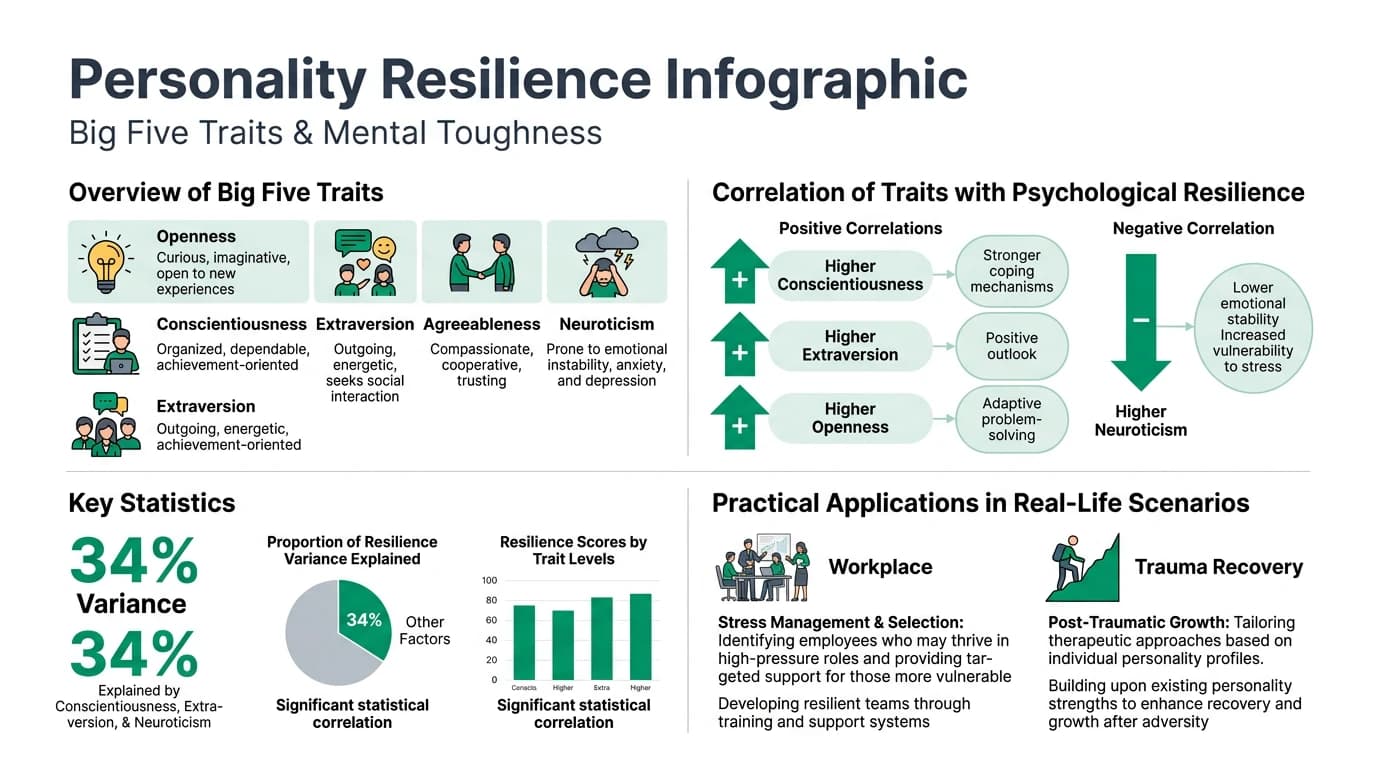
Conscientiousness, extraversion, agreeableness, and openness positively predict psychological resilience, while neuroticism negatively predicts it. Together, these traits explain approximately 34 percent of resilience variance in research samples.
Source: PubMed Central
Executive Summary
Psychological resilience is the capacity to recover from adversity, adapt to change, and maintain functioning under stress. It is not a fixed trait. It arises from the interplay of personality, coping strategies, social support, and learned behaviors 1.
Research consistently shows that Big Five personality traits predict resilience outcomes. Conscientiousness, extraversion, and agreeableness are the strongest positive predictors. Neuroticism is the strongest negative predictor.
Key takeaway: Resilience is partly dispositional, but it can be developed. Understanding your Big Five profile reveals which resilience pathways come naturally and which require deliberate effort.
Important: Resilience does not mean suppressing emotions or powering through distress. It involves flexible adaptation that includes seeking help when needed.
What Psychological Resilience Means
Resilience is often misunderstood as simply "toughness." In research, it is defined more precisely as adaptive functioning despite significant adversity 2.
- Bounce-back capacity: Returning to baseline functioning after setbacks.
- Growth through adversity: Extracting meaning and competence from difficult experiences.
- Flexible coping: Switching between coping strategies depending on the situation.
- Sustained functioning: Maintaining performance and relationships during ongoing stress.
| Resilience Component | Definition | Example |
|---|---|---|
| Recovery | Returning to emotional baseline | Resuming normal work after a project failure |
| Resistance | Maintaining stability during adversity | Staying productive during organizational restructuring |
| Reconfiguration | Adapting to a new reality | Changing career direction after job loss |
| Post-traumatic growth | Gaining strength from hardship | Developing deeper empathy after personal loss |
Resilience is distinct from ego-resiliency (a personality trait reflecting flexible adaptation) and from simple stress tolerance. For broader context on stress and coping, see our stress management coping guide.
The Big Five Traits: Quick Reference
Before examining each trait's contribution to resilience, here is a summary of the full Big Five framework.
- Openness to experience: Creativity, intellectual curiosity, and preference for novelty.
- Conscientiousness: Self-discipline, organization, and goal persistence.
- Extraversion: Social energy, assertiveness, and positive emotionality.
- Agreeableness: Cooperation, empathy, and interpersonal warmth.
- Neuroticism: Emotional reactivity, stress sensitivity, and negative affect.
| Trait | Core Quality | Resilience Direction | Mechanism |
|---|---|---|---|
| Openness | Curiosity and flexibility | Positive | Adaptive reappraisal, finding meaning |
| Conscientiousness | Discipline and planning | Strongly positive | Problem-focused coping, health behaviors |
| Extraversion | Social energy | Positive | Social support mobilization, positive affect |
| Agreeableness | Cooperation and trust | Positive | Social capital, emotional regulation |
| Neuroticism | Emotional reactivity | Strongly negative | Rumination, avoidant coping |
For a full guide to the Big Five framework, see our Big Five personality test guide.
Conscientiousness: The Strongest Resilience Predictor
Conscientiousness is the most consistent positive predictor of resilience across multiple studies and populations 3. It accounts for the largest share of explained variance.
Why conscientiousness builds resilience:
- Promotes proactive coping: planning ahead, organizing resources, and preparing for setbacks.
- Supports health behaviors that buffer stress: regular exercise, adequate sleep, and avoiding substance misuse.
- Enables goal persistence through difficulty rather than giving up.
| Conscientiousness Facet | Resilience Mechanism | Practical Example |
|---|---|---|
| Self-discipline | Sustains effort during adversity | Maintaining a workout routine during a stressful period |
| Achievement striving | Fuels goal persistence | Continuing education after career setback |
| Orderliness | Reduces chaos-induced stress | Keeping organized systems during crisis management |
| Deliberation | Prevents impulsive reactions | Pausing before responding to a provocative email |
| Dutifulness | Maintains commitments to self and others | Showing up for responsibilities despite personal difficulty |
For a deeper dive into this trait, see our conscientiousness guide.
Extraversion and Social Resilience
Extraversion contributes to resilience primarily through social support mobilization and positive affect 4.
- Social support: Extraverts tend to build and maintain larger support networks that buffer against adversity.
- Positive affect: The positive emotionality component of extraversion helps maintain optimism during setbacks.
- Active coping: Extraverts are more likely to seek external resources and assistance.
| Extraversion Facet | Resilience Contribution | Evidence |
|---|---|---|
| Warmth | Deepens social bonds that provide emotional support | Correlates with perceived social support (r = 0.30) |
| Gregariousness | Maintains social contact during isolation periods | Reduces loneliness-driven distress |
| Assertiveness | Facilitates help-seeking and boundary-setting | Predicts active coping strategy use |
| Positive emotions | Buffers negative affect during adversity | Broadens cognitive resources (Fredrickson, 2001) 5 |
Caveat: Extraversion's protective effect depends on the availability of social resources. In situations of forced isolation, extraverts may actually experience greater distress than introverts.
Agreeableness as a Social Buffer
Agreeableness contributes to resilience through interpersonal mechanisms 6.
- Social capital: Agreeable individuals invest in relationships that become resources during hardship.
- Emotional regulation: Cooperation and empathy reduce interpersonal conflict, a major source of stress.
- Community engagement: Agreeableness predicts volunteerism and mutual aid, creating reciprocal support systems.
| Agreeableness Facet | Resilience Pathway | Practical Outcome |
|---|---|---|
| Trust | Enables help-seeking without suspicion | Faster access to support during crises |
| Altruism | Creates reciprocal support networks | Others offer help when you need it |
| Compliance | Reduces interpersonal conflict | Lower chronic stress from social friction |
| Tender-mindedness | Enhances empathic accuracy | Better emotional support quality |
Openness and Adaptive Flexibility
Openness to experience facilitates resilience through cognitive flexibility and meaning-making 7.
- Cognitive reappraisal: Open individuals are more likely to reframe adversity as a growth opportunity.
- Creative problem-solving: Novel approaches to challenges emerge from intellectual curiosity.
- Acceptance of change: Comfort with ambiguity makes transitions less distressing.
| Openness Component | Resilience Mechanism | Research Finding |
|---|---|---|
| Intellectual curiosity | Drives learning from setbacks | Associated with post-traumatic growth |
| Imagination | Enables future-oriented planning | Predicts adaptive coping flexibility |
| Aesthetic sensitivity | Provides emotional outlets (art, music, nature) | Buffers depressive symptoms |
| Openness to values | Supports meaning-making after loss | Facilitates existential resilience |
Neuroticism: The Primary Risk Factor
Neuroticism is the strongest negative predictor of resilience, consistently associated with maladaptive coping and prolonged distress 8.
- Rumination: High-neuroticism individuals replay negative events, prolonging emotional pain.
- Avoidant coping: Tendency to withdraw from problems rather than addressing them.
- Catastrophizing: Overestimating the severity and permanence of setbacks.
- Physiological stress amplification: Elevated cortisol response extends recovery time.
| Neuroticism Facet | Resilience Impact | Evidence-Based Intervention |
|---|---|---|
| Anxiety | Chronic worry depletes coping resources | Mindfulness-based stress reduction 9 |
| Depression | Hopelessness reduces problem-solving motivation | Cognitive behavioral therapy |
| Vulnerability | Helplessness under pressure | Gradual exposure to manageable stressors |
| Angry hostility | Damages social support networks | Anger management and communication training |
| Impulsiveness | Leads to maladaptive coping (substance use, overspending) | Impulse control techniques and delay strategies |
For a complete profile of this trait, see our neuroticism guide.
Quantitative Evidence: What the Research Shows
Several large-scale studies have quantified the relationship between Big Five traits and resilience outcomes.
| Study | Sample | Key Finding | Variance Explained |
|---|---|---|---|
| Oshio et al. (2018) 1 | Meta-analysis of 30 studies | All five traits significantly predict resilience | Combined model: 34 percent |
| Campbell-Sills et al. (2006) 10 | 132 undergraduates | Conscientiousness strongest positive predictor; neuroticism strongest negative | 22 percent (partial model) |
| Ercan (2017) 11 | 371 university students | Ego-resiliency mediates trait-coping relationship | Indirect effects significant |
| Davydov et al. (2010) 2 | Review of resilience frameworks | Personality traits interact with environmental factors | Varies by context |
Key pattern: Across studies, the same three traits consistently emerge as the most important for resilience: conscientiousness (positive), extraversion (positive), and neuroticism (negative).
Trait Combinations and Resilience Profiles
Individual traits do not operate in isolation. Specific combinations create distinct resilience profiles.
- High conscientiousness and low neuroticism: The most resilient profile. Combines proactive coping with emotional stability.
- High extraversion and high agreeableness: Strong social resilience. Relies on relationship networks for recovery.
- High openness and high conscientiousness: Adaptive and disciplined. Finds meaning in adversity while maintaining structure.
- High neuroticism and low conscientiousness: Most vulnerable profile. Emotional reactivity without structured coping.
| Profile | Strengths | Vulnerabilities | Recommended Focus |
|---|---|---|---|
| Disciplined-Stable (high C, low N) | Proactive coping, emotional calm | May underestimate emotional needs | Build emotional awareness |
| Social-Connected (high E, high A) | Support networks, positive affect | Dependent on social availability | Develop independent coping |
| Adaptive-Structured (high O, high C) | Meaning-making, goal persistence | May over-intellectualize emotions | Practice emotional expression |
| Reactive-Unstructured (high N, low C) | Sensitivity to problems | Rumination, avoidant coping | Start with behavioral routines |
Practical Strategies for Building Resilience
Evidence-based resilience interventions target specific personality-coping pathways 9.
For everyone:
- Build a consistent daily routine that includes sleep, exercise, and social contact.
- Practice cognitive reappraisal: ask "what can I learn?" after setbacks.
- Maintain at least three reliable social connections you can reach during crises.
Trait-specific strategies:
- High neuroticism: Prioritize CBT skills, mindfulness, and journaling to reduce rumination.
- Low extraversion: Schedule regular social check-ins even when you prefer solitude.
- Low conscientiousness: Use external accountability systems (apps, partners, coaches).
- Low openness: Practice small, structured exposures to novel experiences.
- Low agreeableness: Invest in relationship repair skills and active listening practice.
Resilience-building action plan
- Complete a Big Five assessment to identify your trait profile.
- Identify your two strongest and two weakest resilience pathways from the trait tables above.
- Select one trait-specific strategy to practice for 30 days.
- Build or strengthen three reliable social support connections.
- Establish a daily routine that includes physical activity and adequate sleep.
- Schedule a quarterly review of your coping effectiveness.
FAQ
Can resilience be learned, or is it purely genetic?
Resilience is partly dispositional, with personality traits explaining about 34 percent of variance. The remaining variance is influenced by learned coping skills, social support, and life experience. Resilience training programs have shown measurable effects across diverse populations 9.
Which Big Five trait is most important for resilience?
Conscientiousness is the strongest positive predictor, while neuroticism is the strongest negative predictor. However, optimal resilience emerges from the combination of multiple traits rather than any single one 1.
Does high neuroticism make resilience impossible?
No. High neuroticism increases vulnerability to stress, but structured interventions like CBT, mindfulness, and regular exercise can substantially improve coping outcomes. Many resilient individuals score moderately high on neuroticism but compensate with strong conscientiousness 8.
How does ego-resiliency differ from psychological resilience?
Ego-resiliency is a personality trait reflecting flexible adaptation to changing circumstances. Psychological resilience is a broader outcome that includes recovery from specific adversities. Ego-resiliency mediates the relationship between Big Five traits and coping strategies 11.
Can personality change improve resilience over time?
Yes. Longitudinal studies show that neuroticism naturally decreases and conscientiousness increases with age, both of which improve resilience. Intentional personality development through therapy and skill-building accelerates these changes 12.
What role does social support play in trait-resilience pathways?
Social support mediates the relationship between extraversion, agreeableness, and resilience outcomes. Individuals high in these traits build stronger support networks, which buffer against stress. However, social support is also accessible through deliberate effort regardless of trait levels 4.
Are there gender differences in trait-resilience relationships?
Some studies find that agreeableness is a stronger resilience predictor in women, while conscientiousness is relatively stronger in men. However, the overall pattern of trait-resilience associations is consistent across genders 1.
How does resilience apply to workplace burnout?
High conscientiousness and low neuroticism protect against burnout, while high extraversion facilitates recovery through social engagement. Organizations can support resilience by reducing chronic stressors and providing coping resources 3.
Notes
Primary Sources
| Source | Type | URL |
|---|---|---|
| Oshio et al. (2018) | Meta-analysis of resilience and Big Five | doi.org/10.1016/j.paid.2018.01.048 |
| Kotov et al. (2010) | Meta-analysis of personality and psychopathology | doi.org/10.1037/a0020327 |
| Joyce et al. (2018) | Systematic review of resilience training | doi.org/10.1136/bmjopen-2017-017858 |
| Campbell-Sills et al. (2006) | Resilience, personality, and coping | doi.org/10.1016/j.brat.2005.05.001 |
| Fredrickson (2001) | Broaden-and-build theory | doi.org/10.1037/0003-066X.56.3.218 |
Conclusion
Psychological resilience is not a single trait you either have or lack. It emerges from the combination of personality dispositions, learned coping skills, and environmental supports. Your Big Five profile reveals your natural resilience pathways and highlights areas for deliberate development.
Focus on strengthening your weakest pathway while leveraging your natural strengths. Resilience is buildable at any age and from any starting point.
Footnotes
-
Oshio, A., Taku, K., Hirano, M., & Saeed, G. (2018). Resilience and Big Five personality traits: A meta-analysis. Personality and Individual Differences, 127, 54-60. ↩ ↩2 ↩3 ↩4
-
Davydov, D. M., Stewart, R., Ritchie, K., & Chaudieu, I. (2010). Resilience and mental health. Clinical Psychology Review, 30(5), 479-495. ↩ ↩2
-
Roberts, B. W., Lejuez, C., Krueger, R. F., Richards, J. M., & Hill, P. L. (2014). What is conscientiousness and how can it be assessed? Developmental Psychology, 50(5), 1315-1330. ↩ ↩2
-
Swickert, R. J., Hittner, J. B., & Foster, A. (2010). Big Five traits interact to predict perceived social support. Personality and Individual Differences, 48(6), 736-741. ↩ ↩2
-
Fredrickson, B. L. (2001). The role of positive emotions in positive psychology: The broaden-and-build theory of positive emotions. American Psychologist, 56(3), 218-226. ↩
-
Caprara, G. V., Alessandri, G., Di Giunta, L., Panerai, L., & Eisenberg, N. (2010). The contribution of agreeableness and self-efficacy beliefs to prosociality. European Journal of Personality, 24(1), 36-55. ↩
-
Kashdan, T. B., & Rottenberg, J. (2010). Psychological flexibility as a fundamental aspect of health. Clinical Psychology Review, 30(7), 865-878. ↩
-
Kotov, R., Gamez, W., Schmidt, F., & Watson, D. (2010). Linking "big" personality traits to anxiety, depressive, and substance use disorders: A meta-analysis. Psychological Bulletin, 136(5), 768-821. ↩ ↩2
-
Joyce, S., Shand, F., Tighe, J., Laurent, S. J., Bryant, R. A., & Harvey, S. B. (2018). Road to resilience: A systematic review and meta-analysis of resilience training programmes and interventions. BMJ Open, 8(6), e017858. ↩ ↩2 ↩3
-
Campbell-Sills, L., Cohan, S. L., & Stein, M. B. (2006). Relationship of resilience to personality, coping, and psychiatric symptoms in young adults. Behaviour Research and Therapy, 44(4), 585-599. ↩
-
Ercan, H. (2017). The relationship between resilience and the Big Five personality traits in emerging adulthood. Eurasian Journal of Educational Research, 70, 83-103. ↩ ↩2
-
Roberts, B. W., Walton, K. E., & Viechtbauer, W. (2006). Patterns of mean-level change in personality traits across the life course: A meta-analysis of longitudinal studies. Psychological Bulletin, 132(1), 1-25. ↩