personal-development
Personality and Impulse Control: How Big Five Traits Shape Self-Control and Acting on Urges
Explore how the Big Five personality traits influence impulse control, self-discipline, and decision-making in finance, habits, and everyday choices.
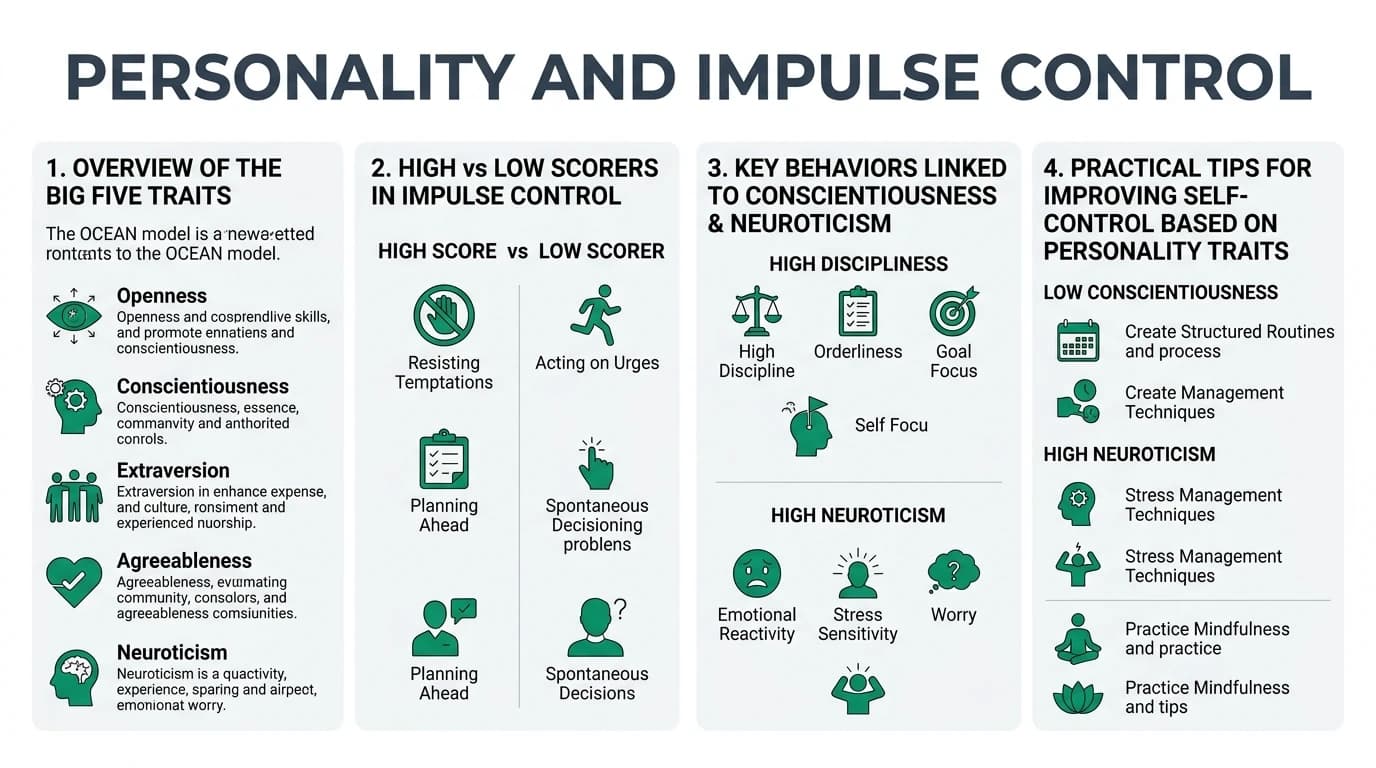
Quick answer
Which Big Five trait is linked to impulse control?
Conscientiousness is the core Big Five trait for impulse control, characterized by self-discipline, organization, and goal-directed behavior.
Source: Simply Psychology
Executive Summary
Understanding how personality traits influence impulse control can help you make better financial decisions, form healthier habits, and resist everyday temptations. The Big Five traits—openness, conscientiousness, extraversion, agreeableness, and neuroticism—play key roles in this process.
The bottom line: Conscientiousness is crucial for self-control, while neuroticism often leads to impulsivity. Knowing your personality can guide you to improve self-discipline and decision-making.
Critical Warning: Always consider individual differences and consult professionals for personalized advice.
What Are the Big Five Personality Traits?
The Big Five traits provide a framework for understanding personality:
- Openness: Curiosity and willingness to explore.
- Conscientiousness: Discipline and organization.
- Extraversion: Sociability and energy.
- Agreeableness: Compassion and cooperation.
- Neuroticism: Tendency towards emotional instability.
Big Five Traits and Impulse Control
| Trait | High Scorers (Resist Urges) | Low Scorers (Give In) |
|---|---|---|
| Conscientiousness | Disciplined, goal-focused | Impulsive, distracted |
| Neuroticism | N/A (vulnerable) | Anxiety-driven impulses |
| Extraversion | Neutral/mixed | Potential for social spending |
How Does Conscientiousness Enhance Self-Control?
Conscientiousness is the strongest predictor of impulse control. It involves:
- Self-discipline: Ability to stick to plans.
- Organization: Keeping tasks and goals in order.
- Goal-directed behavior: Focus on long-term rewards.
High vs. Low Conscientiousness Scenarios
| Scenario | High Outcome | Low Outcome |
|---|---|---|
| Finance | Budgeting effectively | Impulse buying |
| Habits | Consistent exercise routine | Skipping workouts |
| Decisions | Thoughtful planning | Last-minute changes |
Why Does Neuroticism Lead to Impulsivity?
Neuroticism often results in poor impulse control due to:
- Emotional instability: Frequent mood swings.
- Anxiety: Drives impulsive decisions to relieve stress.
- Compulsive behaviors: Linked to buying and risk-taking.
Neuroticism Effects
| Behavior | Correlation (r) | Mediation |
|---|---|---|
| Compulsive buying | 0.40 | Self-esteem mediation |
| AAS use | High | Impulsivity as a factor |
Can Extraversion Influence Acting on Urges?
Extraversion's impact on impulse control is mixed:
- Social spending: More likely in high extraversion.
- Energy levels: Can lead to spontaneous decisions.
- Peer influence: Group dynamics affect choices.
How Does Agreeableness Affect Resistance?
Agreeableness can make resisting urges challenging:
- People-pleasing: Difficulty saying no.
- Conflict avoidance: Leads to impulsive agreements.
- Self-esteem mediation: Filters effects on urges.
Is Openness to Experience Linked to Impulse Control?
Openness has a weaker direct link to impulse control:
- Curiosity-driven: May lead to trying new things impulsively.
- Creativity: Can result in spontaneous decisions.
- Exploration: Driven by interest rather than impulse.
How Can Self-Esteem Mediate Impulse Control?
Self-esteem plays a crucial role in mediating Big Five effects:
- Confidence: Reduces vulnerability to impulses.
- Self-worth: Influences decision-making.
- Mediation paths: Channels effects of traits like neuroticism.
Self-Esteem Mediation Paths
| Trait | Direct Effect? | Indirect via Self-Esteem |
|---|---|---|
| Neuroticism | Yes | Strong mediation |
| Extraversion | No | Limited mediation |
Impulse Control in Finance and Habits
Understanding personality can improve financial habits and decision-making:
- Budgeting: Conscientious individuals plan effectively.
- Impulse buying: Linked to low conscientiousness and high neuroticism.
- Delayed gratification: Affected by trait stability over time.
Impulsivity Predictors
| Predictor | Effect on Urges |
|---|---|
| Neuroticism | Increases |
| Impulsivity | Heightens |
| Delayed Gratification | Reduces |
Key Takeaways
- Conscientiousness: Essential for self-control.
- Neuroticism: Linked to impulsivity and compulsive buying.
- Self-esteem: Mediates effects of personality traits.
Action checklist
- Identify your dominant Big Five traits.
- Focus on building self-esteem to improve impulse control.
- Develop habits that align with your personality strengths.
FAQ
Which Big Five trait best predicts self-control?
How does neuroticism lead to poor impulse control?
Do conscientious people resist financial temptations better?
Can you improve impulse control by changing habits?
What role does extraversion play in acting on urges?
How does openness to experience affect daily decisions?
Why do agreeable people struggle with saying no to impulses?
Notes
Primary Sources
| Source | Type | URL |
|---|---|---|
| NIH/PMC | Peer-reviewed | Link |
| PubMed | Peer-reviewed | Link |
Conclusion
Understanding your Big Five personality traits can significantly impact your impulse control and decision-making. By focusing on self-esteem and conscientious habits, you can better manage urges and improve your financial and personal life.