personality-tests
Big Five Traits and Addiction Vulnerability
Research-backed guide to how each Big Five personality trait influences addiction risk, substance use patterns, and evidence-based prevention strategies.
Quick answer
How do Big Five traits predict addiction risk?
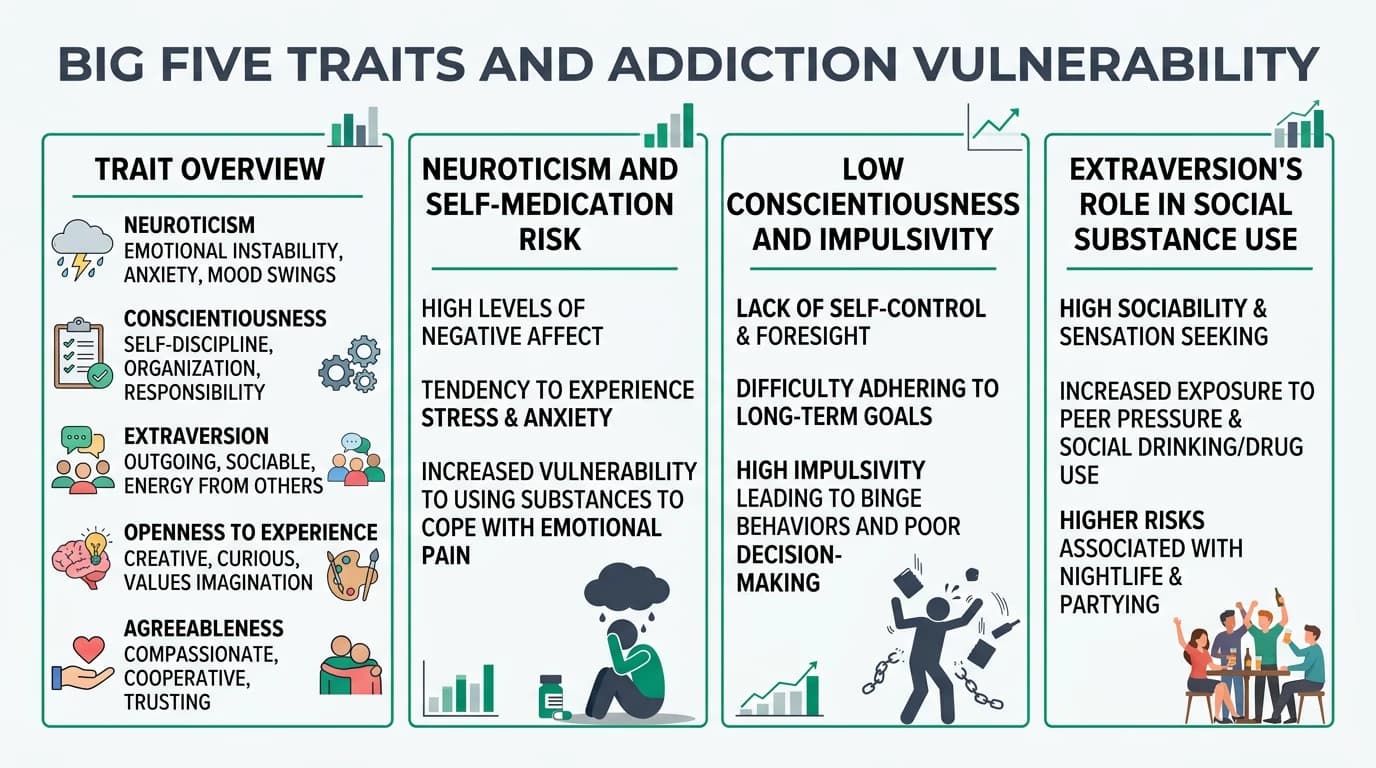
High neuroticism and low conscientiousness are the strongest personality predictors of addiction vulnerability. Neuroticism drives self-medication with substances, while low conscientiousness reduces impulse control. Together, these traits explain a significant portion of substance use disorder risk beyond demographic factors alone.
Executive Summary
Personality traits are among the most robust psychological predictors of addiction vulnerability. Meta-analytic research consistently identifies two Big Five dimensions as the strongest risk factors: high neuroticism and low conscientiousness 1.
Neuroticism increases vulnerability through negative affect and self-medication pathways. Low conscientiousness amplifies risk through poor impulse control and weak self-regulation. Extraversion, agreeableness, and openness show more nuanced relationships that vary by substance type and social context.
Key takeaway: Personality-informed prevention and treatment improves outcomes by targeting the specific psychological pathways that drive addiction risk for each individual.
Important: Addiction is a complex condition influenced by genetics, environment, social factors, and personality. Personality traits are risk modulators, not deterministic causes. This guide is for educational purposes and does not constitute clinical advice.
How Personality Connects to Addiction
The relationship between personality and addiction operates through multiple psychological mechanisms, not simple causation 2.
- Self-medication: Using substances to regulate negative emotions (neuroticism pathway).
- Impulsivity: Acting on urges without considering consequences (low conscientiousness pathway).
- Sensation-seeking: Pursuing novel and intense experiences (extraversion and openness pathway).
- Social conformity: Using substances to fit in or maintain social bonds (agreeableness pathway).
- Coping deficits: Lacking adaptive strategies to manage stress, leading to substance reliance.
| Mechanism | Primary Trait Driver | Substance Pattern | Risk Level |
|---|---|---|---|
| Self-medication | High neuroticism | Alcohol, opioids, sedatives | High |
| Impulsivity | Low conscientiousness | Multiple substances, binge patterns | High |
| Sensation-seeking | High extraversion | Stimulants, party drugs, alcohol | Moderate |
| Experimentation | High openness | Cannabis, hallucinogens | Low to moderate |
| Social conformity | Low agreeableness (deviance) | Context-dependent | Moderate |
| Coping deficit | High N combined with low C | Escalating use, polysubstance | Very high |
For broader context on personality and mental health, see our mental health research guide.
The Big Five Traits: Addiction Risk Summary
Each trait contributes differently to addiction vulnerability. The following summary provides a framework for understanding these relationships before examining each trait in detail.
- Neuroticism: The strongest risk factor. Drives substance use as emotional coping.
- Conscientiousness: The strongest protective factor. Enables self-regulation and health behaviors.
- Extraversion: Mixed effects. Social facilitation of use versus positive coping resources.
- Agreeableness: Low levels predict deviance-based substance use.
- Openness: Predicts experimentation but not necessarily problematic use.
| Trait | Direction of Risk | Effect Size | Most Affected Substances | Mechanism |
|---|---|---|---|---|
| Neuroticism | Increases risk | Large (d = 0.40 to 0.60) | Alcohol, opioids, sedatives | Negative affect regulation |
| Conscientiousness | Decreases risk | Large (d = minus 0.40 to minus 0.55) | All substances | Self-control, health behavior |
| Extraversion | Mixed | Small to moderate (d = 0.10 to 0.25) | Alcohol, stimulants | Social facilitation, sensation-seeking |
| Agreeableness | Low increases risk | Moderate (d = minus 0.15 to minus 0.30) | Varies by context | Deviance proneness, nonconformity |
| Openness | Weak, mixed | Small (d = 0.05 to 0.15) | Cannabis, hallucinogens | Novelty-seeking, experimentation |
Neuroticism: The Self-Medication Pathway
Neuroticism is the most consistent and powerful personality predictor of substance use disorders 1. The primary mechanism is self-medication: using substances to reduce negative emotional states.
Why neuroticism drives addiction vulnerability:
- Chronic negative affect creates persistent motivation to alter emotional states.
- Anxiety and depression increase the perceived relief value of substances.
- Rumination prolongs distress, extending the window of vulnerability.
- Physiological stress reactivity makes chemical relief more reinforcing.
| Neuroticism Facet | Addiction Pathway | Substance Preference | Evidence |
|---|---|---|---|
| Anxiety | Uses substances to reduce worry and tension | Alcohol, benzodiazepines | OR = 2.0 to 2.8 for alcohol use disorder 3 |
| Depression | Self-medicates low mood and anhedonia | Opioids, alcohol | Strong association in longitudinal studies |
| Vulnerability | Overwhelmed by stressors, seeks escape | Sedatives, cannabis | Correlates with avoidant coping |
| Angry hostility | Uses substances to manage frustration | Alcohol, stimulants | Predicts aggressive intoxicated behavior |
| Impulsiveness | Acts on urges without reflection | Multiple substances | Overlaps with low conscientiousness risk |
Clinical implications:
- Screening for high neuroticism can identify individuals at elevated risk before substance use begins.
- Treatment that addresses underlying negative affect, such as cognitive behavioral therapy, improves outcomes beyond substance-focused interventions alone.
- Emotion regulation training reduces reliance on chemical coping.
For a detailed profile of neuroticism, see our neuroticism guide.
Conscientiousness: The Protective Shield
Low conscientiousness is the second strongest personality predictor of addiction, operating through impulsivity, poor self-regulation, and weak health behavior maintenance 4.
- Impulse control: Conscientious individuals delay gratification and resist urges.
- Health behaviors: Conscientiousness predicts exercise, sleep hygiene, and nutrition, all of which buffer addiction risk.
- Goal persistence: Long-term goals compete with immediate substance gratification.
- Treatment adherence: Conscientious individuals are more likely to complete treatment programs.
| Conscientiousness Facet | Protective Mechanism | Addiction Relevance | Risk When Low |
|---|---|---|---|
| Self-discipline | Resists substance urges | Strongest protective facet | Binge patterns, inability to stop |
| Deliberation | Considers consequences before acting | Reduces impulsive first use | Unplanned substance use in risky contexts |
| Achievement striving | Prioritizes goals over immediate pleasure | Motivates sobriety maintenance | Lack of motivation for recovery |
| Orderliness | Maintains structured routines | Supports recovery routines | Chaotic lifestyle enabling use |
| Dutifulness | Fulfills commitments to self and others | Supports accountability in recovery | Unreliable treatment attendance |
Practical implications for prevention:
- Building self-regulation skills in adolescence reduces later substance use risk.
- Structured environments with clear expectations support low-conscientiousness individuals.
- External accountability systems (sponsors, check-ins, apps) compensate for weak internal regulation.
For a comprehensive exploration of this trait, see our conscientiousness guide.
Extraversion: Social Facilitation and Sensation-Seeking
Extraversion shows a more complex relationship with addiction than neuroticism or conscientiousness. Its effects vary by substance type and social context 5.
- Social facilitation: Extraverts encounter more substance use opportunities through social activity.
- Sensation-seeking: The excitement-seeking facet of extraversion predicts novelty-driven use.
- Positive affect: Extraverts may use substances to enhance already-positive states.
- Social resources: Extraversion also provides social support that can protect against addiction.
| Extraversion Facet | Addiction Pathway | Protective Pathway | Net Effect |
|---|---|---|---|
| Gregariousness | More social exposure to substances | Larger support network for recovery | Context-dependent |
| Excitement-seeking | Pursuit of intense experiences via substances | Seeks healthy thrills (sports, travel) | Depends on available alternatives |
| Assertiveness | Can resist peer pressure | May initiate substance use in groups | Mixed |
| Positive emotions | Enhancement motive for substance use | Natural reward sensitivity reduces need for chemicals | Slightly protective |
| Activity | High energy reduces sedentary substance use | Channels energy into productive pursuits | Modestly protective |
Key finding: Extraversion's risk is highest when combined with low conscientiousness and in environments where substance use is the primary social activity 5.
Agreeableness: Conformity and Deviance Pathways
Low agreeableness predicts addiction vulnerability primarily through deviance proneness and antagonistic social behavior 6.
- Nonconformity: Low-agreeableness individuals are less deterred by social norms against substance use.
- Antagonism: Conflict with others may drive isolation and coping-based substance use.
- Rule-breaking: Disregard for rules extends to substance-related laws and norms.
- Peer influence resistance: High agreeableness can protect against deviant peer influence, but can also increase vulnerability to peer pressure for substance use.
| Agreeableness Level | Risk Pathway | Typical Pattern | Prevention Strategy |
|---|---|---|---|
| Very low | Deviance and antisocial behavior | Early onset, multiple substances | Address conduct issues early, mentoring |
| Low | Nonconformity with substance norms | Recreational use despite risks | Strengthen internal motivation for health |
| Moderate | Context-dependent | Uses in social pressure situations | Assertiveness and refusal skills training |
| High | Conformity to peer norms | Uses if peer group uses | Build peer networks with healthy norms |
Openness: Experimentation Without Escalation
Openness to experience predicts initial substance experimentation, particularly with cannabis and hallucinogens, but shows weak or nonsignificant associations with substance use disorders 7.
- Novelty-seeking: Intellectual curiosity extends to exploring altered states of consciousness.
- Experimentation versus dependence: Open individuals try substances but do not necessarily develop problematic patterns.
- Substance specificity: The association is strongest for psychedelics and cannabis, weakest for alcohol and opioids.
- Cultural context: Openness-driven experimentation varies by cultural attitudes toward specific substances.
| Substance Category | Openness Association | Escalation Risk | Evidence Quality |
|---|---|---|---|
| Cannabis | Moderate positive | Low to moderate | Replicated across multiple samples 7 |
| Hallucinogens | Moderate positive | Low | Consistent with novelty-seeking mechanism |
| Alcohol | Weak or nonsignificant | Not independently predicted | Overshadowed by neuroticism and extraversion effects |
| Opioids | Nonsignificant | Not predicted by openness | Other traits dominate this pathway |
| Stimulants | Weak positive | Low | Primarily driven by extraversion facets |
High-Risk Trait Profiles
Individual traits do not operate in isolation. Specific combinations create amplified or attenuated risk profiles 8.
- High N, Low C (highest risk): Emotional distress with no internal braking mechanism. Most strongly associated with substance use disorder diagnosis.
- High N, High E, Low C: Emotional distress combined with social exposure and poor impulse control. Risk of social substance escalation.
- High E, Low A, Low C: Sensation-seeking with deviance proneness and weak self-regulation. Risk of early-onset polysubstance use.
- High C, Low N (lowest risk): Strong self-regulation with emotional stability. Most protected profile.
| Risk Profile | Trait Combination | Primary Mechanism | Substance Risk Level | Recommended Intervention Focus |
|---|---|---|---|---|
| Emotional-Impulsive | High N, Low C | Self-medication with no self-control | Very high | CBT for emotion regulation plus impulse control training |
| Social-Impulsive | High E, Low C | Social exposure plus poor restraint | High | Environmental management plus self-regulation skills |
| Deviant-Reactive | Low A, High N | Antagonism plus emotional coping | High | Social skills training plus stress management |
| Curious-Unstructured | High O, Low C | Experimentation with no boundaries | Moderate | Structured activities plus harm reduction education |
| Stable-Disciplined | Low N, High C | Strong regulation, low distress | Low | Maintenance and monitoring |
Evidence-Based Prevention Strategies
Personality-informed prevention targets the specific mechanisms through which traits create vulnerability 9.
For high-neuroticism individuals:
- Teach emotion regulation skills before substance exposure age.
- Provide alternative coping strategies: exercise, journaling, social support.
- Screen for anxiety and depression as gateway conditions to self-medication.
- Build distress tolerance through graduated exposure techniques.
For low-conscientiousness individuals:
- Use external structure: routines, accountability partners, environmental controls.
- Build self-regulation skills through explicit instruction and practice.
- Reduce environmental access to substances during high-risk periods.
- Set concrete, achievable goals with immediate feedback.
For high-extraversion, sensation-seeking individuals:
- Provide healthy high-stimulation alternatives: sports, adventure activities, creative pursuits.
- Build substance-free social networks and activities.
- Teach risk assessment skills specific to social substance situations.
For strategies on building resilience, see our resilience guide.
Addiction risk reduction action plan
- Complete a Big Five assessment to identify your trait-based risk and protective factors.
- Identify which addiction pathway (self-medication, impulsivity, social, experimentation) is most relevant to your profile.
- Develop at least three alternative coping strategies for your primary risk mechanism.
- Build environmental supports: remove access to substances during high-risk emotional states.
- Establish a regular check-in schedule with a trusted person for accountability.
- If you score high on neuroticism, pursue evidence-based anxiety or depression treatment proactively.
- Review and adjust your prevention strategies quarterly.
FAQ
Does high neuroticism guarantee addiction problems?
No. High neuroticism is a risk factor, not a deterministic cause. Many high-neuroticism individuals never develop substance problems, particularly when they have strong conscientiousness, good social support, and effective coping strategies. Risk factors increase probability but do not determine outcomes 1.
Can personality traits change enough to reduce addiction risk?
Yes, modestly. Neuroticism tends to decrease and conscientiousness tends to increase naturally with age. Targeted interventions like cognitive behavioral therapy can accelerate beneficial changes. However, the primary strategy is building trait-appropriate coping skills rather than trying to change core personality 10.
Is extraversion a risk factor or a protective factor?
Both. Extraversion increases social exposure to substances and sensation-seeking behavior, but it also provides social support networks that facilitate recovery. The net effect depends on the social environment and whether healthy social alternatives are available 5.
How does conscientiousness protect against addiction?
Conscientiousness provides multiple protective mechanisms: impulse control, health behavior maintenance, goal persistence, treatment adherence, and structured routines that reduce opportunities for substance use. It is the strongest personality-based protective factor across all substance types 4.
Are certain substances more associated with specific traits?
Yes. Neuroticism is most strongly associated with alcohol, opioid, and sedative use disorders. Extraversion predicts social alcohol use and stimulant experimentation. Openness predicts cannabis and hallucinogen experimentation. Low agreeableness predicts deviance-driven use across substance types 7.
Should personality tests be used in addiction treatment?
Personality assessment can improve treatment matching and outcome prediction. Identifying a patient's trait profile helps clinicians select interventions that target their specific vulnerability pathways. However, personality assessment should complement, not replace, comprehensive clinical evaluation 9.
What is the most dangerous trait combination for addiction?
The combination of high neuroticism and low conscientiousness is consistently identified as the highest-risk profile. This combination pairs emotional distress that motivates substance use with poor impulse control that prevents self-regulation. Adding high extraversion further increases risk through social exposure 8.
How early can personality-based addiction risk be identified?
Big Five traits show measurable stability from early adolescence, and personality-based risk assessment is feasible from approximately age 12 onward. Early identification allows preventive intervention before substance exposure typically begins. Childhood temperament measures can provide even earlier indicators 10.
Notes
Primary Sources
| Source | Type | URL |
|---|---|---|
| Kotov et al. (2010) | Meta-analysis of personality and psychopathology | doi.org/10.1037/a0020327 |
| Bogg & Roberts (2004) | Meta-analysis of conscientiousness and health behaviors | doi.org/10.1037/0033-2909.130.6.887 |
| Conrod et al. (2010) | Personality-targeted prevention trial | doi.org/10.1001/archgenpsychiatry.2009.173 |
| Terracciano et al. (2008) | Five-factor model and drug user profiles | doi.org/10.1186/1471-244X-8-22 |
| Hakulinen et al. (2015) | Personality and alcohol consumption pooled analysis | doi.org/10.1016/j.drugalcdep.2015.03.006 |
Conclusion
Personality traits are significant and modifiable contributors to addiction vulnerability. High neuroticism and low conscientiousness represent the clearest risk factors, operating through self-medication and impulsivity pathways respectively. Extraversion, agreeableness, and openness create more nuanced risk patterns that depend on substance type and social context.
Personality-informed prevention and treatment works. Programs that target specific trait-based mechanisms, such as emotion regulation for high-neuroticism individuals and impulse control for low-conscientiousness individuals, show stronger outcomes than generic approaches. Understanding your Big Five profile is a practical first step toward reducing your specific risk.
Footnotes
-
Kotov, R., Gamez, W., Schmidt, F., & Watson, D. (2010). Linking "big" personality traits to anxiety, depressive, and substance use disorders: A meta-analysis. Psychological Bulletin, 136(5), 768-821. ↩ ↩2 ↩3
-
Sher, K. J., Bartholow, B. D., & Wood, M. D. (2000). Personality and substance use disorders: A prospective study. Journal of Consulting and Clinical Psychology, 68(5), 818-829. ↩
-
Hakulinen, C., Elovainio, M., Batty, G. D., Virtanen, M., Kivimaki, M., & Jokela, M. (2015). Personality and alcohol consumption: Pooled analysis of 72,949 adults from eight cohort studies. Drug and Alcohol Dependence, 151, 110-114. ↩
-
Bogg, T., & Roberts, B. W. (2004). Conscientiousness and health-related behaviors: A meta-analysis of the leading behavioral contributors to mortality. Psychological Bulletin, 130(6), 887-919. ↩ ↩2
-
Ruiz, M. A., Pincus, A. L., & Schinka, J. A. (2008). Externalizing pathology and the five-factor model: A meta-analysis of personality traits associated with antisocial behavior and substance use. Journal of Personality Disorders, 22(5), 466-486. ↩ ↩2 ↩3
-
Malouff, J. M., Thorsteinsson, E. B., Rooke, S. E., & Schutte, N. S. (2007). Alcohol involvement and the five-factor model of personality: A meta-analysis. Journal of Drug Education, 37(3), 277-294. ↩
-
Terracciano, A., Lockenhoff, C. E., Crum, R. M., Bienvenu, O. J., & Costa, P. T. (2008). Five-factor model personality profiles of drug users. BMC Psychiatry, 8, 22. ↩ ↩2 ↩3
-
Lackner, N., Unterrainer, H. F., & Neubauer, A. C. (2013). Differences in Big Five personality traits between alcohol and psilocybin users. Journal of Psychoactive Drugs, 45(3), 213-218. ↩ ↩2
-
Conrod, P. J., Castellanos-Ryan, N., & Strang, J. (2010). Brief, personality-targeted coping skills interventions and survival as a non-drug user over a 2-year period during adolescence. Archives of General Psychiatry, 67(1), 85-93. ↩ ↩2
-
Roberts, B. W., Walton, K. E., & Viechtbauer, W. (2006). Patterns of mean-level change in personality traits across the life course: A meta-analysis of longitudinal studies. Psychological Bulletin, 132(1), 1-25. ↩ ↩2