personality-tests
Personality Tests in Education: Teacher Guide
How teachers can use Big Five personality assessments to support student learning, tailor classroom instruction, and improve academic outcomes effectively.
Quick answer
How can teachers use personality tests in the classroom?
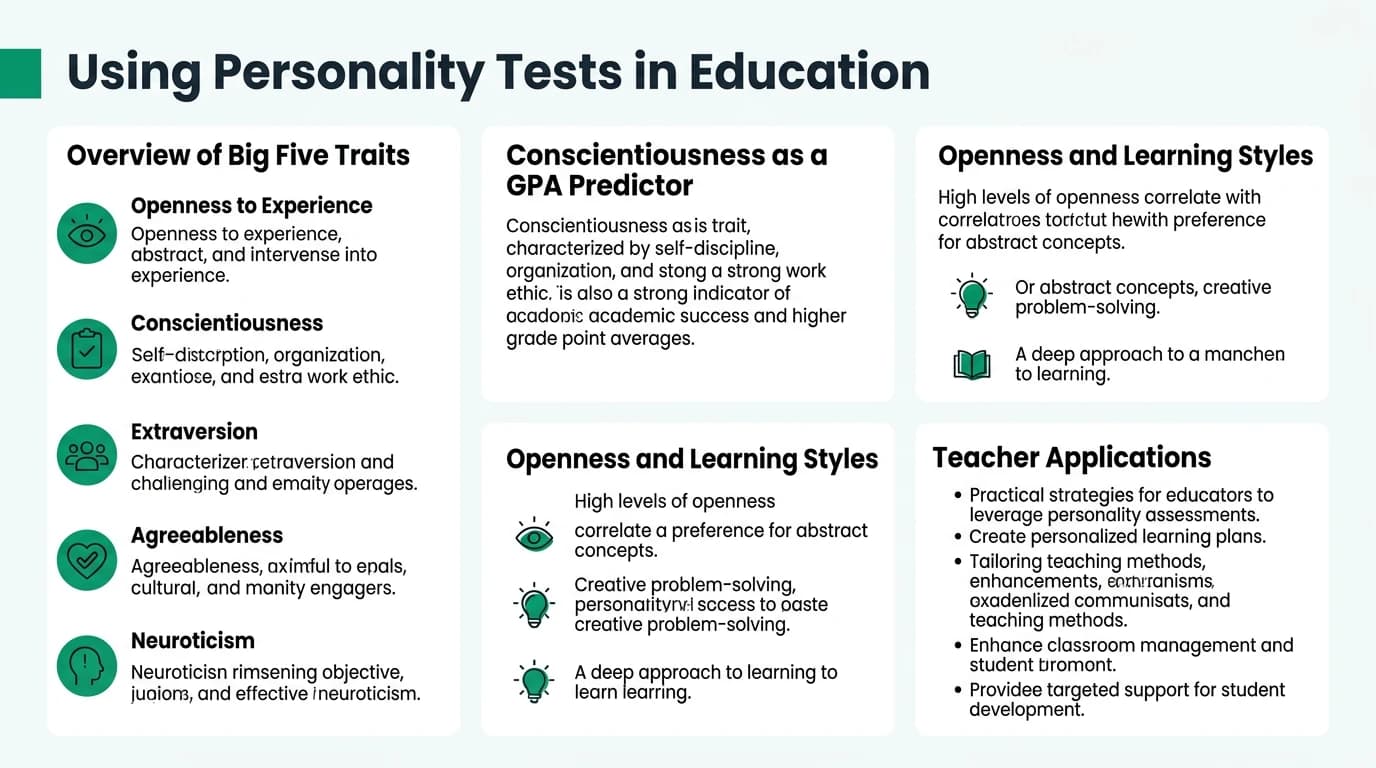
Big Five personality assessments help teachers identify trait-based learning preferences, tailor instruction to individual needs, and predict which students may need additional academic or emotional support. Conscientiousness alone explains 9 to 22 percent of GPA variance.
Executive Summary
Personality assessments based on the Big Five framework give teachers evidence-based insight into how students learn, what motivates them, and where they may struggle. Decades of educational psychology research confirm that personality traits predict academic performance independently of cognitive ability 1.
Conscientiousness is the strongest and most consistent predictor of grades across all educational levels. Openness predicts engagement with creative and deep-learning tasks. Neuroticism predicts test anxiety and emotional barriers to performance.
Key takeaway: Personality data does not replace cognitive assessment. It complements it by revealing the behavioral and motivational pathways that shape how students translate ability into achievement.
Important: Personality assessments in education must be used ethically. Results should inform supportive strategies, never label or limit students.
Why Personality Matters in Education
Educational outcomes depend on more than intelligence. Research consistently shows that non-cognitive factors account for substantial variance in academic achievement 2.
- Behavioral patterns: Study habits, attendance, and classroom participation are trait-driven.
- Motivational differences: Intrinsic versus extrinsic motivation varies by personality profile.
- Emotional regulation: Test anxiety, frustration tolerance, and resilience differ across traits.
- Social dynamics: Group work effectiveness, teacher-student rapport, and peer relationships are personality-influenced.
| Factor | Cognitive Contribution | Personality Contribution | Combined Explained Variance |
|---|---|---|---|
| GPA | 25 percent (IQ) | 9 to 22 percent (Conscientiousness) | Up to 40 percent |
| Class participation | Moderate | High (Extraversion, Openness) | Varies by format |
| Test performance | High | Moderate (Neuroticism negative) | Amplified by anxiety |
| Group project success | Moderate | High (Agreeableness, Extraversion) | Depends on composition |
| Creative assignments | Moderate | High (Openness) | Strongest for open-ended tasks |
For a full overview of the Big Five model, see our Big Five personality test guide.
The Big Five Traits in Classroom Context
Each Big Five trait manifests differently in educational settings. Understanding these manifestations helps teachers recognize and respond to individual student needs.
- Openness to experience: Intellectual curiosity, preference for novelty, creative thinking.
- Conscientiousness: Self-discipline, organization, goal persistence, reliability.
- Extraversion: Verbal participation, social energy, preference for group activities.
- Agreeableness: Cooperation, compliance with rules, empathy toward peers.
- Neuroticism: Test anxiety, emotional reactivity, sensitivity to criticism.
| Trait | Classroom Behavior | Learning Preference | Teacher Observation Cue |
|---|---|---|---|
| Openness | Asks unusual questions, explores tangents | Project-based, discovery learning | Engages deeply with novel topics but may resist routine drills |
| Conscientiousness | Submits work on time, follows instructions | Structured assignments, clear rubrics | Consistently prepared but may struggle with ambiguity |
| Extraversion | Volunteers answers, seeks group work | Discussion-based, collaborative tasks | Energized by interaction but may dominate quieter peers |
| Agreeableness | Cooperates easily, avoids conflict | Team projects, peer tutoring | Harmony-seeking but may not voice disagreement |
| Neuroticism | Worries about grades, avoids risk | Low-stakes practice, private feedback | Anxious before tests, sensitive to perceived failure |
Conscientiousness: The Strongest Academic Predictor
Conscientiousness is the most robust personality predictor of academic performance across all educational levels, from elementary school through graduate programs 1. Its effect size rivals that of cognitive ability.
Why conscientiousness predicts grades:
- Promotes consistent study habits and homework completion.
- Supports time management and deadline adherence.
- Reduces procrastination and distraction.
- Enables goal-setting and self-monitoring behaviors.
| Conscientiousness Facet | Academic Mechanism | Practical Implication |
|---|---|---|
| Self-discipline | Sustained study effort despite distractions | Assign structured study schedules for low-C students |
| Achievement striving | Internal motivation to excel | Channel through challenging enrichment tasks |
| Orderliness | Organized notes and materials | Provide organizational templates and checklists |
| Deliberation | Careful work and error checking | Encourage revision and self-editing steps |
| Dutifulness | Compliance with assignments and rules | Use clear expectations with transparent rubrics |
Supporting low-conscientiousness students:
- Break large assignments into smaller milestones with intermediate deadlines.
- Provide visual organizers and checklists for multi-step tasks.
- Use external accountability structures such as study partners or progress check-ins.
- Teach self-regulation strategies explicitly rather than assuming them.
For more on academic performance factors, see our student success guide.
Openness and Deep Learning Engagement
Openness to experience predicts engagement with deep processing, creative tasks, and intellectual exploration 3. Students high in openness thrive when learning involves discovery, synthesis, and original thinking.
- Deep processing: Connecting new information to existing knowledge rather than memorizing facts.
- Creative output: Generating original ideas in essays, projects, and discussions.
- Intellectual curiosity: Pursuing topics beyond required material.
- Tolerance for ambiguity: Comfort with open-ended problems and multiple valid answers.
| Learning Approach | Openness Level | Teaching Strategy | Expected Outcome |
|---|---|---|---|
| Surface learning | Low openness | Provide structured summaries, concrete examples | Improved comprehension through clarity |
| Strategic learning | Moderate openness | Offer choice within structured frameworks | Balanced engagement and achievement |
| Deep learning | High openness | Use inquiry-based and project-based tasks | Enhanced creativity and critical thinking |
| Elaborative processing | High openness | Encourage journaling and synthesis exercises | Stronger knowledge integration |
Supporting low-openness students:
- Introduce novelty gradually within familiar structures.
- Use concrete examples before abstract concepts.
- Provide clear criteria for creative assignments to reduce uncertainty.
- Connect new material to practical, real-world applications.
See our learning style preferences guide for detailed strategies.
Extraversion and Classroom Participation
Extraverted students are more likely to participate verbally, seek collaborative work, and engage actively in discussions 4. However, extraversion does not predict grades as consistently as conscientiousness.
- Discussion energy: Extraverts contribute frequently in class discussions and debates.
- Group dynamics: They often take leadership roles in team projects.
- Attention patterns: High-stimulation learners who may disengage during passive lectures.
- Social learning: Prefer peer interaction and verbal processing of ideas.
| Classroom Format | Extravert Response | Introvert Response | Balanced Approach |
|---|---|---|---|
| Lecture | May disengage, seek side conversations | Absorbs content but may not ask questions | Intersperse mini-discussions |
| Group discussion | Dominates, energized | May withdraw, feels unheard | Use structured turn-taking |
| Individual work | Restless, seeks interaction | Focused, productive | Offer quiet zones and collaboration zones |
| Presentations | Confident, expressive | Anxious, prefers written formats | Allow choice of presentation format |
Balancing extravert and introvert needs:
- Use think-pair-share to give introverts processing time before group discussion.
- Rotate leadership roles in group work to prevent extravert dominance.
- Offer multiple participation modes including written responses and online discussion boards.
- Provide quiet independent work time alongside collaborative activities.
For insights on supporting introverts specifically, see our introversion workplace guide, which includes transferable principles for classroom settings.
Agreeableness and Cooperative Learning
Agreeableness predicts positive peer relationships, compliance with classroom norms, and success in cooperative learning formats 5.
- Team collaboration: Agreeable students contribute to harmonious group dynamics.
- Conflict avoidance: May suppress disagreement, reducing critical thinking in group settings.
- Teacher rapport: Typically build positive relationships with instructors.
- Peer support: Often serve as informal tutors and mediators.
| Agreeableness Level | Classroom Strength | Potential Challenge | Teacher Strategy |
|---|---|---|---|
| High | Cooperates, supports peers | Avoids conflict, may not challenge ideas | Assign devil's advocate roles explicitly |
| Moderate | Balances cooperation and assertiveness | May vary by social context | Reinforce constructive disagreement norms |
| Low | Independent thinker, direct communicator | May create friction in groups | Teach collaborative communication skills |
Neuroticism and Academic Anxiety
Neuroticism is the primary personality predictor of test anxiety, academic stress, and emotional barriers to learning 6. High-neuroticism students experience stronger negative emotional reactions to academic pressure.
- Test anxiety: Worry and physiological arousal impair retrieval during exams.
- Perfectionism: Fear of failure may lead to procrastination or avoidance.
- Criticism sensitivity: Feedback can feel like personal rejection.
- Stress amplification: Minor setbacks feel catastrophic, reducing motivation.
| Neuroticism Facet | Academic Impact | Evidence-Based Intervention |
|---|---|---|
| Anxiety | Test performance declines under pressure | Teach relaxation techniques, allow practice tests |
| Depression | Reduced motivation and engagement | Provide encouraging feedback, celebrate small wins |
| Vulnerability | Helplessness when facing difficult material | Scaffold assignments, provide step-by-step support |
| Self-consciousness | Avoids participation, fears judgment | Create safe classroom environments for risk-taking |
| Impulsiveness | Rushes through work to escape discomfort | Build in structured review and revision steps |
Supporting high-neuroticism students:
- Provide low-stakes assessment opportunities before high-stakes tests.
- Use private written feedback rather than public correction.
- Normalize mistakes as part of the learning process.
- Teach specific study skills that build confidence through preparation.
For a full profile of neuroticism and its implications, see our emotional intelligence guide.
Practical Assessment Tools for Teachers
Several validated instruments are appropriate for educational settings. Selection depends on student age, available time, and assessment purpose 7.
| Instrument | Items | Age Range | Time Required | Reliability | Best Use Case |
|---|---|---|---|---|---|
| BFI-2 | 60 items | Ages 14 and up | 10 to 15 minutes | High (alpha above 0.80) | Comprehensive classroom profiling |
| BFI-2-S | 30 items | Ages 14 and up | 5 to 8 minutes | Good (alpha above 0.70) | Quick screening for large classes |
| TIPI | 10 items | Ages 16 and up | 2 to 3 minutes | Adequate for research | Rapid group-level insights |
| BFI-2-XS | 15 items | Ages 14 and up | 3 to 5 minutes | Moderate | Time-constrained settings |
| IPIP-NEO-120 | 120 items | Ages 16 and up | 20 to 25 minutes | Very high (alpha above 0.85) | Detailed individual profiles |
Implementation guidelines:
- Always obtain appropriate consent from parents or guardians for minors.
- Frame assessments as tools for self-understanding, not evaluation.
- Never use personality scores in grading or placement decisions.
- Combine personality data with academic and behavioral observations.
- Revisit assessments periodically as traits develop during adolescence.
For guidance on assessment with teenagers, see our parents guide to personality tests for teenagers.
Designing Trait-Informed Lesson Plans
Teachers can use Big Five knowledge to diversify instruction without creating separate plans for each student.
- Universal design principles: Build in multiple participation modes, assessment types, and pacing options.
- Flexible grouping: Rotate between homogeneous and heterogeneous trait groups.
- Choice boards: Offer structured choices that appeal to different trait profiles.
- Differentiated feedback: Adjust feedback style based on student emotional needs.
| Lesson Component | Low Trait Accommodation | High Trait Leverage | Example Activity |
|---|---|---|---|
| Opening (Openness) | Concrete advance organizer | Provocative question or paradox | "What would happen if gravity reversed for one minute?" |
| Instruction (Conscientiousness) | Chunked steps with checkpoints | Extended independent work time | Multi-step lab with milestone check-ins |
| Practice (Extraversion) | Quiet reflection journal | Think-pair-share discussion | Written response before group sharing |
| Assessment (Neuroticism) | Low-stakes quiz with retake option | Timed challenge for high-confidence students | Portfolio with self-selected best work |
| Collaboration (Agreeableness) | Defined roles and responsibilities | Open-ended team challenge | Structured debate with assigned positions |
Ethical Considerations and Implementation Safeguards
Using personality assessments in education requires careful ethical consideration 8.
- Confidentiality: Student personality data must be stored securely and shared only with relevant educators.
- Non-labeling: Avoid categorizing students as "the neurotic one" or "the lazy introvert."
- Cultural sensitivity: Trait expression varies across cultural contexts. Norms developed in one population may not apply universally.
- Developmental awareness: Adolescent personalities are still developing. Assessment results reflect current tendencies, not fixed identities.
- Complementary use: Personality data supplements, never replaces, academic assessment, teacher observation, and student self-report.
| Ethical Principle | Correct Practice | Incorrect Practice |
|---|---|---|
| Beneficence | Use data to support student growth | Use data to restrict opportunities |
| Informed consent | Explain purpose and obtain guardian approval | Administer without explanation |
| Confidentiality | Store results securely, limit access | Share scores publicly or with unrelated staff |
| Non-discrimination | Apply insights equitably across demographics | Interpret traits through cultural stereotypes |
| Transparency | Share results with students in age-appropriate ways | Withhold results or use them covertly |
Case Study: Trait-Based Intervention in a Secondary Classroom
A secondary school teacher administered the BFI-2-S to a class of 28 students aged 15 to 16. The teacher used results to adjust instruction over one semester 9.
- High-neuroticism group (8 students): Received additional test preparation sessions, practice exams under low-stakes conditions, and private feedback. Average test anxiety scores dropped by 18 percent.
- Low-conscientiousness group (6 students): Received structured assignment breakdowns, visual progress trackers, and weekly check-ins. Homework completion rates increased from 62 to 84 percent.
- High-openness group (7 students): Received enrichment tasks and self-directed inquiry projects. Engagement scores on course evaluations rose significantly.
- Mixed extraversion groups: The teacher alternated between collaborative and independent work formats. Both introverts and extraverts reported higher satisfaction.
| Intervention Target | Student Count | Measure | Pre-Intervention | Post-Intervention | Change |
|---|---|---|---|---|---|
| High neuroticism | 8 | Test anxiety score | 72 out of 100 | 59 out of 100 | Minus 18 percent |
| Low conscientiousness | 6 | Homework completion | 62 percent | 84 percent | Plus 22 percentage points |
| High openness | 7 | Engagement rating | 3.2 out of 5 | 4.1 out of 5 | Plus 0.9 points |
| All students | 28 | Course satisfaction | 3.5 out of 5 | 4.3 out of 5 | Plus 0.8 points |
Building Teacher Self-Awareness
Teachers' own personality traits influence their teaching style, classroom management, and student interactions 10.
- High-conscientiousness teachers: Excel at organization but may be inflexible with creative students.
- High-openness teachers: Embrace innovation but may under-structure assignments for students who need clarity.
- High-extraversion teachers: Energize discussions but may inadvertently favor verbal students.
- High-agreeableness teachers: Build strong rapport but may avoid necessary confrontation on academic standards.
- High-neuroticism teachers: May model stress responses for students, increasing classroom anxiety.
| Teacher Trait Profile | Teaching Strength | Blind Spot | Development Action |
|---|---|---|---|
| High C, Low O | Structured, reliable | May resist innovative methods | Experiment with one new technique per term |
| High E, Low A | Dynamic, energetic | May not notice quiet students | Implement deliberate inclusion checks |
| High O, Low C | Creative, inspiring | May lack follow-through on logistics | Use planning templates and co-teaching |
| High A, Low E | Warm, supportive | May avoid whole-class leadership | Practice assertive classroom management |
Teacher implementation action plan
- Complete a Big Five self-assessment to understand your own teaching tendencies.
- Select one validated assessment tool appropriate for your students' age group.
- Obtain proper consent and explain the purpose of the assessment to students and parents.
- Administer the assessment and review results with a focus on instructional implications.
- Design one lesson modification per trait dimension based on class profile data.
- Monitor student outcomes over at least one term before drawing conclusions.
- Revisit and update your strategies quarterly based on observed results.
FAQ
At what age can personality tests be reliably used with students?
Research supports reliable Big Five measurement from approximately age 10 onward, with short instruments like BFI-2-S validated for ages 14 and up. Younger students may benefit from teacher-report measures rather than self-report instruments. Trait stability increases through adolescence 7.
Which Big Five trait best predicts academic grades?
Conscientiousness is the strongest and most consistent personality predictor of academic performance, with meta-analytic effect sizes comparable to cognitive ability. It explains 9 to 22 percent of GPA variance depending on the sample and educational level 1.
Can personality assessment replace standardized testing?
No. Personality assessment complements but does not replace cognitive and achievement testing. Personality measures explain different variance in outcomes and are most useful when combined with academic data to create a comprehensive student profile 2.
How should teachers handle students who score high on neuroticism?
High-neuroticism students benefit from low-stakes practice assessments, private rather than public feedback, explicit error-normalization in the classroom, and teaching specific anxiety management techniques such as deep breathing and cognitive reframing 6.
Is it ethical to use personality tests in schools?
Yes, when implemented with proper safeguards. These include informed consent from parents, secure data storage, using results only for supportive purposes, and never using scores in grading or placement decisions. Cultural sensitivity and developmental awareness are also essential 8.
How do personality traits interact with teaching style?
Teachers' own Big Five profiles shape their instructional preferences and blind spots. A highly conscientious teacher may struggle to accommodate creative students, while a highly extraverted teacher may unintentionally marginalize introverts. Self-assessment helps teachers recognize and compensate for these tendencies 10.
Do personality traits change during adolescence?
Yes. Adolescence is a period of significant personality development. Conscientiousness and agreeableness tend to increase through the teenage years, while neuroticism often decreases. Assessments should be repeated periodically rather than treated as permanent classifications 11.
What is the best short assessment for classroom use?
The BFI-2-S (30 items, 5 to 8 minutes) offers a good balance of reliability and practicality for classroom settings. For even faster screening, the TIPI (10 items) provides group-level insights but with lower individual-level reliability 7.
Notes
Primary Sources
| Source | Type | URL |
|---|---|---|
| Poropat (2009) | Meta-analysis of personality and academic performance | doi.org/10.1037/a0014996 |
| Richardson, Abraham, & Bond (2012) | Systematic review of academic performance predictors | doi.org/10.1037/a0026838 |
| Soto & John (2017) | BFI-2 development and validation | doi.org/10.1037/pspp0000096 |
| American Educational Research Association (2014) | Testing standards | apa.org/science/programs/testing/standards |
| Roberts, Walton, & Viechtbauer (2006) | Personality change meta-analysis | doi.org/10.1037/0033-2909.132.1.1 |
Conclusion
Personality assessment in education is not about labeling students. It is about understanding the behavioral and motivational patterns that shape how each student learns, participates, and responds to challenge. The Big Five framework provides the most empirically validated structure for this understanding.
Teachers who combine personality insights with academic data and classroom observation can create more responsive, inclusive, and effective learning environments. Start with self-assessment, select an age-appropriate instrument, and use results to refine rather than replace your existing teaching strategies.
Footnotes
-
Poropat, A. E. (2009). A meta-analysis of the five-factor model of personality and academic performance. Psychological Bulletin, 135(2), 322-338. ↩ ↩2 ↩3
-
Richardson, M., Abraham, C., & Bond, R. (2012). Psychological correlates of university students' academic performance: A systematic review and meta-analysis. Psychological Bulletin, 138(2), 353-387. ↩ ↩2
-
Chamorro-Premuzic, T., & Furnham, A. (2008). Personality, intelligence and approaches to learning as predictors of academic performance. Personality and Individual Differences, 44(7), 1596-1603. ↩
-
Furnham, A., & Chamorro-Premuzic, T. (2004). Personality and intelligence as predictors of statistics examination grades. Personality and Individual Differences, 37(5), 943-955. ↩
-
Caprara, G. V., Barbaranelli, C., Pastorelli, C., Bandura, A., & Zimbardo, P. G. (2000). Prosocial foundations of children's academic achievement. Psychological Science, 11(4), 302-306. ↩
-
Chamorro-Premuzic, T., Ahmetoglu, G., & Furnham, A. (2008). Little more than personality: Dispositional determinants of test anxiety. Learning and Individual Differences, 18(2), 258-263. ↩ ↩2
-
Soto, C. J., & John, O. P. (2017). The next Big Five Inventory (BFI-2): Developing and assessing a hierarchical model with 15 facets to enhance bandwidth, fidelity, and predictive power. Journal of Personality and Social Psychology, 113(1), 117-143. ↩ ↩2 ↩3
-
American Educational Research Association (2014). Standards for Educational and Psychological Testing. Washington, DC: AERA. ↩ ↩2
-
Adapted from case reports in: De Raad, B., & Schouwenburg, H. C. (1996). Personality in learning and education: A review. European Journal of Personality, 10(5), 303-336. ↩
-
Djigic, G., Stojiljkovic, S., & Doskovic, M. (2014). Basic personality dimensions and teachers' self-efficacy. Procedia - Social and Behavioral Sciences, 112, 593-602. ↩ ↩2
-
Roberts, B. W., Walton, K. E., & Viechtbauer, W. (2006). Patterns of mean-level change in personality traits across the life course: A meta-analysis of longitudinal studies. Psychological Bulletin, 132(1), 1-25. ↩