decision-support-tools
Big Five Role-Fit Calculator
Interactive calculator that maps Big Five trait tendencies to role-fit hypotheses for hiring, team design, and coaching conversations.
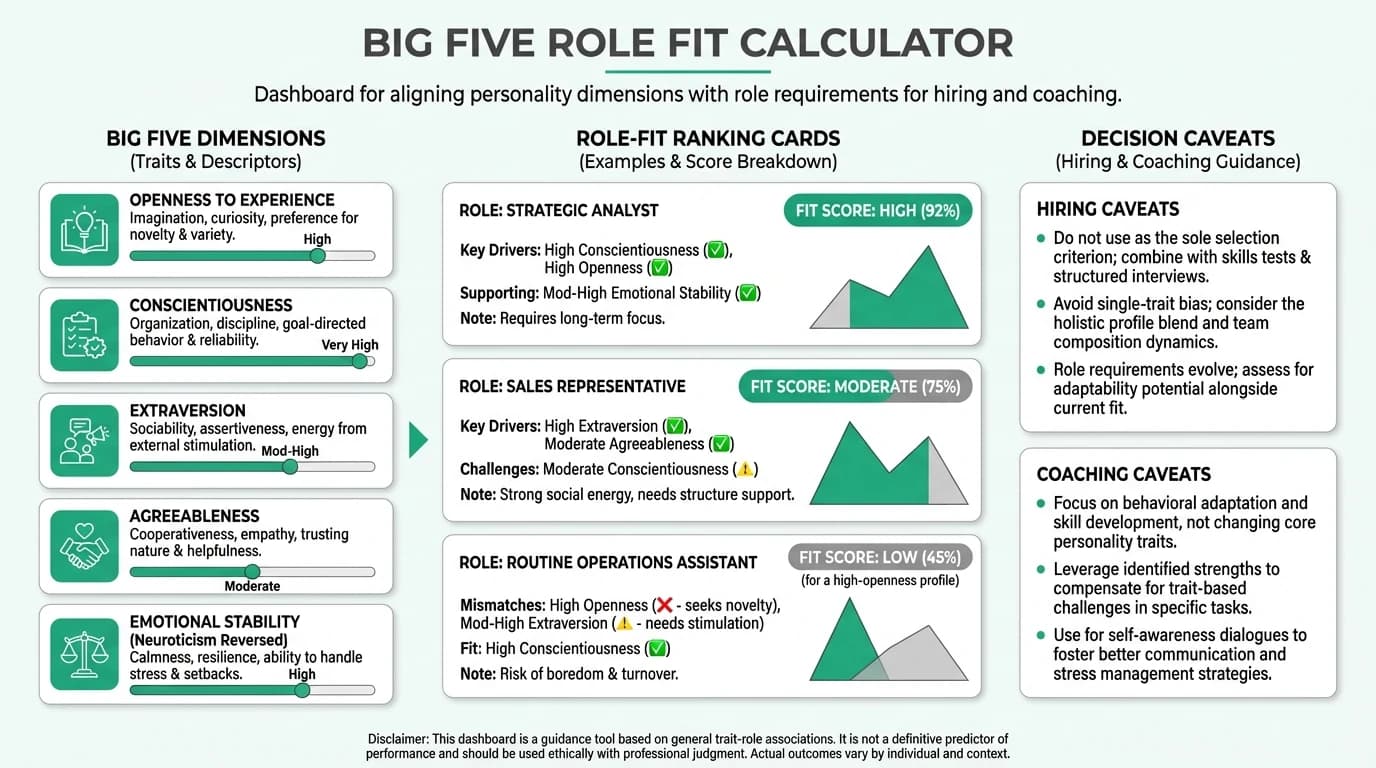
What this tool is for
The Big Five Role-Fit Calculator helps you turn trait scores into role-fit hypotheses. It is designed for:
- hiring conversations,
- coaching and role redesign,
- team composition discussions.
The output is not a verdict. It is a structured starting point for better decisions.
For deeper interpretation, use Big Five Personality Test: Complete Interpretation Guide, and run governance checks with Personality Test Reliability.
How to use it
- Set each trait slider based on your latest Big Five profile.
- Review the ranked role-fit suggestions.
- Compare the output with role requirements and behavioral evidence.
- Document assumptions before making decisions.
Interpretation guardrails
Use this tool responsibly
- Do not use the score as an auto-filter in hiring.
- Cross-check with interviews and work-sample evidence.
- Treat "fit" as context-dependent, not fixed identity.
- Reassess when role scope or environment changes.
Primary Sources
| Source | Type | URL |
|---|---|---|
| APA Dictionary | Five-factor model definition | dictionary.apa.org/five-factor-model |
| McCrae & John (1992) | Foundational FFM paper | doi.org/10.1111/j.1467-6494.1992.tb00970.x |
| Soto & John (2017) | BFI-2 validation study | doi.org/10.1037/pspp0000092 |
FAQ
Does this tool replace a full assessment process?
No. It supports decision quality but should be combined with interviews, skill evidence, and context analysis.
Can this be used for internal mobility?
Yes. It is useful for generating hypotheses about role transitions and support needs.
Why does one trait not determine the final output?
Because role fit usually depends on interactions between dimensions, not isolated scores.