personality-tests
Big Five Personality and Exercise Preferences
How the Big Five personality traits predict exercise preferences, workout enjoyment, and fitness adherence based on peer-reviewed sports psychology research.
Quick answer
How do personality traits affect exercise preferences?
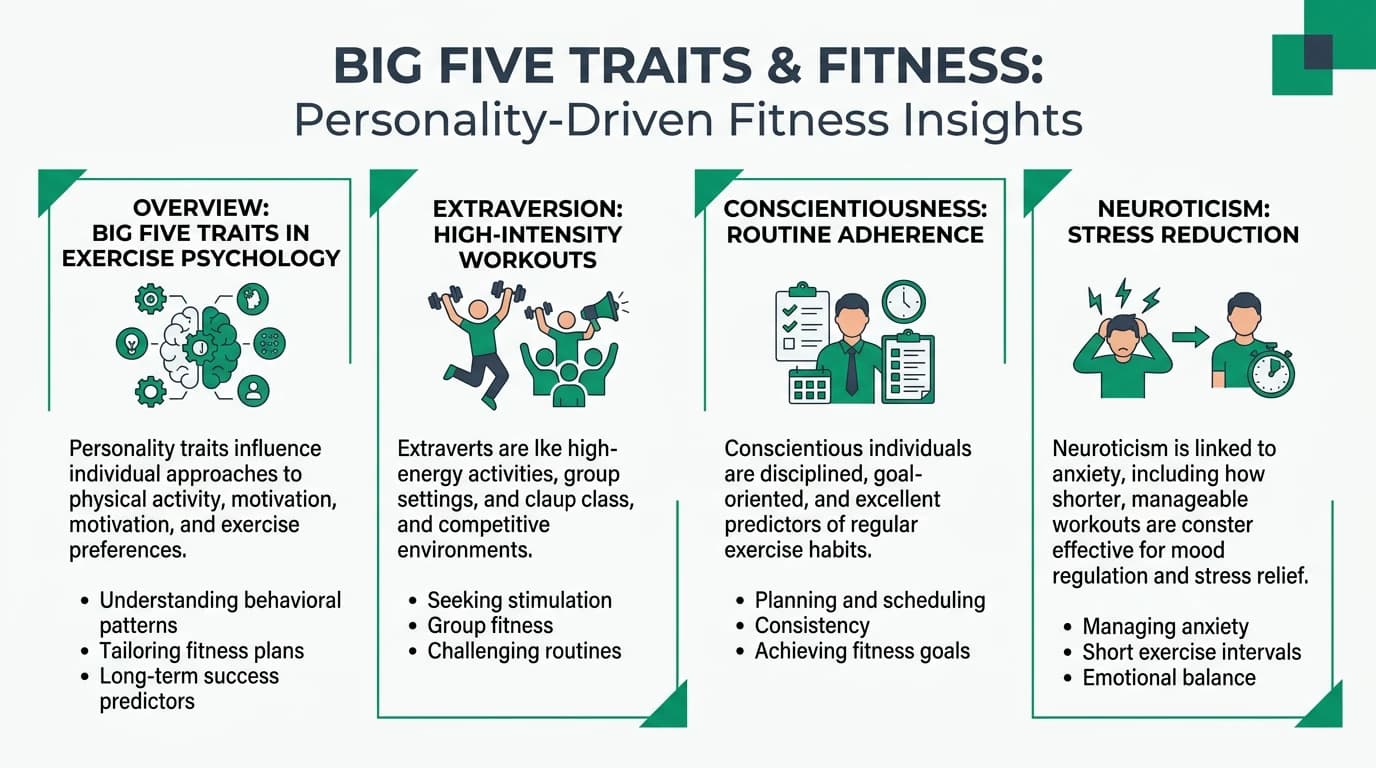
Extraversion is the strongest predictor of high-intensity exercise enjoyment (HIIT, cycling). Conscientiousness drives workout routine adherence and strength-task consistency. Neuroticism benefits most from short, unmonitored activity bursts for stress relief. Openness links to exercise via intrinsic motivation, while agreeableness favors steady, cooperative activities.
Key Takeaways
- Extraversion is the strongest predictor of high-intensity exercise enjoyment, including HIIT and max-effort cycling.
- Conscientiousness drives routine adherence, weekly exercise hours, and strength-task consistency through self-efficacy.
- Neuroticism has a dual role: it hinders sustained effort but produces the largest stress reduction from short activity bursts.
- Openness links to exercise behavior exclusively through intrinsic motivation, not self-efficacy.
- Agreeableness shows the weakest exercise link, with a slight preference for low-intensity, cooperative activities.
- Personality traits predict exercise preferences and baseline fitness, but mediators like self-efficacy and motivation are critical pathway variables.
- Trait-matched workouts improve both enjoyment and long-term adherence compared to generic fitness prescriptions.
For a comprehensive overview of how personality develops and changes over time, see our complete Big Five guide.
Disclaimer: This article summarizes sports psychology research for educational purposes. It is not personalized medical or fitness advice. Consult a healthcare provider before starting any exercise program.
The Big Five and Exercise: An Overview
A 2025 study led by University College London, published in Frontiers in Psychology, established that all five OCEAN traits predict distinct exercise preferences in the general population1. Earlier meta-analyses (Rhodes and Pfaeffli, 2012) laid the groundwork, but the UCL study was the first to map traits to specific intensity enjoyment levels using prescribed exercise protocols.
The table below summarizes each trait's primary exercise influence.
| Trait | Preferred Intensity | Primary Mechanism | Fitness Metric Link | Population Evidence |
|---|---|---|---|---|
| Extraversion | High (HIIT, max cycling) | Enjoyment of arousal | VO2peak | General public, athletes |
| Conscientiousness | Moderate and steady | Routine and goal pursuit | Weekly exercise hours | College students, general |
| Neuroticism | Short, unmonitored bursts | Stress avoidance and relief | Heart rate recovery | General public |
| Openness | Varied and novel | Intrinsic motivation | Behavior frequency | College students |
| Agreeableness | Low and cooperative | Social harmony | Slight preference only | Athletes, gym members |
- Conscientiousness and extraversion carry the highest predictive weight for exercise behavior across populations12.
- Agreeableness frequently shows null results in exercise studies when demographic variables are controlled3.
- Personality traits explain variance in physical activity engagement, but environmental and motivational factors also play crucial roles4.
Extraversion and High-Intensity Preferences
Extraverts experience higher arousal as pleasurable rather than aversive. This biological tendency makes high-intensity workouts inherently more enjoyable for them.
How Extraversion Drives Fitness
- Enjoyment of peak effort makes HIIT classes and max-effort cycling rewarding rather than punishing.
- Social energy fuels engagement in organized sports and group fitness.
- Higher weekly activity hours compared to introverts, particularly in structured programs.
- VO2peak correlation shows extraverts tend to have better cardiovascular fitness at baseline1.
The UCL study found extraversion was the single strongest predictor of highest-intensity enjoyment in a general public sample, surpassing all other Big Five traits5.
Extraversion Exercise Profile
| Exercise Aspect | High Extraversion | Low Extraversion |
|---|---|---|
| Preferred workout | HIIT, team sports, group classes | Solo running, swimming, home workouts |
| Intensity sweet spot | High to maximum effort | Low to moderate effort |
| Social preference | Group settings, gym floor | Independent, private spaces |
| Adherence driver | Excitement and social reward | Routine and habit |
| Risk factor | Overtraining from chasing intensity | Under-stimulation, boredom |
| Stress response | Exercise as social outlet | Exercise as quiet reset |
- Introverted individuals should not force group fitness formats. Solo activities like trail running, swimming, or home-based strength training align better with their energy patterns.
- For more on how introversion functions in structured environments, see our workplace introversion guide.
Extravert-Optimized Workout Scenarios
| Personality Profile | Recommended Activity | Why It Works | Adherence Forecast |
|---|---|---|---|
| High extravert, office worker | Lunchtime HIIT class | Matches arousal preference and breaks monotony | High (enjoyment-driven) |
| High extravert, competitive | CrossFit or team sport league | Social pressure and competition fuel consistency | Very high |
| Low extravert, anxious in groups | Solo cycling with metrics tracking | Removes social stress while maintaining intensity control | Moderate to high |
| Low extravert, routine-oriented | Morning home strength circuit | Predictable, quiet, low-barrier | High (habit-driven) |
Conscientiousness as the Adherence Engine
While extraversion predicts which exercises people enjoy, conscientiousness predicts whether they actually show up consistently. It is the trait most strongly associated with long-term exercise adherence.
The Conscientiousness-Fitness Connection
- Weekly exercise hours increase significantly with higher conscientiousness scores1.
- Strength tasks like planks and push-ups are preferred over novelty-driven cardio because they reward discipline and measurable progress2.
- Self-efficacy fully mediates the conscientiousness-to-exercise pathway in college students, meaning belief in one's capability is the mechanism3.
- Motivation also mediates the relationship, creating a dual-pathway chain model3.
A study of college students found that the conscientiousness-exercise link was entirely explained by self-efficacy and motivation—remove those mediators, and the direct relationship disappears3.
Conscientiousness Fitness Profile
| Fitness Behavior | Highly Conscientious | Less Conscientious |
|---|---|---|
| Weekly workout frequency | Consistent (4-5 sessions) | Irregular (0-3 sessions) |
| Preferred exercise type | Strength, structured cardio | Whatever feels easy or fun |
| Planning approach | Scheduled in advance | Spontaneous if at all |
| Progress tracking | Detailed logs, apps | Minimal or none |
| Recovery adherence | Follows rest protocols | Skips or overtrains |
| Long-term trajectory | Steady improvement | Boom-bust cycles |
Strategies for Less Conscientious Exercisers
You do not need to be naturally disciplined to maintain an exercise routine. External systems compensate effectively:
- Automate your schedule by setting recurring calendar blocks with location and workout details pre-filled.
- Use commitment devices like prepaid class packages or gym contracts with cancellation fees.
- Pair with a conscientious workout partner who will hold you accountable.
- Start absurdly small: commit to five minutes rather than an hour, letting momentum build naturally.
- Track one metric only (e.g., days per week) to reduce planning friction.
For deeper insight into how conscientiousness predicts success across life domains, see our complete conscientiousness guide.
Neuroticism's Dual Role in Exercise
Neuroticism presents a paradox in exercise psychology. It negatively predicts sustained effort and prolonged workout enjoyment, yet neurotic individuals experience the largest stress reduction from physical activity when the format is right.
How Neuroticism Shapes Exercise
- Stress relief is the primary motivator, not enjoyment or achievement.
- Short bursts outperform sustained sessions because extended effort triggers anxiety about performance.
- Unmonitored activity is preferred—neurotic individuals dislike heart rate tracking, performance comparison, or instructor observation5.
- Heart rate recovery is poorer in high-neuroticism individuals, reflecting physiological stress sensitivity1.
| Exercise Factor | High Neuroticism Pattern | Low Neuroticism Pattern |
|---|---|---|
| Primary motivator | Stress and anxiety relief | Achievement and enjoyment |
| Optimal duration | Short bursts (10-20 min) | Extended sessions (45-60 min) |
| Monitoring preference | None (no trackers, no observers) | Enjoys data and feedback |
| Post-exercise outcome | Significant stress reduction | Moderate mood elevation |
| Sustained effort tolerance | Low | High |
| Competitive settings | Avoids | Thrives |
Neuroticism-Friendly Exercise Prescriptions
| Scenario | Recommended Format | Duration | Key Adjustment |
|---|---|---|---|
| Anxious desk worker | Solo yoga flow at home | 15 min morning sessions | No mirrors, no tracking |
| Stressed parent | Brisk neighborhood walk | 20 min during lunch break | No performance goals |
| Overwhelmed student | Bodyweight circuit in dorm | 10 min between study blocks | No comparison to others |
| Office burnout risk | Swimming at off-peak hours | 20-30 min, self-paced | Quiet environment, no lanes |
- The key insight for neurotic exercisers: remove all performance pressure. The goal is nervous system regulation, not fitness optimization.
- For related strategies on managing stress through personality, see our stress management guide.
- Sleep quality and exercise interact strongly for neurotic individuals. Our sleep quality guide covers this connection.
Openness and Motivation Pathways
Openness to experience connects to exercise through a single, specific pathway: intrinsic motivation. Unlike conscientiousness (which works through self-efficacy) or extraversion (which works through arousal preference), openness drives exercise purely through internal interest and curiosity.
Openness-Exercise Mechanism
- Positive link to exercise behavior exists only through motivation, not self-efficacy3.
- Lower enjoyment of high-intensity exercise because physical discomfort overrides novelty interest2.
- Creativity in workout design appeals to open individuals, who tire of repetitive routines quickly.
- Athletic preparation benefits from openness through flexible, creative cross-training approaches6.
| Exercise Aspect | High Openness | Low Openness |
|---|---|---|
| Workout variety | Constantly rotating activities | Same routine for months |
| Response to repetition | Boredom and dropout | Comfort and consistency |
| Intensity tolerance | Low to moderate | Variable |
| Activity examples | Dance fitness, rock climbing, martial arts | Treadmill running, machine circuits |
| Motivation source | Novelty, learning, self-expression | Routine, duty, health obligation |
| Adherence risk | Drops activities once novelty fades | Plateaus but persists |
Mediation Pathways: How Traits Reach Exercise Behavior
The chain-mediation model from a recent college student study clarifies how each trait connects to actual exercise behavior3.
| Trait | Via Self-Efficacy | Via Motivation | Direct Effect | Net Behavior Impact |
|---|---|---|---|---|
| Conscientiousness | Yes (full mediation) | Yes | None (fully mediated) | Strongly positive |
| Extraversion | Yes (partial) | Yes (partial) | Small direct effect | Positive |
| Neuroticism | Negative (partial) | Negative (partial) | Small negative direct | Negative overall |
| Openness | No | Yes (sole pathway) | None | Positive (moderate) |
| Agreeableness | No | No | None | Null in most models |
Agreeableness and Low-Intensity Preferences
Agreeableness is the Big Five trait with the weakest and most inconsistent links to exercise behavior. Most studies find null or near-null results when demographic variables are controlled.
What the Evidence Shows
- Slight preference for easy, steady exercise like walking, gentle cycling, and group-paced activities2.
- Team dynamics contribution through cooperation, making agreeable individuals valued in group sports settings67.
- No significant independent prediction of exercise frequency or behavior in college student samples3.
- General personality factor studies suggest agreeableness contributes indirectly to gym environment fit, but not to exercise intensity or volume7.
| Agreeableness Level | Exercise Preference | Social Dynamic | Team Sport Fit |
|---|---|---|---|
| High | Steady, cooperative | Supportive, avoids conflict | Strong team player |
| Moderate | Flexible | Balanced | Adaptable |
| Low | Competitive, independent | Challenges others | Solo sport or leadership role |
Personality Predictors of Baseline Fitness
Beyond preferences, personality traits predict measurable fitness outcomes. The 2025 UCL study measured baseline fitness using standardized protocols and found trait-specific predictions1.
| Fitness Metric | Primary Trait Predictor | Direction | Secondary Predictor | Population |
|---|---|---|---|---|
| VO2peak | Extraversion | Positive | Neuroticism (negative) | General public |
| Weekly exercise hours | Conscientiousness | Positive | Extraversion (positive) | General public, students |
| Heart rate recovery | Neuroticism | Negative | Extraversion (positive) | General public |
| Strength endurance | Conscientiousness | Positive | None significant | College students |
| Overall fitness composite | Conscientiousness | Positive | Extraversion (positive) | General public |
- Post-intervention, all groups showed fitness improvements regardless of personality traits1. Personality predicts starting point and preferences, not ceiling potential.
- In a meta-analysis of Chinese athletes, openness predicted preparation quality and conscientiousness predicted training consistency, while low neuroticism predicted composure under competitive pressure6.
Athlete Personality Benchmarks
| Trait | Performance Impact | Sport Context | Evidence Trend |
|---|---|---|---|
| Openness | Creative preparation, flexible tactics | Team sports | Growing research base |
| Conscientiousness | Training consistency, discipline | All sports | Strong predictor across studies |
| Neuroticism (low) | Composure under pressure | Individual competition | Significant competitive advantage |
| Extraversion | Team cohesion, energy in group events | Team sports | Moderate predictor |
| Agreeableness | Cooperation, conflict reduction | Team sports | Indirect performance link |
Limitations and Research Gaps
Not all findings are robust. Responsible interpretation requires acknowledging where the evidence is weak.
- 12-week interventions showed no significant Big Five effect on belief or behavior changes, suggesting traits predict preferences but not short-term responsiveness to programs4.
- Agreeableness frequently shows null results and should not be over-interpreted as an exercise predictor23.
- Long-term studies beyond 12 weeks are scarce. Most evidence comes from cross-sectional data.
- Environmental mediators (neighborhood walkability, gym access, climate) remain unlinked to personality-exercise models4.
- Population specificity means athlete findings (e.g., Chinese meta-analysis) do not generalize directly to recreational exercisers6.
| Limitation | Impact on Recommendations | Research Need |
|---|---|---|
| Short intervention windows | Cannot claim traits predict program responsiveness | Studies spanning 6-12 months minimum |
| Agreeableness null findings | Should not prescribe agreeableness-based workouts | Larger samples with behavioral outcomes |
| Cross-sectional dominance | Correlation, not causation established | Longitudinal exercise tracking with personality measures |
| Athlete-to-public gap | Performance findings may not apply to gym-goers | Recreational population replication studies |
| Missing environmental data | Personality may interact with access and resources | Multi-level models including environment |
Important: Personality traits explain meaningful variance in exercise engagement, but they are not sole determinants. Use trait information to inform exercise choices, not to limit them.
Trait-matched exercise action checklist
- Take a validated Big Five personality assessment to identify your dominant traits.
- Match your top trait to the exercise preference tables above to identify compatible workout types.
- If high in extraversion, prioritize high-intensity group formats (HIIT, team sports, CrossFit).
- If high in conscientiousness, build structured weekly schedules with progress tracking.
- If high in neuroticism, choose short, unmonitored, low-pressure activity formats.
- If high in openness, rotate activities regularly to maintain motivation through novelty.
- Address mediators directly: build self-efficacy through small wins and cultivate intrinsic motivation.
- Reassess your exercise approach every 3 months as fitness levels and preferences evolve.
FAQ
How does extraversion predict exercise enjoyment?
Extraversion is the strongest Big Five predictor of high-intensity exercise enjoyment. A 2025 UCL study published in Frontiers in Psychology found that extraverts consistently rated HIIT and maximum-effort cycling as more enjoyable than introverts, likely because high arousal states feel pleasurable rather than aversive to extraverted individuals15.
Can conscientiousness improve workout adherence?
Yes. Conscientiousness is the trait most consistently linked to exercise routine adherence, weekly exercise hours, and strength-task consistency. However, a college student study found this relationship is fully mediated by self-efficacy and motivation—meaning conscientiousness works by boosting belief in one's capability and desire to exercise, not through discipline alone3.
What exercise format works best for neurotic individuals?
Short bursts of unmonitored activity produce the best outcomes for highly neurotic individuals. Yoga, brisk walking, and bodyweight circuits of 10-20 minutes performed without heart rate trackers, observers, or performance comparisons are ideal. The UCL study found that neurotic individuals showed the largest stress reduction from exercise when pressure and monitoring were removed5.
Does openness to experience influence exercise behavior?
Openness links to exercise behavior exclusively through intrinsic motivation, not self-efficacy. Highly open individuals are drawn to novel, varied activities (dance fitness, martial arts, climbing) but tend to show lower enjoyment of high-intensity workouts due to discomfort sensitivity. The risk is dropout once novelty fades23.
Why does agreeableness show weak results in exercise studies?
Agreeableness frequently produces null or near-null results in exercise behavior research after controlling for demographics. While agreeable individuals may contribute positively to team dynamics through cooperation, the trait does not independently predict exercise frequency, intensity preference, or adherence in most study designs37.
Can personality traits predict baseline fitness levels?
Yes. Conscientiousness predicts overall fitness composites and weekly activity hours. Extraversion predicts VO2peak (cardiovascular capacity). Neuroticism negatively predicts heart rate recovery. These predictions hold in general population samples, though post-intervention improvements occur regardless of personality traits1.
What are the limitations of personality-exercise research?
Key limitations include reliance on cross-sectional data (correlation, not causation), short intervention windows (12 weeks showing no personality effects on behavior change), frequent null findings for agreeableness, limited environmental context, and poor generalizability from athlete samples to recreational exercisers. Long-term longitudinal studies are needed14.
How do self-efficacy and motivation mediate the personality-exercise link?
A chain-mediation model shows that conscientiousness and extraversion reach exercise behavior through both self-efficacy and motivation. Neuroticism works negatively through both pathways. Openness operates only through motivation. Agreeableness shows no mediation through either pathway. Understanding these mediators helps design interventions that target the right psychological mechanism for each personality type3.
Notes
Primary Sources
| Source | Type | Key Contribution | URL |
|---|---|---|---|
| Frontiers in Psychology (UCL study) | Peer-reviewed journal | Trait-intensity enjoyment mapping in general population | Link |
| PubMed Central (college students) | Peer-reviewed journal | Chain mediation model: traits via self-efficacy and motivation | Link |
| University College London News | Institutional press release | Public-facing summary of 2025 exercise personality study | Link |
| PLOS ONE (athlete meta-analysis) | Peer-reviewed journal | Big Five and athletic performance across sport types | Link |
| Gymnica | Peer-reviewed journal | Personality and fitness club environment preferences | Link |
Conclusion
Your personality traits create exercise preferences, not exercise limits. Extraversion predicts intensity enjoyment, conscientiousness predicts adherence, neuroticism predicts stress-relief benefit, openness predicts motivation-driven variety, and agreeableness plays a minimal independent role.
The practical application is clear: identify your dominant traits, match your workout format to your psychological wiring, and build systems that address your specific adherence risks. An extravert forcing themselves through solo treadmill sessions, or a neurotic individual pushing through monitored HIIT classes, is working against their personality rather than with it.
Trait-matched exercise is not about limitation. It is about selecting the path of least psychological resistance toward consistent physical activity.
Footnotes
-
Menzies, R. et al. (2025). Personality traits predict exercise preferences and baseline fitness in a general population sample. Frontiers in Psychology. Available at: https://pmc.ncbi.nlm.nih.gov/articles/PMC12279706/ ↩ ↩2 ↩3 ↩4 ↩5 ↩6 ↩7 ↩8 ↩9 ↩10
-
Psychiatrist.com (2025). Your personality could unlock a love of exercise: Summary of UCL study on Big Five and exercise intensity preferences. Available at: https://www.psychiatrist.com/news/your-personality-could-unlock-a-love-of-exercise/ ↩ ↩2 ↩3 ↩4 ↩5 ↩6
-
Li, X. et al. (2025). Big Five personality traits, self-efficacy, and motivation as predictors of exercise behavior in college students. PubMed Central. Available at: https://pmc.ncbi.nlm.nih.gov/articles/PMC12323249/ ↩ ↩2 ↩3 ↩4 ↩5 ↩6 ↩7 ↩8 ↩9 ↩10 ↩11 ↩12
-
Medical Xpress (2026). Big Five personality traits link to exercise beliefs but not behavior change over 12 weeks. Available at: https://medicalxpress.com/news/2026-02-big-personality-traits-link-beliefs.html ↩ ↩2 ↩3 ↩4
-
University College London (2025). Personality type can predict which forms of exercise people enjoy. UCL News. Available at: https://www.ucl.ac.uk/news/2025/jul/personality-type-can-predict-which-forms-exercise-people-enjoy ↩ ↩2 ↩3 ↩4
-
Zhang, Y. et al. (2024). Personality traits and athletic performance: A meta-analysis of Chinese athletes. PLOS ONE. Available at: https://journals.plos.org/plosone/article?id=10.1371%2Fjournal.pone.0312850 ↩ ↩2 ↩3 ↩4
-
Bostanci, O. et al. (2020). Personality traits and fitness club environments. Gymnica. Available at: https://gymnica.upol.cz/pdfs/gym/2020/04/05.pdf ↩ ↩2 ↩3