personality-tests
Big Five Traits and Public Speaking Confidence
Learn how the Big Five personality traits influence public speaking confidence and anxiety, with evidence-based strategies to present effectively.
Quick answer
How do the Big Five personality traits affect public speaking?
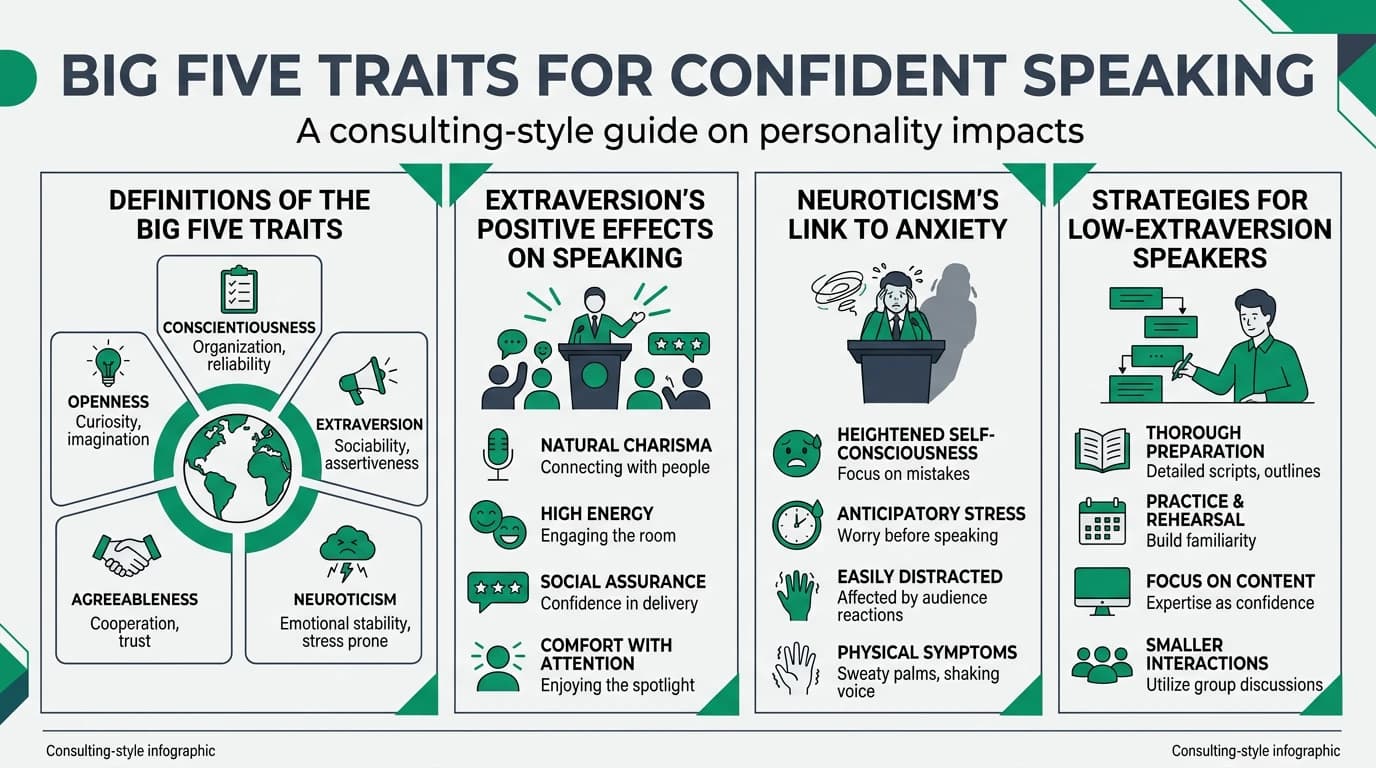
Extraversion is the strongest positive predictor of public speaking performance, enhancing fluency and audience engagement. Neuroticism is the strongest negative predictor, increasing speech anxiety. Conscientiousness improves preparation quality, openness enhances adaptability, and agreeableness supports audience rapport.
Executive Summary
Public speaking anxiety affects an estimated 75 percent of the population to some degree. The Big Five personality traits offer a research-backed framework for understanding why some individuals thrive at the podium while others struggle with debilitating nervousness1.
The bottom line: Your personality profile does not determine your public speaking ceiling — it reveals your starting point and the specific strategies that will work best for you.
- Extraversion accounts for approximately 6 percent of variance in oral presentation scores1.
- Neuroticism is the primary driver of speech anxiety, particularly in high-stakes contexts2.
- Conscientiousness enables superior preparation, which compensates for lower natural confidence3.
Critical: Believing that only extraverts can be effective speakers is a myth. Research shows introverts who use targeted strategies match or exceed extraverted speakers in structured settings1.
What Are the Big Five Personality Traits?
The Big Five (OCEAN) model is the gold standard in personality psychology, backed by decades of cross-cultural validation. Each trait exists on a spectrum rather than as a binary category4.
- Openness to Experience: Imagination, intellectual curiosity, and creative thinking.
- Conscientiousness: Self-discipline, organization, and reliability.
- Extraversion: Social energy, assertiveness, and positive affect.
- Agreeableness: Warmth, cooperation, and conflict avoidance.
- Neuroticism: Emotional volatility, anxiety proneness, and stress sensitivity.
| Trait | High-Scorer Profile | Low-Scorer Profile | Speaking Implication |
|---|---|---|---|
| Openness | Creative, improvisational, idea-rich | Practical, structured, routine-oriented | Content innovation vs. template reliance |
| Conscientiousness | Meticulous preparer, detail-oriented | Spontaneous, flexible, less organized | Preparation depth vs. on-the-fly adaptation |
| Extraversion | Energized by audiences, naturally fluent | Reserved, reflective, energy-depleted by crowds | Natural stage presence vs. deliberate practice |
| Agreeableness | Warm, audience-focused, empathetic | Direct, challenging, debate-oriented | Rapport building vs. persuasive argumentation |
| Neuroticism | Anxious, self-conscious, performance-worried | Calm, composed, emotionally steady | Anxiety management vs. natural composure |
For a comprehensive trait overview, see our extraversion complete guide and neuroticism complete guide.
Extraversion: The Natural Advantage
Extraversion is the most studied trait in public speaking research. A landmark study by Amirian and Tavakoli (2016) found that extraversion explains approximately 6 percent of variance in oral presentation scores — a meaningful effect in behavioral research1.
- Extraverted speakers show greater fluency, longer utterances, and more eye contact.
- They experience a "performance high" from audience energy that fuels engagement.
- Their natural assertiveness commands attention without appearing aggressive1.
| Extraversion Facet | Impact on Speaking | Observable Behavior | Audience Perception |
|---|---|---|---|
| Assertiveness | Strong positive | Confident posture, direct address | Authoritative and credible |
| Sociability | Moderate positive | Audience interaction, Q-and-A comfort | Approachable and relatable |
| Positive emotionality | Strong positive | Enthusiasm, vocal variety | Engaging and energizing |
| Activity level | Moderate positive | Dynamic movement, gestures | Visually stimulating |
When Extraversion Backfires
High extraversion is not universally advantageous. Over-expressiveness can distract from content, and extraverted speakers sometimes prioritize entertainment over substance1.
- Excessive energy may overwhelm analytical audiences.
- Dominating Q-and-A sessions can alienate quieter participants.
- Spontaneity without preparation leads to rambling and lost focus.
| Risk | Symptom | Correction Strategy |
|---|---|---|
| Over-talking | Exceeding time limits regularly | Practice with strict timers |
| Shallow content | Entertaining but substance-light | Script key data points and evidence |
| Audience steamrolling | Not pausing for input | Build structured pause points |
Neuroticism and Speech Anxiety
Neuroticism is the strongest predictor of public speaking anxiety. Individuals high in neuroticism experience amplified physiological stress responses — elevated heart rate, sweating, trembling — that can severely impair performance2.
- The relationship between neuroticism and speech anxiety is stronger in women than men in some studies2.
- High neuroticism activates threat-processing brain regions even in low-risk speaking scenarios.
- Anticipatory anxiety (before the speech) is often worse than performance anxiety (during the speech)5.
| Anxiety Component | Neuroticism Contribution | Physical Manifestation | Cognitive Manifestation |
|---|---|---|---|
| Anticipatory anxiety | Very high | Sleep disruption, nausea | Catastrophic thinking, avoidance |
| Performance anxiety | High | Trembling hands, voice shaking | Mind blanking, self-monitoring |
| Post-event rumination | High | Fatigue, tension headaches | Replaying "mistakes," shame |
| Recovery period | Moderate | Physical exhaustion | Lingering self-doubt |
Evidence-Based Anxiety Reduction Strategies
Research identifies specific interventions that target neuroticism-driven speaking anxiety25.
- Cognitive restructuring: Replace catastrophic thoughts ("I will fail") with realistic assessments ("I am prepared and the audience wants me to succeed").
- Systematic desensitization: Gradual exposure from small groups to larger audiences over weeks.
- Controlled breathing: Box breathing (4-4-4-4 pattern) reduces physiological arousal before speaking.
- Visualization: Mental rehearsal of successful performance outcomes.
| Strategy | Effectiveness for High Neuroticism | Time to See Results | Difficulty Level |
|---|---|---|---|
| Cognitive restructuring | High | 4-6 weeks | Moderate |
| Systematic desensitization | Very high | 8-12 weeks | Low to moderate |
| Controlled breathing | Moderate | Immediate | Low |
| Visualization | Moderate | 2-4 weeks | Low |
| Beta-blocker medication | High (physical symptoms) | Same day | Requires prescription |
For broader anxiety management strategies, explore our stress management and coping guide.
Conscientiousness: Preparation as Power
Conscientiousness compensates for lower natural confidence through superior preparation. Highly conscientious speakers invest more time in research, rehearsal, and structural planning — producing presentations that are clear, logical, and well-timed3.
- Conscientious preparation reduces uncertainty, which is the primary trigger for anxiety.
- Structured presentations are rated higher on clarity and professionalism by audiences.
- Over-preparation can become a liability when rigidity prevents adaptation to audience cues3.
| Preparation Dimension | High Conscientiousness | Low Conscientiousness |
|---|---|---|
| Research depth | Exhaustive, multi-source | Surface-level, single-source |
| Rehearsal frequency | Multiple full run-throughs | One or zero rehearsals |
| Slide quality | Polished, error-free | Rough, last-minute |
| Time management | Precisely timed sections | Runs over or under time |
| Contingency planning | Backup slides, tech failsafes | No backup plan |
| Conscientiousness Level | Speaking Strength | Speaking Weakness | Optimization Tip |
|---|---|---|---|
| Very high | Flawless delivery, confidence | Robotic, inflexible | Practice improvisational exercises |
| Moderate | Balanced preparation and flexibility | Neither extreme | Continue refining both skills |
| Low | Natural, spontaneous energy | Disorganized, under-rehearsed | Use templates and checklists |
Openness and Adaptive Presentation
Openness to experience equips speakers with creativity, intellectual range, and the ability to pivot when presentations go off-script. High-openness speakers generate more original content and handle unexpected questions with greater ease1.
- Open speakers use richer vocabulary and more varied examples.
- They adapt well to diverse audiences by reading the room.
- However, over-complexity can lose audiences who prefer straightforward information1.
| Scenario | High-Openness Response | Low-Openness Response | Audience Impact |
|---|---|---|---|
| Hostile question | Reframe creatively, find common ground | Repeat prepared answer defensively | Perceived flexibility vs. rigidity |
| Technical failure | Improvise without slides | Panic, request tech support | Perceived competence under pressure |
| Mixed-expertise audience | Layer content for multiple levels | Deliver at one level | Broader engagement vs. partial disconnect |
| Unexpected time cut | Prioritize key insights spontaneously | Struggle to condense | Professional adaptation vs. visible stress |
Agreeableness and Audience Connection
Agreeableness shapes the relational dimension of public speaking. Agreeable speakers create warmth and psychological safety, making audiences more receptive to their message4.
- They excel at storytelling, anecdotes, and emotional appeals.
- Audience trust ratings are higher for speakers perceived as warm and cooperative.
- However, excessive agreeableness may weaken persuasive or authoritative delivery4.
| Speaking Context | High Agreeableness Advantage | High Agreeableness Disadvantage |
|---|---|---|
| Team presentation | Collaborative, inclusive tone | May defer to stronger voices |
| Persuasive pitch | Empathetic framing, trust building | May soften critical arguments |
| Workshop facilitation | Creates safe learning environment | Difficulty managing disruptive attendees |
| Debate or panel | Respectful, balanced perspective | May avoid necessary confrontation |
Trait Interactions in Speaking Contexts
Real speaking performance emerges from trait combinations rather than individual traits in isolation. Understanding how traits interact creates more accurate predictions and more targeted strategies1.
- Extraversion plus Openness: The "dynamic innovator" — charismatic, creative, and engaging. Excels in persuasive and motivational speaking.
- Conscientiousness plus Low Neuroticism: The "calm expert" — thorough, composed, and authoritative. Excels in technical and educational presentations.
- High Neuroticism plus High Conscientiousness: The "prepared worrier" — anxious but well-rehearsed. Over-preparation compensates for anxiety.
| Trait Combination | Speaking Style | Best Context | Development Focus |
|---|---|---|---|
| High Extraversion + High Openness | Dynamic, creative, audience-interactive | Keynotes, motivational talks | Add structure and data rigor |
| High Conscientiousness + Low Neuroticism | Methodical, calm, evidence-rich | Technical presentations, lectures | Add storytelling and vocal variety |
| High Agreeableness + High Openness | Warm, creative, audience-empathetic | Workshops, team meetings | Strengthen assertiveness |
| High Neuroticism + High Conscientiousness | Well-prepared, detail-oriented | Structured presentations with notes | Practice anxiety management techniques |
Assessing Your Speaking Personality Profile
Accurate self-assessment is the first step toward targeted improvement. Several validated instruments measure the Big Five traits relevant to speaking performance4.
- NEO-PI-R: The gold standard for comprehensive Big Five assessment (240 items).
- Big Five Inventory (BFI): A shorter, widely used 44-item measure.
- TIPI (Ten-Item Personality Inventory): Ultra-brief screening tool for quick profiling.
| Assessment Tool | Items | Time Required | Reliability | Best Use |
|---|---|---|---|---|
| NEO-PI-R | 240 | 45 minutes | Very high | Clinical and professional development |
| Big Five Inventory | 44 | 10 minutes | High | Research and self-awareness |
| TIPI | 10 | 2 minutes | Moderate | Quick screening |
| IPIP-NEO | 120 or 300 | 20-60 minutes | High | Free online assessment |
For more on personality assessment tools and their validity, visit the American Psychological Association personality page.
Strategies by Personality Profile
The most effective approach to public speaking improvement depends on your specific Big Five profile. One-size-fits-all advice wastes time and can worsen anxiety for some profiles12.
For Introverted Speakers (Low Extraversion)
- Start with small, familiar audiences and gradually increase size.
- Use the "extraverted behavior" technique: adopt assertive body language for short, defined periods.
- Leverage preparation depth as a confidence source.
- Choose structured formats (presentations, panels) over open-ended formats (networking, improv).
For High-Neuroticism Speakers
- Accept anxiety as a physiological response, not a character flaw.
- Build a pre-speech ritual that activates calm (breathing, grounding, positive self-talk).
- Practice in low-stakes environments before high-stakes ones.
- Consider our resilience and mental toughness guide for long-term coping.
For Low-Conscientiousness Speakers
- Use presentation templates to impose structure.
- Set non-negotiable rehearsal deadlines.
- Record practice sessions and review for timing and clarity.
| Profile | Core Challenge | Top Strategy | Expected Timeline |
|---|---|---|---|
| Low Extraversion | Energy depletion, low stage presence | Graduated exposure practice | 8-12 weeks |
| High Neuroticism | Debilitating anxiety | Cognitive restructuring plus desensitization | 6-12 weeks |
| Low Conscientiousness | Under-preparation | Template-driven workflow | 2-4 weeks |
| Low Openness | Rigid delivery, poor adaptation | Improvisational exercises | 4-8 weeks |
| Low Agreeableness | Cold or confrontational tone | Empathy and storytelling training | 4-6 weeks |
Myths vs. Evidence on Personality and Speaking
Several persistent myths prevent people from developing their public speaking skills. Research challenges each of these misconceptions12.
- Myth: Great speakers are born, not made. Evidence: Speaking skills respond to deliberate practice regardless of personality profile1.
- Myth: Introverts cannot be powerful speakers. Evidence: Introverts who prepare thoroughly often outperform extraverts in structured settings1.
- Myth: Anxiety always hurts performance. Evidence: Moderate anxiety can enhance focus and energy when managed properly5.
- Myth: Personality traits are fixed. Evidence: Traits shift across the lifespan, and behavioral change is possible with targeted intervention4.
| Myth | Reality | Key Study |
|---|---|---|
| Only extraverts can speak well | Introverts excel in structured formats | Amirian and Tavakoli, 2016 |
| Anxiety ruins performance | Moderate anxiety sharpens focus | Behnke and Sawyer, 2004 |
| Personality is fixed | Traits change with practice and age | Roberts et al., 2006 |
| Confidence equals competence | Preparation matters more than charisma | Riggio and Friedman, 1986 |
Learn more about how personality affects workplace communication in our communication styles guide.
Public speaking improvement checklist
- Complete a Big Five personality assessment to identify your speaking profile.
- Identify your top two speaking challenges based on your trait scores.
- Select two to three strategies matched to your specific personality profile.
- Practice at least one speech per week in a low-stakes environment.
- Record and review at least two practice sessions for self-feedback.
- If high in neuroticism, implement a pre-speech anxiety management ritual.
- Gradually increase audience size over an eight-to-twelve-week period.
- Seek feedback from audiences on clarity, engagement, and confidence.
FAQ
Can introverts become excellent public speakers?
Absolutely. Research by Amirian and Tavakoli (2016) found that introverted speakers who use structured preparation and graduated exposure techniques match or exceed extraverted peers in formal presentation settings. Many renowned speakers — including Bill Gates and Susan Cain — identify as introverts. Source: Amirian & Tavakoli, 2016
How much does extraversion actually affect speaking performance?
Extraversion accounts for approximately 6 percent of variance in oral presentation scores. This is statistically significant but leaves 94 percent of performance determined by other factors — including preparation, practice, content quality, and audience rapport skills. Source: Amirian & Tavakoli, 2016
What is the best way to manage speech anxiety for high-neuroticism individuals?
A combination of cognitive restructuring and systematic desensitization is most effective. Cognitive restructuring addresses catastrophic thinking patterns, while desensitization gradually builds tolerance through progressive exposure. Controlled breathing techniques provide immediate physiological relief. Source: Behnke & Sawyer, 2004, Communication Education
Does conscientiousness help with public speaking?
Yes. Conscientiousness drives superior preparation — deeper research, more rehearsals, better time management, and higher-quality slides. Studies show that preparation quality is one of the strongest predictors of audience ratings, often outweighing natural charisma or confidence. Source: Poropat, 2009, Psychological Bulletin
How does openness to experience affect presentation adaptability?
High openness enables speakers to improvise when technology fails, pivot when audiences react unexpectedly, and generate creative content that stands out. Open speakers use richer vocabulary and more diverse examples, making their presentations more intellectually stimulating. Source: Amirian & Tavakoli, 2016
Can personality traits change over time to improve speaking?
Yes. While core personality traits are relatively stable, they shift meaningfully across the lifespan — conscientiousness and agreeableness increase, and neuroticism decreases with age. Targeted behavioral interventions (such as exposure therapy for anxiety) can also produce measurable trait-level changes. Source: Roberts et al., 2006, Psychological Bulletin
What assessment tools are best for understanding my speaking personality?
The NEO-PI-R is the most comprehensive tool for clinical and professional use (240 items). For quicker self-assessment, the Big Five Inventory (44 items) or the free IPIP-NEO (120 items) provide reliable results. The Ten-Item Personality Inventory (TIPI) is suitable for initial screening only. Source: American Psychological Association
Is it true that some anxiety actually helps speaking performance?
Yes. Research on communication apprehension by Behnke and Sawyer (2004) found that moderate anticipatory anxiety can sharpen focus, increase energy, and motivate more thorough preparation. The key is managing anxiety to keep it in the facilitative range rather than allowing it to become debilitating. Source: Behnke & Sawyer, 2004
Notes
Primary Sources
| Source | Type | URL |
|---|---|---|
| Amirian & Tavakoli (2016) — Language Testing in Asia | Journal Article | Link |
| Behnke & Sawyer (2004) — Communication Education | Journal Article | Link |
| Poropat (2009) — Psychological Bulletin | Meta-Analysis | Link |
| Roberts, Walton, & Viechtbauer (2006) — Psychological Bulletin | Meta-Analysis | Link |
| American Psychological Association — Personality Resources | Official Resource | Link |
Conclusion
Public speaking confidence is not an innate gift reserved for extraverts. It is a skill shaped by personality, refined by practice, and optimized by self-awareness. The Big Five framework gives you a precise map of your strengths and vulnerabilities as a speaker.
Whether you are a naturally energetic extravert or a thoughtful introvert, the research is consistent: targeted strategies matched to your personality profile produce the fastest and most sustainable improvement. Start with assessment, commit to practice, and trust the science.
Footnotes
-
Amirian, S. M. R. & Tavakoli, E. (2016). "Academic Oral Presentation Self-Efficacy, the Big Five, and Oral Presentation Performance." Language Testing in Asia, 6, Article 15. Available at: https://languagetestingasia.springeropen.com/articles/10.1186/s40468-016-0030-1 ↩ ↩2 ↩3 ↩4 ↩5 ↩6 ↩7 ↩8 ↩9 ↩10 ↩11 ↩12 ↩13
-
Behnke, R. R. & Sawyer, C. R. (2004). "Public Speaking Anxiety as a Function of Sensitization and Habituation Processes." Communication Education, 53(2), 164-173. Available at: https://doi.org/10.1080/0363452042000265189 ↩ ↩2 ↩3 ↩4 ↩5 ↩6
-
Poropat, A. E. (2009). "A Meta-Analysis of the Five-Factor Model of Personality and Academic Performance." Psychological Bulletin, 135(2), 322-338. Available at: https://doi.org/10.1037/a0014996 ↩ ↩2 ↩3
-
Roberts, B. W., Walton, K. E., & Viechtbauer, W. (2006). "Patterns of Mean-Level Change in Personality Traits Across the Life Course." Psychological Bulletin, 132(1), 1-25. Available at: https://doi.org/10.1037/0033-2909.132.1.1 ↩ ↩2 ↩3 ↩4 ↩5
-
Spielberger, C. D. (1983). "State-Trait Anxiety Inventory (STAI)." Consulting Psychologists Press. Referenced via the American Psychological Association: https://www.apa.org/pi/about/publications/caregivers/practice-settings/assessment/tools/trait-state ↩ ↩2 ↩3