personality-tests
Big Five Team Building Guide for Managers
Practical guide to building high-performing teams using Big Five personality traits. Includes optimal compositions, role benchmarks, and leadership tips.
Quick answer
How do the Big Five personality traits improve team building?
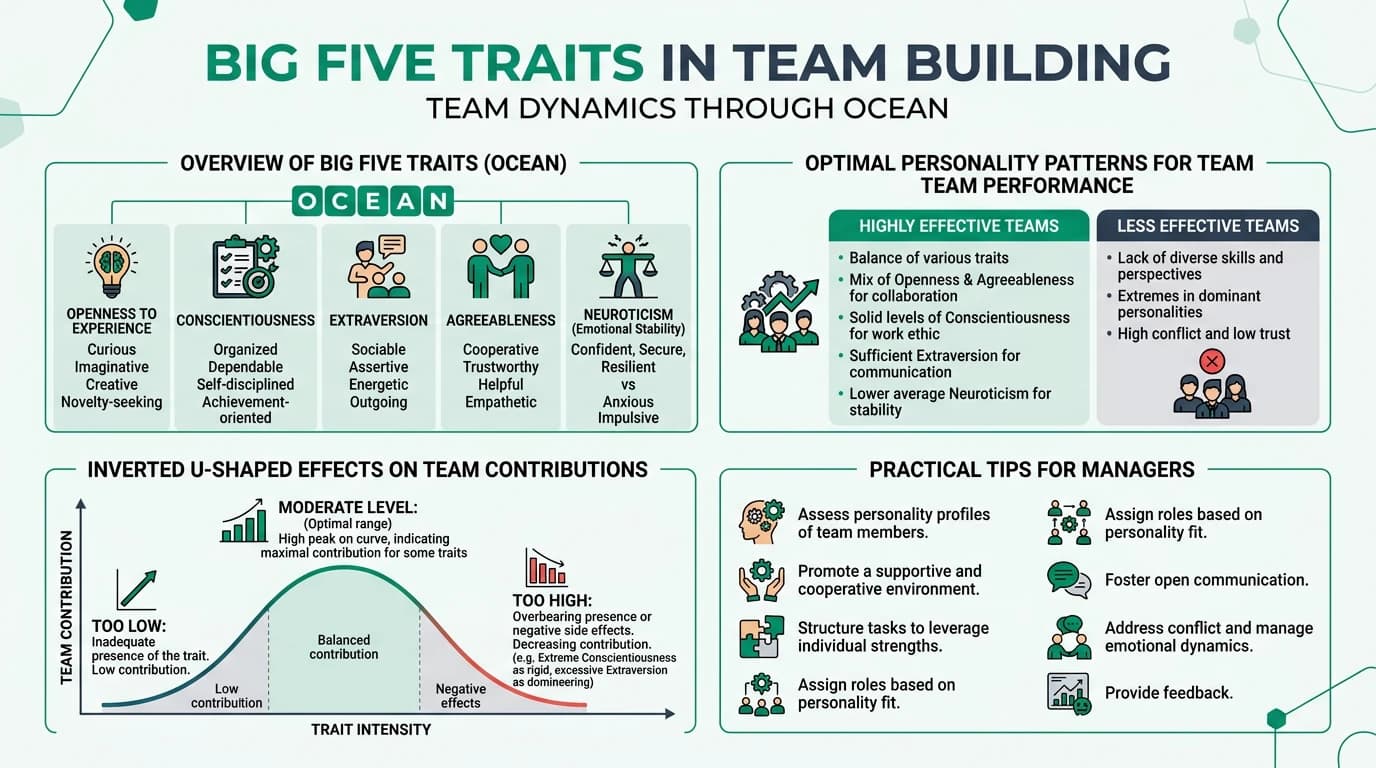
The Big Five traits (openness, conscientiousness, extraversion, agreeableness, neuroticism) predict team creativity, cohesion, and role suitability. Research shows teams with moderate extraversion, high openness, and high conscientiousness generate significantly more creative ideas than other compositions. Traits follow inverted U-shaped curves: benefits peak at moderate-to-high levels and diminish at extremes.
Key Takeaways
- Balanced teams outperform uniform ones: diverse Big Five compositions produce higher creativity and cohesion than teams where all members share similar trait profiles12.
- Traits follow inverted U-shaped curves: extraversion, agreeableness, and conscientiousness benefit team performance up to a peak, then produce diminishing or negative returns1.
- Moderate extraversion is optimal for teams: a few high extraverts for leadership paired with moderate or introverted members for focused execution creates the best dynamic2.
- High openness drives innovation: teams scoring high on openness generate more ideas of higher quality during brainstorming tasks2.
- Agreeableness aids cooperation but hinders tough decisions: managers need to calibrate agreeableness levels, especially in leadership roles where decisive action is required13.
- Neuroticism should be minimized in high-pressure teams: low neuroticism predicts emotional stability and resilience under stress across entrepreneurs, managers, and supervisors3.
- Personality assessments provide group-level predictions that go beyond individual skill matching for team composition4.
For a comparison of personality frameworks for team coaching, see our Big Five vs. Enneagram guide.
Disclaimer: This guide synthesizes organizational psychology research for educational purposes. Personality assessments should inform team decisions alongside other factors like skills, experience, and cultural fit. Never use personality data as the sole criterion for hiring or role assignment.
The Big Five Framework for Teams
The Big Five personality traits, often abbreviated as OCEAN, represent the most validated and widely used model for understanding individual differences in workplace settings14. Each trait maps to specific team behaviors.
- Openness to experience: drives creativity, willingness to explore new approaches, and intellectual curiosity.
- Conscientiousness: predicts reliability, task completion quality, and adherence to deadlines.
- Extraversion: fuels social interaction, leadership emergence, and team energy.
- Agreeableness: promotes cooperation, trust-building, and conflict reduction.
- Neuroticism: indicates emotional reactivity, stress vulnerability, and anxiety levels.
| Trait | Team Contribution | Risk When Extreme | Optimal Level for Teams |
|---|---|---|---|
| Openness | Idea generation, creative problem-solving | Impractical ideas, resistance to routine | High for innovation teams; moderate for execution |
| Conscientiousness | Task quality, deadline adherence, norm compliance | Rigidity, micro-management, inflexibility | High for accuracy teams; moderate for creative |
| Extraversion | Social facilitation, leadership, morale | Dominance, reduced input from quieter members | Moderate overall; few high for leadership roles |
| Agreeableness | Cooperation, trust, conflict mediation | Indecisiveness, groupthink, avoidance of hard truths | Moderate to high; lower for managers |
| Neuroticism | Vigilance, risk awareness (at mild levels) | Stress contagion, instability, team anxiety | Low across all roles |
Understanding these trait-to-behavior mappings is the first step toward intentional team composition. For deeper communication strategies based on these traits, see our communication styles guide.
Optimal Personality Patterns for Team Performance
Not all trait combinations produce equal results. Research on 65 three-person groups found that specific personality patterns significantly outperformed others on creativity and idea generation tasks2.
Teams with moderate extraversion, high openness, and high conscientiousness generated the highest quantity and quality of ideas. Uniform high-extraversion teams, by contrast, suffered from dominance competition and reduced listening.
- Diversity beats uniformity: complementary trait mixes minimize blind spots and maximize collective capability2.
- Inverted U-shaped effects: a 220-participant study found that extraversion, agreeableness, and conscientiousness all show positive teamwork contributions up to a peak, then negative returns beyond that point1.
- Cohesion is not automatic: some high-performing patterns do not produce the highest cohesion, suggesting managers must actively cultivate team bonds alongside composition2.
| Team Pattern | Idea Quantity | Creativity Quality | Cohesion Level | Best Use Case |
|---|---|---|---|---|
| Moderate extraversion + high openness + high conscientiousness | Very high | Very high | Moderate to high | Innovation sprints, product development |
| Uniform high extraversion | Moderate | Low to moderate | Low (dominance conflicts) | Short-term sales pushes only |
| High conscientiousness + low neuroticism | Moderate | High (accurate) | High | Quality assurance, compliance |
| High agreeableness + moderate openness | Moderate | Moderate | Very high | Customer service, support teams |
| Low openness + low extraversion | Low | Low | Variable | Not recommended as default composition |
Practical Application
- Audit your current team: score each member on the Big Five using a validated assessment (BFI-44 or equivalent).
- Identify gaps: if your team lacks openness, innovation will suffer. If conscientiousness is low, deadlines will slip.
- Hire for complement: new hires should fill trait gaps, not duplicate existing strengths.
- Rotate compositions: for project-based work, assemble teams based on the task type (creative vs. execution vs. client-facing).
Extraversion in Team Leadership and Dynamics
Extraversion is the trait most visibly tied to team leadership. Extraverts naturally emerge as leaders, drive social interaction, and maintain team energy14.
However, the relationship between extraversion and team performance is not linear. Beyond a moderate level, additional extraversion creates dominance dynamics that suppress contributions from quieter members.
- A 220-participant study confirmed the inverted U-shape: teamwork contributions peaked at moderate-to-high extraversion, then declined1.
- Entrepreneurs and managers both score high on extraversion, but the best teams pair a few high-extraversion leaders with moderate or low-extraversion executors3.
- Excessive extraversion in all team members leads to competition for airtime rather than collaborative output.
| Team Extraversion Level | Leadership Quality | Collaboration Quality | Innovation Output | Risk |
|---|---|---|---|---|
| Low across all members | Weak: no natural leader emerges | Poor: minimal social facilitation | Low | Stagnation, isolation |
| Moderate with one or two high | Optimal: clear but non-dominant leadership | Strong: balanced input | High | Minimal |
| High across all members | Chaotic: multiple competing leaders | Fragmented: everyone talks, few listen | Moderate | Dominance, burnout |
Manager Action Items
- Identify natural leaders: use personality data to confirm (not assume) who should lead.
- Protect introverted contributors: create structured turn-taking in meetings and async contribution channels.
- Rotate facilitation: even with a natural extravert leader, rotating meeting facilitation prevents dominance entrenchment.
- Balance extraverted energy: pair extraverts with reflective partners for decision-making to avoid impulsive choices.
For a comprehensive look at how personality shapes leadership, explore our leadership and Big Five traits guide.
Conscientiousness for Task Quality and Execution
Conscientiousness is the reliability engine of any team. High-conscientiousness members hit deadlines, maintain quality standards, and hold the team accountable to its commitments13.
Yet this trait also follows a curvilinear pattern. Beyond a certain threshold, excessive conscientiousness produces rigidity, micro-management, and resistance to change.
- Positive zone: high conscientiousness predicts strong task engagement, adherence to group norms, and consistent output quality1.
- Negative zone: very high levels reduce adaptability, creating friction when plans need to change quickly1.
- Among supervisors, conscientiousness is the most prevalent high-scoring trait, confirming its link to reliability-focused roles3.
| Conscientiousness Level | Task Completion Rate | Quality of Output | Adaptability | Best Team Role |
|---|---|---|---|---|
| High | Excellent: rarely misses deadlines | High: thorough and detailed | Low: resists plan changes | Project manager, quality lead |
| Moderate | Good: occasionally needs reminders | Reliable: consistent standards | Moderate: adjusts when needed | Core team contributor |
| Low | Poor: frequent delays | Inconsistent: varies widely | High: comfortable with ambiguity | Idea generator (needs structure support) |
Building Conscientiousness into Team Processes
- Formalize milestones: clear checkpoints compensate for low-conscientiousness members without micromanaging.
- Pair strategically: assign a conscientious partner to every creative or low-conscientiousness team member.
- Automate tracking: use project management tools (Asana, Jira, Linear) to make progress visible without relying on individual discipline.
- Reward completion: recognize deadline adherence publicly to reinforce conscientious behavior across the team.
Agreeableness: Cooperation Versus Decision-Making
Agreeableness is the social glue of teams, promoting trust, cooperation, and conflict reduction. But excessive agreeableness creates groupthink, indecision, and an inability to deliver hard feedback13.
The inverted U-shape is especially pronounced for this trait. Research shows that moderate agreeableness maximizes both cooperation and decision quality, while high agreeableness sacrifices the latter1.
- Agreeable team members build trust faster and reduce interpersonal friction, accelerating early-stage team formation4.
- However, teams that are uniformly high in agreeableness struggle with critical decisions, strategic pivots, and honest performance feedback3.
- Managers, in particular, tend to score lower on agreeableness than employees and supervisors, reflecting the need for tough-minded decision-making in leadership3.
| Agreeableness Level | Cooperation Quality | Decision-Making Speed | Conflict Resolution | Leadership Fit |
|---|---|---|---|---|
| High | Excellent: harmonious, trusting | Slow: avoids confrontation | Good for interpersonal conflicts | Poor: struggles with tough calls |
| Moderate | Good: collaborative and candid | Balanced: considers input then decides | Balanced: addresses issues directly | Good: decisive yet empathetic |
| Low | Challenging: friction-prone, blunt | Fast: direct and unilateral | Variable: may escalate conflicts | Strong for strategy; needs coaching on empathy |
Strategies for Managers
- Diversify agreeableness: do not build a team that is uniformly agreeable or uniformly disagreeable.
- Assign devil's advocate roles: in high-agreeableness teams, formally designate someone to challenge group consensus at each meeting.
- Separate relationship maintenance from decision-making: use structured decision frameworks (RACI, weighted scoring) to depersonalize tough calls.
- Coach low-agreeableness members: assertiveness is valuable, but unchecked bluntness erodes team trust.
For strategies on handling disagreements, see our conflict resolution guide.
Openness: Driving Team Innovation
High openness is the strongest predictor of creative output in team settings. Teams with elevated openness scores produce more ideas and ideas of higher originality during brainstorming tasks2.
This trait is particularly valuable in innovation-driven industries, R&D departments, and product development teams. However, high-openness teams may struggle with execution and follow-through without conscientious anchors.
- In a Virginia Tech study, teams with high-openness members generated significantly more ideas and higher-rated creativity than low-openness groups2.
- Entrepreneurs score notably higher on openness than managers and supervisors, reflecting the trait's link to risk tolerance and novel thinking3.
- Openness also correlates with comfort in diverse teams, making it valuable for cross-functional and multicultural group work4.
| Openness Level | Brainstorming Output | Idea Originality | Execution Discipline | Recommended Pairing |
|---|---|---|---|---|
| High | Very high volume of ideas | High: novel, unconventional | Low: tends to stall on implementation | Pair with high-conscientiousness executors |
| Moderate | Good: steady idea flow | Moderate: practical innovations | Moderate: can follow through with support | Balanced teams for most tasks |
| Low | Limited: prefers proven methods | Low: conventional, safe | High: strong execution of existing plans | Stability-focused roles (operations, compliance) |
Activating Openness in Your Team
- Structured brainstorming: use techniques like brainwriting (silent idea generation before group discussion) to capture open thinkers' ideas without extraversion bias.
- Innovation time allocation: dedicate 10 to 20 percent of team time to exploratory work for high-openness members.
- Cross-pollination: rotate team members across projects to expose low-openness contributors to diverse perspectives.
- Execution handoff: create clear transition points where ideation ends and execution begins, staffing each phase appropriately.
Managing Neuroticism in Teams
Low neuroticism is preferred across all team roles. Emotionally stable members maintain composure under pressure, reduce stress contagion, and provide a calming influence during crises53.
Research consistently shows that neuroticism should be minimized at the team level. High-neuroticism members can elevate anxiety across the group through emotional contagion, particularly in high-stakes environments.
- Entrepreneurs, managers, and supervisors all score low on neuroticism across meta-analytic reviews3.
- High-neuroticism team members require additional support structures: clear expectations, regular check-ins, and psychological safety4.
- The negative effects of neuroticism are amplified in remote teams where nonverbal reassurance cues are absent.
| Neuroticism Level | Team Stability | Stress Contagion Risk | Performance Under Pressure | Support Needed |
|---|---|---|---|---|
| Low | High: calm, resilient | Minimal | Strong: composed under deadlines | Standard management |
| Moderate | Adequate: generally stable | Moderate: occasional anxiety spikes | Variable: depends on support | Regular check-ins, clear expectations |
| High | Low: frequent emotional disruptions | High: anxiety spreads to others | Poor: chokes under pressure | Structured support, predictable workflow |
Supporting High-Neuroticism Team Members
- Psychological safety: create a team culture where mistakes are learning opportunities, not punishments.
- Predictable workflows: reduce surprise deadlines and last-minute changes, which disproportionately impact neurotic individuals.
- Private feedback channels: deliver constructive feedback one-on-one rather than publicly, which amplifies anxiety.
- Wellness integration: normalize mental health breaks and stress management practices as part of team operations.
For strategies on remote team dynamics, explore our remote teams playbook.
Building Complementary Teams: A Composition Framework
The goal of personality-informed team building is not to find perfect individuals but to create complementary mixes that cover all functional needs24.
Different task types demand different trait compositions. A creative sprint requires different personality architecture than a quality audit or a client delivery.
- Avoid cloning: hiring people who mirror the manager's personality is the most common composition mistake2.
- Map tasks to traits: align team roles with trait strengths before assigning work4.
- Accept trade-offs: no composition is perfect for all tasks. Build in flexibility to reconfigure.
| Team Type | Ideal Trait Composition | Expected Strength | Expected Weakness | Mitigation |
|---|---|---|---|---|
| Innovation / R&D | High openness, moderate extraversion, high conscientiousness | Creative output, idea quality | Execution speed | Add structured milestones |
| Quality / Compliance | High conscientiousness, low neuroticism, moderate agreeableness | Accuracy, reliability | Slow to innovate | Schedule periodic innovation reviews |
| Client-Facing / Sales | High extraversion, moderate agreeableness, moderate conscientiousness | Relationship building, responsiveness | Internal process discipline | Assign ops support partner |
| Leadership / Strategy | Moderate extraversion, low agreeableness, high conscientiousness | Decisive, organized, directive | Team warmth | Add high-agreeableness second-in-command |
| Cross-Functional | Balanced across all traits | Versatility, adaptability | No dominant strength | Assign trait-specific roles within team |
Assessment and Hiring with the Big Five
Using Big Five assessments in hiring and team formation provides data-driven insights beyond resumes and interviews4.
- Self-report surveys (BFI-44, NEO-PI-R) provide individual trait profiles in 10 to 60 minutes.
- Peer reviews offer a complementary perspective on how traits manifest in team settings.
- Behavioral observation during trial periods or simulations reveals traits in action rather than self-perception.
| Assessment Method | What It Measures | Time Investment | Best Application | Limitation |
|---|---|---|---|---|
| Self-report survey (BFI-44) | Individual trait profile | 10–15 minutes | Pre-hiring screening, team audits | Social desirability bias |
| Peer/360 review | Perceived traits in context | 20–30 minutes per rater | Existing team optimization | Rater bias, relationship effects |
| Behavioral simulation | Traits in action under pressure | 1–2 hours | Leadership selection, high-stakes roles | Resource-intensive |
| Structured interview with trait anchors | Trait indicators via behavioral questions | 30–45 minutes | Complementing traditional interviews | Interviewer training required |
Best Practices
- Never use personality as a gatekeeping tool: assessments should inform role placement, not eliminate candidates.
- Combine with skills data: personality complements technical and experiential fit, not replaces it.
- Share results transparently: when team members understand each other's profiles, collaboration improves4.
- Reassess periodically: personality shifts over time, particularly conscientiousness and agreeableness, warranting annual team audits.
Leadership Styles Adapted to Team Profiles
Effective leaders adjust their style to match the personality composition of their team43. A single leadership approach applied uniformly across diverse personalities wastes potential and creates friction.
| Leadership Style | Best for Team Profile | Core Approach | Risk if Mismatched |
|---|---|---|---|
| Transformational | High openness, high extraversion | Inspire, challenge, innovate | Overwhelms low-openness teams |
| Transactional | High conscientiousness, moderate agreeableness | Clear rewards, structured expectations | Feels rigid to high-openness teams |
| Servant | High agreeableness, moderate neuroticism | Support, empower, remove obstacles | May lack direction for low-conscientiousness teams |
| Directive | Low agreeableness, low conscientiousness | Clear orders, close monitoring | Stifles autonomy in high-openness teams |
| Coaching | Mixed profiles, developing teams | Develop strengths, address gaps | Time-intensive; not suited for urgent execution |
Adapting in Practice
- Assess your team first: do not default to your natural leadership style. Use the team's trait profile as the starting point.
- Flex by individual: within the same team, a high-openness innovator may need transformational leadership while a high-conscientiousness executor thrives under transactional clarity.
- Evolve over time: as team composition changes through hiring and attrition, reassess and adjust your approach.
- Invest in self-awareness: managers who understand their own Big Five profile make better adaptation decisions.
For an in-depth guide on leadership and personality, see our leadership personality guide.
Role-Specific Trait Benchmarks
Research reveals distinct personality signatures for different professional roles. These benchmarks help managers match people to positions where their natural traits become assets3.
A Frontiers in Psychology meta-analysis found consistent trait patterns across entrepreneurs, managers, supervisors, and employees.
| Role | High Traits | Low Traits | Performance Implication |
|---|---|---|---|
| Entrepreneur | Openness, conscientiousness, extraversion | Neuroticism | Risk tolerance, innovation, self-direction |
| Manager | Conscientiousness, extraversion | Agreeableness, neuroticism | Decisive leadership, tough calls under pressure |
| Supervisor | Conscientiousness, agreeableness | Neuroticism | Reliable execution, team harmony |
| Employee (general) | Agreeableness, moderate conscientiousness | Variable | Cooperative, task-oriented |
| Creative Director | Openness, moderate extraversion | Low conscientiousness risk | Visionary thinking, idea facilitation |
| Operations Lead | Conscientiousness, low neuroticism | Low openness acceptable | Process adherence, stability |
- Entrepreneurs differentiate most clearly on openness and low neuroticism, reflecting comfort with uncertainty3.
- Managers stand apart with lower agreeableness, enabling the tough decisions that leadership demands3.
- Supervisors balance conscientiousness with agreeableness, maintaining both standards and team morale3.
Team building action checklist
- Administer a validated Big Five assessment (BFI-44 or similar) to all team members.
- Map each member's trait profile to their current role and identify misalignments.
- Analyze the team's aggregate composition for gaps (low openness means weak innovation, low conscientiousness means missed deadlines).
- For the next hire, define the trait profile that complements existing team composition rather than duplicating it.
- Adapt your leadership style to the dominant trait profile of your team using the leadership table above.
- Implement structured processes (milestones, decision frameworks, brainstorming protocols) that compensate for trait-based weaknesses.
- Schedule a quarterly team personality review to track shifts and adjust composition strategies.
FAQ
How can I assess my team's Big Five personality traits?
Use validated self-report instruments like the BFI-44 (44 items, 15 minutes) or the shorter BFI-10 for rapid screening. Supplement with peer reviews or 360 feedback for a contextual perspective. Free research-grade options are available through the International Personality Item Pool (IPIP). Michigan State University Online
What is the best personality mix for a creative team?
Research on three-person groups found that teams with high openness, moderate extraversion, and high conscientiousness generated the most ideas and the highest-rated creativity. Avoid uniform high-extraversion compositions, which create dominance conflicts. Virginia Tech / VTechWorks
Why should managers avoid building uniform personality teams?
Uniform teams lack complementary strengths. All-extravert teams compete for attention; all-agreeable teams avoid hard decisions; all-conscientious teams resist change. Balanced compositions outperform uniform ones in both creativity and task completion across studies. Prewett et al., 2009 / PMC
How does agreeableness affect team decision-making?
Moderate agreeableness optimizes both cooperation and decision quality. High agreeableness promotes groupthink and avoidance of tough calls, while low agreeableness creates friction. Managers in particular tend to score lower on agreeableness than other roles, reflecting leadership's decisiveness demands. Antoncic et al., 2023 / Frontiers
What role does neuroticism play in team dynamics?
Low neuroticism is preferred across all team roles. High-neuroticism members increase stress contagion, reduce team stability, and perform poorly under pressure. They require predictable workflows, private feedback channels, and psychological safety to contribute effectively. Antoncic et al., 2023 / Frontiers
Can too much conscientiousness hurt team performance?
Yes. Research confirms an inverted U-shaped relationship: conscientiousness benefits teamwork contributions up to a peak, then produces rigidity, micro-management, and resistance to change. The optimal level depends on the task (higher for accuracy, moderate for innovation). Prewett et al., 2009 / PMC
How should I adapt my leadership style to team personality?
Match your leadership approach to the dominant traits in your team. Transformational leadership works best with high-openness teams, transactional with high-conscientiousness, servant leadership with high-agreeableness. Within mixed teams, flex your style by individual rather than applying one approach uniformly. Michigan State University Online
What Big Five traits differentiate entrepreneurs from managers?
Both score high on conscientiousness, extraversion, and low on neuroticism. Entrepreneurs score significantly higher on openness (risk tolerance, novelty seeking) while managers score lower on agreeableness (enabling tough decisions). Supervisors, by contrast, combine high conscientiousness with high agreeableness. Antoncic et al., 2023 / Frontiers
Primary Sources
| Source | Type | URL |
|---|---|---|
| PubMed Central (PMC) | Meta-analysis on Big Five and teamwork contributions | PMC6767192 |
| Virginia Tech (VTechWorks) | Research on personality patterns and team creativity | VTechWorks |
| Frontiers in Psychology | Meta-analysis of Big Five across professional roles | Frontiers 2023 |
| Michigan State University Online | Applied guide to Big Five in team leadership | MSU Online |
Conclusion
Building high-performing teams is not about finding star individuals. It is about assembling complementary personality profiles that cover the full range of team needs, from creative ideation to disciplined execution to emotional stability under pressure.
Start by assessing your current team with a validated Big Five instrument. Identify composition gaps, adapt your leadership style, and hire for complement rather than similarity. The evidence is clear: personality-informed team building produces measurably better outcomes than intuition alone.
Footnotes
-
Prewett, M. S., Walvoord, A. A. G., Stilson, F. R., Rossi, M. E., & Brannick, M. T. (2009). The relationship between Big Five personality and teamwork: An updated meta-analysis. Human Resource Management Journal, 19(4), 316–335. https://pmc.ncbi.nlm.nih.gov/articles/PMC6767192/ ↩ ↩2 ↩3 ↩4 ↩5 ↩6 ↩7 ↩8 ↩9 ↩10 ↩11 ↩12 ↩13
-
Peeters, M. A. G., Van Tuijl, H. F. J. M., Rutte, C. G., & Reymen, I. M. M. J. (2006). Personality and team performance at the team level. Journal of Research in Personality, 40(5), 715–733. https://vtechworks.lib.vt.edu/items/353bd459-091b-44f0-a2e1-ea98e6e8550a ↩ ↩2 ↩3 ↩4 ↩5 ↩6 ↩7 ↩8 ↩9 ↩10 ↩11
-
Antoncic, B., Kregar, T. B., Singh, G., & DeNoble, A. F. (2023). The Big Five personality traits of entrepreneurs, managers, supervisors, and employees. Frontiers in Psychology, 14, 976022. https://www.frontiersin.org/journals/psychology/articles/10.3389/fpsyg.2023.976022/full ↩ ↩2 ↩3 ↩4 ↩5 ↩6 ↩7 ↩8 ↩9 ↩10 ↩11 ↩12 ↩13 ↩14 ↩15 ↩16
-
Michigan State University. (2024). Lead your team with the Big Five model. MSU Online Resources. https://www.michiganstateuniversityonline.com/resources/leadership/lead-your-team-with-big-five-model/ ↩ ↩2 ↩3 ↩4 ↩5 ↩6 ↩7 ↩8 ↩9 ↩10 ↩11
-
Zhao, H. & Seibert, S. E. (2006). The Big Five personality dimensions and entrepreneurial status: A meta-analytical review. Journal of Applied Psychology, 91(2), 259–271. ↩