hiring-tools
Hiring Assessment Stack Builder
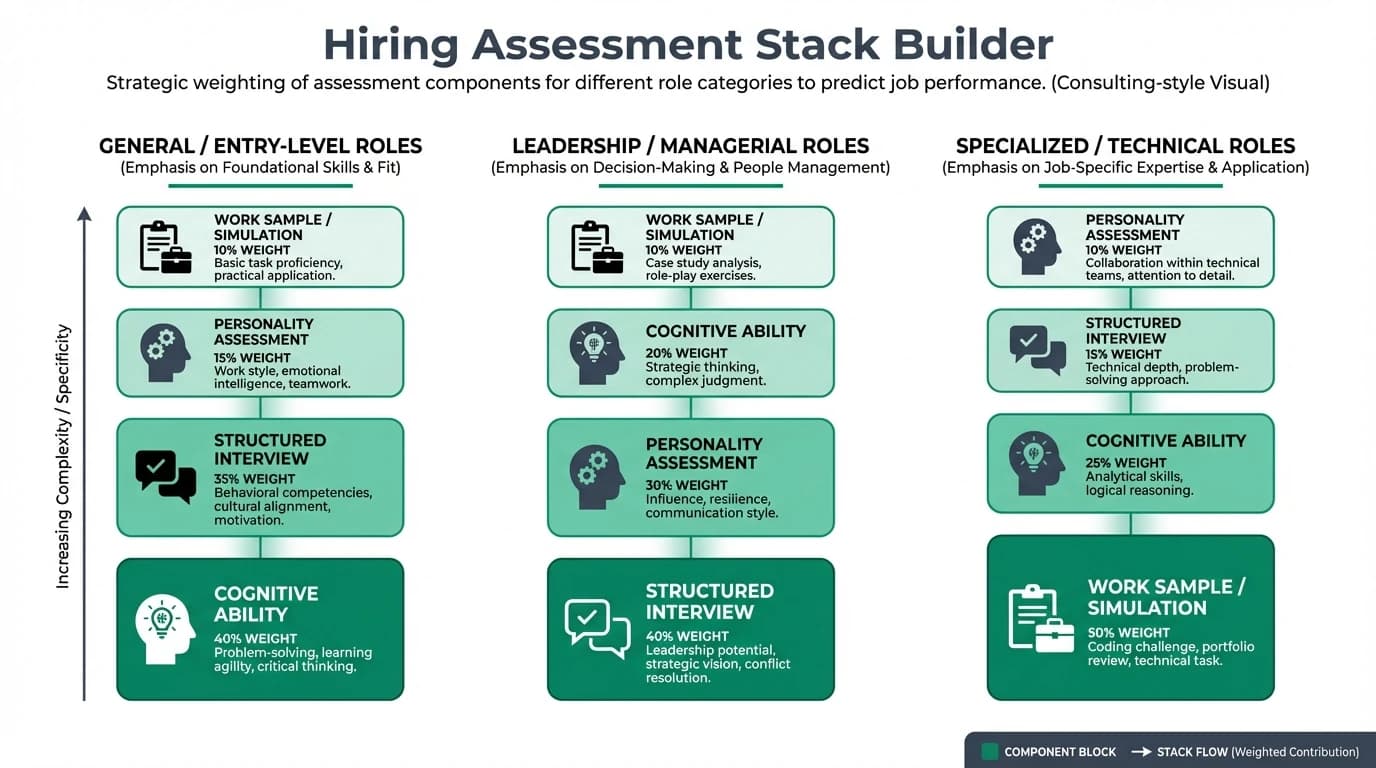
Build a role-specific hiring assessment stack using cognitive, personality, structured interview, and work-sample weighting.
Quick answer
What does this builder help you decide?
It helps you choose how much weight to assign cognitive tests, personality tests, interviews, and work samples, based on role context and decision risk.
Source: SIOP
Why this tool matters
Hiring teams often over-index on one signal and underuse complementary evidence. This tool forces a structured weighting conversation before scorecards are finalized.
For practical implementation, pair this with How to Use Big Five in Hiring and Cognitive Ability vs Personality Tests in Hiring.
How to use it
- Select your role cluster.
- Set your risk posture.
- Choose annual hiring volume.
- Review recommended weighting.
- Validate weights against outcomes after one hiring cycle.
What good output looks like
| Signal | Typical role in decision |
|---|---|
| Cognitive test | Baseline reasoning and problem-solving signal |
| Personality test | Workstyle and behavioral tendency signal |
| Structured interview | Contextual and behavioral verification |
| Work sample | Closest proxy to real task execution |
The best stack is rarely static. Keep recalibration loops in place.
Primary Sources
| Source | Type | URL |
|---|---|---|
| SIOP | Hiring assessment guidance | siop.org |
| NCBI (PMC) | Selection validity research | pmc.ncbi.nlm.nih.gov/articles/PMC12194090 |
| APA Dictionary | Personality construct definition | dictionary.apa.org/five-factor-model |
Guardrails
Deployment checklist
- Do not auto-reject based on one test output.
- Require panel calibration before rollout.
- Track adverse impact by subgroup.
- Audit signal drift every quarter.
FAQ
Should personality tests get the highest weight?
Not by default. Weight should follow role demands and evidence quality.
When should work-sample weight increase?
Usually when execution quality is highly role-critical and measurable.
How often should the stack be recalibrated?
Every quarter or after major hiring context changes.